In the dense fir forest of Hürtgen, eight kilometers southeast of Aachen, the sun never reached the ground even at noon. There, on November 8, 1944, a German sniper lay in a shallow hole behind a tree trunk, holding a Karabiner 98k fitted with a ZF 4 scope. He had been in that position since before dawn, eating nothing, barely moving. Through four-power German optics, at a range of 190 meters, he watched the back of an American lieutenant’s head.
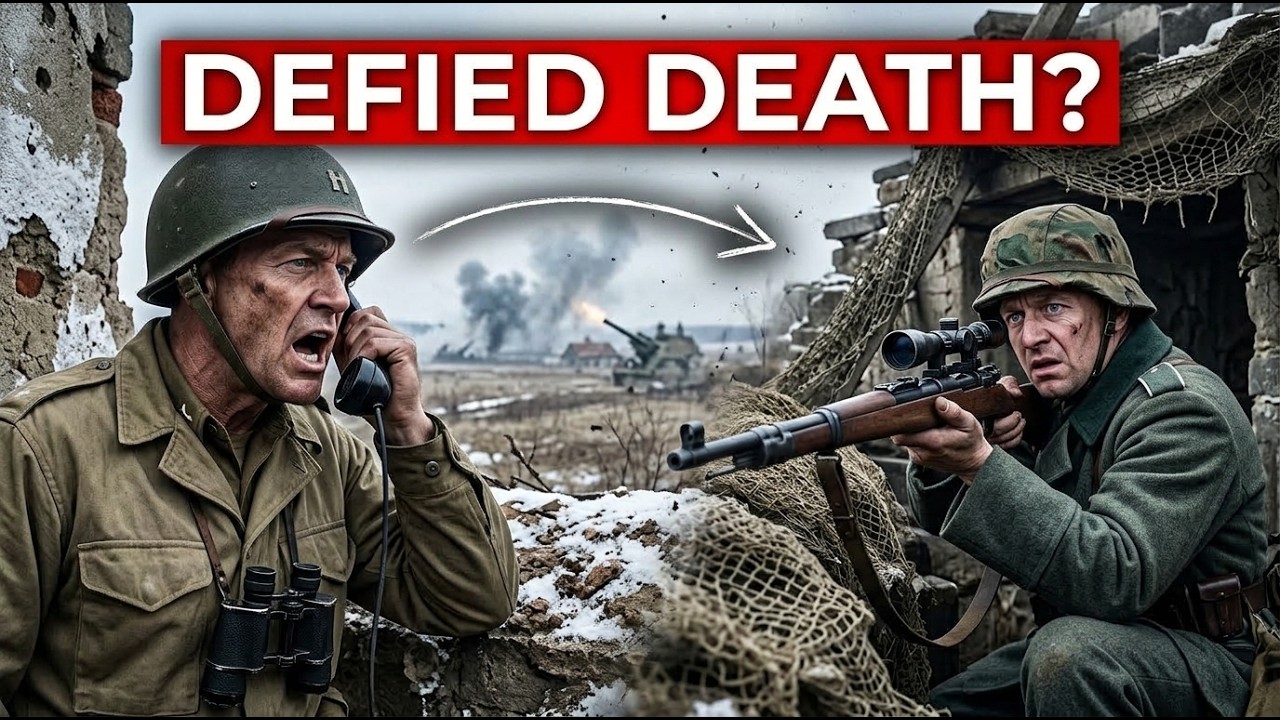
The sniper had learned his trade well. Priority targets: officers first, then observers, then anyone carrying a radio. Here, all three were combined in a single man. The American was crouched behind a blasted fir, pressing a headset against his cheek while a radioman sat beside him.
The lieutenant was talking calmly, as if on a telephone. The part the sniper could not comprehend was that the American knew he was there. Ninety seconds earlier, a bullet from that same rifle had killed a soldier four meters to the lieutenant’s left. The lieutenant had watched the man fall.
He had looked directly toward the path of the bullet, toward the sniper’s scope, and then returned to his radio and kept talking. By every rule the German had learned, by every rule that had worked on every front where he had served, this was not what was supposed to happen. An officer who was located took cover. A spotter who was exposed moved.
A radio operator who was pinpointed went to ground, because the radio was what made him worth the bullet. And every soldier alive knew that. This American did none of it. He simply finished his sentence.
The sniper laid his crosshair on the base of the man’s skull and began to squeeze the trigger slowly. Eleven seconds later, the forest above his head exploded. He never fired the shot. This is not a story about that forest.
It is an investigation into a question that German sniper training could not answer, that Wehrmacht infantry manuals could not explain, and that staff officers in the German intelligence services never resolved. Why did American forward observers keep calling in fire while under direct threat? Not once, and not as an act of extraordinary courage by an extraordinary man, but systematically, in every sector, in every division from Normandy to the Rhine. German snipers recorded the same behavior and interpreted it as fanaticism, stupidity, or drug use.
It was none of those things. It was arithmetic. To understand it, one must go back ten years to a peacetime artillery school in Oklahoma, where a group of American officers, in the absence of any war, quietly redefined what a man on a battlefield was. The German sniper was not wrong.
The Wehrmacht’s sniper doctrine rested on a principle so sound that every army on earth used a version of it. It was called decapitation. A military unit is not merely a collection of men; it is a collection of men plus a single nervous system. Kill the nervous system and the men remain, but the unit does not.
So the target list was arranged: officers, observers, signal and telephone operators, machine gun crews, runners, and finally, ordinary soldiers. The German sniper was not employed to reduce enemy numbers. He was employed to surgically remove the enemy’s ability to function. And nowhere did this work better than against artillery, because of how German artillery was organized.
The German observation post was run by an artillery officer who was not merely a pair of eyes. He was the forward brain of the battery. He knew his guns personally, their accuracy, their characteristics, the wear of their barrels. He carried much of the calculation in his head.
Killing him did not cost the Germans one officer; it cost them an entire battery. His replacement did not know the ground, had not registered the targets, and needed hours, sometimes days. During those hours, the guns behind him were practically blind. A single bullet, a single man, a single capability neutralized.
That was the exchange, and it was an excellent one. So the sniper made the trade. He shot the American observer and waited for the American artillery to go silent. It did not.
Ninety seconds later, there was another man in the same position with the same radio, and the incoming fire was no less powerful, no less late, no less accurate. Sometimes it was heavier, because the infantry battalion that had just lost an officer had a definite opinion about that. The sniper’s report moved up the chain and was written into division intelligence summaries. A German staff officer read it and concluded the only things his doctrine allowed him to conclude: the shot must have missed, or the Americans had a second observer already in position, or this sector was exceptional.
It was not exceptional. It was the entire war. The man behind the scope was not the nervous system. He was only a sensor.
And the Germans had no concept of a sensor because that function did not exist in their army. When an American lieutenant in the Hürtgen Forest saw a German position, he did not compute firing solutions. He did not calculate deflection, elevation, charge, time of flight, or corrections for powder temperature and barrel wear. He had never learned those things and did not need them.
He said something close to this over the radio: fire mission, coordinates 427 391, infantry in the open at the tree line, I will adjust. That message traveled five kilometers to the rear, to a tent, where three or four men who had never seen the battlefield sat at a table with a map. That tent was called the fire direction center, and all the calculation in the American artillery system happened inside it. The fire direction center received the coordinates.
It had the firing charts, survey data, meteorological corrections, and wear tables for every barrel in the battalion. It decided which guns, how many, what shell, what fuse, what pattern, and sent the coordinates to the gun pits. The observer’s remaining contribution was two more sentences: correction, back 100, right 50, and then three words: fire for effect. That was the job: look, talk, correct, talk.
This changed everything mechanically. First, the observer needed almost no specialized training. In the German system, replacing an observation officer meant training an artillery officer. In the American system, replacing an observer meant training a man who could read a map and speak clearly over a radio.
Infantry officers were trained to do it. Infantry sergeants were trained to do it. By late 1944, a rifle company commander who had never worn artillery insignia could pick up a handset and direct the fire of a full battalion. Second, the observer was not attached to a battery; he was attached to a network.
He did not call his own guns, because he had no guns. He called on the guns, every muzzle within range that the fire direction center chose to engage. One voice, one map reference, and the answer might be four howitzers or forty-eight. Third, and this was what the sniper could not see through his scope, the observer was replaceable in less than a minute, and he knew it.
That was the answer. The American lieutenant crouching behind that shattered trunk, with a German scope tracking the back of his neck, was not brave in the way the sniper imagined. He was rational in a way that was available only to a man inside a system built like his was. He knew that if he stopped and went to ground, the fire mission would stop.
He knew that if he finished his sentence and died, the fire mission would not stop. His radioman had heard every word. The fire direction center had the coordinates. The correction had already reached the tent.
His death would cost the American army one lieutenant and almost zero minutes of artillery capability. The calculation in front of him was not his life against the sniper’s life. It was the next eleven seconds of transmission against the next eleven seconds of German mortar fire falling on the infantry company behind him. Those men made that trade because the system made it survivable for everyone except them.
Forward observer teams suffered casualties at rates comparable to infantry platoon leaders, the two worst jobs in the American army. The men who did it were not unaware. They were the most aware men on that hill. They understood, in a way the sniper watching them could never grasp, that they were not the weapon.
They were the trigger. And there was another trigger in the man beside them, and another in the sergeant twenty meters away, while the weapon itself was in a tent five kilometers to the rear, where it could not be shot. None of this was an accident, and none of it was invented during the war. It was invented in peacetime by bored men at Fort Sill, Oklahoma in the early 1930s.
The United States Army between the wars was small, underfunded, and had little to do. The Field Artillery School spent that decade doing something no other army’s artillery branch did during its idle years. It asked whether the observer should be the computer. The work is most closely associated with Carlos Brewer, who ran the artillery section of the school in the early 1930s, and it continued under officers who followed him, including Orlando Ward, who would later command an armored division in Tunisia.
What they built, refined year after year through the 1930s, and wrote into doctrine by 1941, was the graphical firing chart and the centralized fire direction center. The idea was almost insultingly simple. Take the mathematics away from the man who can see, and give it to the men who cannot see anything at all. The consequences were not simple.
Once the mathematics moved into the fire direction center, the observer ceased to be rare. Once the observer ceased to be rare, he could be pushed forward into positions where no artillery officer would previously have risked himself. Once he was forward, response time collapsed. A target could move from an observer’s eye to shells in the air in under three minutes, compared to ten to fifteen minutes for a German battery engaging an unregistered target.
And once any observer could talk to any fire direction center, the guns ceased to belong to anyone. One voice could summon a battalion’s strength, or a larger target with grander terms for bigger things: division artillery, corps artillery, everything within range, all of it falling at once. One man, one sentence, forty-eight guns. The other half of the hidden variable was the radio itself.
None of this worked without it, and American radio technology in 1944 was not the same as the German equipment. The SCR-300, the backpack set weighing about thirty pounds that infantry called the walkie-talkie, used frequency modulation. FM. It was among the first combat radios to use FM extensively anywhere, and about fifty thousand were made.
FM did something amplitude modulation could not. It ignored noise: engine noise, ignition noise, the electrical chaos of a battlefield, and much of the primitive jamming available at the time. A German set under the same conditions transmitted static with a man’s voice somewhere inside it. The American set transmitted the man’s voice clearly.
Below it sat the SCR-536, the handheld set weighing five pounds, with an effective range of about a mile. About one hundred thirty thousand were made. Put the pieces on a table together and see what the sniper was actually up against: a tent full of mathematics that could not be shot, a radio network clear enough to pass corrected coordinates through the noise of bombardment, a training pipeline capable of producing observers faster than the German army could kill them, and at the front of it all, a man whose only irreplaceable asset was that he was the one who could see at that moment. Kill him and you removed a pair of eyes from a system that had thousands.
Kill a German observer and you removed a brain from a system that had one per battery. The same rifle, the same range, the same bullet. But the process was fundamentally different, and there was nothing in German sniper training that could tell a man which process he was engaged in. The Germans were not blind.
They understood, at the level of effect, exactly what was being done to them. The official American history records the same tone again and again, described by one officer as monotonous regularity. German prisoners describing, without being asked, American artillery: its weight, its accuracy, and above all its speed, and the specific terror of fire that arrived without registration rounds, minutes after a man was seen at a location that had never been recorded. German officers who commented after the war on American performance were consistently unimpressed with American infantry methods and consistently impressed, sometimes grudgingly, with the flexibility of American artillery.
The manuscripts written by captured German commanders for the U. S. Army’s Foreign Military Studies program returned to this constantly. What they pointed to was not the guns.
Germany had good guns. What they pointed to was response time: the sense of an enemy who could convert observation into destruction faster than a German staff could convert observation into a decision. They diagnosed the symptom correctly. They never diagnosed the cause.
They attributed it to superior communications equipment, which was partially true and mostly incomplete. They attributed it to unlimited ammunition, which was true and irrelevant to the specific question. They attributed it, in some reports, to American officers being allowed to expend shells without accountability. Almost no one on the German side wrote down the structural truth: that the Americans had moved the intelligence of the artillery system from the observer to a tent in the rear, and by doing so had made the man at the front expendable without making the capability expendable.
This was why they missed it, not because they were stupid. They missed it because their own doctrine was built on the opposite assumption, and it was an assumption they were proud of. Auftragstaktik, mission command, the great German inheritance, placed judgment at the front. It placed the thinking man at the point of contact.
That was why the Wehrmacht was the most flexible army in Europe in 1940. The Americans, in this narrow sphere, did the opposite. They pulled the thinking to the rear and pushed the sensing forward. And the German staff officers who read the sniper reports could not see it, because in their framework the man crouching in the open with a radio was by definition a decision maker, and decision makers did not act that way.
They were watching a machine and looking for a man inside it. The sniper in the opening scene is a composite figure. German sniper reports describing this behavior are real and numerous. The specific man behind the root mass stands in for all of them, and the Hürtgen Forest in November 1944 is the place where one would most reliably find him.
Everything else is documented as best as it can be. So here is the verdict on the question he could not answer. The Germans were not wrong to shoot at the observer. Based on what they knew, with the army they had, against every previous enemy they had fought, he was the correct target, correctly prioritized, and the German sniper who did it was performing his job to a professional standard.
Where they were wrong was in what they were buying. They thought they were buying silence. They were buying only a vacancy. The American system had been deliberately designed in peacetime by officers with nothing better to do than think, so that any vacancy at the front line would be filled in less than a minute at no cost to the artillery.
The German sniper’s economy was based on one bullet, one man, one capability. The American answer was to build a capability that did not depend on one man. And the men who paid the price for that design were the ones crouching in the open with the radios. That is the thing worth reflecting on.
The system was survivable because they were not. Every advantage in this story, the speed, the flexibility, the fire that arrived without warning at a location spotted ninety seconds earlier, was purchased at the front line by lieutenants, radiomen, and reconnaissance sergeants who understood exactly what their replaceability meant and picked up the headsets anyway. They were not fanatics. They were not drugged.
They were not, for the most part, men who were extraordinarily brave by nature. They were ordinary Americans given a piece of equipment and a set of procedures that told them, with perfect clarity, that the most useful eleven seconds of their lives might be their last eleven seconds, and that finishing the transmission mattered more than surviving. The sniper looking at the back of that head saw only a man. He did not see the tent, or the maps, or the fifty thousand radios, or the ten years in Oklahoma, or the two hundred infantrymen behind the pines whose next hour depended on whether that transmission was completed correctly.
He saw a target. But he was aiming at a network. That is why he never got his answer, and why, eleven seconds later, the answer came from the sky above him.