Born in the Louvre Palace on May 29, 1627, Anne Marie Louise d’Orléans entered the world with royal blood and a staggering inheritance. Her father, Gaston, Duke of Orléans, was the younger son of King Henry IV and brother of the reigning King Louis XIII. Her mother, Marie de Bourbon, Duchess of Montpensier, died less than a week after giving birth, leaving her newborn daughter a vast fortune and the title of Duchess of Montpensier at just six days old. Almost overnight, the infant became one of the wealthiest heiresses in France.
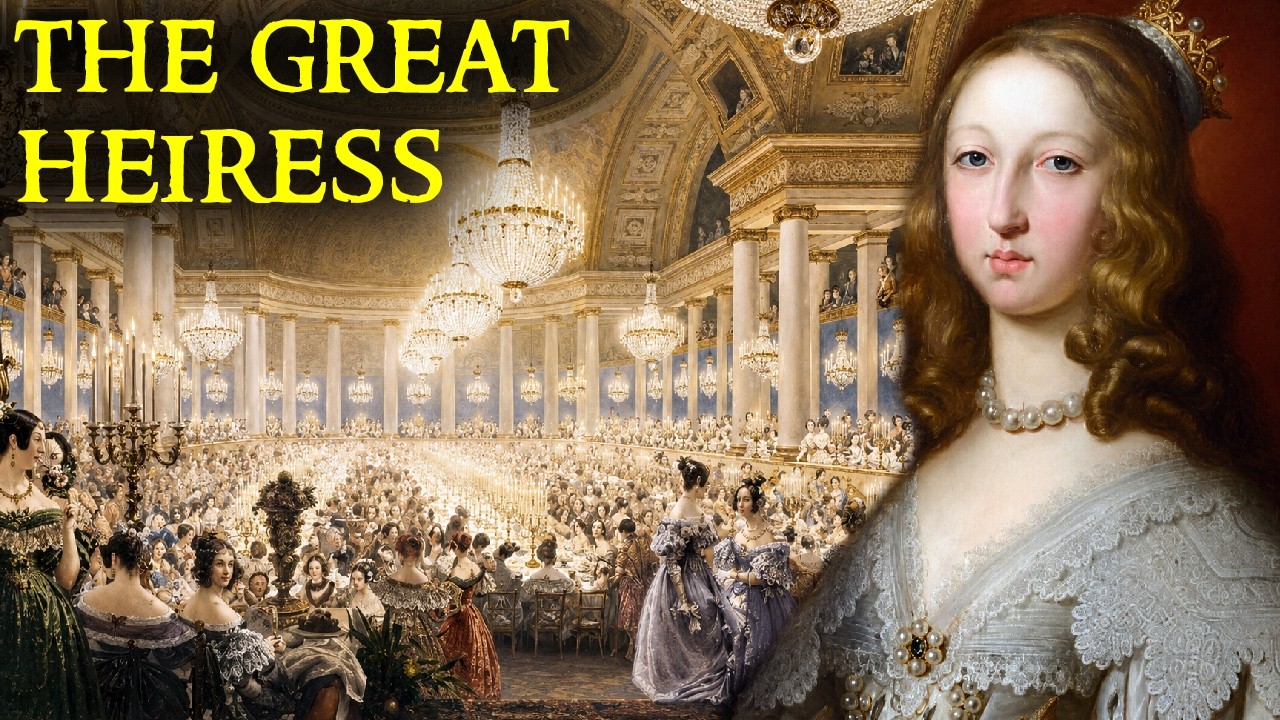
Anne Marie grew up in and around the royal court, raised at the Palais des Tuileries under the care of a governess. Her father remarried in secret in 1632, wedding Marguerite of Lorraine against the wishes of Louis XIII, who opposed the match because France was in conflict with Lorraine. The marriage was annulled under pressure, and Gaston produced no surviving male heir for years. When the future Louis XIV was born in September 1638, the eleven-year-old Anne Marie joked that she would one day marry the infant, calling him her “little husband” to the amusement of the court.
Both the king and Cardinal Richelieu reprimanded her for the remark. For many years, her fate seemed tied to her father’s ambitions. Gaston finally remarried Marguerite of Lorraine in 1643, with Louis XIII granting permission on his deathbed. Their only son, Jean Gaston, Duke of Valois, died in August 1652 at the age of two from dehydration and complications caused by a severe bout of diarrhea.
That death made Anne Marie her father’s eldest surviving child and the heiress to his vast estates and titles. But by then, her own reputation had already taken a dangerous turn. France was plunged into civil war during the Fronde, a series of revolts that broke out in 1648 against heavy taxation and the weak regency government of the young Louis XIV. The uprising lasted five years and spread from Paris to other major cities.
Anne Marie’s sympathies were complicated. In the early years, she supported rebel leaders in Bordeaux and even traveled there herself. Later, she helped negotiate a peace between the rebellious city and the royal government. But when fresh unrest erupted in 1652, she traveled to Orléans to negotiate with the rebels there.
Denied entry at the city gates, she crossed the river by boat, scrambled over the defenses, and slipped through a gap in the gate. She was soon paraded through the streets as an unofficial figurehead of the rebellion. Returning to Paris, she tied her fate permanently to the rebel cause. On July 2, 1652, during the Battle of Faubourg Saint-Antoine beneath the walls of the Bastille, she ordered the fortress cannons to fire on royal forces in support of Louis, Prince of Condé, the government’s most dangerous enemy and her own royal cousin.
Despite her intervention, the rebellion was crushed. Anne Marie fled Paris as the royalists triumphed. The Fronde collapsed the following year, and the young Louis XIV emerged determined that no challenge to royal authority would ever threaten him again. Branded a dangerous rebel, Anne Marie went into exile at the remote Château of Saint-Fargeau in Burgundy.
The neglected manor was in poor condition, and the fallen princess spent the next five years rebuilding it while staying out of sight, afraid of imprisonment at any moment. Her father was stripped of many of his lands and titles for his role in the revolt. During her exile, Anne Marie transformed Saint-Fargeau into a grand baroque residence, employing the architect Louis Le Vau, who later became famous for his work at Versailles. Much of his work at the château was destroyed by fire in the eighteenth century.
By 1657, the turmoil of the civil war had begun to fade. Anne Marie, now thirty, finally emerged from exile and rejoined the court alongside her father, who had been permitted to return. She was regarded as reasonably pretty but hardly a beauty of the French court. What she lacked in glamour, she more than compensated for in wealth.
When her father died on February 2, 1660, at the age of fifty-one, she succeeded to a vast array of lands, farms, castles, and manors. Overnight, the once-exiled rebel princess became one of the most desirable unmarried women in Europe, known widely as La Grande Mademoiselle. At thirty-two, she was still unmarried, something almost scandalous for a princess of her rank. The chaos of the Fronde and her years in exile partly explained this, but the real story was more extraordinary.
Over the years, princes and royal suitors had pursued her immense fortune, yet again and again the negotiations collapsed or she refused the match. In 1646, a proposal suggested she marry Ferdinand III, Holy Roman Emperor, after the death of his wife. The talks collapsed, and Ferdinand married elsewhere. After her return to court, a proposal suggested she marry her first cousin Philip, Duke of Orléans, the younger brother of Louis XIV, but Philip was thirteen years younger than her, immature, and still attached to his mother.
She rejected the match. There were discussions about marrying her to Charles, the future King of England, during his years of exile, but after the restoration of the monarchy in 1660, Charles married Catherine of Braganza instead. In 1663, Louis XIV suggested she marry Afonso VI of Portugal, a king sixteen years younger than her, physically disabled, and widely regarded as unstable. She was horrified and refused to leave France for distant Lisbon.
Anne Marie rejected every marriage prospect offered to her, but in the late 1660s, she fell in love with Antoine Nompar de Caumont, the first Duke of Lauzun. He came from an impoverished minor noble family and had risen to prominence at court as a diplomat to Spain. After a courtship of several months, Anne Marie asked her cousin the king for permission to marry him. To the astonishment of the court, Louis initially agreed, and the pair were set to marry in Paris in December 1670.
Just days before the ceremony, the king reversed his decision. The match had provoked outrage among the French royal family, who considered Lauzun far beneath her rank. Louis’s wife and the Duke of Orléans also stood to inherit much of her estates if she never married. Anne Marie was furious when the wedding was canceled and withdrew from public life for weeks.
Worse was still to come. Lauzun was arrested and imprisoned for daring to marry so far above his station. Held under heavy guard, he repeatedly attempted to escape and failed each time. As the years dragged on, reports emerged of his increasingly erratic behavior.
His cell fell into chaos, and his beard and appearance became so wild that some believed he was losing his mind. He remained in prison for over ten years while Anne Marie desperately petitioned for his release. Eventually, she was pressured into surrendering vast estates and wealth to secure his freedom. Lauzun was finally released in 1681.
Rumors spread that the pair had secretly married, but the years of imprisonment had transformed him. The fiery romance that had once scandalized the French court was now little more than ashes. After more than a decade of separation, bitterness, and humiliation, their love affair was effectively over. Anne Marie was left disillusioned by the events of the 1670s.
She spent increasing time away from court at the Palais du Luxembourg, a great royal residence on the outskirts of Paris that she had inherited when her stepmother, Marguerite of Lorraine, died in 1672. By the 1680s, the French court had moved to Versailles, but the Grande Mademoiselle was rarely seen there. She lived a quiet, reclusive life and died at the Palais du Luxembourg on April 5, 1693, at the age of sixty-five. Shortly before her death, Lauzun requested to see her, and she refused him.
Her great estate, reduced in order to pay for his release twelve years earlier, largely passed to her cousin, the Duke of Orléans. Despite this, the courtier and memoirist the Duke of Saint-Simon stated at her funeral that she had been the wealthiest single princess in Europe. She was laid to rest at the Basilica of Saint-Denis outside Paris two weeks after her death. During the ceremony, a ghastly incident occurred.
In early modern France, it was tradition for the entrails of royals to be removed and embalmed separately so the body could lie in state longer without decomposing quickly. In the case of the Duchess of Montpensier, her entrails began to ferment, and the urn holding them exploded during the service, creating a rotten smell that drove many attendees from the church. It was an undignified end for a woman born with immense wealth, royal blood, and every advantage imaginable, yet who spent much of her life trapped by the very power and privilege that was supposed to make her untouchable.