A passing driver on a desolate stretch of country road in Stonington, Connecticut, came upon a brush fire in the dark one evening. He pulled over and called 911, then reached for his fire extinguisher. Before he could act, a local fire chief arrived and began putting out the flames. When the chief angled the extinguisher upward so the chemicals would fall gently rather than blast the burning object, he realized what he was looking at: a human body.
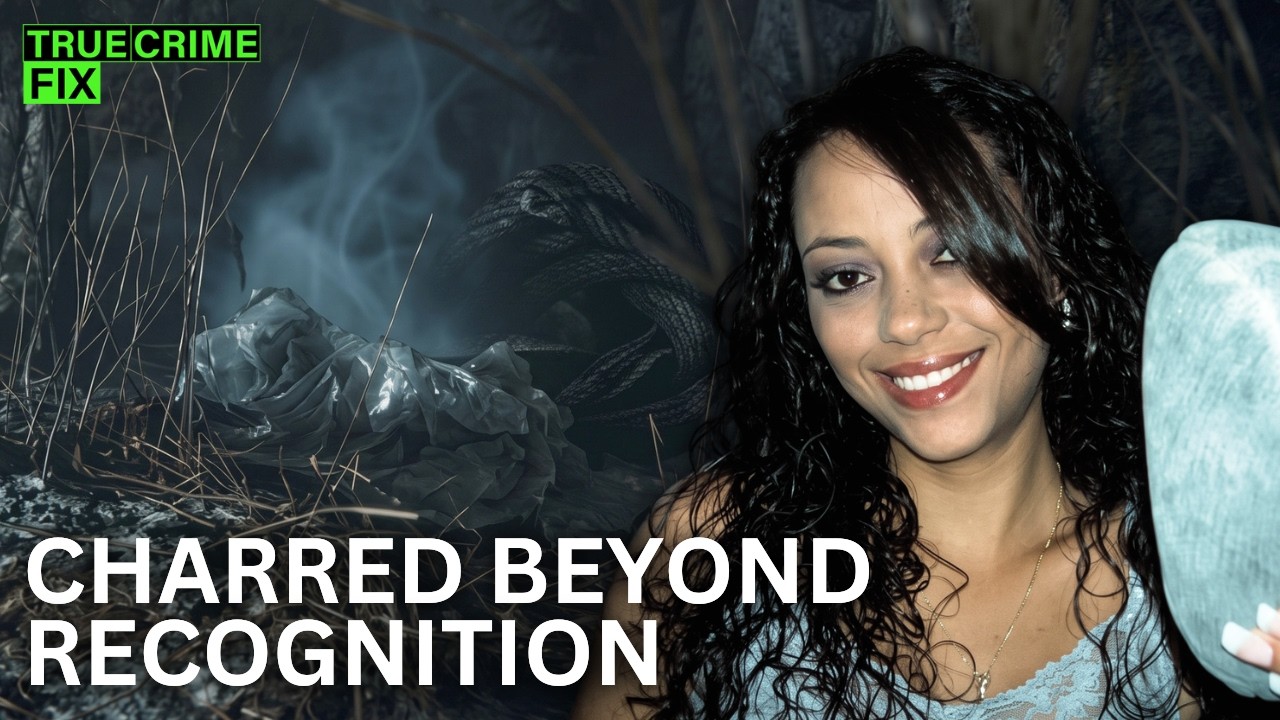
The scene was immediately sealed off as a crime scene. The body was charred beyond recognition. It had been wrapped in layers of plastic, blankets, sheets, and duct tape, bound so thoroughly that it was clear this was not where the victim had died. This was a dump site.
Connecticut State Troopers closed the roadway and began documenting everything, knowing that every fiber and every wound might hold the key to identifying the dead and catching whoever had left her there. The body was brought to Dr. Ira Kanfer, a forensic pathologist with three decades of experience and more than four thousand autopsies behind him. As his team carefully unwrapped the layers to avoid destroying trace evidence, they found a young woman in her twenties, a light-skinned black female who could also have been Latin.
She was missing her nose, her ears, her fingers, and her toes, and a patch of skin had been cut away from her lower back. The mutilation was deliberate. Without fingers, there were no fingerprints. Without toes, any toe rings or tattoos were gone.
The killer had tried to make identification impossible. The front of the body was burned far more severely than the back, indicating she had been set on fire while lying on her back. The area of her lower back pressed into the ground was better preserved, and there the skin had clearly been cut away. Dr.
Kanfer assumed a tattoo had once been there. Connecticut detectives searched the state data bank for young women reported missing with large tattoos on their backs. They found nothing. When they expanded the search to neighboring districts, they got a hit more than eighty miles away on Long Island, New York.
Rebecca Koster was a twenty-four-year-old nursing assistant who lived at home with her parents. Her father had filed the missing person report after her employer called to say she had never shown up for work. She had been out with friends the night before, and no one had seen her since 3:30 that morning. The missing person flyer mentioned a large butterfly tattoo on her lower back.
Despite the striking similarities, Connecticut detectives were skeptical because of the distance involved. They turned to Dr. Kanfer for confirmation. He found something the killer had overlooked.
The teeth had been left intact. Dental records are a foolproof form of identification when teeth are present, and even when they are not, markers in the jaw can still be compared. Long Island police personally brought Rebecca’s dental records to Connecticut. Dr.
Kanfer compared them to the teeth of the dead woman, and a match was made. Rebecca Koster had been found burning on the side of a road in Connecticut. Detectives had to deliver the worst news a family can hear. Her mother, Barbara, was at home when her husband received the call that detectives were at the house.
When she asked if it was bad news, they asked her to sit down. They told her Becky had been found and that it was a homicide. Barbara ran out of the house, down the driveway, screaming that someone had killed her baby. Investigators began reconstructing Rebecca’s last movements.
She had been out with her best friend Nicole and her boyfriend Dan, a man she had only recently begun dating. Around 3:30 that morning, she called her mother to say she was home and safe. But the next day she never showed up for work. Nicole said Rebecca had gone home early, leaving her with Dan and some other friends.
Dan was brought in for questioning. He swore he had walked Rebecca to her front door, made sure she got inside safely, and left. He agreed to a polygraph, and the results suggested he was being untruthful. But the test was not conclusive, and his story matched those of the friends who had been with them.
A search of his home turned up nothing. With no hard evidence linking him to the murder, investigators widened the suspect pool. Dr. Kanfer turned to the question of time of death.
Rebecca had been seen drinking at a bar, but toxicology came back negative for alcohol and drugs. That meant she had metabolized the alcohol, which meant she had been alive for hours after she left the bar. Dr. Kanfer estimated the time of death at about four hours after she was last seen, though he acknowledged it was an inexact science.
Rebecca’s family pulled up her phone records. Two calls had come into her phone early that morning, at 4:10 and 4:27, both from the same number with a 617 area code. Whoever called at 4:27 was likely the last person to speak with her. Police traced the cell tower data and determined the caller was moving from west to east, toward Rebecca’s house.
The first call lasted about fifteen minutes, the second only about twenty seconds. It appeared the caller had arrived at her home and was letting her know he was there. When police tried to contact the number, there was no response, and there was no record of it anywhere. It was an untraceable burner phone.
Dr. Kanfer still had to determine the cause of death. There was no soot in the lungs, meaning she was not breathing when the fire was set. She was already dead.
Because the burning obscured external injuries, he examined the internal organs. He found a stab wound on the liver, with several hundred cubic centimeters of fluid and clotted blood in the abdominal cavity. He also found four sharp-force injuries to the neck. X-rays revealed an air embolism in the heart, meaning at least one of the neck wounds had been inflicted while she was still alive, drawing air into the venous system and stopping her heart.
The official cause of death was homicide by multiple stab wounds to the neck and liver. Police returned to the bar where Rebecca had spent her last night, the Butcher Boy, and obtained the surveillance footage. In it, Rebecca sat by herself while her friends mingled. A man approached her, older than the usual crowd, dressed conservatively in a sweater vest.
They appeared to exchange information, and the man seemed to take her phone and punch in a number. Investigators re-interviewed the people who had been with Rebecca that night. One woman, Jennifer, remembered the man had made her uncomfortable, that he was pushy and creepy, and that he had taken her phone and entered his name and number into her contacts. Computer crimes detectives extracted the information.
A contact entry read J. Brown, with the same 617 number that had called Rebecca. Before investigators could track down J. Brown, the Connecticut Crime Laboratory delivered another crucial piece of evidence.
The latent fingerprint examiner had processed the duct tape wrapped around Rebecca’s body and developed two thumbprints, left and right, on the sticky side. A search of the state data bank identified them as belonging to Evans Ganthier. Ganthier had a criminal background, including domestic incidents with his girlfriend and allegations that he had pimped her out and photographed women in his garage. Jennifer was brought back to the station and shown a photo array.
She positively identified Ganthier as the man who had called himself Jay and put his number in her phone. Jay Brown was not a person. It was Evans Ganthier’s alias. Investigators located Ganthier’s SUV parked beside his girlfriend’s residence in the Bronx.
The next day they watched him walk to the vehicle and placed him under arrest. He consented to searches of his vehicle and residence. In the garage there was a roller, a scrub brush, a broom, cement cleaner, paint, and a paint tray, and an area that had clearly been cleaned and painted over. Nothing there linked Rebecca to the scene.
But in his vehicle, crime lab technicians found red stains throughout the car, including a blood stain on the driver’s side console that had dripped downward. DNA testing determined the blood was Rebecca Koster’s. Confronted with the evidence, Ganthier launched into an elaborate story. He said he had met her at the bar, they talked, and he decided to call her to continue his own party.
She gave him directions to her house. Once in the car, she started foaming at the mouth, seeming to have a medical emergency. At his house, she was unsteady, tripped over a set of dumbbells, hit her head on the cement, and bled profusely. He put her in the back of his SUV to drive her to a hospital, but on the way she stopped breathing.
He panicked, cut off her fingers and toes, carved the tattoo out of her lower back, wrapped her body, drove onto the Port Jefferson Ferry, and ended up near Stonington. He bought gasoline, pulled over, threw her body on the side of the road, poured gasoline on it, and lit it on fire. He admitted to mutilating and burning her body but denied killing her, insisting she died by accident. Investigators knew that if they could not refute his story, he might face only the lesser charge of abusing a corpse.
Dr. Kanfer was able to prove she was alive when the stab wounds were delivered, because the liver hemorrhage and the air embolism could only have occurred while her heart was still beating. There was no skull fracture, no subdural hemorrhage, no head trauma of any kind. Her death was caused by the stab wounds, not by any fall.
Ganthier was charged with second-degree murder. Throughout the trial he maintained his innocence, painting himself as a panicky man who had done the wrong thing. The prosecution pointed out that Ganthier claimed Rebecca had never been in the front seat of the car, yet her blood was pooled there, evidence that violence had occurred inside the vehicle. Rebecca’s mother sat through every day of the four-week trial.
After deliberating for five and a half hours, the jury found Evans Ganthier guilty. The judge sentenced him to the maximum of twenty-five years to life, condemning his unthinkably cruel behavior after Rebecca’s death. For Dr. Kanfer and the detectives, the case was a reminder that they spoke for the dead.
If Rebecca’s dental records and the evidence they gathered had not been found, she might have been buried in Potter’s Field, unknown and unavenged. Her mother took no satisfaction beyond the sentence. Finding him guilty brought relief that he would not hurt anyone else, she said, but it did not bring her daughter back.