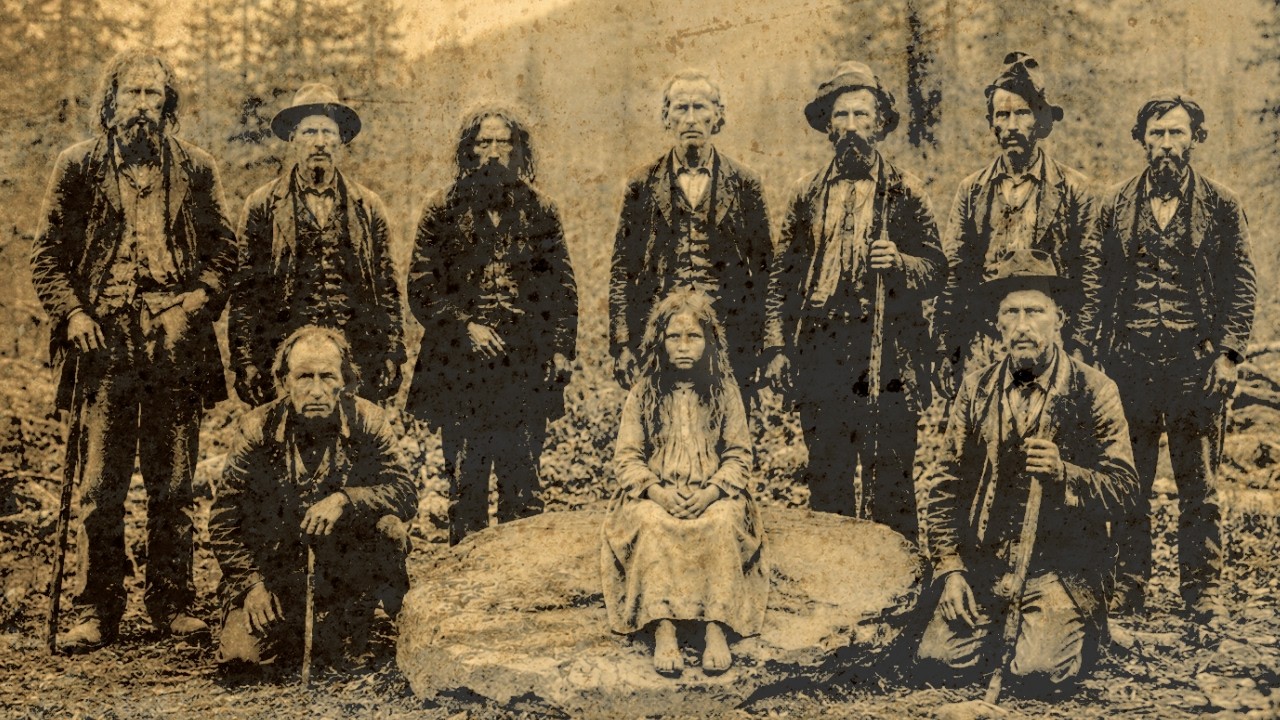
In the autumn of 1874, a search party climbed into the high country of the Great Smoky Mountains looking for a body. They expected to find the remains of a little girl missing for nineteen days. Instead, they found the girl alive, sitting upright on a flat gray stone in a clearing none of them recognized. Her hands were folded in her lap, her dress was clean, and she showed no signs of hunger, cold, or fear.
When the men asked where she had been, she told them about people made of light who had come down from the seven stars. The mountains themselves were ancient, worn down over hundreds of millions of years, wrapped in the thick fog the Cherokee called the land of blue smoke. Only a generation earlier, the United States government had forced nearly the entire Cherokee nation off this land along the Trail of Tears. Thousands died.
A stubborn remnant hid in the highest folds of the Smokies, keeping the old stories alive. Into this country came poor, isolated settler families who knew the woods well and knew there were places on the high ridges where a wise person did not go. The girl was ten years old. The surviving records do not give a reliable last name, and there is a reason for that.
For the sake of the telling, the fragments call her Emiline. She lived in a cove on the North Carolina side of the range with her family. By every account she was an ordinary child, not a liar, not given to strange fancies. She went missing on an ordinary afternoon in early October.
Her mother watched her go up the slope behind the cabin to gather chestnuts. That was the last anyone saw of her for nineteen days. When her father went looking at dark, he found her basket sitting upright in the middle of the path, half full of chestnuts. Around it, in the soft ground, there was not a single track leading away.
It was as if the girl had been lifted straight up off the path. Within a day, dozens of men came in from the surrounding coves to search. They brought tracking hounds. The dogs would not climb.
At a certain elevation, they stopped and sat down, whining, staring up at a bald patch of grass near the crest where men had sometimes seen strange lights. For three more days, no man could get a dog past that line. The men climbed without them and came down each evening with the same report: there was no sign of the girl, but there was a feeling of being watched by something patient and enormous and not unkind. One older searcher, who knew the Cherokee stories, said the lights on that bald were not new.
He said they appeared in years when things were about to change. Then he warned them, “We are not going to find her. She is going to be given back. ”
On the nineteenth day, that is precisely what happened.
Four men working a shoulder of the ridge they had already covered twice walked out of a stand of hemlock into a clearing they were certain had not been there the week before. In the center stood an enormous flat gray stone, worn smooth as though polished by ages of rain. Sitting on it was Emiline, in perfect health. Her dress was not torn, her hair was still braided, her lips were not cracked with thirst.
When she saw the men, she smiled as though she had been expecting them. The cousin who picked her up later swore she was warm all the way through, warm like a stone lying in the sun, and that she weighed almost nothing. She did not cry, did not ask for her mother, and seemed to think nothing strange had happened at all. When her mother fell to her knees sobbing, Emiline patted her gently on the back and said, “Do not cry.
I was not lost. They knew exactly where I was the whole time. ”
Over the following weeks, as Emiline began to talk, the family stopped telling the story. They sent for a preacher, then sent him away.
Her father began sleeping with a loaded rifle because his daughter kept trying to walk back up the ridge at night. She kept saying they were waiting for her, that she had promised to return. She described being taken by a light that came down through the trees in seven separate columns, each a different color. Where they touched the ground, the path she knew became a path she had never seen.
At the end of it were the people. She called them people, not spirits or angels. They were tall, made of the same light, and they did not speak with their mouths; their words appeared inside her head. They told her not to be afraid, because she had been here before.
“This is not the first world,” they told her. “It is not even the second. ”
They showed her the history of the world. She saw a prior civilization of white stone cities that grew proud and clever and forgot the people from the stars entirely.
Then the water came, a wall of dark water and mud that buried everything. The people from the stars did not stop it. They were sad, but this was simply what happens to a world that forgets. She said they showed her the mud beneath the very mountains, where bones and trees and broken things were packed down flat, and buildings lay buried under the coves.
The flat gray stone she was found on, she said, was the top of one of those buildings, a door that had never fully closed. The preacher could not abide what she said about time. She told him that the nineteen days had felt like a single long afternoon, and also like her whole life, and also like no time at all, all at once. She said the people felt sorry for human beings because we forget, and forgetting is the saddest thing there is, and that is why they keep coming back to remind us before the water comes again.
Word of the child’s story reached the Cherokee still hidden in the high country. Among them was an old woman, one of the last who knew the full body of the old stories. When she was told what the child had said, she did not laugh. She said the child had been told the truth, the same truth her people had kept for longer than anyone could count.
She told the settlers the story of the seven stars: seven boys who would not do their work were scolded by their mothers, and in shame danced a prayer to be taken away. Six rose into the sky to become the bright stars of the cluster; one was caught by his mother’s hand and pulled down, sinking into the earth, and from that spot grew a pine tree. This is why there are six bright stars in the cluster and one faint one. She also told them about the Nunnehi, the people who live anywhere, a race of spirit people who lived under the mountains.
They were not ghosts, but a separate kind of people who had always been there, friendly to the Cherokee, guiding lost hunters home and warning of danger. There were stories of hunters invited into their townhouses inside the rock, spending what felt like a single evening and coming out to find years had passed. And there was a prophecy that the Nunnehi once offered to take the entire Cherokee people into the mountains to keep them safe forever from the coming troubles. Some accepted and walked into the mountainside and were never seen again.
The old woman said the people who took Emiline were the Nunnehi, and they did not take people by accident. The child had been chosen, and she was sent back with a message not really for her family, but for the world that was coming, the world of machines and cities and forgetting. A few weeks after she was found, Emiline drew a map. Her father gave her charcoal and paper, hoping she would get the strangeness out of her head.
On one side, she drew the sky, a tight cluster of seven dots, and pressed harder on one so it stood apart, then drew that same one a second time down low, as though it had fallen. On the other side, she drew the mountain, the clearing, the flat stone, and a pattern of smaller stones arranged around it. The shape of the stones on the ground was the same shape as the stars in the sky, with a line connecting each stone to its star. She said, “The stones on the ground are the same as the stars in the sky.
The people put them there a long time ago, so they would always be able to find the door. ” She said that when the seven stars stood directly over the flat stone, the door opened. “That is how they came for me. That is how I am going to go back.
”
The girl did not settle back into being a child. She was gentle and calm, but unnervingly still. She stopped being afraid of the dark, of storms, of death. And every so often, she would try to leave.
Her father barred the door at night and slept across the threshold. He asked her once what would happen if she went back. She said there was no dying and no forgetting inside, and she would be with the people and be happy and would never again have to feel time dragging her forward one lonely moment at a time. He wept, understanding that she was not describing being kidnapped.
She was describing going home. It was during this period that she gave the warnings the family guarded most closely. The people were counting, she said. The world had a number of turns left, like a clock winding down, and the number was not large.
She spoke of a time when the mountains would fill with more people than anyone could imagine, when the earth would be covered in a web of light and sound, when human beings would build towers taller than the drowned white cities and decide again that they had made themselves and needed no one. “When the world is at its proudest and its brightest, when it has completely forgotten,” she said, “that is when the water is closest. ” The flood does not come to punish a suffering world. It comes to reset a world that has climbed too high and forgotten the ground it is standing on.
The child who said these words had never seen a city larger than a county seat, never seen an electric light, never seen anything that flew. The world she described, a web of light over the whole earth, towers of glass, uncountable crowds, was a vision of the century that came after her. The family, terrified of the preacher’s reaction and of being thought mad, did everything they could to make the story disappear. There are hints in the accounts that a page was removed from a county record, that her name was struck out, that the family was encouraged to say the girl had simply been lost and found, and to never repeat what she said about the seven stars and the drowned world and the door under the stone.
The same machinery that had erased Cherokee memory reached down and erased the settler child’s version of it too. More than one man went looking for the door. Emiline’s own father went back more than once and always came down shaken and silent. The accounts that survived tell a consistent story: they could not always find the clearing.
Men who knew that ridge as well as their own yards would go up and find only ordinary forest. Then months or years later, they would stumble into it again by accident, as though the clearing kept its own kind of time and opened only when it chose. The rational explanation is strong: a lost child, sheltered perhaps by the very Cherokee who still lived hidden in that high country, fed and kept warm for nineteen days, then returned, with a traumatized mind weaving stories from the legends she absorbed. That case can be made.
But it does not explain how a child produced imagery of a future she could not have imagined. It does not explain the specific pattern of Appalachian disappearances she seems to sit at the front of, decades before anyone recognized a pattern. And it does not explain why four grown men and an old Cherokee woman who had every reason to be skeptical all came away convinced they had brushed up against something real. The fragments give two endings for Emiline.
In the first, she grew up, married, raised children, and lived a long ordinary life. But on certain autumn nights, when the seven stars climbed over the eastern ridge, she would stand in her yard with her face lifted to the sky. If asked what she was looking at, she would smile and say, “They still come. ” In the second ending, the one the mountain people preferred, she went back.
On a clear, cold night in her young womanhood, when the seven stars stood directly over the ridge, she walked up the old path and did not come back. There was no body, no tracks. This time she was not taken. She went.
To this day, there are places in the high Smokies where local people will tell you not to go up to certain balds when the autumn stars are bright. They cannot always say why, only that their grandmothers told them. The warning survived, worn down like the mountains, until only its shape remained: do not go up when the seven stars are over the ridge. The whole of the story is about forgetting.
The people pitied human beings because we forget. The old world drowned because it forgot. The child’s own name was struck from the record so the world would forget her. And remembering was the whole of the message.
The people did not take Emiline to hurt her. They took her to make her remember, and sent her back so that others would remember too.