In the spring of 2024, a retired bookkeeper named Myrtle Hansen was helping sort through the belongings of a deceased man named Wayne Galt at an estate sale outside Sapulpa, Oklahoma. In a storage room behind the kitchen, she found a shoebox on a high shelf. Inside were decades of carbon-copy receipts from Galt’s roadside diner, bundled with rubber bands and dating back to the 1980s. One receipt, written in a flowing hand, carried the name Sandra K.
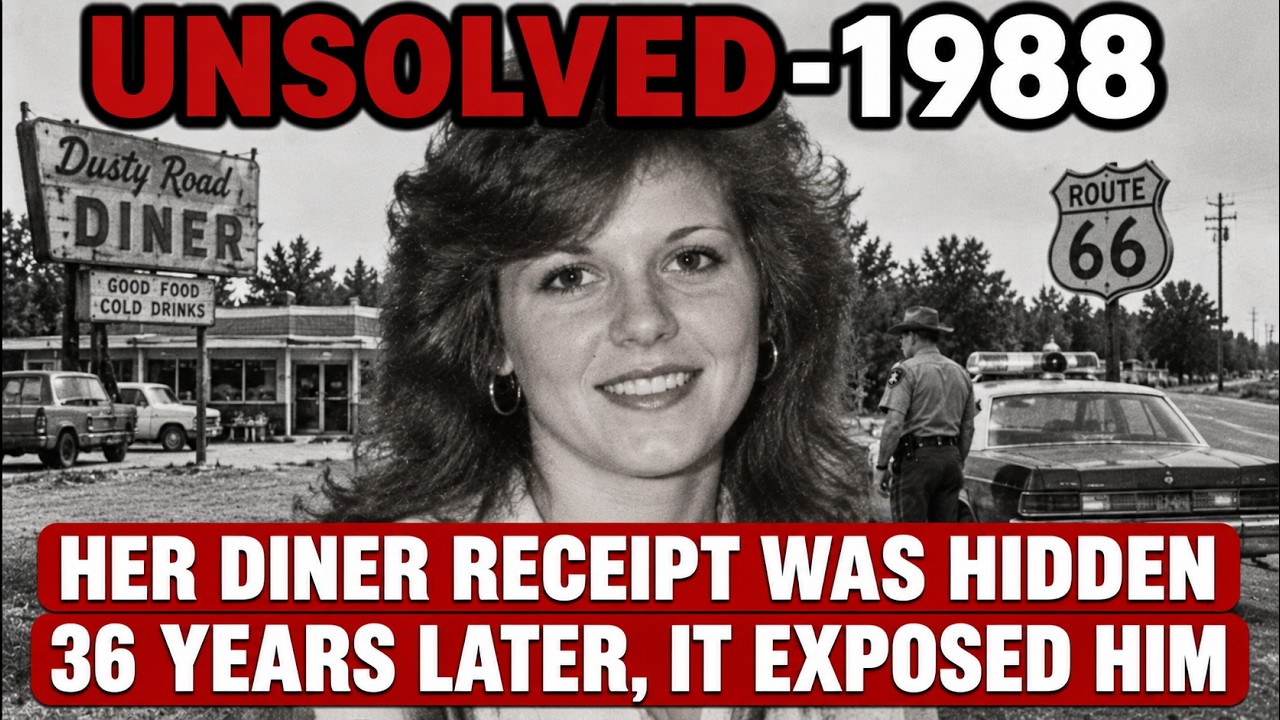
Burch and a notation that the meal had been paid by personal check on September 13, 1988. That name belonged to a woman who had vanished from the same stretch of Route 66 thirty-six years earlier, and that receipt destroyed the story Galt had told investigators for decades. Sandra Burch was thirty-one years old in the autumn of 1988. She grew up in Wichita, Kansas, the second of three daughters of a hardware store owner and a music teacher.
By the time she disappeared, she had spent four years as a pharmaceutical sales representative covering a five-county territory in Oklahoma and southern Kansas. She drove rental cars, stayed in budget motels, ate at whatever was open, and called her husband David every evening at seven from whatever pay phone or motel telephone was available. She kept a zippered planner full of appointment cards and mileage logs, organized her sample case alphabetically by category, and maintained a garden at home that she tended on weekends. David was an electrician; together they had a golden retriever named Dulie.
The calls at seven were short and reliable, a daily confirmation that she was where she said she would be and that she would be home Thursday. She was good at her job, her territory one of the top performers in the regional division. On September 13, 1988, Sandra had two appointments: a ten o’clock meeting at a family practice in Broken Arrow and a two o’clock meeting at an orthopedic clinic in Okmulgee. After the second appointment, she checked into a budget motel outside Sapulpa and called David at 7:05 that evening.
It was the last call she made. When David called the motel the next morning, the front desk told him her room had not been slept in. Her rental car was in the lot. Her sample case was still in the trunk.
Her suitcase lay open on the bed with clothes laid out for the next day. She was never seen again. Tulsa County Sheriff’s Office Detective Al Puit led the investigation from the autumn of 1988 through the following spring. He was a methodical investigator with twenty years of homicide experience.
He established Sandra’s route, interviewed the motel staff, cleared two men seen near the motel that afternoon, and interviewed every business owner along the Route 66 corridor between Sandra’s motel and the Okmulgee clinic. He interviewed Wayne Galt twice. Galt, then forty-four, had run the Dusty Road Diner for fifteen years, a Route 66 establishment three-quarters of a mile from Sandra’s motel. He told Puit he had been working his regular Tuesday shift the day she disappeared.
He said he had not seen a woman matching her description and that he would have remembered a lone woman traveling the highway. He said it clearly and without hesitation, both times. Puit could find nothing to contradict him. Sandra paid for meals in cash while traveling, according to David, so no credit card record placed her at the diner.
The investigation stalled within a year. Sandra was formally declared dead in 1995, and the case was listed as an open unsolved homicide. Puit retired in 1999. He told a colleague that the Burch case was one he had never been able to put down, and that something about the diner interview had stayed with him without becoming anything he could act on.
He died in 2011, never knowing why he had been right to keep holding it. David Burch contacted the Tulsa County Sheriff’s Office every year through the 1990s. He described Sandra as a person who did not take detours, who planned her route, and who would not have stopped off her circuit without a reason. He remarried in 2001 and moved to Arizona in 2008, but he never stopped asking.
Galt ran the diner until 2007 and then retired to a house outside Sapulpa with his wife, Darlene. He kept a shoebox of business receipts, as he had always done. He died of a heart attack in March 2019. Darlene had died two years earlier.
Their children, arranging the estate sale in the spring of 2024 with a church volunteer group, had no reason to expect anything unusual in the shoeboxes their father had used for his records for years. Myrtle Hansen did. She had lived in Sapulpa her entire life and remembered the Sandra Burch case from the local papers in 1988. She examined the receipt from September 13th and recognized the name.
She called the Tulsa County Sheriff’s Office. The cold case detective assigned to the case was Detective Priya Nair, thirty-nine, part of a cold case unit established in 2021. She took possession of the shoebox, examined the receipt, then pulled the original case file. She found Puit’s notes from both Galt interviews and the documented clearing of Sandra’s personal check, which had been traced during the original investigation as part of establishing her financial activity, but had never been specifically linked to the diner because no one had had reason to place her there.
The receipt was the link that had been sitting on a shelf for thirty-six years. Nair obtained a search warrant for the Galt estate property. The diner itself had changed hands and changed names, but the property, including the storage area and an adjacent section of ground, had remained structurally continuous through both ownership transfers. A concrete pad measuring approximately twelve by sixteen feet had been poured in the spring of 1989, about six months after Sandra vanished, and had been in place through both subsequent ownership periods.
Galt had poured it himself, paying cash for the materials and telling the hardware supplier he was extending his storage area. No permit for the concrete work existed at the county permitting office between 1985 and 1992, a fact which was unremarkable for a rural Route 66 commercial property in the late 1980s. In November 2024, ground penetrating radar was used across the rear of the property. The survey detected an anomaly beneath the pad at a depth of approximately four feet, consistent in profile with a person’s remains.
Excavation was completed over three days in early December in coordination with the Oklahoma State Bureau of Investigation. The remains of a woman were recovered. DNA analysis confirmed the identification as Sandra K. Burch.
Galt had buried her beneath a concrete pad on his own property. He had then walked into an interview with a homicide detective, looked him in the eye, and said he had never seen her. He had said it clearly, without hesitation, both times he was asked. He ran the diner for nineteen more years, served thousands of customers, retired, outlived his wife, and died in March 2019 without a charge, without a consequence, without a single morning when anyone who knew him had any reason to doubt him.
The Tulsa County District Attorney’s Office issued a formal case closure in January 2025, identifying Galt, deceased, as the person responsible for the death of Sandra K. Burch. A posthumous case closure document was entered into the county record. David Burch, living in retirement in Arizona by then, was contacted by Detective Nair in December 2024.
He asked only one question: did she suffer? Nair told him what she could. He thanked her and asked if he could have a copy of the receipt. She told him she would make sure he got one when the legal proceedings were complete.
Sandra Burch had her clothes laid out for Thursday on the motel bed, the practical preparation of a woman who planned her mornings in advance. She had a husband who called when she said she would be home, a dog who knew her car by sound, and a garden in September fullness that needed her through the fall. Galt kept a shoebox of receipts for thirty-six years on a high shelf in the house where he lived out the rest of his life three-quarters of a mile from where he had buried her. Nobody knows why a man keeps something like that.
Whether it was the accounting habit of a small business owner or something darker, the need to hold the evidence of what he had done, the receipt was there, and then a retired bookkeeper spent a Saturday looking at carbon copies the way she had looked at receipts her whole professional life, one at a time, because receipts are where the details live. The concrete pad was removed. The property remains under the jurisdiction of the Tulsa County Sheriff’s Office until the estate proceedings are complete. The diner that stands there now serves the same mix of locals and highway travelers in a building that carries no weight of what happened below the storage area.
The weight was in the shoebox. Now it is in the record.