In February 2026, a single filing with the Securities and Exchange Commission revealed a fact stranger than any fiction a candy company could invent. A trust created to educate poor children held roughly seventy-nine percent of the voting shares of The Hershey Company. The trust was established in November 1909 by Milton Hershey and his wife Catherine. Both had been dead for more than eighty years.
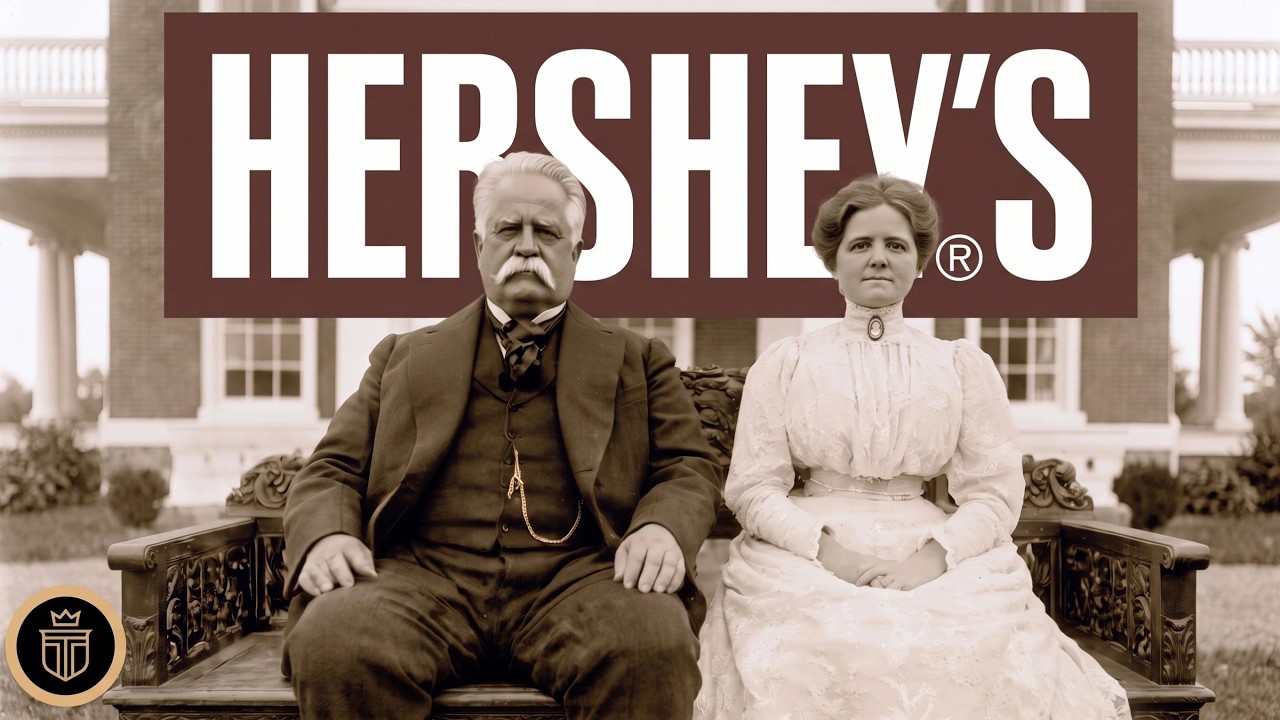
Yet by the terms of a document they signed together in Pennsylvania, they still controlled the company. Milton Snavely Hershey was born on September 13, 1857, on a small farm in Derry Township, a rural pocket of Central Pennsylvania that smelled of hay and dairy cows. His father Henry was a dreamer who chased oil gushers and silver rushes, moving the family so frequently that Milton attended seven different schools before the fourth grade. He left school for good at around age nine.
At fourteen, he took his first paying job at a German language newspaper and was fired within months. In 1872, Milton was hired by a Lancaster candy maker named Joseph R. Royer. For the next four years, he swept floors, waited on customers, and learned the craft of confectionery by hand, boiling sugar over open flames, pulling caramel with his bare hands, and turning out batches of ice cream.
Those four years were the only real education Milton Hershey ever received. At nineteen, Milton borrowed $150 from a relative and opened his own candy shop in Philadelphia, betting on the crowds of the Centennial Exposition. The timing looked promising, but the business strangled itself. He offered too broad a product line, his suppliers demanded cash, and his wholesale customers paid slowly.
For six years he slept under the shop counter, rearranged debts, and worked himself to exhaustion. In 1882, the business collapsed into bankruptcy. He was twenty-four, with nothing to show for it except scars on his hands from boiling sugar and an intimate knowledge of every way a small confectionery business could fail. From Philadelphia, Milton went to Denver, where his father was pursuing yet another failed scheme.
He found work with a local confectioner who made caramels using fresh milk instead of paraffin wax, a technique that produced a creamier, smoother candy. No one in the eastern United States made caramels that way because fresh milk spoiled quickly and could not be shipped long distances. Milton learned the method in detail and carried it east with him. He tried Chicago and then New York, failing in both cities.
Finally, forced to scrape together capital from a former Philadelphia employee, he returned to Lancaster and founded the Lancaster Caramel Company in 1886, using the fresh milk technique from Denver. In the spring of 1887, an English importer placed an order for $2,400 worth of caramels. The family finally opened their wallets. By the early 1890s, the company employed more than a thousand workers and exported caramels across the world.
Then in 1893, Milton traveled to Chicago for the World’s Columbian Exposition, where everything he understood about his business became obsolete. In the Machinery Building, he found the exhibit of J. M. Lehmann, a German engineering company that had built a fully operational chocolate production line on the fair floor.
The line roasted cocoa beans, ground them, and transformed them into smooth, sweet milk chocolate. The aroma reached Milton before he understood what he was looking at. He stood before the equipment and told his cousin with sudden certainty that caramels were a fad and chocolate was permanent. He purchased the machinery on the spot.
For the next six years, Milton ran both the caramel company and the new chocolate company simultaneously, solving a fundamentally chemical problem. Milk is eighty-seven percent water, and water is the enemy of chocolate. Condensed cream failed. Whole milk failed.
Only skim milk, condensed in a closed kettle with sugar added before condensing began, produced the mixture that would become the distinctive Hershey taste. By 1900, he had cracked it. In that same year, he sold the entire Lancaster Caramel Company for $1 million in cash and kept the chocolate machinery and formulas. His future was a mass-produced, affordable milk chocolate bar for ordinary Americans, selling for five cents in every corner store and railway newsstand in the country.
Rather than building his factory in Philadelphia or New York, he broke ground in 1903 in Derry Township, the same rural community where he was born. Land was cheap, the local farmers offered reliable labor and fresh milk, and rail lines were nearby. But Milton did not build only a factory. He built a town.
Chocolate Avenue became the main thoroughfare, intersecting with Cocoa Avenue at the town square. Residential streets were named for cocoa-growing regions around the world. He built parks, a swimming pool, a trolley system, a department store, a bank, a hotel, a church, a school, a zoo, and eventually an amusement park. During the Great Depression, when factories were laying off workers by the hundreds of thousands, he launched the Great Building Campaign, constructing the Hotel Hershey, the Hershey Theatre, a sports arena, and a stadium, specifically to keep his workers on the payroll.
By 1907, the first Hershey’s Kisses rolled off a stamping machine, hand-wrapped in foil. By the First World War, the Hershey chocolate bar was the first industrial chocolate many American soldiers had ever tasted. The public face of this success was a small, mustachioed industrialist. The private face was more complicated.
In the spring of 1897, business travel took Milton through Jamestown, New York, where he met Catherine Elizabeth Sweeney, called Kitty, a twenty-six-year-old woman of Irish immigrant parentage. She took her time assessing the middle-aged confectioner who kept appearing at her workplace. She would later say he was the poorest hand to write a letter she had ever met, preferring terse telegrams. They married quietly on May 25, 1898, in the rectory of St.
Patrick’s Cathedral in New York. Kitty transformed him, bringing gaiety and social grace into his stunted life. He brought her fresh flowers every day without exception. She called him her little Dutchman.
They could not have children, and the grief of that discovery is the unspoken engine behind the entire Hershey dynasty. Milton addressed it obliquely in later years. “I have no heirs,” he said, “and so I decided to make the orphan boys of the United States my heirs. ”
Kitty was no passive ornament in the design of this project.
Her years working for the Lancaster Charity Society gave her a detailed understanding of institutional child welfare. She insisted that the children of the school would not be clothed in uniforms or any other distinctive dress, a decision rooted in her own childhood memory of poverty and the shame of wearing clothes that mark you as a charity case. Catherine Hershey signed the deed of trust alongside her husband on November 15, 1909. She was already dying.
The first signs of illness appeared in 1902, diagnosed as locomotor ataxia, a progressive neurological disorder that robbed its sufferers of coordination and balance. Catherine refused to be diminished by it, supervising the construction of the family mansion and traveling to Europe in search of treatment. By late 1914, she was almost completely paralyzed. In March 1915, Milton was called away on business.
Catherine insisted on making the trip back to Hershey in a convertible with the top down. Her numbed limbs could not register how cold the March wind was. She developed pneumonia. As her condition worsened, she asked Milton to fetch her a glass of champagne, sending him out of the room because she did not want him present at the end.
Catherine Elizabeth Sweeney Hershey died at 1:30 in the afternoon on Thursday, March 25, 1915. She was forty-three years old. Milton gave every employee the day off and free train tickets to attend her funeral. He was so shattered that he could not bring himself to inter her body for four years.
He never remarried. In his later years, he would ask his driver to take him to the rose garden he had built at her request, where he would sit quietly among what everyone called Kitty’s roses. On November 13, 1918, Milton executed his will during his own lifetime, transferring his controlling stock in the Hershey Chocolate Company into the trust that funded the school. He did it so quietly that the American public did not learn of it for almost five years.
When the New York Times finally reported it in 1923, the headline revealed that a Pennsylvania chocolate manufacturer had transferred his entire wealth to educate orphan boys. The school became the majority shareholder in all the enterprises he had established. From that day onward, the Hershey Chocolate Company had no human owner with a personal financial stake in its sale. Its beneficial owner was a school for children without parents.
The mechanism by which Catherine’s school controls the company more than a century after her death is elegantly simple. The Hershey Company maintains a dual class share structure. Common shares carry one vote each. Class B shares carry ten votes each.
The Milton Hershey School Trust owns virtually all of the Class B shares, commanding about seventy-eight percent of the total voting authority while holding only about twenty-eight percent of the company’s economic interest. Hershey, as one analyst put it, is not a candy company with a charity attached. It is a charity that owns a candy company, and one that is structurally forbidden to sell it. That structure was tested in the summer of 2002, when the trust announced it was exploring a sale of its controlling stake.
The town of Hershey reacted with fury. Workers marched on Chocolate Avenue carrying signs that read “Do not sell our town. ” Three of the largest confectionery companies on Earth submitted real bids. The Wrigley Company offered $12.
5 billion, with assurances the factories would remain open and the combined company would be renamed Wrigley Hershey. Then Pennsylvania’s attorney general went to court, arguing that the school needed protecting, that a sale of this nature was a matter of trust law and charitable intent, not corporate convenience. For the first time in the history of American mergers, a chocolate school for orphan children blocked a $12. 5 billion acquisition.
Under legal pressure, the trust board voted ten to seven to terminate the entire sale process. The pattern was established. In 2016, Mondelez International made an unsolicited $22. 8 billion offer, with extraordinary concessions including moving its headquarters to Hershey and keeping the Hershey name.
The trust rejected it unanimously the same afternoon. In December 2024, Mondelez returned for a third attempt, which was rejected within days. Meanwhile, the trust generated serious problems from the inside. In 2006, it purchased a golf club for two to three times its appraised value, and a lawsuit alleged the purchase was engineered to rescue the company’s chief executive from a personally embarrassing financial position.
Pennsylvania’s attorney general launched two separate investigations, resulting in settlements that imposed term limits and cut trustee compensation. The purpose for which all of this corporate machinery exists is extraordinary. The Milton Hershey School today enrolls more than 2,100 children from lower-income families, from pre-kindergarten through twelfth grade, entirely free of charge. Housing, meals, clothing, medical and dental care, counseling, and tutoring, all at zero cost.
The children live on a 7,000-acre campus in more than 180 student homes, each housing eight to twelve children cared for by married couples who live with them full-time. The endowment reported total assets of approximately $23. 4 billion, larger than the endowments of most Ivy League universities. The school began with four boys on September 3, 1910.
The original deed of trust signed by Milton and Catherine Hershey remains the governing document of the entire structure. Its instructions on how the children must be treated were Catherine’s language. They were to be fed with plain wholesome food. They were to be clothed neatly and without distinctive dress.
Their health was to be carefully attended to. These were the demands of a woman who remembered what institutional charity felt like from the wrong side of it. Milton Hershey died on October 13, 1945. Catherine died on March 25, 1915.
Together they had signed a piece of paper in November 1909, and the piece of paper had gone on to survive the Great Depression, the Second World War, the Civil Rights Movement, three separate billion-dollar takeover attempts, and two attorney general investigations.