He could not hear the judge. Ismael “El Mayo” Zambada, the man who had commanded the largest drug trafficking empire on earth, leaned forward in the Brooklyn courtroom and asked the court to slow down. He needed his earpiece adjusted. Then the seventy-six-year-old, who had spent half a century evading every government on the continent, sat expressionless as a judge sentenced him to die in prison.
Federal agents packed the gallery to watch the end of one of the most violent criminal reigns in modern history. But the life sentence was not the real story. Everyone saw that coming. The real story lay in the quiet details buried in court filings: the sealed medical records, the judge’s mention of Zambada’s failing mind, and the specific type of prison he would be sent to.
El Mayo was not headed to a supermax like his old partner El Chapo. He was headed to a federal prison hospital, a locked-down medical facility for inmates whose bodies and minds are shutting down. The same kind of place where Bernie Madoff took his last breath and where the Unabomber died. For nearly fifty years, Zambada never lost.
He was never captured, never arrested, never spent a single night in a Mexican prison. It took one betrayal and one plane ride he never agreed to take to end everything forever. Now the man who owned the mountains of Sinaloa would spend whatever time he had left in a hospital bed with a guard outside the door, slowly losing his memory of the empire he built. Ismael Zambada García was born on January 1, 1948, in a tiny farming community called El Álamo, just outside Culiacán in the Mexican state of Sinaloa.
As a boy he worked the fields. By his teenage years he was doing manual labor and, according to some accounts, working at a funeral home. Sinaloa in the 1960s was not like the rest of Mexico. The mountains had been growing opium poppy and marijuana since before World War II.
The drug trade was not a hidden underworld; it was the local economy. When a young Zambada moved into trafficking in the late 1960s and early 1970s, he was doing what many ambitious young men in the region were doing. The difference was what he became. By the 1980s, Zambada had worked his way into the orbit of the Guadalajara cartel, the first true Mexican drug superpower, run by Miguel Ángel Félix Gallardo, the man they called El Padrino.
Under that umbrella, Zambada learned the business from the inside: the smuggling routes, the Colombian cocaine connections, the bribery networks, the logistics. He was good. While other traffickers were loud, flashy, and violent in public, Zambada was quiet, methodical, and patient. People who knew him described him less like a gangster and more like a businessman who happened to sell the most profitable product on earth.
Then came 1989. Félix Gallardo was arrested. The Guadalajara cartel shattered, and its territory was carved up among his former lieutenants. Out of the wreckage in Sinaloa, a new organization rose, built around a small circle of men that included a short, ambitious trafficker named Joaquín Guzmán Loera, better known as El Chapo, and the calm, calculating rancher from El Álamo, Ismael Zambada.
That organization became the Sinaloa cartel. Zambada’s reputation as the quiet businessman hid a brutal reality. American prosecutors laid it out in black and white. He employed armies of sicarios, hitmen who kidnapped, tortured, and murdered on his orders.
When he pleaded guilty, Zambada admitted in open court that he ordered killings, not that violence happened around him, but that he personally gave orders that ended human lives. The wars he fought were some of the bloodiest in the history of organized crime. In the 1990s, the Sinaloa cartel went to war with the Arellano Félix organization in Tijuana, a conflict so vicious that the Arellano brothers tried to assassinate both El Chapo and El Mayo multiple times. Zambada survived every attempt.
His enemies did not. In 2008 came the war that changed Mexico forever. The Sinaloa cartel turned on its former allies in the Juárez cartel and fought for control of Ciudad Juárez, the single most valuable smuggling corridor into the United States. For about four years, Juárez became the most dangerous city on the planet.
At the peak of the fighting, the city saw thousands of murders per year. Bodies hung from bridges, ordinary residents caught between cartel gunmen, mass shootings in the streets. Estimates put the death toll from that one conflict in the tens of thousands. When the smoke cleared, Sinaloa had won.
Zambada’s organization controlled the corridor. Through every war and massacre, Zambada’s name almost never appeared in the headlines. El Chapo was the famous one. El Chapo gave interviews, dug tunnels, made dramatic prison escapes.
Zambada stayed in the mountains, ran the daily operations, managed the politicians on the payroll, and kept the machine running. Many analysts believed El Mayo, not El Chapo, was the true operational brain of the Sinaloa cartel. One statistic separated him from every other cartel boss in history. El Chapo was arrested three times.
Félix Gallardo was captured. The Arellano brothers were killed or imprisoned. The Zetas’ leaders were hunted down one after another. Zambada, across roughly five decades in the drug trade, was never arrested.
Not once. He never spent a single day in a cell. Mexican Marines raided his camps and found warm food still on the table. He gave exactly one interview in his life, in 2010, to a legendary Mexican journalist.
He admitted he lived in constant fear of capture and that he had escaped the military four times narrowly. But he also made it clear the drug trade would never die with any one man, because the moment a boss falls, another is already waiting. He ran his life by rules most traffickers were too greedy or too vain to follow. He never chased fame.
He slept in a different location constantly, rotating between remote ranches deep in territory where a stranger could not walk a mile without being reported. He refused to stay anywhere with only one way out. He kept his circle brutally small. The real product he bought with all those bribes was not protection.
It was information, warnings, a phone call twenty minutes before the helicopters arrived. The system survived even betrayal from inside his own bloodline. His eldest boy, Vicente Zambada, known as El Vicentillo, was groomed to be his heir. Captured in 2009, extradited to Chicago, and eventually making a deal with the US government, Vicentillo became a cooperating witness.
In 2019, he took the stand at El Chapo’s trial and spilled the cartel’s secrets in open court. His testimony helped bury his father’s partner for life. Even after that, the Americans still could not touch El Mayo himself. At its height, the organization he ran operated in dozens of countries.
It moved cocaine from South America, produced methamphetamine and heroin domestically, and in its final era flooded the United States with fentanyl, the drug driving the deadliest overdose crisis in American history. Prosecutors would say it was difficult to overstate the magnitude of his crimes. Tens of thousands of parents burying their children. Entire regions of Mexico living under armed occupation.
Police forces, mayors, and generals bought and owned. By the early 2020s, Zambada had become the most wanted cartel figure alive. After El Chapo was extradited in 2017 and convicted in a Brooklyn courtroom in 2019, the entire weight of the American government shifted onto Zambada. The DEA wanted him.
The FBI wanted him. Federal prosecutors had indictments waiting in multiple districts across the United States. The US State Department put a $15 million reward on his head, one of the largest bounties ever offered for a drug trafficker. And for years, nobody collected, because you could not get to El Mayo.
He was not brought down by a raid, a wiretap, or an informant network. He was brought down by family. Not his family. El Chapo’s.
After El Chapo went away for life, his sons, known as Los Chapitos, took over his faction of the cartel. They were younger, flashier, more violent, and they bet the entire business on fentanyl. One of them, Ovidio Guzmán, was captured in 2023 and extradited to the United States. The dominoes started falling in a way nobody saw coming.
On July 25, 2024, another of El Chapo’s sons, Joaquín Guzmán López, got on a small plane in Mexico. El Mayo Zambada was on that plane with him. Hours later, that plane touched down at a tiny airstrip near Santa Teresa, New Mexico, just outside El Paso. Waiting on the tarmac were American federal agents.
Just like that, no shootout, no raid, no manhunt. The most wanted drug lord on earth was in handcuffs on US soil. According to Zambada’s own lawyer, he did not get on that plane willingly. The story laid out in court filings was like something out of a movie.
Zambada said he was lured to a meeting outside Culiacán, supposedly to help mediate a local political dispute. When he arrived, he was ambushed. He said he was beaten, tied up, hooded, forced into a truck, driven to an airstrip, and physically loaded onto that plane against his will by Joaquín Guzmán López and his men. The son of his lifelong partner kidnapped him and hand-delivered him to the United States government.
One of the men connected to that meeting, a prominent Sinaloa politician, was murdered that very same day. Mexican investigators concluded his killing was tied directly to the ambush. Even the Mexican government was blindsided. The working theory across Mexico was simple.
The Chapitos traded El Mayo. The old king was sold out by the heirs of his own house. Within weeks of the arrest, Sinaloa erupted into open civil war. Zambada’s faction went to war with Los Chapitos.
Culiacán, a city of a million people, saw daily gun battles, bodies dumped in the streets, schools closed, businesses shuttered. That war raged for nearly two years and claimed thousands of lives. When Zambada appeared in federal court in El Paso days after his capture, people were stunned. The boogeyman of the drug war was wheeled into the courtroom in a wheelchair, elderly, frail, diminished.
His attorneys described a man suffering from a complex of chronic illnesses: diabetes, hypertension, and other serious age-related conditions requiring constant medical care. From Texas, the government moved him to Brooklyn, the same federal district that convicted El Chapo. He was held at the Metropolitan Detention Center, the facility that held Sean “Diddy” Combs, Sam Bankman-Fried, and R. Kelly, a jail so infamous for brutal conditions that federal judges had publicly condemned it.
A man pushing eighty in failing health, locked in one of the most criticized jails in America, in a country whose language he did not speak. The charges were staggering. A seventeen-count indictment in the Eastern District of New York, the centerpiece being leading a continuing criminal enterprise, the Kingpin statute, plus racketeering conspiracy under RICO, drug trafficking conspiracies covering cocaine, heroin, methamphetamine, and fentanyl, conspiracy to commit murder, money laundering, and firearms offenses. In 2025, the Justice Department made a decision: they would not seek the death penalty.
Once that was off the table, the calculus changed completely. On August 25, 2025, in Brooklyn federal court, Ismael Zambada García pleaded guilty. He admitted to being a principal leader of the Sinaloa cartel’s continuing criminal enterprise. He took responsibility for trafficking at least one and a half million kilograms of cocaine into the United States, over three billion individual doses, plus enormous quantities of heroin and fentanyl.
He admitted to paying millions of dollars in bribes to police, military officers, and politicians at every level of the Mexican government. And he admitted to ordering the kidnappings and murders that kept his empire intact. There would be no trial. Unlike El Chapo, who forced an eleven-week spectacle, El Mayo went quietly.
His lawyer insisted he was not cooperating. He gave up no names. He took his sentence and kept his mouth shut. Sentencing day came on Monday, July 20, 2026.
The courtroom was packed with DEA agents, prosecutors from three different states, reporters, and sketch artists. El Mayo walked in slowly, in a tan jail jumpsuit over an orange t-shirt, escorted by US marshals. He struggled to hear the translator and asked Judge Brian Cogan, the same judge who sentenced El Chapo, to speak slower. They had to adjust his earpiece.
Reading in Spanish from a piece of paper, he gave his final public statement. No one wins in a war like this one. He apologized for the harm he caused. He urged the younger generation to choose a different path.
The violence, he said, has to end. Judge Cogan then handed down the only sentence the law allowed: life in prison without the possibility of parole. The court also entered a $15 billion forfeiture judgment against him, though prosecutors admitted they had not located most of that money. Then came the detail that revealed how his life would end.
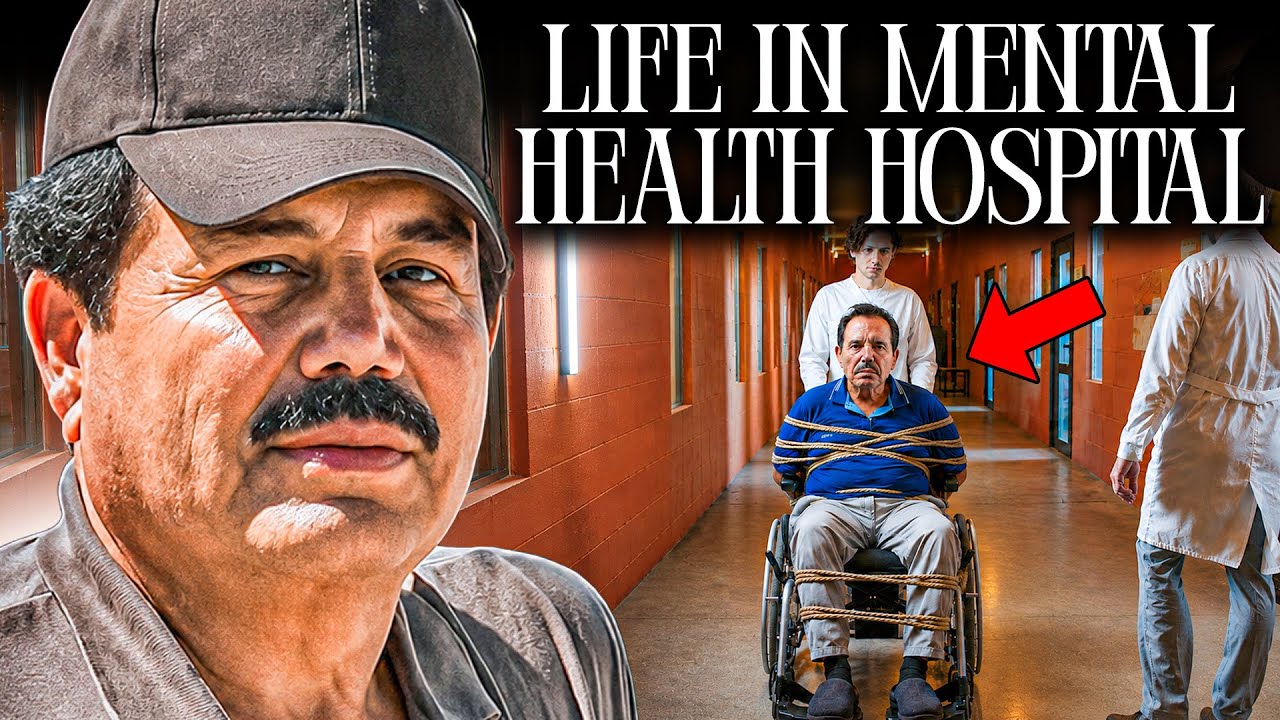
Acting on a request from the defense, the judge announced he would formally recommend that Zambada serve his sentence at a federal prison hospital, a medical facility where he could be treated for what his lawyer called a complex of age-related health issues. The judge ordered his medical records sealed. But he disclosed that Zambada suffered from a number of progressive illnesses, and that his mental state was, in the judge’s own words, drifting toward cognitive impairment. A federal medical center is a strange hybrid.
It is a real prison with fences and guards, but inside it functions like a hospital. The inmates are the federal system’s sickest men: cancer patients, dialysis patients, men with dementia, men in the final stages of terminal illness. Days revolve around medication schedules, nurse visits, wheelchairs, and hospital beds. Bernie Madoff died at the Butner Medical Center in 2021.
Ted Kaczynski, the Unabomber, died there in 2023. The medical centers are the last stop. Zambada’s days would be blood pressure checks and insulin and trays of soft food. His communication would likely be screened under the tightest restrictions, because the loyalty that protected him for fifty years was the exact reason the government could not let him talk freely to anyone.
The man who could not be found by satellites and special forces would be counted by guards multiple times a day. He would age surrounded not by family or loyal gunmen, but by dying strangers and medical staff who knew him only as an inmate number. And if the judge’s words held true, if his mind was really slipping, the empire, the wars, the betrayal, maybe even the reason he was locked up at all, might all slowly fade from his own memory. US officials framed the conviction as historic, a message to every cartel leader that no one escapes forever.
The last great figure of the old generation of Mexican traffickers was gone. But the problem he represented was not finished. The Sinaloa cartel did not collapse when he was taken. It split, and the war between his faction and El Chapo’s sons turned Sinaloa into one of the most violent places in Mexico.
The fentanyl did not stop flowing. The $15 billion was never found. Prosecutors admitted that people loyal to El Mayo still controlled large parts of the organization. He predicted this himself sixteen years earlier.
Lock up the bosses, kill the bosses, it does not matter, because the replacements are already there. His story ended the way almost no one expected: not in a gunfight in the mountains, not peacefully on a ranch, but fading away in a prison hospital bed in a country that hunted him for half a century.