In February 2022, a real estate agent clearing a house in the Nairobi suburb of Karen made a discovery hidden behind a rusty water tank in the roof space. Inside a cardboard box was a leather-bound photo album, stamped on the inside cover with a name in faded gold ink: E. Finch-Hatten. The photos inside were of Laikipia Plateau, dated to the first two weeks of September 1982.
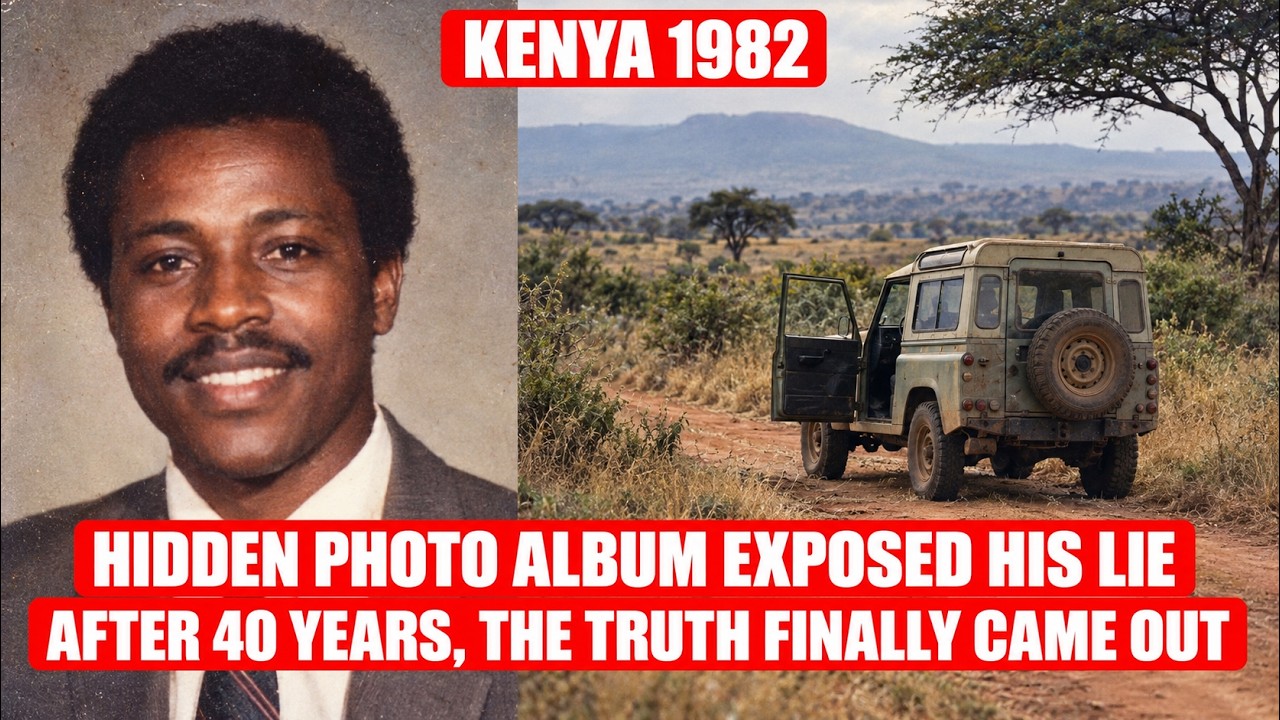
One set of thirty-one images, taken at dusk, showed the northern boundary of a wildlife reserve, the road along the Ewaso Ng’iro River, and a Land Rover parked in the tall grass at the edge of the track. In eight of those images, the edge of the frame caught part of a tall figure in a bush shirt, photographed from behind or from the side, standing near the vehicle. The Land Rover was registered to the Ol Ari Nyiro Wildlife Reserve. It was the car of Joseph Kamau, a reserve manager who had vanished forty years earlier.
Joseph Kamau was thirty-four years old in September 1982. Born in Nyeri at the foot of Mount Kenya, he had studied wildlife management at Egerton University, graduated in 1971, and spent eleven years building a career in conservation. He worked for the Kenya Wildlife Service in Amboseli, then as a field manager for a conservation project in Samburu, and since 1980 as manager of the Ol Ari Nyiro Wildlife Reserve on the Laikipia Plateau. The reserve was a twelve-thousand-acre project funded by a consortium of European conservation organizations, designed to prove that community-involved wildlife management could work on a large scale.
Kamau kept detailed records and filed quarterly reports to the funding consortium in Brussels. In the six months before his disappearance, he had been documenting what he believed was an illegal arrangement between a safari operator on the plateau and a government official in Nairobi concerning access rights to reserve land that had not been granted through official channels. He had written to the consortium about it. He had been advised to be careful.
On the evening of September 11, 1982, Kamau drove from the reserve headquarters at the river crossing toward the northern boundary of the land, where he had arranged to meet a community liaison officer to discuss a fencing dispute. He was last seen around 6:30 p. m. by the reserve’s maintenance supervisor, Samuel Njoro, who watched him drive north in his Land Rover.
By 9:00 p. m. , he had not returned. By 10:00, Njoro contacted the reserve’s radio contact in Nanyuki.
By 7:00 the next morning, the Land Rover was found on the road five kilometers north of the crossing. The engine was running, the driver’s door was open, Kamau’s field notebook was on the passenger seat, and his water bottle was on the dashboard. He was not in the grass around the car, nor on the road ahead or behind it. The community liaison officer he was on his way to meet told investigators he had waited at the fence line until 8:00 p.
m. and Kamau never arrived. No body was ever found. The police investigation was led by Inspector Francis Muthoni of the Criminal Investigation Department in Nanyuki.
Over the month following the disappearance, he conducted sixty-three interviews across the plateau. Through those interviews, he built a clear picture of the land rights dispute Kamau had been investigating. At the center of it was a name: Edward Finch-Hatten. Finch-Hatten was forty-seven in 1982.
He had come to Kenya in 1961, the youngest son of a Lincolnshire coffee-farming family, and spent the 1960s building a safari company on the Laikipia Plateau serving wealthy European and American clients. By 1982, he was one of the most prominent business figures in the region, a man who knew how to reach the right officials in Nairobi and convert those relationships into influence. Muthoni established that Finch-Hatten had made an informal arrangement with a senior official in the Ministry of Lands concerning access rights to part of the Ol Ari Nyiro reserve. The agreement was exactly what Kamau had been documenting.
If reported formally to the European funding consortium, it would have cost Finch-Hatten his existing access arrangement and possibly his ability to operate on the plateau. Finch-Hatten had an alibi. He claimed he had been at his lodge the entire evening of September 11. He said his lodge manager and two guests could confirm it.
Muthoni interviewed all three, and their statements matched. There was no physical evidence in the Land Rover, no witness to what had happened on the road, and no body. With no body, no physical evidence, and an alibi corroborated by three separate witnesses, Muthoni could not move forward against Finch-Hatten. In his case summary in February 1983, he wrote that the disappearance of Joseph Kamau remained mysterious, that criminal suspicion could not be ruled out, and that the case was classified as a missing person until further information became available.
That classification remained essentially unchanged for the next forty years. The land dispute Kamau had been investigating was quietly resolved in 1984, two years after his disappearance, in a manner that, according to records examined in a later inquest, heavily favored Finch-Hatten’s company. The funding consortium in Brussels was informed that the dispute had been settled through local negotiations, without being given the specific terms, and continued to fund the reserve. Finch-Hatten’s safari business continued on the plateau.
In 1988, his business partner, Graham Alderton, who had run the photographic side of the safaris from 1975 to 1988, left Kenya after a falling out over the dissolution of their partnership and returned to the United Kingdom. Alderton had been interviewed briefly in 1982 and had confirmed Finch-Hatten’s alibi. Grace Kamau, Joseph’s wife, was twenty-nine when her husband disappeared. They had three children: two sons, David and Peter, and a daughter, Esther, who was two years old.
After the disappearance, Grace moved with the children to Nyeri to be near her mother-in-law and continued working as a nurse. Every year, she made inquiries to the Kenya Police about the status of the case. The responses ranged from brief to nonexistent. In 1988, she hired a Nairobi lawyer to file a civil suit demanding an official inquiry into her husband’s disappearance.
The case moved through the courts for four years and was dismissed in 1992 on procedural grounds. In 1997, a public inquiry into land rights violations on the Laikipia Plateau briefly heard testimony about the arrangements at Ol Ari Nyiro. Finch-Hatten appeared before the commission represented by a lawyer and repeated his account of the evening of September 11, 1982. The commission took the testimony into consideration and moved on to another topic.
Finch-Hatten sold his safari company in 2001 and retired to a house in Karen, where he lived until his death in 2009 at the age of seventy-four. He died without ever being charged. David Kamau, Joseph’s eldest son, was twelve when his father disappeared. By 2019, he was forty-nine, a lawyer specializing in land rights in Nairobi.
He had spent the previous decade filing requests under Kenya’s Freedom of Information Act for any remaining documents related to his father’s case. In 2019, he obtained a partial copy of Inspector Muthoni’s original case file, documents that had never been provided to the family in forty years. In those documents, David read for the first time Muthoni’s conclusion regarding Finch-Hatten. He also read the name of Finch-Hatten’s former business partner, Graham Alderton, who had been interviewed briefly in 1982 and confirmed the alibi.
He read that Alderton had left Kenya in 1988 and returned to the United Kingdom. He began systematically searching for Alderton. Graham Alderton had returned to Kenya from the United Kingdom in 2004 and lived in the house in Karen until his death in 2019. He had no surviving relatives in Kenya.
The estate was being administered by a Nairobi law firm. When the real estate agent found the photo album, she set it aside rather than throwing it away, because she had learned over twenty years of clearing houses that old photographs are among the things families might want back. She sent a photograph of the cover to the law firm administering the estate. A legal assistant, searching the name online, found a reference to the 1997 land rights inquiry.
She sent the photograph to a colleague. That colleague knew, through a contact in Nairobi legal circles, that a lawyer named David Kamau had spent years searching for any evidence connected to his father’s 1982 disappearance on the Laikipia Plateau. The next morning, David Kamau went to Karen. In March 2022, the album was presented to the Directorate of Criminal Investigations.
The case was assigned to a team specializing in old cases, led by investigator Amina Obio. The thirty-one photographs of the northern plateau, taken at dusk in September 1982, showed the Land Rover, confirmed by photo analysis and vehicle identification to be registered to the Ol Ari Nyiro Wildlife Reserve, Joseph Kamau’s vehicle. They showed the track where it was found the next morning with the engine running and the door open. The images were undated, but compared against the numbered roll sequences that Alderton had apparently kept in his photographic records, they could be dated with reasonable accuracy to the first two weeks of September 1982.
A forensic photography team identified that the dusk photographs were taken on the northern boundary track of the Ol Ari Nyiro reserve on the evening of September 11, 1982, the evening Edward Finch-Hatten had sworn on four separate occasions over forty years that he was at his lodge twelve kilometers away. Edward Finch-Hatten was dead. He had died in 2009. The legal consequences of the photographs could not lead to his prosecution.
But in Kenya, a formal inquest allows a court to determine responsibility in cases of death or disappearance, even when criminal prosecution is impossible. It is a determination that places the facts on the official record, for the state and for the family of the deceased. Inspector Obio recommended this procedure to the Director of Public Prosecutions, and the recommendation was accepted. A formal inquest into the disappearance of Joseph Kamau opened at the Nairobi High Court in January 2023, forty-one years after Kamau drove north on the road to the river.
The court heard testimony from Grace Kamau, seventy years old, who spoke in a calm, steady voice that had clearly held firm for decades. It heard testimony from David Kamau. It heard from Samuel Njoro, the maintenance supervisor, now in his eighties, who described the Land Rover driving north in the evening light and said he had thought about it on and off for forty years. The court heard from a forensic photography expert, from the DCI vehicle identification analysts, and from a historian specializing in land rights who placed the 1982 reserve arrangements in their full political context.
The court also recorded the full text of Inspector Muthoni’s 1983 case summary, the document that named Finch-Hatten and had been ignored for forty years. The inquest concluded in October 2023. The presiding judge ruled that Joseph Kamau had not disappeared voluntarily, that his disappearance was the result of unlawful killing, and that the evidence presented to the court, the photographs, the vehicle identification, the documented land rights motive, and the impossibility of Finch-Hatten’s alibi, was sufficient to establish the responsibility of Edward Finch-Hatten for that crime. The ruling was entered into the official record of the Republic of Kenya.
It named him. It stated what he had done. It stated it clearly, in court, on the record, forty-one years after the fact. Grace Kamau sat in the courtroom as the verdict was read.
She was twenty-nine when Joseph drove north on the road. She was seventy when the judge read his name. She had spent forty-one years nursing in Nyeri, raising three children, making inquiries, and waiting for someone to say what she had always known. When the judge finished reading, she did not cry.
She told her son David afterward that she had used up whatever would have made her cry somewhere in the past forty years. She said she wanted to go home. She said she wanted to sit in her kitchen and have a cup of tea and enjoy some quiet.