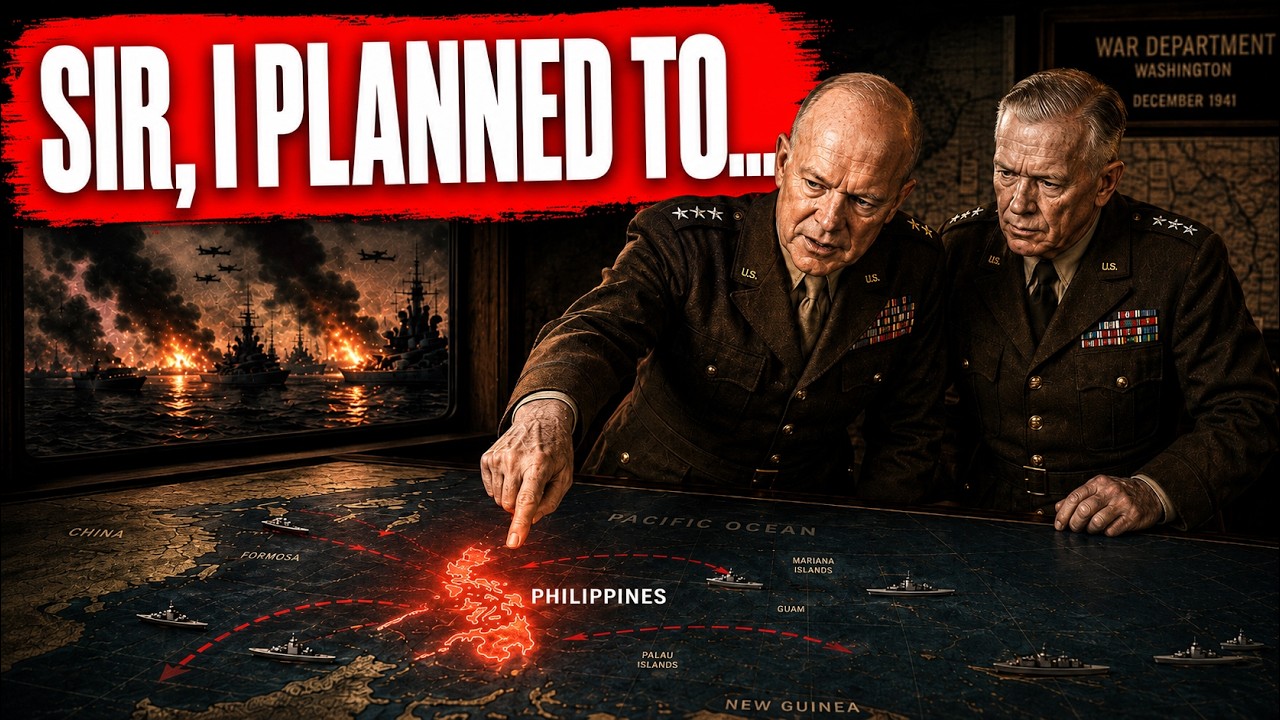
On December 14, 1941, a brigadier general stepped off a train in Washington, D. C. , after a two-day journey from Texas.
He had been summoned by the office of the Army Chief of Staff with no explanation. Inside the Munitions Building, General George Marshall asked him a single question about the war in the Pacific, gave him a few hours to think it over, and then told him only that he agreed.
That man was Dwight David Eisenhower, 51 years old, with 26 years in uniform and no combat command experience. He had pinned on his first star barely two months earlier after strong work in the Louisiana maneuvers. The voice on the phone in San Antonio had been Colonel Walter Bedell Smith, calling for Marshall.
Eisenhower packed a bag, said goodbye to his wife, and rode east into a country transformed by the attack on Pearl Harbor five days earlier.
Marshall did not offer coffee or small talk. He turned Eisenhower toward a map of the Pacific and laid out the situation in the Philippines in flat language. Then he asked: What should the general line of American strategy be?
Eisenhower asked for a few hours. Marshall gave them without comment.
Eisenhower had spent four years in the Philippines during the 1930s. He knew the arithmetic of ships and distance and Japanese naval power. No relief force could reach Bataan and Corregidor in time.
A dishonest answer promising rescue would have been easier to say. He wrote the hard version down instead, adding that the appearance of effort had to continue anyway, because abandoning the Philippines outright would cost the United States the trust of every ally and occupied people watching to see what an American promise was worth.
Marshall told him he agreed. Then he said Washington already had plenty of officers who could explain a problem from every angle and wait for someone above them to decide. What he needed were officers who could work a problem through on their own judgment and come back with a decision already made.
Eisenhower had just proven he was one of them.
By the end of December, Eisenhower was assigned to the war plans division, working the Pacific desk. Cables from Manila described the shrinking perimeter on Corregidor, ground he had walked himself under Douglas MacArthur. Through late December and into January, Roosevelt and Churchill met in Washington for the Arcadia Conference.
Eisenhower was one floor below, writing the paper that explained why Germany had to be defeated first, even though Japan had drawn the United States into the fight.
On February 28, 1942, Eisenhower produced a memorandum laying out three non-negotiable requirements of Allied strategy: Britain had to be held as a base, German and Japanese forces had to be kept from linking up across the Middle East, and the Soviet Union had to be kept fighting. Together, those pointed toward a cross-channel invasion of northwestern Europe as quickly as possible. Marshall read it, agreed, and carried its logic into arguments with skeptical British planners.
The promotions came fast. On March 27, 1942, barely six months after his first star, Eisenhower became a major general. In April, the war plans division became the operations division, and he became its chief.
In May, Marshall sent him to London to assess Allied planning firsthand. Then in June, Marshall named him commanding general of the European theater of operations. Within days, Eisenhower received a third star.
Six months earlier, he had been an obscure chief of staff in San Antonio. Now he sat at the head of the entire American military buildup in Britain. His diary from these months describes exhaustion bordering on constant, meals eaten standing at his desk, sleep rationed.
He had not campaigned for attention. He had simply kept answering the questions placed in front of him honestly, and Marshall had kept handing him larger versions of the same test.
By the summer of 1942, that test was about to take a new form. Marshall wanted a direct assault across the English Channel sooner rather than later. Churchill wanted nothing of the kind in 1942, arguing that an underprepared invasion of France would be broken on the beaches.
Roosevelt, weighing the political need to get American troops fighting Germans somewhere before the year was out, sided with Churchill. The landings would happen in French North Africa instead, under the name Operation Torch. Eisenhower, the theater commander with no combat experience, would command them.
He set up advance headquarters in a damp tunnel carved into the rock of Gibraltar. In late October and early November of 1942, he waited on word of an operation whose outcome depended as much on politics as on artillery. The plan called for three separate landing forces striking almost simultaneously on November 8.
George Patton would land at Casablanca. A second force would land at Oran. A third would land at Algiers.
Nobody could say with confidence how the French garrisons would respond. At Casablanca, French coastal batteries opened fire on Patton's approaching ships, and the exchange continued for three days. At Oran, French warships fought a short naval action before being destroyed.
At Algiers, pro-Allied French resistance fighters had staged an uprising hours before the landings, seizing the telephone exchange and the radio station, buying crucial hours for the troops coming ashore.
By the end of the first day, several hundred Americans and French soldiers on both sides were dead in a battle between two nations not on paper at war with each other.
Then came the coincidence that changed the shape of the campaign. Admiral Francois Darlan, commander-in-chief of all Vichy French armed forces and the second most powerful man in the Vichy government, happened to be in Algiers visiting his son, who was gravely ill with polio. Darlan was the single French official in North Africa with the authority to order every French unit on the continent to stop fighting.
Mark Clark flew into Algiers on November 9 and met Darlan directly. The negotiation was conducted at gunpoint in every sense that mattered. Darlan hesitated, then negotiated, then hesitated again as word arrived that the government of Marshal Petain, under German pressure, had publicly disavowed him.
The gamble held. On November 10, Darlan ordered a general ceasefire across French North Africa. In exchange, he was recognized as head of French civil and military authority in North Africa.
The military logic was not difficult to follow. It stopped the fighting within days instead of weeks. Judged as anything else, it was a catastrophe waiting to explode.
Darlan was one of the most recognizable collaborators in the Vichy government, a man who had negotiated directly with Hitler and signed off on anti-Jewish laws applied across French North Africa. British and American newspapers ran editorials asking how a war being fought in the name of liberty could begin by installing a leading Vichy collaborator as ruler of newly liberated territory. Charles de Gaulle was reportedly incandescent.
Eisenhower found himself defending a decision he had approved but not personally negotiated. He flew to Algiers in mid-November, met Darlan face to face, and drafted cables to Washington laying out exactly what the alternative would have cost. Roosevelt was forced to address it publicly, calling the arrangement a temporary expedient justified solely by the stress of battle.
The arrangement did not last long enough to become the permanent embarrassment many feared. On December 24, 1942, Darlan was shot twice at close range in the entrance hall of his own headquarters by a young French monarchist named Fernand Bonnier de la Chapelle, barely 20 years old. He was tried within two days and executed by firing squad on the day after Christmas.
Darlan died within hours of the shooting. No credible evidence has ever tied Eisenhower or any Allied official directly to the killing, though the speed of the trial left the question permanently unresolved.
For Eisenhower, the political fallout was barely finished when the military side delivered its own harsh lesson. Through January and into February 1943, American forces pushed east from Algeria toward German and Italian armies gathering under Field Marshal Erwin Rommel. On February 19, Rommel struck the inexperienced American II Corps at the Kasserine Pass.
The result was the worst defeat American ground forces suffered against Germany in the entire war.
American troops broke and fell back more than 50 miles in a matter of days. Roughly 6,000 soldiers were killed, wounded, or taken prisoner in less than a week. War correspondents described columns of retreating American vehicles clogging the roads.
Rommel described the Americans as inexperienced and still learning the basic craft of war. A private verdict that stung all the more for being accurate.
The defeat landed squarely on Eisenhower's desk. He had visited the front only days before the attack and had come away with private doubts about Major General Lloyd Fredendall's grip on his own command. Doubts he had not acted on quickly enough.
Eisenhower relieved Fredendall within days and installed George Patton in his place. Patton restored order to II Corps with a speed that startled the men serving under him, requiring every soldier to wear a steel helmet, leggings, and a necktie at all times. The point was never really about neckties.
Within weeks, II Corps was back on the offensive.
The recovery was rapid. Through March and April, the Allied ring around Axis forces in Tunisia tightened from three directions. Rommel, exhausted and ill, left North Africa for good in early March.
On May 13, 1943, the last organized Axis resistance in Tunisia surrendered. Roughly 230,000 German and Italian soldiers went into Allied captivity, a number larger than the entire German force lost at Stalingrad three months earlier.
Marshall's original wager had been tested in the harshest possible conditions, first by politics and then by German tanks, and it had held.
The months after Tunisia moved fast. In July 1943, Eisenhower commanded the invasion of Sicily, the first Allied landing on European soil. Sicily fell in 38 days.
In September, Eisenhower's forces crossed to the Italian mainland, landing at Salerno against fierce German resistance. The Italian government agreed to an armistice, taking Italy out of the war as a German ally.
By the autumn of 1943, a larger question dominated every Allied planning session. Somebody would need to command the invasion of northern France. Inside the American military establishment, there was an assumption so widely shared it had almost calcified into fact: the command would go to Marshall himself.
He was the senior American soldier, the architect of the entire buildup.
Roosevelt traveled to Cairo in late November 1943, then to Tehran in early December to meet with Churchill and, for the first time in the war, Joseph Stalin. Stalin pressed hard for firm commitments, a fixed date for the invasion, and pointedly a named commander to lead it. Roosevelt understood the force of that argument.
He also understood that naming a commander meant making a decision he had been able to avoid for months.
The difficulty was not military. Almost everyone agreed that either Marshall or Eisenhower could handle the command competently. The difficulty was what removing Marshall from Washington would cost the rest of the war effort.
As Army Chief of Staff, Marshall was managing the entire American war effort across every theater at once. Sending him to London would leave a gap in Washington that nobody could say with confidence how to fill.
Roosevelt asked Marshall directly what he personally wanted. Marshall declined to answer the question at all. He told the president that the decision belonged entirely to him, that he would serve wherever the country believed he could be most useful.
Roosevelt, according to those who spoke with him afterward, found himself unable to imagine functioning without Marshall in Washington. He made his decision on the way back from Tehran. The command of Operation Overlord would go to Eisenhower.
Marshall would remain in Washington.
Word reached Eisenhower before any formal announcement. On December 7, 1943, exactly two years to the day after Pearl Harbor, Roosevelt stopped near Tunis and asked Eisenhower to drive him out to see the ancient ruins of Carthage. Riding together in the back of the car, Roosevelt turned to him and said without any warning that he was going to command Overlord.
There was no announcement, no photographers, just a handful of words spoken between two men in the backseat of a car parked beside the ruins of a city more than 2,000 years dead.
The public announcement came on Christmas Eve, December 24, 1943, exactly one year to the day after Darlan had been shot dead in Algiers. Roosevelt confirmed by radio broadcast that Eisenhower would command the Allied invasion of northwestern Europe.
Marshall's own reaction to being passed over deserves more attention than it usually receives, because there was, by every surviving account, no bitterness in it at all. He had built Eisenhower's entire career with his own hands. When the largest command of the war went to the man he had built rather than to himself, he offered no complaint, publicly or privately.
If anything, those close to him described a kind of quiet satisfaction, the sense that the officer he had gambled on in December of 1941 had grown exactly as Marshall had hoped he would.
For Eisenhower, the appointment closed a circle that had opened exactly two years earlier. He had walked into Marshall's office in December 1941, an obscure brigadier general with no combat experience, asked to answer an impossible question about a battle already effectively lost. He returned to that same relationship two years later as the officer chosen ahead of Marshall himself to command the invasion that would end the war in Europe.
There had been no plan, no announcement, no moment when anyone could have said with confidence where the road from that first difficult afternoon was actually leading. There had only been one honest answer after another delivered under real pressure, across a Philippines memorandum written in a borrowed office, a February strategy paper, a political scandal in Algiers, a defeat in a Tunisian mountain pass, and finally a handful of quiet words spoken in the back of a car parked beside the ruins of Carthage.
By the spring of 1944, Eisenhower was in England again, this time as Supreme Allied Commander, presiding over the largest concentration of military power ever assembled for a single operation. The staff around him had grown from the handful of officers who had once shared his tunnel headquarters in Gibraltar into a vast Allied command structure spanning two nations, dozens of divisions, and thousands of ships and aircraft. All of it ultimately answering to a man who two and a half years earlier had stepped off a train in Washington with nothing but a small bag and no idea why he had been summoned.