On December 30, 1944, a 44-year-old British major general climbed into a light aircraft at an airfield in Belgium, in weather that had grounded nearly all other flight traffic over Europe that morning. He had told no one what he was about to do. He flew to Versailles to save the career of a man who did not yet know it was about to end.
Waiting at a headquarters outside Paris was the Supreme Allied Commander, Dwight Eisenhower. On his desk lay a drafted telegram addressed to the Combined Chiefs of Staff in Washington and London. It accused no one.
It simply stated that the alliance could keep either Eisenhower or Bernard Montgomery, and that a choice had to be made.
Two hundred meters away, American soldiers were dying in the snow around Bastogne at a rate of hundreds per day. The two highest ground commanders in the West had stopped speaking to one another.
—
The crisis began on the morning of December 16, 1944, when fog settled over the Ardennes, thick and low enough to ground all Allied aircraft on the continent. Under that fog, along a 135-kilometer stretch of forest and frozen farmland on the Belgian-German border, three German armies moved forward through the trees.
Nearly 200,000 men formed that first wave, supported by almost a thousand tanks and assault guns. They struck a sector the American command had deliberately left thinly held. The VIII Corps under Major General Troy Middleton held the entire line with four divisions.
Two were exhausted units sent to the Ardennes to rest after heavy losses in the Hürtgen Forest. One, the 106th Infantry Division, had arrived only five days earlier and had never been in combat.
Thirty-two kilometers behind them, in the Hotel Alfa in Luxembourg City, an American lieutenant general read the first reports and did not believe them. His name was Omar Nelson Bradley. He was 51 years old, a farmer’s son from Clark County, Missouri, and he commanded the 12th Army Group, making him responsible for more American soldiers than any commander in the history of the U.
S. Army.
War correspondent Ernie Pyle had called him “the G. I.’ s general,” and the name stuck because it was accurate.
Bradley did not shout. He did not pose for photographers. He was not a brilliant military mind, and he never claimed to be.
He was a careful man, and in an army built almost overnight from civilians, carefulness proved worth more than genius.
—
By the evening of December 17, reports reached Bradley of a massacre near Malmedy, where SS troops had shot approximately 84 American prisoners in a field. By December 19, two full regiments of the inexperienced 106th Division, some 7,000 men, had surrendered on the Schnee Eifel—the largest mass surrender of American soldiers in the European war.
The German breakthrough drove a wedge straight through the middle of Bradley’s command. His 12th Army Group consisted of three armies. The Third Army under George Patton lay to the south.
The First Army under Courtney Hodges and the Ninth Army under William Simpson lay to the north. The German advance split them apart, and every hour the wedge grew, the harder it became for Bradley to reach the two armies on the far side.
On December 19, Eisenhower called his senior commanders to a cold barracks in Verdun. There was no heating in the room. Eisenhower told them the situation should be seen as an opportunity, not a disaster.
Patton, who had already ordered his staff to plan exactly this, said he could pull three divisions out of an attack to the east, turn them 90 degrees, and drive them north into the German flank within days. Officers around the table understood how close that was to impossible. Patton meant it, and he did it.
But no one at Verdun solved the problem of the North.
—
That evening, back at headquarters outside Paris, two officers on Eisenhower’s own staff sat down with a map and reached a conclusion neither wanted to speak aloud. Major General Kenneth Strong, Eisenhower’s intelligence chief, and Major General John Whiteley, deputy for operations, were both British. They concluded that Bradley could no longer effectively control the First and Ninth Armies from Luxembourg, that someone north of the bulge needed to take over, and that the only army group headquarters in position to do so was the 21st—British, and led by Field Marshal Bernard Montgomery.
They presented this to Eisenhower’s chief of staff, Lieutenant General Walter Bedell Smith. Smith was American, known for his short temper, and he immediately understood how it would look: two British officers proposing to place two American armies under a British field marshal. He told them they were no longer acceptable as staff officers and sent them out of the room.
Then he sat up all night thinking about it.
The next morning, December 20, Bedell Smith walked into Eisenhower’s office and advised exactly what Strong and Whiteley had recommended—on his own authority, because he had analyzed the problem and reached the same conclusion.
Eisenhower took perhaps a minute to decide. Around 10:30 that morning, he called Bradley in Luxembourg and told him that with immediate effect, the First and Ninth Armies would be placed under Montgomery’s operational command for the duration of the emergency.
There was silence on the line. Bradley objected. He said the Germans could still be handled from his position.
He said transferring American armies to a British commander would look to the American public and the American army like a judgment on American leadership. Eisenhower listened and told him the decision was final.
Bradley put down the phone and said almost nothing. An officer present remembered that his hands were trembling.
—
To understand why that call hit so hard, one must understand who Bernard Law Montgomery was and why American commanders had spent six months learning to fear him.
He was 57 that December, three and a half months a field marshal, the highest rank the British army grants. He was small, wiry, sharp-faced, a lifelong soldier who neither drank nor smoked and went to bed every night at 9:30, on the theory that a tired commander makes bad decisions. He was, by honest assessment, the most successful British field commander of the war.
At El Alamein in late 1942, he had taken an Eighth Army that had been repeatedly beaten in the North African desert and given it a decisive victory—the first Britain had achieved.
British soldiers trusted him because he did not attack until he was ready. He built up. He rehearsed.
He gathered overwhelming power and then used it. The men in his divisions knew he would not waste them on an improvised gamble.
The problem was everything else about him. Montgomery was incapable of admitting mistakes and could not hide what he thought of those around him. During the summer of 1944, he had commanded all Allied ground forces in Normandy, both American and British, and had done so competently.
But on September 1, that command passed to Eisenhower, and Montgomery never accepted the change.
Throughout the autumn, he wrote Eisenhower letter after letter arguing that the broad advance across a front stretching from the North Sea to Switzerland was a mistake. The Allies should concentrate everything on a single narrow thrust into the industrial heart of Germany, he insisted, and that thrust should naturally be under one ground commander. He never wrote the words literally, but no one reading those letters doubted which ground commander he had in mind.
The Americans had two very good reasons not to listen. The first was the port of Antwerp. On September 4, British armor had captured the largest port in Europe, but a port is useless if ships cannot reach it.
Antwerp lies 80 kilometers inland on the Scheldt estuary, and the Germans held both banks. Clearing the Scheldt was Montgomery’s responsibility, and for weeks he treated it as secondary. The estuary was not cleared until early November, at a cost of about 13,000 Canadian casualties, and the first Allied convoy did not unload in Antwerp until November 28.
The second reason was Operation Market Garden. On September 17, Montgomery launched an airborne and armored attack designed to seize a series of bridges in the Netherlands and cross the Rhine at Arnhem in one stroke. It was his own concept, uncharacteristically bold, and it failed.
The British 1st Airborne Division was destroyed at Arnhem, losing nearly 8,000 of the 10,000 men deployed. Montgomery described the operation for the rest of his life as 90 percent successful.
—
On the afternoon of December 20, Montgomery arrived at the headquarters of the American First Army outside Lierneux. He did not send word ahead. He walked in past American staff officers who had been awake for four days and had no idea he was coming.
A British officer present later described the moment with a phrase that would haunt Montgomery for the rest of his career: the field marshal had entered the headquarters of the American First Army like Christ coming to cleanse the temple.
The worst part was that the temple did need cleansing. What Montgomery found was worse than anything being reported to Luxembourg. The First Army’s command post had already been forced to move once, abandoning the spa town of Spa so hastily that maps remained on the walls and a fuel depot of over 7.
5 million liters was left undefended. Courtney Hodges, the army commander, had been awake for most of four days. Officers who saw him described a man who had stopped talking, who sat motionless behind his desk, who had to be addressed twice before answering.
Montgomery walked into that situation and began issuing orders within the hour. He had a system, and whatever one thought of the man, the system worked. He maintained a network of young liaison officers, most in their twenties, who drove to forward units every morning, saw the situation with their own eyes, and returned each evening to report directly to him, bypassing the entire chain of command.
Within 36 hours, he had a clearer picture of where the German spearheads actually were than anyone in the American command structure had gathered in four days.
He found that no one had built a coherent northern flank. He saw American divisions being thrown into the fight piecemeal as they arrived. And at the eastern edge of the breakthrough, he found an American armored division in a salient around the crossroads of Saint-Vith, about to be encircled.
The 7th Armored Division had held Saint-Vith since the second day of the offensive, and their defense had disrupted the German timetable more than anything else in the first week. But by December 21, they were nearly surrounded. Matthew Ridgway, the airborne corps commander responsible for that sector, wanted them to stay.
Ridgway was one of the toughest men in the American army, and his instinct was always that ground once taken was not given back.
Montgomery overruled him. On December 22, he authorized the withdrawal. He was right.
Holding Saint-Vith two more days would have cost an entire armored division for ground that had already done its job. Every serious study of the battle since has agreed with him.
It did not matter. American officers had spent five months reading in their own newspapers that they were driving the Germans back to the Rhine. Now a British field marshal had arrived, taken command of their armies, and within 72 hours ordered ground to be given up.
—
Montgomery also began straightening the northern line, pulling units back to shorten the front and free up formations. He assembled the VII Corps under Major General Joe Collins into a reserve that he refused to commit until he judged the German advance was exhausted. Collins wanted to attack.
Ridgway wanted to attack. Hodges, recovering, wanted to attack. Montgomery told them all to wait.
Militarily, waiting was defensible. The German spearheads were running out of fuel on their own, and a premature counterattack against a still-moving armored force would have been costly. But every day of waiting was a day the men of the 101st Airborne Division in Bastogne were being shelled.
And a day the American press wondered why the northern part of the front had fallen silent. And a day officers in Luxembourg said aloud that the British had pulled their armies back to keep them from fighting.
On December 20, and again in the days after, Montgomery did something that would have ended the discussion entirely had it become public. He sent a signal to London and headquarters suggesting that Courtney Hodges was not fit to continue commanding the First Army, and asking whether he should be relieved. He was right to raise the question.
Any commander who took over a unit in that condition would have asked the same thing, and Montgomery raised it through proper channels rather than acting on his own authority.
Eisenhower’s answer came carefully worded. Hodges, he explained, was the quiet, reserved type, and Bradley retained full confidence in him. Montgomery was told he had the authority to relieve Hodges if he genuinely considered it necessary, but that he should first understand what the American command thought of the man.
Montgomery let it rest. Hodges recovered, resumed effective command within days, and led the First Army competently through the Rhineland and across Germany. On this point, Bradley and Eisenhower were right and Montgomery was wrong, and Montgomery never mentioned it again.
—
On Christmas Day 1944, Montgomery drove to Luxembourg to speak with Bradley in person for the first time since the offensive began. Two men were in that room. Two accounts came out of it, and they do not describe the same conversation.
Bradley remembered being lectured. He remembered Montgomery telling him the Americans had brought this on themselves by attacking on too broad a front, against the advice he had been giving since September, that this was the result of ignoring him, and that the situation now required a single ground commander with real authority. Bradley said afterward he had never been so angry in his life, and that for the first time in his career he nearly lost his self-control completely.
Montgomery, writing to Field Marshal Alan Brooke in London that same evening, described something very different. He wrote that Bradley looked thin, tired, and uncomfortable, that he seemed to agree with everything Montgomery proposed, and that the American command was in a state requiring strong leadership. He left the room believing he had convinced Bradley.
He had not convinced Bradley. He was not even close. And the fact that Montgomery genuinely could not see the difference is the most important fact about him in this entire story.
—
Four days later, he put it in writing. On December 29, Montgomery sent Eisenhower a letter with an attached draft directive he proposed Eisenhower issue. The directive stated that full operational command of the coming offensive should rest with a single commander, and it identified the boundaries and forces in a way that left no doubt who that commander would be.
He was asking the Supreme Allied Commander to sign a document, drafted by a subordinate, that would transfer most of the ground war to that subordinate.
At the bottom, he added a postscript. He wrote that he was raising the matter again only because he was so anxious to prevent another failure. Another failure—in a letter written by the man responsible for the Scheldt and Arnhem, to the man who had held a coalition together for four months in the third week of a battle in which American soldiers were dying at a rate of hundreds per day.
Eisenhower read it in his office at Versailles and stopped trying to manage Bernard Montgomery for the first time in the war. He did not answer the letter. Instead, he began drafting a telegram to the Combined Chiefs of Staff.
While he was still working on it, a message arrived from Washington that removed the last reason to hesitate. George Marshall, the Army chief of staff, had read the same British newspapers and telegraphed Eisenhower that he must not make any concession on the question of a British ground commander. The message was unmistakable: the American army would not accept it, and if Eisenhower agreed to it, he would lose Washington’s support.
The document Eisenhower and Bedell Smith worked on for two days accused Montgomery of nothing. It did not need to. It calmly laid out the position and stated that the command structure in the West had become unworkable, that Eisenhower could no longer function within the current arrangements, and that the Combined Chiefs must decide the matter.
In practice, such a telegram could end only one way. The Combined Chiefs would not remove the Supreme Allied Commander three weeks after a German offensive had punched a hole in his front. They would remove the field marshal.
And a name was already circulating. In late December, Churchill and Eisenhower discussed bringing Field Marshal Harold Alexander from Italy to replace Air Chief Marshal Arthur Tedder as deputy supreme commander. On paper it was a simple personnel change.
For anyone who understood how these things actually worked, it was something else. Alexander was a field marshal, the equal of Montgomery in rank, enormously popular with the Americans in a way Montgomery never was, and he had previously commanded Montgomery in North Africa and Sicily. Placing Alexander in that post meant the ground command Montgomery had been asking for for four months could be created at any moment and given to someone else.
—
Montgomery, at his tactical headquarters in the Belgian village of Zonhoven, knew nothing of this. He had sent his letter. He considered the discussion substantively closed and was waiting for a reply.
The man who found out was his chief of staff. Major General Francis de Guingand was 44 years old and had been Montgomery’s chief of staff since the summer of 1942. He was, in almost every respect, the opposite of the man he worked for.
He drank, smoked heavily, and played cards late into the night with anyone who would join. He was generous with compliments and personable in manner, and for two and a half years he had quietly repaired relationships Montgomery had damaged without ever noticing he had damaged them. Officers at Allied headquarters liked him.
Bedell Smith, who liked almost no one, trusted him completely.
On December 30, de Guingand received a phone call from Bedell Smith, who told him what was sitting on Eisenhower’s desk. De Guingand was not healthy that winter. He had been running on fumes for months.
What he did next, he did knowing what it would cost him physically.
He ordered an aircraft and flew from Belgium to Paris in weather so bad the flight should not have been attempted, through the same low cloud cover that had grounded Allied airpower for the first week of the German offensive. He reached Versailles and was taken straight to Eisenhower. Bedell Smith was there.
Tedder was there. No one in that room was on Montgomery’s side.
De Guingand read the draft telegram. He understood immediately that this was not a negotiating document, that Eisenhower was past the point of managing the problem, and that if this went to Washington and London, his chief would be finished within a week. He did not defend Montgomery’s letter of the 29th.
He could not. Instead, he asked Eisenhower for 24 hours and made a simple, practical argument: Montgomery did not realize what he had done; he had written the letter believing he was being helpful; if he were made to understand the cliff he stood on, he would put it right in writing; and the dismissal of a British field marshal in the middle of a German offensive would hand Berlin a propaganda victory worth more than a division.
Eisenhower did not want to give him the day. Tedder argued against it. Bedell Smith, the American who had once thrown two British officers out of his office for thinking like Britons, argued for it.
Eisenhower gave him the 24 hours.
—
De Guingand flew back in worsening weather, landed, and drove to Zonhoven through a landscape of bare orchards and darkened villages, past columns of American trucks heading the other way with their headlights masked to slits. The tactical headquarters was not a castle or a hotel. It was a collection of caravans and tents in a field, as Montgomery had insisted on running his headquarters since the desert: close to the front, small, deliberately uncomfortable.
De Guingand walked into that caravan and told him without preamble that the Supreme Allied Commander intended to go to the Combined Chiefs of Staff, that the matter would be decided in Washington and not in Belgium, and that Montgomery was about to be sacked.
According to de Guingand’s own account, written after the war, Montgomery did not argue. He did not object. He did not explain the merits of his position a second time.
He was completely silent, and the change in him was so total that de Guingand, who had worked beside him every day for two and a half years, found it painful to watch.
Then Montgomery asked him a question he had almost certainly never asked another human being in his adult life.
“What must I do, Freddie?”
De Guingand reached into his pocket and pulled out a sheet of paper he had written before going in. Montgomery read it. He did not change a word.
He signed it, and it went to Eisenhower that same day.
It said that he had spoken to Freddie and understood that Eisenhower was concerned about many considerations in these very difficult days. That he had given his honest opinion because he thought Eisenhower would need it. That there were undoubtedly many factors affecting the situation that he could not see.
And then the sentence that saved him: “Whatever your decision may be, you can rely on me 100 percent to carry it out, and I know Brad will do the same.” He asked Eisenhower to tear up the earlier letter. He signed it, “Your very devoted subordinate, Monty.”
Eisenhower received it, and the telegram to the Combined Chiefs of Staff was never sent. It went into a drawer, and the crisis was, as far as the Supreme Allied Commander was concerned, over. It had lasted about 48 hours.
Almost no one outside a handful of officers knew it had happened at all.
—
Eight days later, Montgomery destroyed everything de Guingand had accomplished for him.
On January 3, 1945, the northern counterattack finally began. Collins moved south with the VII Corps while Patton advanced north from the Bastogne area. It went slower than the Americans wanted, in weather conditions that made every kilometer costly.
But the German front began to close.
And on January 7, Montgomery held a press conference at his tactical headquarters in Zonhoven. He had been persuaded to do it, partly to soothe the controversy that had nearly cost him his command and to demonstrate publicly that the Allied high command was united.
He walked into a room full of war correspondents in the familiar uniform and beret the whole world knew. By his own lights, he was there to praise the Americans. And on some points, he did exactly that.
He described the American soldier as “a very brave fighting man” with “the tenacity in battle which goes to make a great soldier.” He said he had tried to feel almost like an American soldier, so that he would not take inappropriate actions or give offense. He closed with a call for unity, telling the correspondents the team must rally behind the captain of the team, and that captain was Eisenhower.
But those were not the sentences that made the rounds. What made the rounds was the rest of it.
Montgomery described how he had been called in, and that the first thing he did was make sure the battlefield was cleaned up. He described how he had thrown the full available power of the British Army Group into the fight, and that the correspondents should therefore see British troops fighting on both sides of the American units that had taken a hard knock. And he told them it had been “a most interesting battle,” and that he thought it might be “one of the most interesting and difficult battles” he had ever conducted.
Conducted. A battle in which 19,000 American soldiers had been killed. In which more than 80,000 men had been killed, wounded, captured, or succumbed to the cold, and in which British losses for the entire month were only a few hundred men.
And the field marshal called it interesting and difficult.
Every American officer who read the transcript in the following days read the same thing: that the Americans had been beaten and a British commander had come to clean up the mess for them.
There is a defense, and it deserves mention because it might be true. Montgomery’s own people later insisted that a German propaganda station had broadcast a falsified version of the press conference, deliberately rewritten to inflame the Americans and split the alliance, and that some of the anger in the American command was a reaction to words Montgomery never actually spoke. That claim was never fully verified in either direction.
It also did not matter. The real transcript was more than sufficient on its own, and it was in every American newspaper within days.
—
In Luxembourg, Omar Bradley read it. The men who were with him at Hotel Alpha that week remembered the quality of the silence more than anything he actually said. Bradley was not a man who raised his voice, threw things, or made speeches to his staff.
He read, put the paper down, and stared at the wall for a long time. The officers in the room understood without being told that the point at which this could be repaired had passed.
He had built his entire career on not being that kind of man—on being the steady one, the officer who absorbed difficulties and passed down a calm version so the men below him could continue their work. He had spent three weeks with two-thirds of his command taken from him. He had spent Christmas Day being told it was his own fault.
He had watched British newspapers argue for a month that the American army needed a British commander to take care of it. And now this.
According to his own account, written six years later, Bradley called Eisenhower and said the only thing he had never said to a superior officer in his life. He said this was the one thing he could not accept: if Montgomery were given command of all Allied ground forces, Eisenhower would have to send him home, because he could not serve under him.
Bradley had never threatened to resign over anything. He had swallowed Kasserine. He had swallowed being placed under Patton, a man who had once been his subordinate in Sicily.
He had swallowed the loss of two armies in December without a public word of criticism. This was the line.
And when Patton heard this, he told Bradley that if Bradley resigned, he would go with him.
Two days later, on January 9, Bradley did something else he had never done. He called a press conference himself, the first of his career, and told American correspondents in plain language that the transfer of the First and Ninth Armies had been a temporary arrangement for reasons of communication and geography, and nothing more. It was not a dramatic performance.
It was a careful, dry, factual correction, delivered by a man who had clearly decided that silence no longer worked.
The alliance stood closer to breaking than at any other moment in the war, and it was not the Germans who had caused it.
—
The man who finally ended it was not Eisenhower, not Marshall, and certainly not Montgomery. On January 18, 1945, Winston Churchill stood in the House of Commons and spoke about the battle in the Ardennes. He told the House that the Americans had deployed 30 or 40 men for every man Britain had deployed, and had lost 60 or 80 for every British loss.
He said that in telling the story, care must be taken to give the American army full credit. And then he spoke the sentence that ended the discussion: this was “undoubtedly the greatest American battle of the war and will, I believe, be regarded as an ever-famous American victory.”
The Prime Minister of the United Kingdom had stood in Parliament and publicly corrected his own field marshal.
The command structures returned to normal, or as close to normal as was possible after something like this. On January 17, the First Army returned to Bradley’s 12th Army Group. The Ninth Army did not.
Simpson and his divisions remained under Montgomery for the next phase, the destruction of German forces west of the Rhine, and the argument over when they would return would last another 11 weeks.
—
On February 8, Montgomery launched Operation Veritable, with the First Canadian Army fighting south through the Reichswald through flooded terrain and mud—the kind of methodical, costly, carefully prepared battle that was the purest expression of everything he believed about warfare. On February 23, after a two-week delay because the Germans had released the water behind the Roer dams and flooded the valley, Simpson’s Ninth Army launched Operation Grenade and drove northeast to meet the Canadians. It worked.
It was slow, it cost a great deal, but it worked. By mid-March, the west bank of the Rhine north of Cologne was in Allied hands.
Montgomery then began preparing the operation he had been thinking about since the previous summer: a large-scale crossing of the Rhine on a scale never before attempted, with more than 3,000 guns, two airborne divisions, and an artificial smoke screen stretching 60 miles along the riverbank. It was scheduled for March 24.
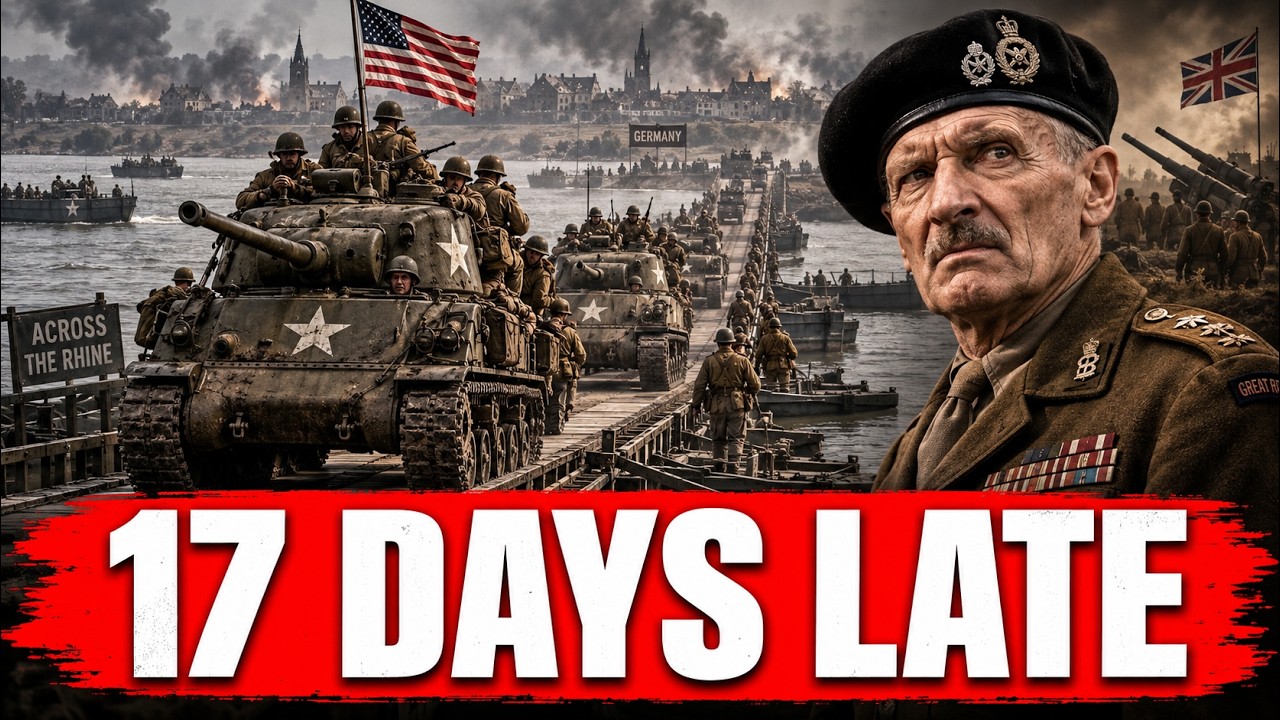
And on March 7, 17 days before Montgomery was ready, a lieutenant from an American armored division walked up a road above a small town on the Rhine called Remagen, looked through the haze at the river, and saw something no one in the Allied high command believed still existed. The Ludendorff railway bridge at Remagen was still standing.
Every other bridge over the Rhine had been dropped into the water by German engineers as the Allies approached. That was the doctrine. But at Remagen, the explosives had been reduced by an officer concerned about civilian traffic.
The emergency charges were partly mislaid, and when the fuse was finally lit that afternoon, the bridge rose, settled back, and stayed standing.
The men who saw this belonged to Combat Command B of the 9th Armored Division, an American unit that had been badly mauled in the Ardennes three months earlier and rebuilt. The officer who led the first platoon across the bridge, through rifle fire, past a gap in the roadway, while German engineers were still trying to detonate the remaining charges, was Second Lieutenant Carl Timmermann. He was 22 years old.
He was the son of an American soldier and a German mother, and he had been born in Frankfurt. The first American officer to set foot on the far bank of the Rhine had been born on the wrong side of it.
When the news reached Bradley at 12th Army Group, his reaction was immediate and totally uncharacteristic. He told Hodges to throw everything he had across it. Then he called headquarters and got a staff officer who told him a crossing at Remagen simply was not in the plan, that the terrain behind it was difficult, and that the main effort was supposed to operate in the north.
Bradley did not argue with the staff officer. He asked to speak to Eisenhower, and Eisenhower said to put everything he had across the bridge—this was the best chance they had been given.
Within 24 hours, 8,000 Americans were on the eastern bank. Within a week, more than 25,000, with pontoon bridges laid alongside the original span. The Ludendorff bridge itself, weakened by the explosives, shellfire, and the enormous weight of traffic, finally collapsed into the river on March 17, killing 28 American engineers who were trying to strengthen it.
By then it did not matter. The bridgehead was permanent.
Five days before the collapse, on March 12, 1945, Omar Bradley was promoted to general, four stars—the same rank Eisenhower had held when he took command in Europe.
—
And on the night of March 22, George Patton put the Third Army across the Rhine at Oppenheim—without airborne drops, without a smoke screen, without a preliminary bombardment, and without telling anyone until it was done. He crossed in the dark in assault boats, losing a few dozen men. He made sure the announcement included a specific detail: that the Third Army had crossed the Rhine before the 21st Army Group.
And when he walked across the pontoon bridge his engineers had built, he stopped halfway to urinate into the river, with a photographer standing by to record it.
The next night, March 23, Montgomery began Operation Plunder. It was the largest river crossing ever undertaken. More than 3,000 guns opened fire along a stretch of the Rhine, a bombardment audible 80 kilometers away.
A smoke screen 100 kilometers long had been burning for days to blind German observers. On the morning of the 24th, two airborne divisions, one American and one British, were dropped behind the far bank in a single operation—the largest airborne operation ever conducted on one day and one location. Churchill came to watch.
Alan Brooke came to watch. It was technically a triumph, executed exactly as designed by a commander who had planned it for nine months.
It was 17 days too late. The Rhine, the last great barrier before Germany, the obstacle that had dominated Allied planning for two years, had already been crossed twice by American armies before Montgomery’s guns opened fire. Once by accident at Remagen, by a division that had been beaten in the Ardennes.
Once deliberately at Oppenheim, by a man who did it specifically so Montgomery would not be first.
—
The decision that settled everything came four days later, and it did not come from Bradley. On March 28, 1945, Eisenhower sent a telegram directly to Joseph Stalin in Moscow, setting out his plans for the final phase of the war in Europe. He did not consult the British Chiefs of Staff before sending it.
He did not consult Churchill. He informed a foreign head of state about Allied strategy before informing his own ally.
The message stated that the main Allied advance into Germany would be made in the center, by Bradley’s 12th Army Group, advancing toward Leipzig and Dresden to link up with the advancing Soviet armies and split Germany in two. Berlin was not the objective. Berlin was not mentioned as an objective at all.
The reaction in London was explosive. Brooke considered it a betrayal of the agreed strategy. Churchill wrote to Eisenhower and then to Roosevelt, arguing that Berlin remained the decisive political prize and that leaving it to the Soviets would shape Europe for a generation.
He was right, and it changed nothing.
On April 4, the Ninth Army was returned to Bradley’s 12th Army Group. Montgomery lost Simpson and his divisions for good. Bradley now commanded four field armies, about 1.
3 million men—the largest force ever placed under the command of a single American officer, before or since. The general who had been told in December that his command would be halved. The general who had picked up the phone in January and offered to go home rather than take orders from Bernard Montgomery, ended the war with the main force, the main axis, and the largest army group in the history of the United States.
Montgomery was left with the northern flank. His task was to liberate Holland, take Bremen and Hamburg, and advance northeast fast enough to reach the Baltic Sea at Lübeck before the Red Army arrived, sealing off the Danish peninsula. It was a real mission, and it was important, and British armor reached Lübeck on May 2 with only hours to spare.
But it was a flank protection, and everyone at every headquarters in Europe understood that it was a flank protection.
As for Berlin, Bradley was asked what it would cost to take the city by ground offensive before the Soviets. He estimated about 100,000 casualties and called that a pretty high price for a prestige object. The Red Army took Berlin instead, at a cost of over 80,000 Soviet dead in the final battle.
Sixteen years later, a wall was built straight through that city.
—
On May 4, 1945, on a windswept heath south of Hamburg called the Lüneburg Heath, Bernard Law Montgomery received the moment of his life. A German delegation came through the lines to his tactical headquarters, which stood on open ground under a gray northern sky with nothing around it but scrub, sand, and wind. Admiral Hans-Georg von Friedeburg led them.
They arrived in long overcoats, saluted correctly, and represented a government that by then governed almost nothing.
Montgomery, who had spent his entire professional life better at understanding the theater of command than at understanding people, left them standing outside in the wind while he finished what he was doing. Then he read the terms aloud himself in a tent at a simple trestle table covered with an army blanket, while outside a Union Jack flapped on a pole in the heath wind and a handful of correspondents and photographers pressed against the canvas.
He accepted the unconditional surrender of all German forces in Northwest Germany, in the Netherlands, in Denmark, in Schleswig-Holstein, and on the Danish islands. More than a million men laid down their arms by his signature.
Somewhere behind that tent, in the fields and ditches and ruined cities stretching across five countries, lay the graves of the men it had taken to get there. And there was no ceremony for them at all.
It was the greatest moment of his career, and it came exactly four months after he had lost every important argument. He never saw the contradiction. That is the thing about him historians have never quite gotten past.
In his memoirs, published in 1958, Montgomery came closer to an admission than on any other subject, writing that he should never have held that press conference. The feeling against him among the American generals had become so strong that anything he said was bound to be wrong. It is a kind of apology.
It is also, read properly, a statement that the fault lay with everyone but himself.
—
Bradley had the last word in public, and he took it twice. In 1951, he published his own account of the war and set out the December crisis in detail, in the flat, factual, devastating prose of a man who had waited six years to explain what had happened. In 1983, a second volume, assembled from his papers and published after his death, went considerably further, and the restraint of the first book was entirely gone.
The two men lived another 25 years after the war and never reconciled. Bradley became chief of staff of the U. S.
Army, then the first chairman of the Joint Chiefs of Staff, and was promoted to five-star general of the army. Montgomery became chief of the Imperial General Staff and then, from 1951, deputy supreme commander of Allied forces in Europe at NATO headquarters—a post he held for seven years. Which means they were back at the highest level of the same alliance in the early 1950s, planning the defense of the same continent with Dwight Eisenhower—of all people on earth—at the head of military command in Europe.
They were polite. They were never more than polite. Imagine what that meant in practice.
Two old men in uniform at the same conference table, decorated beyond the point where the ribbons mean anything to a civilian. They planned the defense of Western Europe against the same Soviet armies that had taken the city they had argued about. Together they had commanded millions of people.
They had been on the same side in the greatest war in human history. And somewhere in the background of all those meetings was a staff officer whose quiet, unwritten job was to make sure the two were never seated next to each other.
—
Look at where the pieces landed. Montgomery was right about the northern flank in December, and it cost him dearly. He was right that Hodges was a broken man in the third week of the offensive, and it cost him dearly.
He may have been right that a single ground commander would have been more efficient, and that argument cost him more than everything else combined, because he could never make it in a way that another person could hear without wanting to hit him.
Bradley was right to be furious, and his fury was not the petty behavior his critics later suggested. He had 100,000 men in the field who read American newspapers and needed to believe their own generals had not been quietly assessed and found wanting. And Eisenhower, who had been told all winter in London that he was not a fighting soldier, made the only decision that could hold things together, and then made a second decision in March that handed Berlin to Joseph Stalin.
The question in the title has a simple answer, and it is not dramatic. After Bradley refused to serve under him, Bernard Montgomery did not fight back, did not resign, and did not lose his job. He signed a letter someone else had written for him.
He crossed a river, 17 days after the Americans had already crossed it. He watched his armies taken from him one by one, and he accepted the surrender of a million Germans on a windswept heath, with barely any authority left.
He won the war. He lost everything that came after. And the men who froze to death in the Ardennes that December, in holes in the ground, waiting for the generals behind them to finish deciding who was in charge, never heard a word about any of it.