The story begins in the high desert of what would one day become Nevada, inside a cave thick with smoke, where a child coughs in the dark and cannot stop. At the mouth of the cave, orange light licks up the rock, and beyond the fire are the voices of men who have come to make sure no one walks out alive. This is the story of the Si-Te-Cah, the "Reed Eaters," a people remembered by the Northern Paiute for centuries as monsters with red hair who ate their enemies and stood eight feet tall.
Every version of the story ends the same way: in one long night, a whole people were erased, sealed inside a rock shelter by a wall of burning brush that turned the air itself into a weapon. But the questions no one asks properly are these: What did the Paiute actually mean when they said the people in that cave had red hair? And if a race of giant cannibals really roamed the Great Basin, where are the bones?
The first person to put the story on paper was Sarah Winnemucca Hopkins, a Paiute woman and daughter of a chief, who published her memoir Life Among the Paiutes: Their Wrongs and Claims in 1883. She never said "red hair." She never said "giants."
Those words came later, from other mouths, with very different motives.
What she described was a tribe, not a race of monsters. The Si-Te-Cah were a real people, a neighbor and an enemy who lived in the marshy flats around the shallow lakes of the Humboldt Sink. They ate what the water gave them: fish, ducks, waterfowl, and the starchy roots of the reeds themselves.
They had mothers who wove baskets with patterns unique to their families and children who learned to swim before they learned to run.
But in the version the Paiute told, they had a habit that could not be forgiven: killing captives and eating them. That habit turned a neighbor into a nightmare.
The Great Basin is not a country of green valleys and easy rivers. The lakes shrink and vanish in dry years, and the reed beds are life itself. When two peoples want the same marsh, sooner or later someone bleeds for it.
The Northern Paiute were not a single army but bands of extended families, moving through territory older than any written history. They were not warlike by inclination. In their own oral traditions, they had to be pushed.
And the Si-Te-Cah, if the stories are true, pushed them again and again, taking what they wanted and leaving the Paiute to bury their dead.
So the bands began to talk to each other about what would have to be done.
Sarah Winnemucca was born around 1844 and grew up watching her world break apart under the boots of miners and soldiers and settlers. She learned English, worked as an interpreter for the United States Army, and lectured in the parlors of Boston about what was being done in the deserts white audiences had never seen. In the middle of her memoir, she stopped and told an older story, a story her elders had told her, about a cave.
The elders who gave her that story are nameless to us now, but they were people who had grown up in the Humboldt Sink country. They knew the exact rock formation where the story ended. The cave, now called Lovelock Cave, sits in the side of a hill above a dry lake bed, reachable only by a hard climb up loose talus.
In its opening, a person can stand upright. Deeper in, the ceiling comes down and the air changes.
In Winnemucca's account, the Paiute bands had gathered on the flats below the sink. They had been fighting the Si-Te-Cah for years and had buried too many of their own. They knew where the last of the enemy had gone.
To leave the Reed Eaters in that cave was to let them come out again next year and take more children. To attack the cave head-on up that talus slope into a defended mouth was to lose more warriors than the tribes could afford.
There was a third option. You do not go in after them. You seal the mouth.
You bring brush and reeds and dry sage from the flats below, pile it up, and set it burning. The smoke does the rest.
Winnemucca wrote it in a single, plain line: "Our people together with other tribes fought them a long time and at last drove them into a cave and killed them all."
She did not call it justice. She did not call it a massacre. She called it what her elders called it: a long time.
And at last.
The coalition that formed against the Si-Te-Cah was unusual. It required bands to set aside their own quarrels and unite against a shared threat. Their weapons were bows of juniper and sinew, arrows tipped in obsidian, clubs of hardwood, spears, and above all, fire.
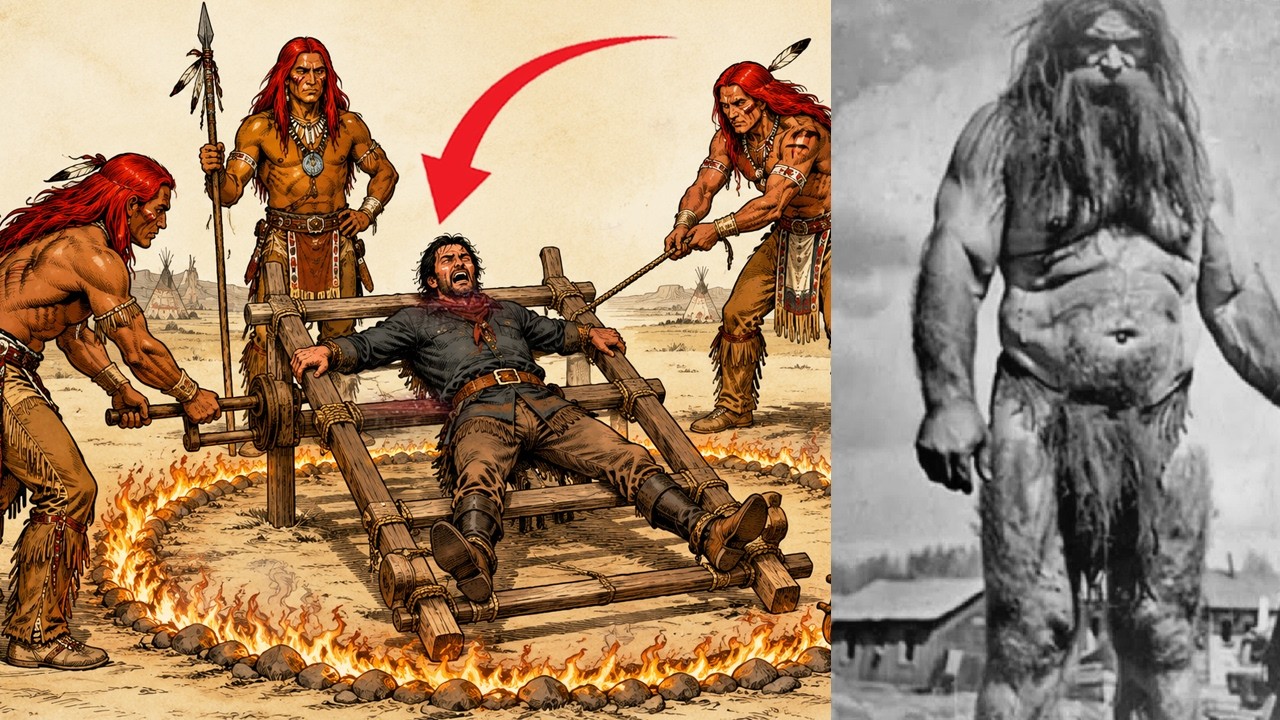
They climbed the slope in the last cool hour of a day no one wrote down.
Every skeleton ever recovered from that cave, every single one, is the size of a normal human being. The tallest is six feet. Not eight, not ten.
Six.
Before there was a cave, there was a marsh. Before there was a massacre, there was a raid. And before that raid, another raid.
The Paiute did not decide overnight to burn a people. They decided slowly, over what may have been generations.
The Si-Te-Cah did not simply take food. They took people. They struck Paiute camps in the pre-dawn hour and carried captives back into the reed country.
In the version the Paiute preserved, the captives did not come home. They were killed, and the elders said they were eaten.
Whether the cannibalism claim was literal, or whether it is what one hungry people accuses another hungry people of when the wetlands run dry, is a question that cannot be answered. What matters is that the Paiute believed it, and fear fed on fear until it became something larger than the truth.
The Humboldt Sink is a closed basin. Water flows in, water does not flow out. When the lakes shrink, the reed beds shrink with them, and every duck and every fish becomes a resource worth killing for.
This was not a war over pride. It was a war over calories.
The final act was not the whole war. It was only the last three days of it.
The Paiute did not attack the cave first. They attacked the marshes. They burned the reed beds.
They killed the men they found in the open. They pressed the Si-Te-Cah band by band, family by family, toward the one place their enemy still believed was safe: the ledge above the sink, the mouth in the cliff.
From the Si-Te-Cah side, the marsh was on fire, relatives were dead in the shallows, and the Paiute were on every high ground. Someone pointed at the cliff and said, "There. If we make it there, we can hold it."
They ran. They climbed the talus with children on their backs. Some accounts suggest hundreds made the climb.
Others suggest a smaller band, a last remnant. They got inside and sat down in the cool dark, and for a moment they thought they might live.
Down on the flats, the coalition worked. They cut brush and sage and gathered armfuls of the same reeds their enemy was named for. They carried it load by load up the slope to the mouth of the cave.
It would have taken hours. It would have been quiet, methodical work.
Winnemucca's elders would later say that the tribes piled brush at the entrance and set it on fire. That is the entire military description of the event she preserves. Nine words.
A whole people ended in nine words.
Inside the cave, the Si-Te-Cah could hear the sound of dry brush being dragged over stone, the sound of flint striking iron, and then the first crackle. The cave was no longer a refuge. It was a trap.
Dry sage catches fast. Within moments, the pile at the cave mouth was a wall of flame six feet high, then eight, then higher, curling smoke into the cave in long gray ropes. The men inside charged the mouth.

Some of them made it into the flame. Everyone who made it through the flame met an arrow.
The Paiute had arranged themselves in a half circle around the base of the slope. Any Si-Te-Cah warrior who came out of that fire came out silhouetted, blinded, on fire himself, into a rain of obsidian points. None of them broke through.
Not one.
Inside, the survivors retreated deeper, away from the mouth, into the low ceilings at the back of the shelter. But smoke does not respect the back of a cave. The ceiling at Lovelock slopes downward as you move inward.
The further back they crawled, the lower the ceiling got, and the sooner the smoke reached their faces. The people who ran deepest died first.
The Si-Te-Cah in that cave were not an army. They were a population. Old people, nursing mothers, boys not yet old enough to draw a bow.
The Paiute knew that. It is why Winnemucca did not decorate the sentence. There is nothing to decorate.
Outside, the Paiute fed the fire. They had gathered enough brush to feed it for hours. They did not need to storm the cave.
They only needed to wait and to shoot anyone who tried to come through it. The strategy was patience, and patience was merciless.
In 1911, when the first miners walked into this cave and started digging out bat guano to sell as fertilizer, they did not find a mass grave. They did not find piles of eight-foot skeletons. They found a scatter of remains, roughly eight documented burials in total, spread across the layers.
Every measurable one of them was a normal-sized human being.
The horror of Lovelock Cave is not that the victims were giants. The horror is that they were not. They were families, and they died in the dark.
Nobody in the Paiute coalition went into the cave that night. You do not walk into a place full of smoke and death in the dark. You wait for the morning.
The morning came cold and pale, a slow bloom of pink over the sink. The fire at the mouth was a bed of gray ash. The rock above the entrance was scorched black.
The air smelled of burnt reeds and something else.
The Paiute did not bury the dead. The bodies were left inside. The living took what they needed and left the rest to the dark, and then the coalition went home.
The war was over. It had ended, as many wars end, not with a treaty but with a silence.
For centuries, no one went into that cave. Bats moved in. Guano piled up in deep layers, covering the reed sandals and the fiber cordage.
The story thinned into a warning wrapped in memory. By the time an old Paiute woman told the story to her granddaughter, the details were already worn smooth. No names, no years, just the shape of the thing.
Then one afternoon in 1911, two men named David Pew and James Hart walked into that cave with shovels, looking to make money on bat guano. They hit a reed sandal, then a fiber net, then a piece of basketry so fine it looked like it had been made yesterday. Then they hit bones.
Human bones.
Pew and Hart were not archaeologists. They were miners in a hurry. They threw the strange objects onto piles outside the cave and kept shoveling.
And they talked. They told stories about what they had found. In the retelling, as bones always do in retelling, the bones grew.
A normal femur became a giant's thigh bone. A tall man became a monster.
Word reached the University of California, Berkeley in 1912. An archaeologist named Llewellyn Loud arrived and began measuring, recording, and drawing maps. He was joined in the 1920s by Mark Harrington.
Together they published a monograph called Lovelock Cave that became the foundation of everything scientific we know about the site.
The report contained thousands of artifacts cataloged, including the famous duck decoys woven from cattail reeds. It also contained the graves. Approximately eight burials with preserved human remains.
Every one of them was measured. The tallest human skeleton ever recovered from the cave is roughly six feet. There are no eight-foot skeletons.
There are no giants.
Decades later, a physical anthropologist named Sheila Brooks went through the "giant" bones that had accumulated in museum drawers. She measured them and identified them by species. Some of the bones were not human at all.
They were cattle. Cow femurs and cow scapulae, mistaken by miners in dim light and by later enthusiasts in warm imagination for the bones of a vanished race.
The hair was the other pillar. Some of the mummified remains preserved hair that looked reddish in the display case. That evidence is real.
But hair does not stay the color it was in life. Over centuries, in an alkaline, dry, chemically active cave environment, black hair oxidizes and pigments shift. Analyses of the hair have shown that reddish tone to be a product of post-mortem change, not a marker of a genetically red-haired population.
The red-haired claim has no cited original Paiute language source. It is an invention of later tellers who needed a monster, not a human being.
The transformation happened in stages, in print. Local newspapers took the miners' talk and ran with it. Bones became giant bones.
Unusual heights became eight to ten feet. The Paiute story, filtered through settlers who had never heard it directly, acquired the details that made it commercial: red hair, cannibalism as a way of life, a distinct race wiped out by the Indians.
By the mid-twentieth century, this version had eaten the original. The giant version was so much louder than the actual one that the Nevada State Museum, exhausted by tourists demanding to see the giant skeletons, finally posted a sign at the entrance to its display. The sign says, in effect, one thing: red-headed giants are a myth.
And here is the fact that reframes everything. When you read Sarah Winnemucca Hopkins' 1883 book, the seed text of this entire legend, she never once identifies the cave in her story as Lovelock Cave. She describes a cave.
She does not name it. The retrospective identification of the cave in Winnemucca's story with the specific rock shelter above the Humboldt Sink was made later by non-Paiute readers looking for a place on a map to hang the story on.
It is possible that the massacre Winnemucca's elders remembered happened somewhere else entirely, and that Lovelock Cave, with its normal-sized graves and its beautiful duck decoys, is a site that only became the center of the legend because a few miners with shovels stumbled into it at exactly the wrong moment in the history of American storytelling.
The story that started with a Paiute grandmother in the 1840s and a book in 1883 is true. Something like it happened somewhere to a people the Paiute remembered as the Si-Te-Cah. They were not giants.
They were not a separate race. They had hair the same color as everyone else's in life. Their bones, when finally measured, were the size of their killers.
What was done to them was done by hungry human beings to other hungry human beings in a hard country, in a fight over reeds and water and the right to survive one more winter. The horror is real. The monsters are not.
And that, in the end, is the harder thing to sit with.