On a grey November morning in 1940, Air Chief Marshal Hugh Dowding opened a letter at Bentley Priory with the same quiet composure he had shown throughout the previous four years. Outside his window, England still stood. Hitler’s invasion fleet had dispersed along the French coast.
The Luftwaffe had been driven from British skies in the first major defeat of the German war machine. Fighter Command, the force Dowding had built from nothing, had just won the Battle of Britain.
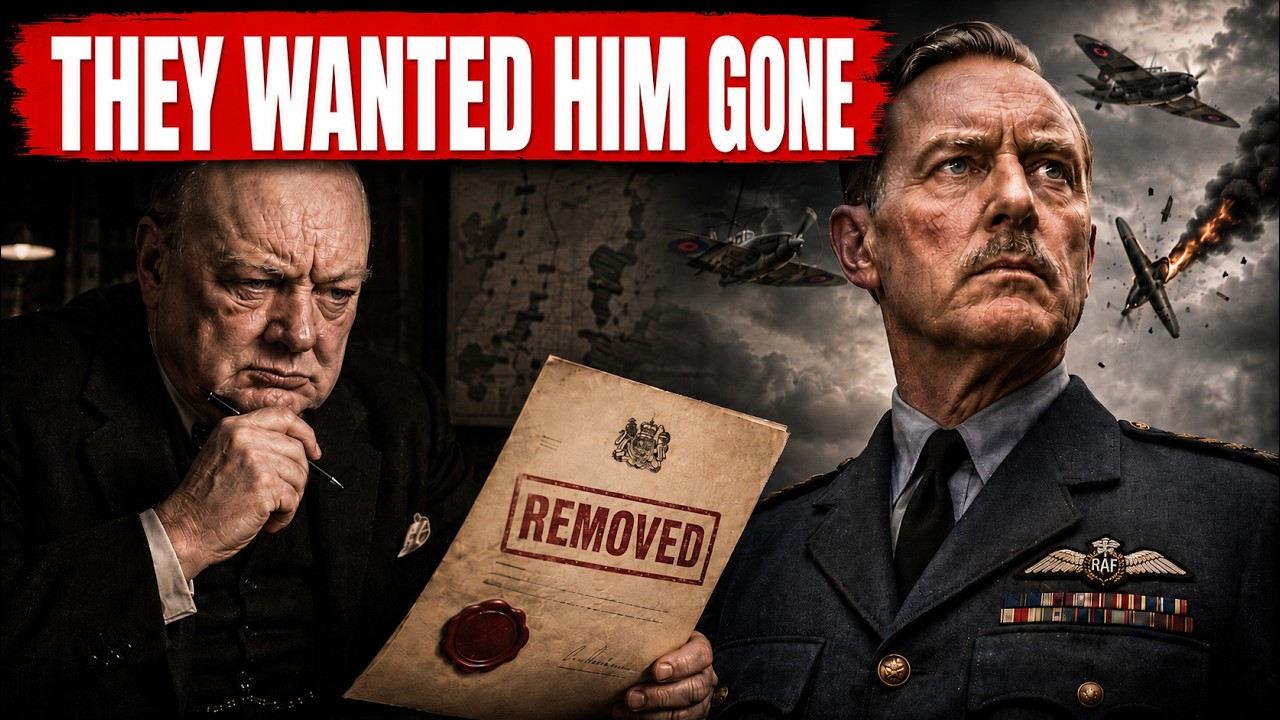
The letter told him his services were no longer required. Not because he had lost, but because he had won in a way that embarrassed the wrong people in the wrong places. A future Marshal of the Royal Air Force would later say that Dowding was the only commander in history to win one of the world’s decisive battles and be dismissed as a reward for his efforts.
To understand how the man who saved Britain received a dismissal letter, you have to go back four years.
Dowding took command of the newly formed Fighter Command on 14 July 1936. He was 54, a widower who had lost his young wife 16 years earlier, and a man the Air Ministry already considered difficult, humourless, and hard to manage. His nickname among pilots and staff officers was “Stuffy.”
It was not born of arrogance. Those who knew him well recognised it came from something quieter and harder to describe: a reserve that was not cruelty but restraint, a distance from a man who never learned, and never much wanted to learn, how to impress important people.
He arrived early and left late. In between, he thought about one problem with a single-minded determination that unsettled those around him: how to stop bombers from reaching London. This was a question the RAF as an institution did not particularly want to hear.
The doctrine governing every plan, every promotion, and every defence budget shilling in the 1930s had been set by Hugh Trenchard, founder of the RAF. It rested on one article of faith: the bomber will always get through. No fighter force, however large, could stop a determined air attack.
The only rational strategy was to build more bombers than the enemy, strike his cities first, and accept that our cities would burn in return.
Dowding disagreed. Unlike most who disagreed with the prevailing wisdom of their institutions, he had spent the previous six years gathering evidence. As Air Member for Supply and Research, he had personally overseen the specifications that produced the two fighters that would ultimately save his country: the Hawker Hurricane and the Supermarine Spitfire.
In February 1935, a physicist named Robert Watson Watt sent a memo to the Air Ministry proposing the detection of aircraft at a distance using reflected radio waves. Most men who read it filed it away and forgot it within a week. Dowding read the same memo and did something almost no one else in his position would have done.
He picked up the phone and demanded a demonstration.
On 26 February 1935, Watson Watt and his young assistant Arnold Wilkins set up a receiver near a BBC transmitter outside the town of Daventry. A heavy bomber flew overhead. On the oscilloscope screen, the reflected signal rose as the bomber passed through the beam.
The experiment worked. Within days, Dowding had released funding. By that summer, the first device could detect a formation of bombers at 60 miles.
Within five years, the Chain Home network could track German aircraft gathering over French airfields from distances exceeding 120 miles, giving Fighter Command roughly 15 minutes of warning before the enemy crossed the coast.
Radar alone would not have won the Battle of Britain. But without it, there would have been no battle to win. There would have been only a slow, grinding defeat.
Fighters taking off too late, too low, and in too few numbers to chase an enemy that had already dropped its bombs and turned for home.
What Dowding built over the next four years was not just a chain of radar stations. It was an integrated system that took raw information from the sky and turned it into decisions in minutes across an entire nation. Historians later called it the Dowding System.
Consider the scale of the challenges that had to be solved. Detecting an incoming raid at distance. Separating real threats from false echoes, flocks of birds, weather, and friendly aircraft returning from patrols.
Converting raw signals into meaningful grid coordinates for the observer on the ground. Transmitting that information by telephone faster than any communications network had been asked to do before. Tracking friend and foe simultaneously across hundreds of miles of coastline without confusing them.
And doing all of this fast enough for a young pilot sitting in his cockpit on readiness to take off, climb, and reach the interception point before the bombers reached their targets.
By September 1939, there were 21 Chain Home radar stations along the eastern and southern coasts of England. The genius of the system lay in what happened to the information after it left the radar operator’s headphones. Readings were converted into coordinates and telephoned directly to the filter room at Bentley Priory, Dowding’s own headquarters.
There, women of the Women’s Auxiliary Air Force moved coloured markers across a huge map table. Each marker represented the track of aircraft somewhere over the English Channel or the French coast. Above them on a raised balcony, filter officers took the chaos of dozens of overlapping reports and turned them into a single confirmed track, with a number, height, and estimated strength.
That filtered information was passed through the hierarchy to the relevant group headquarters. Group 11 covered the vulnerable south-east, the gateway to London. Group 12 covered the Midlands.
Group 10 covered the south-west. Group 13 covered the north. Each group commander decided which sector station should respond, and sector controllers, chosen carefully from former fighter pilots because Dowding believed a pilot only trusts another pilot’s judgement, gave the order to scramble and directed interceptions by radio once the fighters were airborne.
Before the war, an interception rate of 30 to 50 percent was considered a victory. During the Battle of Britain, Fighter Command achieved interception rates approaching 90 percent. The German fighter commander Adolf Galland, who led Luftwaffe squadrons against Dowding’s pilots throughout the summer of 1940, later admitted that the British had an exceptional advantage that was never equalised at any time during the war: their radar and fighter control network.
He called it a very bitter surprise. They had nothing like it.
Dowding did not stop at building the system. He fought bitterly, and often without tact, for the right aircraft and equipment. Against the entrenched bomber advocates, he pushed specifications for a fast, single-seat fighter carrying eight forward-firing machine guns, a requirement that ultimately produced both the Hurricane and the Spitfire.
He resisted, at real professional cost, pressure to commit to the Boulton Paul Defiant, a fighter designed around a rotating gun turret instead of forward guns. When his superiors ordered nine squadrons equipped with Defiants, Dowding’s stubborn resistance meant only two squadrons were so equipped. When one of those two squadrons first entered combat on 19 July 1940, it lost seven of its nine aircraft in a single engagement.
A brutal proof of a point no one at the Air Ministry wanted to hear.
He also fought for something as small and basic as glass. When his engineers proposed bulletproof glass for Hurricane and Spitfire cockpits, the Air Ministry objected on cost grounds. Dowding’s response became one of the most quoted lines of his career: “If Chicago gangs can have bulletproof glass in their cars, I can’t see any reason why my pilots cannot have the same protection in their aircraft.”
The armour glass was installed.
By the spring of 1940, Dowding had built the best air defence system on earth, and in the process had accumulated a quiet, patient collection of rivals who would remember every time he had been right and they had been wrong. Within weeks, the war would give every one of those rivals the opportunity they had been waiting for.
In May 1940, Germany launched its offensive in the west. Within days, the quiet of the previous eight months vanished completely. Six or seven squadrons of Hurricanes from Fighter Command were already based in France supporting the British Expeditionary Force.
There, air power theory met the brutal reality of modern blitzkrieg. The Fairey Battle, a light single-engine bomber sent across the Channel in large numbers, was slow, poorly armed, and completely obsolete. On the first day of the campaign, squadrons suffered losses approaching 40 percent.
By 14 May, the Advanced Air Striking Force had lost nearly three-quarters of its bombers.
The French government, watching its army collapse, demanded reinforcements from London: specifically, 10 additional squadrons of fighters. On 15 May, French Prime Minister Paul Reynaud telephoned Winston Churchill directly and told him in words that needed no translation: “We have been defeated.” Churchill, only five days into his premiership, was desperate to keep his closest ally in the fight and inclined to grant the French request.
Before the War Cabinet met that day, Dowding requested and was granted a few private minutes with the Prime Minister. He came prepared. He placed on the table a single hand-drawn chart tracing recent Hurricane losses over the previous days.
The line was plunging almost vertically toward the bottom of the page. Dowding told Churchill plainly that if losses continued at that rate for another ten days, there would not be a single Hurricane left in France or England. It was not rhetoric.
It was arithmetic, and Dowding had never cared about anything in his career as much as arithmetic.
Air Ministry planners had calculated that at least 52 squadrons were required to organise an effective defence of the British Isles against a serious air attack. By mid-May, Dowding’s actual strength, drained by the fighting in France, was the equivalent of about 36 squadrons, many critically short of aircraft and exhausted pilots. Every squadron sent across the Channel made the gap wider.
What happened next is the moment most serious historians of the battle believe decided the outcome of the war in the west before a single German bomber crossed the coast of Kent. While Churchill travelled to Paris the next day and found French officials burning government documents in garden bonfires in preparation for the fall of the capital, Dowding sat down and wrote a letter. It was addressed to the Under-Secretary of State at the Air Ministry, dated 16 May 1940, and remains one of the most important documents of the Second World War.
He wrote that if an adequate fighter force was kept in Britain, if the Fleet remained intact, and if home defences were properly organised against invasion, the country could carry on the war alone for a long time, perhaps indefinitely. But if the home defence force was drained away in a desperate attempt to save the situation in France, the defeat of France would bring with it the complete and final defeat of Britain as well. The letter did not plead.
It reminded the Air Council, with barely suppressed anger, that their own estimates had set the minimum requirement at 52 squadrons. It demanded to know exactly what strength would be left to Fighter Command once that minimum was reached. Most importantly, it demanded a guarantee that once that minimum was reached, not one more fighter would be sent across the Channel.
Churchill initially resisted, emotionally committed to supporting the French, and continued sending limited reinforcements. But the pressure from Dowding did not relent, and by 19 May, he had persuaded the Chief of the Air Staff, Sir Cyril Newall, to stop any further reinforcement of the French campaign. This was, by any measure, one of Churchill’s hardest decisions of his early premiership, taken against every instinct of loyalty to an ally being destroyed before the world’s eyes.
It was taken because one air marshal refused to soften his numbers to make an unbearable decision easier to accept.
By the time the last Hurricane squadrons were withdrawn from France on 18 June, about 450 aircraft had been lost, and nearly 300 fighter pilots were dead or in enemy hands. In the aftermath of Dunkirk, Fighter Command’s front-line strength had fallen to just 331 Hurricanes and Spitfires, with only 36 in reserve behind them. Had Dowding’s letter not been written, and had Churchill’s instinct to support France to the last squadron prevailed, there is a very real argument that those aircraft and pilots would have been destroyed over French soil in the following weeks, leaving nothing to contest the skies over England that summer.
Dowding’s refusal to comply, an act of professional disobedience in the form of an official memo, may be the single decision most responsible for the fact that Britain still had an air force to fight the battle that was unquestionably coming.
The Battle of Britain is officially dated from 10 July to 31 October 1940, though the most critical fighting was compressed into a much shorter and more brutal period in the middle of that span. Facing Dowding was the Luftwaffe with a strength of over 4,000 aircraft, including more than 1,000 single-engine fighters and around 1,380 bombers. Fighter Command began the battle with about 56 squadrons and nearly 750 single-seat fighters, perhaps 520 of them actually serviceable on any given day.
In terms of raw numbers, the Luftwaffe outnumbered Fighter Command by a ratio approaching four to one.
Dowding’s response to that imbalance was a strategy historians have compared to the ancient Roman general Fabius: patient endurance rather than decisive confrontation. He rarely committed more than half his available forces to any single engagement. He sent small formations, often no more than a squadron or two, to break up incoming bomber formations before they reached their targets, trading the drama of one decisive clash for the quieter, harder discipline of sustained attrition.
Tactical decisions in the air were left to his group and sector commanders, closest to the fighting and best able to respond in real time. Dowding kept the strategic view from above, guarding above all the one resource that could not be quickly replaced: trained, experienced pilots.
His most important subordinate in this arrangement was Air Vice-Marshal Keith Park, commanding Group 11 in south-east England, the sector that stood directly between the Luftwaffe and London and bore the vast majority of the fighting. Park shared Dowding’s philosophy completely, launching quick, small-scale sorties designed to break up enemy bomber formations before they could deliver a concentrated strike, rather than waiting to mass large numbers of his own forces.
The battle passed through distinct phases. Through July and early August came the Channel battles. Dowding deliberately committed minimal fighter forces to protect coastal convoys, recognising that the Luftwaffe was trying to lure his forces into a costly attritional battle on terms favourable to the enemy, and refusing to take the bait.
From 13 August, in an operation the Germans called “Eagle Attack,” the Luftwaffe shifted its focus to British airfields and, critically, to the radar stations themselves. Two days later, on 15 August, a large Luftwaffe formation launched from bases in Norway attacked northern England to test whether Dowding had stripped that region of defences to reinforce the south. He had not.
Group 13 inflicted such heavy losses on the attacking force that the Luftwaffe never again attempted a major daylight raid from Norwegian bases.
On 18 August, the day pilots on both sides would later call “The Hardest Day,” the Luftwaffe lost between 69 and 75 aircraft, and the Junkers Ju 87 Stuka dive bombers suffered such severe losses that they were effectively withdrawn from the battle entirely.
Then came the period that came closest to breaking Fighter Command completely: the last week of August and the first week of September. The Luftwaffe threw its full weight against the sector stations, the nerve centres of Dowding’s entire system. Biggin Hill, Kenley, Hornchurch, and North Weald.
These were not just ordinary airfields. Destroying a sector station meant not only stopping its squadrons from flying, but blinding the network that controlled them. Biggin Hill was bombed six times in three days.
Its operations room was knocked out completely, and the WAAF women who ran it simply moved to a village butcher’s shop and kept working, rerouting communications through improvised lines while engineers raced to repair the station itself. It never stopped operating, though it came noticeably close.
On 31 August, Fighter Command suffered its worst day of the entire battle. Thirty-nine aircraft destroyed and 14 pilots killed. The trend behind these numbers was more alarming than the daily totals.
Experienced pilots, men with hundreds of flying hours, were being killed faster than replacements with a fraction of that experience could be trained to take their place. A new pilot might arrive at his squadron with as little as 10 hours on Spitfires before being sent to face Luftwaffe veterans. By 3 September, Dowding reported to Churchill that a quarter of all Fighter Command pilots had been lost since the start of the battle.
For a brief, frightening period, production of new Hurricanes and Spitfires was actually falling behind the rate of losses in the air. Had those calculations continued unchanged for a few more weeks, Fighter Command would have ceased to exist as an effective fighting force.
What ultimately solved the fundamental problem was an error made by the enemy, not by Dowding. On the night of 24–25 August, a formation of German bombers, either through navigational error or confusion in the darkness, dropped its bombs on central London instead of the designated industrial targets. Churchill ordered a retaliatory raid on Berlin.
Hitler, furious at bombs falling on his capital, ordered the Luftwaffe to abandon its campaign against Fighter Command’s airfields and radar stations and to redirect its full weight toward London itself.
From 7 September, nearly a thousand German aircraft began bombing the docks and the East End day after day. German intelligence at the time believed Fighter Command was on the verge of complete collapse. In fact, the shift in targets could not have come at a better moment for Dowding.
With the direct attacks on sector stations halted, ground crews could finally complete repairs, damaged squadrons recovered their strength, and exhausted pilots got their first real rest in weeks. Fighter Command’s losses, for the first time in over a month, began to fall below the rate at which new aircraft and pilots were arriving.
On 15 September, a date still commemorated in Britain as Battle of Britain Day, the Luftwaffe launched its largest and most concentrated daylight attack of the entire campaign against London, involving nearly 1,500 aircraft. Keith Park directed virtually every available squadron in Group 11 against it. While watching from the underground operations room at Uxbridge, Churchill turned to Park and asked what reserves remained.
Park’s answer became one of the most quoted exchanges of the battle: “There are none.”
The Luftwaffe lost between 56 and 61 aircraft that day. Fighter Command lost between 26 and 31. Two days later, on 17 September, Hitler postponed Operation Sea Lion, the planned invasion of Britain, indefinitely.
The plan was never revived. The invasion threat that had hung over the country since the fall of France was finally over.
By the time the battle subsided at the end of October, the numbers told their own story. Fighter Command had lost 1,087 aircraft and 544 pilots killed. Nearly 3,000 aircrew were later honoured with the Battle of Britain clasp.
The Luftwaffe, in contrast, lost nearly 900 aircraft, with over 2,500 men killed and more than 900 captured. Behind those numbers was another quiet part of the victory: the extraordinary production effort of Lord Beaverbrook, appointed Minister of Aircraft Production in the same week France began to collapse. Beaverbrook pushed British fighter production from 638 aircraft in the first four months of 1940 to 1,875 in the four months that followed.
July alone saw nearly two and a half times as many fighters produced as the German industry managed in the same period. Fighter Command’s total strength actually rose during the battle, from 644 aircraft in early July to 732 by early October, despite months of exhausting continuous combat.
Britain had won. Yet even as the battle in the sky was being fought and won, a very different battle was taking place within the RAF itself. Its instrument was a tactical dispute that became known as the “Big Wing” controversy.
Trafford Leigh-Mallory, commander of Group 12 in the Midlands, and Squadron Leader Douglas Bader, the double-amputee fighter pilot commanding No. 242 Squadron under him, argued that Fighter Command should abandon Park’s approach of launching small formations quickly, in favour of assembling large wings of three, four, or even five squadrons, 60 aircraft or more, into one massive formation before engaging the enemy.
In theory, the argument had a certain appeal: overwhelming force meeting overwhelming force. In practice, it was close to impossible. Assembling a formation of that size took far longer than the six minutes Leigh-Mallory claimed, usually 15 to 20 minutes or more, because individual airfields were too small to allow every squadron to take off at once, and Group 12 squadrons often had to fly to a rendezvous point before the wing could begin to form.
If an enemy raid arrived at an unexpected location, there was no reserve to respond because everything had already been committed to the wing. The radio equipment of the period made it almost impossible for one commander to control several squadrons simultaneously in real time, and in practice the large formation tended to break apart into separate, uncoordinated squadron operations once real fighting began. Most damaging of all, the results claimed for the Big Wing did not stand up to scrutiny.
On 15 September alone, the Duxford wing claimed 105 German aircraft destroyed out of 185 total claims for the day. The Luftwaffe’s actual losses that day, as later confirmed by post-war research into German records, were between 56 and 61 aircraft. Detailed post-war analysis showed claim inflation ratios in some Big Wing operations reaching seven to one.
The deeper truth, more important than any tactical debate, was that the Big Wing controversy was never really about tactics at all. It was about politics and institutional wounded pride. Staff officers noted at the time that during the peak of the battle, there was remarkably little telephone communication between Leigh-Mallory and either Dowding or Park, his nominal superiors, but considerable communication between Leigh-Mallory and Sholto Douglas at the Air Ministry, a man later described as a “hidden influence” working quietly in the shadows to undermine Dowding’s position from within.
Leigh-Mallory reportedly told Bader he could ignore orders from Group 11, and even from Fighter Command itself, if he thought they were wrong. After a heated confrontation in 1939, Leigh-Mallory told his colleagues in words that left no room for misinterpretation that he intended to do everything possible to see Dowding removed from his post.
The Air Ministry leadership had staked its pre-war reputation, and in many cases its entire careers, on the doctrine that fighters could never stop a determined strategic bombing campaign. Dowding and Park had just proven that doctrine catastrophically wrong in the most visible and consequential way imaginable. The Big Wing controversy, whatever its tactical merits or lack thereof, gave the embarrassed institution an acceptable cover, a professionally plausible argument, for removing the two men who had exposed how wrong its founding article of faith had been.
The killing blow was delivered at a meeting of the Air Ministry on 17 October 1940. It had been called by Chief of the Air Staff Cyril Newall, ostensibly to discuss fighter tactics and the growing problem of night defence against German bombing. Newall himself fell ill before the meeting and could not attend.
The chair passed instead to Sholto Douglas, the very officer who would take over Dowding’s job entirely within weeks. Dowding arrived expecting a professional discussion among senior officers and a chance to summarise his strategy for the battle he had just won. Instead, he found Squadron Leader Douglas Bader, a junior officer several ranks below every other man in the room, seated among the assembled air marshals.
Leigh-Mallory had arranged specifically for Bader to attend, ostensibly so the Ministry could hear the view of a serving fighter pilot. No squadron leader who supported Dowding and Park’s approach was invited to present a contrary view. Bader spoke at length about the merits of overwhelming force, restating the Big Wing case to an audience already inclined to favour it.
Douglas ran the meeting, according to at least one witness, not as a neutral chairman but as a prosecutor building a case against the accused. Leigh-Mallory repeated his claim that a five-squadron wing could be assembled in six minutes. No one in the room asked the obvious question: why did it actually take at least 15 minutes every time?
Lord Beaverbrook later described the meeting bluntly as an assembly of air marshals conducting something like a trial, in which Dowding and Park were accused of failure in the very battle they had just won. What happened next should, in any fair account of RAF history, have ended the careers of the men who engineered it. Instead, it ended the careers of the two men who had actually saved the country.
On 24 November 1940, barely three weeks after the Battle of Britain officially ended, Hugh Dowding was relieved of command of Fighter Command. He was given about 24 hours to clear his office at Bentley Priory. His replacement was Sholto Douglas, the same officer who had chaired the 17 October meeting that served as his trial in every sense of the word.
Several forces combined to produce this outcome. Air Chief Marshal Sir Charles Portal, newly appointed Chief of the Air Staff, sided with Douglas and Leigh-Mallory on the tactical question. Archibald Sinclair, Secretary of State for Air, had wanted Dowding removed for some time.
Two retired RAF commanders, Hugh Trenchard and John Salmond, pressed relentlessly from outside the chain of command, using their considerable remaining influence to make the case behind closed doors. Salmond, who had chaired a night defence review committee that became critical of Dowding’s methods, attached a private note recommending his removal.
Churchill’s role in all this was more complex than simply being the villain of the story. Understanding it tells us something important about how great leaders fail the people who serve them best. Churchill had personally intervened twice to extend Dowding’s service when the Air Ministry had tried to force him into retirement in earlier years.
He had written to Sinclair describing Dowding as one of the best men available, calling his leadership an example of genius in the art of war. When Churchill visited Park’s underground operations room at Uxbridge on 15 September, witnesses reported seeing tears in his eyes as he watched the defence of London unfold in real time on the plotting table before him. He knew, to some extent, exactly what Dowding and Park had built and what they had achieved with it.
Yet Churchill carried a particular resentment from May of that year, when Dowding’s arguments had led the War Cabinet to stop sending more fighters to France, a decision Churchill himself had originally wanted to make. Churchill rarely forgot those who opposed him, and he found it difficult, even years later, to forgive people who had proven him wrong, however right they had ultimately been. In his post-war memoirs, Churchill barely mentions Dowding by name, and even gets a key detail of his famous letter wrong, a slip historians have generally interpreted as an unconscious attempt to soften a fact of which Churchill was not entirely proud.
When the dismissal finally came, Churchill accepted it without public objection. He said in a private session years later that it had broken his heart.
The pattern was completed within weeks. Keith Park was relieved of command of Group 11 in December 1940, replaced by Trafford Leigh-Mallory, the same officer who had spent months campaigning against him. The man widely regarded as the best tactical air commander in the RAF, who had personally directed every major engagement of the Battle of Britain from his operations room at Uxbridge, was instead transferred to Training Command, to teach trainees far from any front line.
Dowding’s own departure from Bentley Priory was consistent with the rest of his career in its restraint. When Sholto Douglas arrived to take over and found Dowding still at his desk finishing paperwork, Dowding simply completed what he was writing, then looked up and said good morning. Then he left.
There was no ceremony, no formal handover, no public recognition of what the departing officer had already achieved. His final message to the men he had led, in its simple and unpretentious language, was more moving than any grand farewell. He wrote: “My dear fighter men, in sending you this, my last message, I wish I could say all that is in my heart.
I cannot hope to surpass the simple eloquence of the Prime Minister’s words. Never in the field of human conflict was so much owed by so many to so few. The debt remains and will increase.”
The two men who won the Battle of Britain had been replaced by the two men who had spent months working to undermine them. As one historian later noted, the RAF leadership treated Dowding and Park more harshly for winning the battle than Hermann Göring treated his defeated Luftwaffe generals, largely because Dowding and Park had proven the Air Ministry’s founding doctrine wrong before the entire world. When the Air Ministry later issued an official booklet telling the story of the Battle of Britain, it managed to omit the names of Dowding and Park entirely.
Churchill, on seeing the booklet, was reportedly furious, asking what would be said if an admiral had told the story of Trafalgar and left out Lord Nelson altogether.
History delivered its own quiet verdict shortly afterward. Douglas and Leigh-Mallory, now running Fighter Command and Group 11 respectively, launched a series of offensive fighter sweeps over occupied France throughout 1941. These operations were built explicitly around the large wing formations they had championed.
The Luftwaffe, now fighting on its own terms and over its own territory, inflicted heavy losses on the attacking British formations, with kill ratios reaching more than four to one against the RAF. Fighter Command lost the daylight fighter war over France that year, and many of its most experienced pilots were killed or captured, including, in a detail almost too neat to be fiction, Wing Commander Douglas Bader himself, shot down and captured in August 1941.
Keith Park, meanwhile, went on to prove the validity of his methods in the most dramatic way imaginable. Appointed Air Officer Commanding in Malta in July 1942, he arrived to find the island under near-constant bombing, its fighter force reduced to a handful of serviceable aircraft, and its morale on the verge of collapse. Park applied the same approach that had defined his leadership during the Battle of Britain: small formations intercepting the enemy well before the target, careful husbanding of irreplaceable pilots, and disciplined economy of force rather than dramatic mass engagements.
Within two weeks of his arrival, the bombing of Malta had effectively ceased. The island held, and the wider Mediterranean campaign continued on ground that Malta’s survival had helped secure. Park was later promoted to Air Chief Marshal and eventually took command of Allied Air Forces in South-East Asia in 1945, a post that had until shortly before been held by Leigh-Mallory, who was killed when his aircraft crashed in the French Alps in November 1944 while travelling to take up that same command.
Park spent his remaining years in quiet, unconventional dignity. He became deeply interested in spiritualism and claimed, to the private amusement and sometimes public mockery of his former colleagues, that he could still communicate with the spirits of the pilots who had died flying under his command. Few of those who mocked him paused to consider the weight he carried.
Five hundred and forty-four of his pilots had died, and thousands more had been wounded, because he had sent them into a battle he believed, correctly, that Britain could not afford to lose. If he found comfort in the idea that he could still hear their voices somewhere, it is hard to know who had earned the right to judge him for it. He became a vegetarian, wrote books on theosophy, and campaigned publicly for animal welfare, interests the RAF institution found somewhat embarrassing and mostly chose to ignore.
He was created a Baronet of Bentley Priory in June 1943, but the Air Ministry flatly refused to promote him to Marshal of the Royal Air Force, citing a rule that only officers who had served as Chiefs of the Air Staff qualified for the rank. That same rule was quietly overlooked at the end of the war when both Sholto Douglas and Arthur Harris were promoted to Marshal, though neither had held that specific post.
Dowding died on 15 February 1970 at the age of 87. His ashes were placed beneath the window of the Battle of Britain Memorial in Westminster Abbey, at a ceremony attended by 46 air marshals and many of the fighter pilots he had once called his “boys.” The slow restoration of his reputation took decades and the painstaking work of serious historians.
Robert Wright’s biography, published in 1969 and personally reviewed by Dowding before his death, provided the first major public reassessment. Later studies, most notably Stephen Bungay’s history of the battle published in 2000, concluded that the decisive weapon of the summer of 1940 was not radar alone but the integrated command and control system Dowding had built around it. The difference, as Bungay put it, was what made the difference.
The judgements of Dowding’s contemporaries, delivered after the political dust had settled, remain the strongest testimony. General Sir Frederick Pile, who commanded the anti-aircraft defences alongside Dowding throughout the battle, later wrote that Britain behaved as it so often does in such circumstances, hastening to criticise the man responsible for its salvation. Politician Robert Boothby described the treatment of Dowding as so shameful as to be almost beyond description.
Even Douglas Bader, who had directed his energy and ambition so effectively against Dowding at the time, eventually reached a different conclusion in his later life, writing that rarely in British history had a man deserved so much from his countrymen and received so little, and that Dowding certainly deserved his place alongside Nelson and Wellington among the country’s great leaders.
Statues of Dowding and Park now stand outside St Clement Danes church, the RAF church in the Strand, London. The inscription beneath Dowding’s statue says that his wise and far-sighted judgement and leadership helped ensure victory against overwhelming odds, thus preventing the loss of the Battle of Britain and possibly the war itself, and that for this the people of Britain and the free world owe him a debt largely reflected in the way of life and freedoms they still enjoy. It is hard to think of another commander in British military history honoured so eloquently in stone after being treated with such contempt in life.
The story of Hugh Dowding is ultimately not a story about the Battle of Britain at all. It is a story about what institutions so often do to the people who save them. Dowding was difficult, austere, and a failure at the politics that protected lesser men, and constitutionally incapable of the flattery that might have secured his position.
He opposed Churchill and turned out to be right, a combination Churchill never entirely forgave. He proved that an entire generation of senior officers had been wrong about the most important strategic question of the war. And he did it while working under five separate retirement notices, each one extended just long enough to keep him useful, but not long enough to make him feel secure in his post.
He understood his position with his customary bitterness, telling a friend once that his job was to prevent the loss of the war, not to win it outright, and that when the job was finally done, he expected to be discarded like a bottle stopper that had been removed. He spoke of his losses with a honesty rare for a commander of his generation, saying once that people talk lightly of losses, noting that losing four pilots in a day seemed a small thing, while he felt as though he had lost four of his sons. When asked one day about the knighthood he had received, he said that if it were possible, he would cut the medal into a thousand pieces and give a piece to each of his fighter pilots who had truly earned it.
The numbers alone tell the story with a kind of brutal economy that needs no embellishment. Dowding built from nothing a system that achieved a 90 percent interception rate against a force that outnumbered his own by about four to one. His pilots destroyed nearly 2,000 enemy aircraft while losing just over a thousand of their own.
Five hundred and forty-four of his men died holding that line, those “Few” to whom so much was owed by so many. And yet, within weeks of victory, he was handed a letter and given one day to clear his office, replaced by the very man who had chaired his trial. His finest subordinate was in turn replaced by the officer who had sworn to destroy him.
It remains one of the most shameful episodes in the history of the British armed forces, and one of the most instructive as well. About the gap that so often separates what a person deserves from what an institution is actually willing to give them. The next time you hear someone praised above all for being easy to deal with, or for knowing the right people, or for managing their superiors with practised skill, it is worth remembering Hugh Dowding.
He possessed almost none of those qualities. All he had was the ability to see clearly, to build brilliantly, and to achieve a decisive victory when his country’s entire fate depended on it. And yet, the institution he saved cast him aside the moment he was no longer useful to the men who ran it.