At 11:52 on the night of Thursday, October 17, 2024, Ernesto Olvera went down to the kitchen of his family’s old stone house in the Pastita neighborhood of Guanajuato City for a glass of water and stopped cold on the bottom step. His mother, Socorro, stood with her back to him beside the stove, ladling beef broth into a deep blue enamel soup plate. She set two bolillo rolls beside it, took a key from the pocket of her apron, and opened a new padlock on the basement door. Then she went down slowly, holding the plate in both hands like something sacred.
Ernesto had believed that basement had stayed shut since the afternoon in 1998, and that no one in the house had touched that plate in twenty-six years. What he found when he went down those thirteen stone steps changed everything he thought he knew about his mother, about his sister, and about the afternoon he let go of her hand. Abril Olvera Tapia was born on Thursday, February 11, 1993, in the upstairs room of that same house. The ambulance could not make it up the alley, so she was delivered by Doña Nati, the neighborhood midwife who had brought half the children of Pastita into the world.
The girl had something no one in the family had ever seen: a white streak over her forehead, as wide as a finger, white as cotton. Her father, Eulalio Olvera, known to everyone as Lalo, worked in a mine up in the Sierra. Proudly, he said his daughter had been born with a little vein of silver in her hair. That same morning, Lalo took the small tin milagro, a votive charm, that Socorro had hung on San Ramón Nonato to ask for a safe birth, a tiny baby wrapped in a rebozo, no bigger than a fingernail.
With tin snips he cut it in two from top to bottom. He hung one half on a cord around Ernesto’s neck and kept the other in his shirt pocket. “So you take care of your little sister, mijo. ” Ernesto never took off that half of the tiny baby.
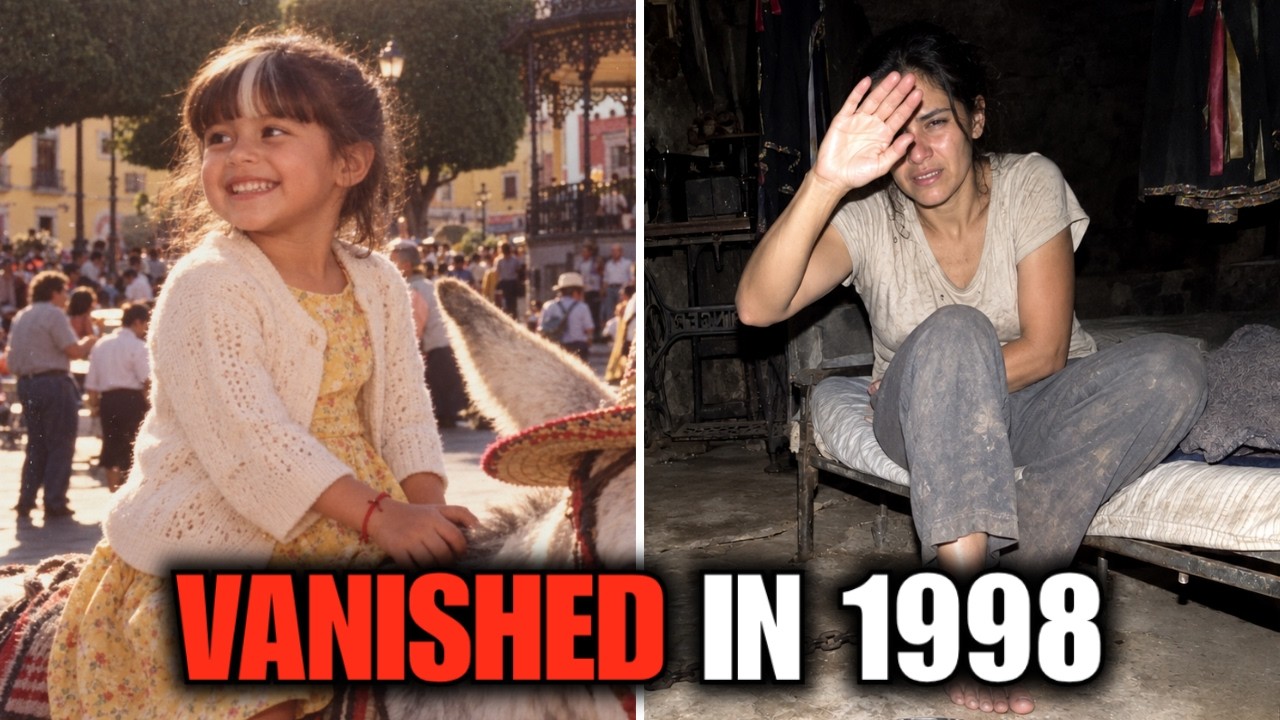
Abril was afraid of people. Out on the street, she never let go of anyone’s hand, not even to pick up a coin. There was only one thing that could make her let go: an animal. When she heard a donkey’s hooves on the stone, she would slip free of whoever’s hand she was holding and run to touch its muzzle.
She ate from only one plate, a deep blue enamel soup plate bought at the tianguis for eight pesos with a little red bird painted on the bottom. Abril would drink her soup down to the last drop, lift the empty plate with both hands, and shout so the whole house could hear: “The little bird came out. ” In the summer of 1998, Socorro knitted her a little bracelet from red yarn and tied it on her left wrist with three knots. “One for your dad, one for your brother, and one for me, so you remember to come back.
” Abril never took it off. In October 1998, Guanajuato was packed with people for the Festival Cervantino. For Socorro, who sewed capes for the estudiantinas, the student minstrel bands, it was the best season of the year. On Saturday, October 17, at five in the afternoon, she had to deliver six capes at the steps of the Teatro Juárez.
Lalo was at the mine, so she took the children along. When they reached the Jardín de la Unión, Socorro crouched down in front of Ernesto, put his sister’s little hand in his, and looked him in the eye. “Don’t let go of her hand, Ernesto. No matter what.
” It was 6:05 in the evening. Socorro climbed the steps of the Teatro Juárez, less than forty paces away, and from there she could see her children sitting on a bench in the square under the laurel trees. On the corner of the square, there was a white donkey with a palm leaf hat tied between its ears. His name was Lucero, and he belonged to the square’s photographer, a man with a gray mustache and a camera hanging from his neck.
Abril saw him and could not see anything else. She pulled her brother over and touched the donkey’s muzzle with the hand that wore the bracelet. Ernesto had only three pesos, not enough for a picture. “Later, sweetie,” the photographer told Abril.
At 6:15, an estudiantina started rehearsing on the steps of the Teatro Juárez, and a crowd gathered that blocked the view of the bench. Ernesto wanted to watch them twirl, to see the ribbons his mother had sewn. He told Abril not to move, not to get up for anything, and he let go of her hand. For the rest of his life, he would swear it was just one minute.
At 6:22, he turned back to the bench and it was empty. By seven that evening, there was a patrol car. By nine, Lalo had arrived from the mine, his face black with dust. That night, the neighbors of Pastita went through every alley, every tunnel, every stairway.
The girl with the white streak was nowhere to be found. On Monday, October 19, the state attorney general’s office took statements. The agents’ theory was that the girl wandered off on her own and fell into one of the abandoned mine shafts that surround the city. They lowered ropes into three old shafts.
They dragged the Presa de la Olla reservoir. They found nothing. In December 1998, Doña Nati, the midwife, sold her house and left Pastita, saying her sister in León needed care. In 1999, the Procuraduría closed the file as a lost person case.
Socorro kept everything in a blue folder. A newspaper clipping from that same year said a woman named Hortensia Garnica in Silao had been sentenced for selling newborns. Socorro took the clipping to the Procuraduría. They told her there was no connection.
She kept it anyway. The blue enamel plate stayed in the living room cabinet with the little red bird facing up. No one ever ate from it again. The basement was shut.
Socorro kept sewing capes, but now at the kitchen table. She could never again go down those thirteen steps. Lalo slowly burned out. On Wednesday, March 2, 2011, at forty-nine years old, his heart stopped at the entrance to the mine.
In 2016, Socorro joined a collective of searching mothers. She gave her DNA sample and started going out on Saturdays with a shovel and a steel rod to search vacant lots. On her chest, always, the laminated card. Distinguishing features: white streak over her forehead.
Ernesto grew up with an empty hand. At seventeen, he moved to León and became an apprentice at a locksmith shop. He was patient and had a good eye. He never said it, but he did not want to hold anyone’s hand ever again.
In 2024, his marriage ended. In September of that year, Ernesto got a call from Doña Toña, a woman from his mother’s collective. “Your mom doesn’t go on the searches anymore. She says her blood pressure’s been acting up, but I saw her at the hardware store buying a padlock and a heavy chain.
Something’s going on with her. ” Ernesto used the separation as an excuse and moved back into the house in Pastita. He noticed small things: a new padlock on the basement door, noises in the early morning hours under the kitchen floor, extra bolillos in the bread bag, his mother thinner, quieter, her hands smelling of bleach. Thursday, October 17, 2024, marked twenty-six years.
That night, Ernesto could not sleep. From the bottom step of the kitchen, he watched his mother open the basement padlock with Abril’s plate in her hands. Then he heard her voice from below. “Today, it’s been twenty-six years.
Today, you’re going to eat from her plate. ” A few seconds of silence, then a dry, tired cough from the far end of the basement, a man’s cough. Then the sound of iron dragging across stone. Socorro came up the thirteen steps with empty hands.
When she saw her son, she did not startle. “Go to bed, mijo. ” He asked who was down there. “I’ll tell you tomorrow.
Go to bed. ” She locked the padlock and went to her room. On Friday, October 18, at 7:40 in the morning, after his mother left for the anniversary mass, Ernesto went down to the basement with his lock pick case. He opened the brass padlock in forty-one seconds.
Behind a bedsheet tied like a curtain, there was a cot, a bucket, and a jug of water. Sitting on the cot was a man over seventy with a gray mustache and thin arms. From his right ankle ran a chain fastened to an iron ring in the wall. On the floor next to the cot was the blue enamel plate, clean, the little red bird looking up at the light bulb.
“Are you the little brother? ” the man said in a raspy voice. “The one who was holding her hand? ” He gave his name as Evaristo Mejía, from Marfil.
“I was the one with the little donkey, the one from the square. ”
Ernesto called his mother six times. When she returned, she showed him a photograph on her phone, a screenshot of a Facebook page post from August 12, 2024. It was a black-and-white photo of a girl sitting on a white donkey, a white streak over her forehead, a thin dark thread on her wrist, and her eyes looking toward someone outside the frame with an enormous smile.
It was Abril. Evaristo had signed a statement in 1998 saying he had not seen any girl with a white streak that afternoon. When the photo surfaced, the fiscalía summoned him. He said he photographed fifty kids a day and did not remember that girl.
The file was closed again. Unknown to Ernesto, in late August, Socorro had called the photographer and told him she wanted to buy all his negatives from 1998, five thousand pesos in cash. He arrived at the house, she served him coffee with sleeping pills, and lured him down to the basement. When Evaristo woke, the chain from the hardware store was around his ankle.
Socorro admitted everything. “I feed him three times a day. I give him his diabetes pills. Nobody has laid a hand on him.
” She explained the plate. “Because last night it had been twenty-six years. I wanted him, when he finished eating, to see the little bird. To remember her.
” Ernesto told her this was kidnapping, that they would put her in prison. “I’ve been in prison for twenty-six years, Ernesto. ” She asked for three days. If the man told her nothing in three days, Ernesto could call whoever he wanted.
That afternoon, Ernesto took down food and a blanket himself. Evaristo waited until Socorro’s footsteps faded, then leaned close. “I only took the picture, young man. But I did see who she left with.
” He would not say the name. “The day I tell her the name, young man, I’m no use to your mom alive anymore. ”
The three days passed. On Monday, October 21, Ernesto took the photo to the fiscalía.
He waited in line an hour and a half. A young woman looked at it for two seconds. “Sir, we get twenty Facebook photos a day in here. Every one of them is somebody’s little girl.
” He waited in the hallway and caught the prosecutor in charge of cold cases coming out for lunch. The man handed the sheet back. “Your mother has been coming to this office for twenty-six years. I understand her.
But that file says lost person. ” Ernesto folded the sheet and left without answering. That night, Evaristo spoke without being asked. “It was a woman from Silao.
The one in the newspaper. The one who sold children. ” Ernesto searched the blue folder and found the clipping from 1999. Hortensia Garnica.
On Tuesday, October 22, Ernesto drove to Silao. Hortensia Garnica, known as Tencha, was seventy-six years old and in a wheelchair. She laughed when she saw the photo. “October of ’98, mijo.
They caught me in June of ’98. I got out in 2009. ” She handed the photo back. “I sold newborns.
Nobody buys a girl who can already talk, who remembers her home, who cries for her mother. Whoever took your sister didn’t buy her. He wanted her, or he wanted to hurt your mother. ”
Back at the house, Ernesto opened the shoebox of negatives his mother had kept.
He looked at the numbers, using the watchmaker’s loupe from his trade. On the strip dated October 17, 1998, frame 23 was Abril sitting on the donkey. Frame 24 was missing, cut out with scissors and the strip taped back together so well it could not be seen against the light. Evaristo went pale when Ernesto held it up.
“Where’s number twenty-four? ” The old man turned toward the wall and said nothing. That night at eight, three men arrived at the door. In front was Fermín Mejía, Evaristo’s son, a municipal police commander.
He had learned from his niece that his father had gone to the Olvera house in August. “I’m not going in without a warrant,” Fermín said. “In forty-eight hours I’ll be back with the Ministerio Público and a search warrant. ” Ernesto followed him out into the alley.
“Commander. Your father lied in 1998. ” Fermín grabbed him by the shirt and shoved him against the stone wall. “My father took pictures of half of Guanajuato.
So now every lost girl is his fault? ” He let go and walked off. Ernesto thought it through with a cool head. If the commander found his father in the basement in forty-eight hours, there would be only one story: the crazy woman who kidnapped an old man.
Nobody would go looking for negative number 24. And Ernesto knew from his trade that nobody cuts out a negative that carefully just to throw it away. They keep it. If Evaristo had kept it, it was in his house in Marfil.
And the first one to walk into that house would be his son. On Wednesday, October 23, at 11:47 at night, Ernesto sat down on the thirteenth step and dialed 911. “My mother has a man chained up in the basement. He’s alive and I need the Fiscalía’s missing persons unit to come.
”
At 12:20 in the morning, the alley filled with blue lights. The paramedics brought Evaristo up dehydrated, his blood sugar dangerously low, but alive. Socorro was waiting in the kitchen with her black rebozo and the blue folder on her lap. When the officer came toward her, she stood up and held out her wrists.
Before she left, she looked at her son. “You did good, mijo. ” The neighbors watched her go in the patrol car. The woman with the photo on her chest, in handcuffs.
At 2:00 in the morning, Yadira Ponce, an agent of the Ministerio Público from the missing persons unit, arrived. Ernesto told her everything, from the photo to the missing negative. That same night, she sent a patrol car to the door of the house in Marfil, before anyone else could get in. On Friday, October 25, the fiscalía searched Evaristo’s house.
In a leather case for an old camera, in a wax paper envelope, was a single frame of negative, number 24. That afternoon, the forensic technician scanned and projected it. It was a blurry photo taken by accident. You could see the back of the white donkey, the brim of the palm leaf hat, a little girl’s hand raised, and an adult’s hand taking hold of it.
From the wrist of that hand hung a cord with keys, and from the cord hung something small, the silhouette of half a tiny baby wrapped in a rebozo, cut from top to bottom. Ernesto took his key ring out of his pocket and set his half next to the paper. The edges fit together perfectly. They formed a single child.
“Who has the other half? ” Yadira asked quietly. Ernesto took a while to answer. On the morning of February 11, 1993, when Abril was born, Lalo gave the other half at the door as thanks to the woman who had just delivered his daughter, the midwife, Doña Nati.
On Saturday, October 26, in the hospital, Evaristo spoke with his public defender present. Doña Nati had delivered both of his children without charging him a peso. In October 1998, she offered him eight hundred pesos to put the girl with the white streak on the donkey when her brother was not paying attention. She told him the girl was going to a family that would give her a better life.
He cut frame 24 out of the strip and hid it. “If she took me down, I’d take her down. ” The girl left laughing. “She never cried.
That’s what won’t let me sleep. ”
On Monday, October 28, Yadira requested from the civil registry in León every registration from late 1998 made with a certificate signed by the midwife Natividad Rosales. Only one turned up. On Friday, November 20, 1998, a couple had registered as their daughter a five-year-old girl, a late registration.
The father, Tomás Lozano. The mother, Refugio Rosales, Doña Nati’s younger sister. The girl’s name: Sofía Lozano Rosales. Date of birth: February 11, 1993.
The same day as Abril. On Tuesday, October 29, the investigative police arrested Natividad Rosales at her home in León. She was eighty-one years old. When they asked for her belongings, she took a cord with keys off her wrist.
From the cord hung half of a tiny tin baby, worn smooth from so much touching. “It’s San Ramón’s,” she said. “As long as I carried it, he was going to forgive me. ”
That same afternoon, Yadira had gone to a shoe factory on the outskirts of León and asked to speak with the stitching supervisor.
Out came a thirty-one-year-old woman with light brown skin, in a blue smock and a hairnet cap. When Yadira told her she was from the Fiscalía, the woman took off the cap. A white streak fell over her forehead, as wide as a finger, white as cotton. On Monday, November 4, 2024, the DNA results came in.
The sample Socorro gave in 2016 matched at 99. 99 percent. Sofía Lozano Rosales was Abril Olvera Tapia. Yadira brought her the result in person.
Sofía read it twice, folded the sheet, and looked up. “And my mom, the one who looked for me, where is she? ” Yadira took a second to answer. “In the Cereso.
”
At Natividad Rosales’s hearing, Doña Nati asked to speak. “My sister lost four babies. I delivered all four of them dead in these hands. ” She said she chose Abril because she was the one who had brought her into the world.
She waited in the square for three weekends. She did not take the girl by the hand in front of her brother, because nobody looks twice at a midwife with a girl from the neighborhood, but a girl crying and a brother shouting, that people remember. With the donkey, the girl left laughing. Refugio was waiting on the bus to León.
Nati gave the girl her real birth date. “I delivered her on that day. I wasn’t going to take her day away from her, too. ” She tried to take off the little bracelet, and the girl screamed for two days straight until Refugio said, “Leave it on her.
She’s just a little girl. ” They told Sofía her family had died in a mine collapse. In 2021 and again in 2022, she asked about her parents, and Nati repeated the lie. The judge put it in a single sentence: as long as Abril’s identity and whereabouts remained hidden, the crime kept being committed.
Natividad Rosales was sentenced to forty-five years in prison for disappearance committed by private individuals, aggravated because the victim was a child. Evaristo Mejía received sixteen years and eight months, with a reduction because his information led to finding Abril alive. The Fiscalía charged Socorro with kidnapping, and she spent the first months in pre-trial detention. In March 2025, she accepted a plea agreement for illegal deprivation of liberty.
Two years in prison. She asked Evaristo for forgiveness in a letter. Sofía did not go to the Cereso. She told Ernesto so the first time they saw each other, at the end of November, on a bench in the Jardín de la Unión under the laurel trees.
“She chained up a man to find me. I don’t know what to do with that, Ernesto. Not yet. ” Ernesto started to apologize for the afternoon with the donkey, for the one minute, for the twenty-six years.
She cut him off. “I remember the donkey. I remember you told me not to move. I let go, Ernesto.
You didn’t let go of me. I went off with the donkey. ” She opened her purse and took out a cookie tin. Inside, faded, was the little red yarn bracelet with three knots.
She never let anyone take it off. In the Cereso, Socorro asked for work in the sewing shop. For three months, she sewed a small estudiantina cape, black with colorful ribbons. She sent it to Sofía with Ernesto, folded in a shopping bag with a note.
“I’m not asking you to come. Just that you remember to come back. ” On Friday, October 17, 2025, one year after that night, Sofía walked up the alley in Pastita for the first time since 1998. Ernesto heated up beef broth and served it in the deep blue enamel plate, the one with the chipped rim.
At 11:52, his phone rang. It was the call the director of the Cereso had authorized for Socorro. He put it on speaker. On the other end, no one spoke.
Sofía drank the broth slowly, down to the last drop. On her left wrist, she wore the little red bracelet with three knots, tied on with a new piece of yarn. She lifted the empty plate with both hands without thinking and said it before she knew she was going to say it. “The little bird came out.
” A long sob came through the phone. Sofía picked it up. “Hi, Amá. ” Socorro gets out of the Cereso in October 2026.
The plate is not in the cabinet anymore. It is on the table.