Before dawn on May 26, 1637, the air over the Mystic River in southeastern Connecticut was cold and still. Inside a palisade of sharpened posts, several hundred Pequot men, women, children, and elders slept in a village of closely packed wigwams. Outside the walls, in the darkness, 77 English soldiers and roughly 300 Mohegan and Narragansett warriors had moved into position.
No one inside knew they were there.
In less time than it takes to eat breakfast, almost every person inside those walls would be dead. Not killed in a battle in the way that word is usually meant, but killed inside a ring of fire, in a village turned into an oven by the men surrounding it.
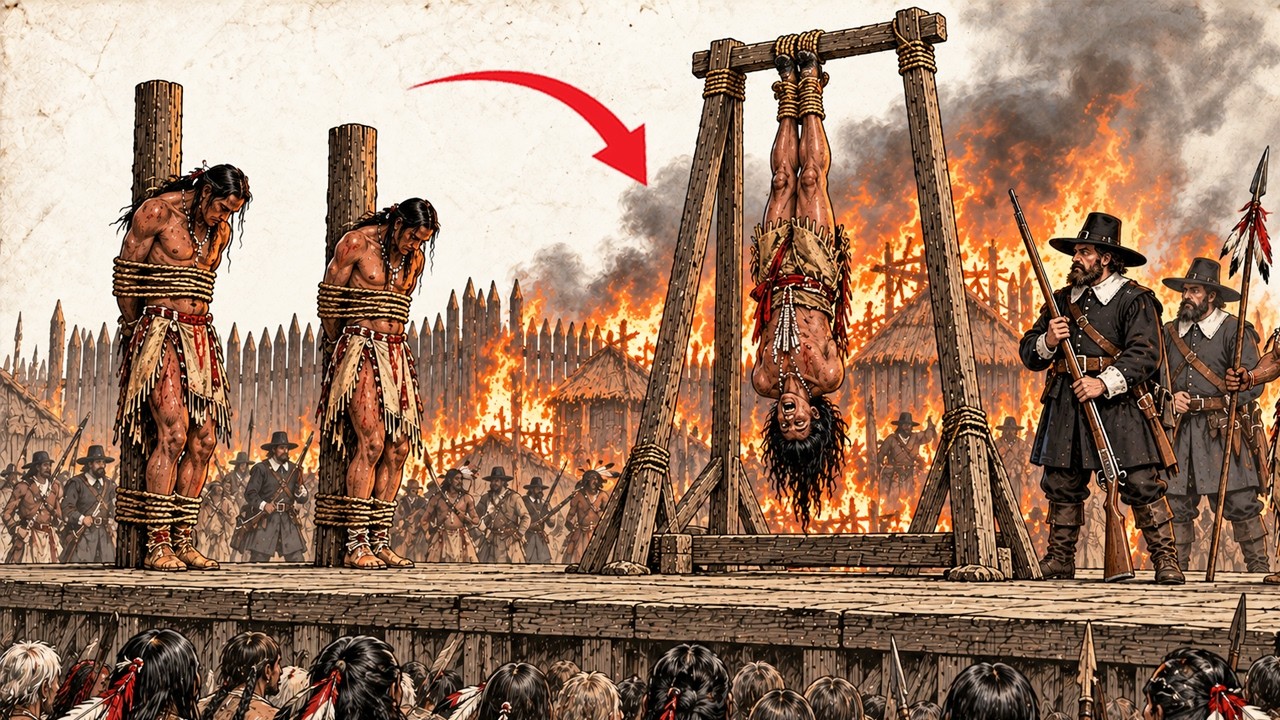
The English did not start the attack by setting the fire. They breached the walls and went in with swords. Then, in a moment that historians still argue about, Captain John Mason reached for a burning stick.
Mason was a professional soldier who had fought in the Netherlands and was trained in European siege tactics. The four English officers who wrote about that morning gave completely different numbers for how many Pequots died: 300, 400, 600, 700. One of them said 14 survivors out of 800.
The gap between those numbers is not an accounting error. It is a window into what the English wanted the memory of this day to be.
Two years before dawn broke on Mystic, John Mason was 33 years old. He was born in England, served as a soldier in the Netherlands, and then crossed an ocean looking for a quieter life. Instead, he ended up a militia commander in Connecticut taking orders from a general court that had voted for war on May 1, 1637.
Mason did not want a long campaign. He wanted one decisive stroke. Beside him, when the expedition finally assembled, was John Underhill, 36, another Netherlands-trained professional and the most technically experienced English officer in New England.
Both men believed they knew what started this. A trader named John Stone was killed in 1634. A trader named John Oldham was killed in 1636.
English blood, English demands, Pequot refusal. That was the version the colonies told themselves. The fuller version involved trade disputes, territorial pressure, and English demands for the surrender of men the Pequots did not necessarily control.
Across the river country, the man the English had decided was their enemy was Sassacus, the principal sachem of the Pequots. His authority rested on kinship, tribute, diplomacy, and a confederation of villages that farmed corn, fished the sound, and traded with everyone from the Dutch to the Narragansett. The Pequots had been a dominant power on that coast for a generation.
In August 1636, Massachusetts had already tried the stick. John Endicott led an expedition against Block Island and the Pequot mainland. It was supposed to force a surrender.
It did the opposite. By the spring of 1637, English parties could not move safely along the Connecticut River.
On May 1st, Connecticut voted for war. On May 10th, Mason sailed. Before he sailed toward Mystic, he stopped at the mouth of the Connecticut River at Saybrook Fort.
Lion Gardiner, a 45-year-old military engineer commanding the fort, met him there.
Gardiner had been living inside what felt like a slow siege for most of a year. His men had been ambushed on the roads, cattle killed, settlers disappeared. Gardiner was skeptical of Mason's plan.
He thought the force was too small. He was right. Mason sailed anyway.
Of the four Englishmen whose accounts shaped four centuries of American memory, only two were actually inside the Mystic palisade when it burned. Gardiner wrote about it from second-hand reports. William Bradford wrote about it from Plymouth, from reports brought back after the fact.
The story told for generations about Mystic was mostly told by men who were not there.
Mason's command was 77 men from Connecticut. Underhill joined him with roughly 20 more from Massachusetts. Fewer than 100 Englishmen in total to destroy a nation.
Their core weapon was the matchlock musket, a heavy firearm that fired only when a smoldering length of cord touched gunpowder in a pan. In wet weather it failed. In wind it failed.
After two or three volleys, the smoke was so thick a man could lose sight of the man next to him.
The English numbers were not what made the expedition work. The Mohegan and Narragansett made it work. Uncas, the Mohegan sachem, had broken with the Pequots over a political dispute older than the English presence.
He brought warriors who knew every path, every stream, every village between Hartford and the sound. Miantonomo, the Narragansett sachem, committed a larger force. Together, the allied native contingent was probably between 200 and 300 fighting men.
Without them, Mason's 77 could not even find the fort, let alone surround it. The English accounts would later minimize this, referring to the allied warriors as "our Indians," as if they were auxiliaries rather than the operational core of the campaign. Both Uncas and Miantonomo believed they were using the English to settle a regional rivalry.
Within six years, Miantonomo would be dead, captured by the Mohegan, handed to the English, and killed by English order.
The English accounts called the people inside the Mystic Palisade "Pequots," "enemies," "warriors." But the fort was a village. Villages contain grandmothers.
They contain nursing infants. Underhill himself would later estimate 600 to 800 inhabitants. Modern researchers believe the overwhelming majority were women, children, and old people, because the Pequot fighting men had been drawn to the other Pequot settlement, the one Mason knew he could not take.
Mystic was a palisaded village on a rise of ground above the river. A wooden wall of upright posts, two entrances, perhaps 70 wigwams inside. The structures were made of bent pole frames covered with layered reed mats.
The mats were watertight. They were also, when dry and spring-warmed, essentially tinder.
The night before the attack, Mason gathered his officers. The decision he was about to make was not the one he was ordered to make. The Connecticut General Court sent him to attack the main Pequot settlement at Weinshauks, Sassacus' own seat of power.
Mason decided not to go there. He was going to Mystic instead.
He would tell the General Court afterward that this was a tactical choice. The truth is simpler and worse. He knew Weinshauks held the warriors.
He knew Mystic held the families. He chose the softer target.
On May 10th, Mason's force sailed from Hartford down the Connecticut River to Saybrook. On May 15th, after the conference with Gardiner, they sailed east along Long Island Sound, past the mouth of the Pequot country, and kept going. This was the first deception.
If any Pequot watcher along the shore saw the English sails pass without landing, the watcher would report that the English had given up or were heading elsewhere.
The force put in on the Narragansett coast, well east of Pequot territory. There Mason met Miantonomo. The warriors were added to the column.
Then the entire force turned west overland. For two days they marched. The weather was hot for May.
Men carried powder horns, matchlocks, swords, pikes, biscuit, dried meat. The pace was punishing. Underhill would write afterward about soldiers so exhausted they could barely stand.
On the evening of May 25th, the force stopped within a few miles of Mystic. The men slept on their arms. There was no fire, no talking above a whisper.
The plan depended on three things: surprise, speed, and the two entrances to the palisade being lightly guarded at dawn.
Somewhere in the darkness, one of the native allies told the English commanders that the warriors inside the fort were not inside the fort. Most of them were at Weinshauks with Sassacus. The men who would meet the English at Mystic would be the ones left to protect the village.
Mason did not change the plan.
Mason was told in advance that the fighting men were elsewhere. He was told that the people inside those walls were overwhelmingly the ones who did not usually fight. And the plan did not change.
Mason's company moved up to one side of the palisade, Underhill's company to the other. Inside the fort, a dog barked. A voice in the village called out in Pequot: "Owenox!
Owenox! Englishmen! Englishmen!"
For one long second, the two sides were frozen inside the same realization. The village knew. The English knew they knew.
Mason gave the order. The English rushed the entrances. Mason's men broke through one gate.
Underhill's men broke through the other. The initial fighting was point-blank. A Pequot warrior inside the palisade drew his bow.
The first arrow struck an English soldier in the chest and deflected off his buff coat. The soldier lived. Behind him came a volley of matchlock fire.
The Pequot defenders fought back from inside the wigwams, from behind sleeping platforms, from the narrow lanes between structures. The English were winning the entry. They were not winning the village.
Pequot resistance inside Mystic has been systematically underwritten in historical memory. The English accounts move very quickly past the first 10 minutes of the assault, the point at which the attack was not yet a massacre, when it was still a battle, and when a village of mostly non-warriors was holding its own against trained European soldiers.
That resistance is why what happens next happens. Mason was somewhere near the center of the fort. His men could not form a line.
They were fighting one on one, two on one in doorways and between structures. One of his sergeants was already wounded. Two English soldiers had been killed outright.
The only two Englishmen who would die inside the palisade.
Mason realized that if his men kept fighting this way, they would lose more of them. Perhaps many more. He looked around the inside of a wigwam.
He saw the reed mats on the walls. He saw the sleeping platforms. He saw a fire still burning low in the hearth.
He bent down and picked up a burning stick.
Underhill was standing on the opposite side of the palisade. He saw what Mason did. When he sat down to write his book the following year, intending to defend the expedition, he wrote it anyway.
"Captain Mason, entering into the wigwams, brought out a firebrand, putting it into the mats with which the wigwams were set on fire."
That is the whole description. There is no agonized deliberation in the sentence. There is one man, one burning stick, one wall.
The mat caught immediately. Dry spring reed, oiled by wood smoke from the hearth fires of the night before, lit the way paper does. The flame ran up the wall of the wigwam in less than 10 seconds.

It jumped to the frame. It jumped to the next wigwam, three feet away. Within a minute, two rows of structures were burning.
Within three minutes, half the fort was burning. Within five minutes, there was no part of the Mystic Palisade that was not on fire.
Mason gave the order his men had been waiting for. Fall back. Fall back out of the fort.
Back through the gates. Back to the outer ring. The English retreated the way they came in.
Underhill's company did the same.
Once the English were outside the palisade, they reformed. Mason's company and Underhill's company took positions on either side of the wall. Beyond them, in a wider ring, stood the Mohegan and Narragansett warriors.
The entire fort was now surrounded by two concentric rings. Anyone who ran out of the burning palisade ran into them.
Pequot defenders now had to choose between burning inside and being shot or cut down trying to come out. Many chose to come out, bows in hand, fighting. They were shot at point-blank range as they emerged.
Behind them came women. Behind the women came children. Behind the children came the elderly, moving slower.
William Bradford, hundreds of miles away in Plymouth, would receive the reports and write the sentence that history has mostly chosen not to read aloud: "Those that escaped the fire were slain with the sword. Some hewed to pieces, others run through with their rapiers, so as they were quickly dispatched. And very few escaped."
Some Pequot families did not come out. The sources differ on how many stayed inside, but the English accounts suggest hundreds. The reed mats were now burning on the sleeping platforms.
The pole frames were collapsing. The baskets of stored corn were catching. The smoke was black and thick enough that the English waiting outside could see figures silhouetted against the fire inside, moving, then not moving.
Bradford closed his description with what he intended as a moment of providential awe: "It was a fearful sight to see them thus frying in the fire, and the streams of blood quenching the same." He meant it as evidence of God's judgment. It reads now as evidence of something else.
The fire moved from wigwam to wigwam faster than people inside could react. The entrances were blocked by English soldiers. The palisade itself could not be climbed quickly.
Some Pequots did try to climb. A few made it over. Most did not.
The warriors who were still armed formed small knots of resistance in the center of the fort, trying to protect the family groups behind them. Accounts of native allies who entered the fort briefly described wigwams in which entire extended families had been killed in a single space. Archaeology has recovered metal and bone fragments at the Mystic site showing evidence of close-quarters combat inside the burning palisade.
People inside the fort were still fighting after the fire began. They were resisting until the structure collapsed on them.
The fire burned at its peak for perhaps 20 minutes. By the time it began to subside, the palisade was a ring of smoldering posts around a flattened village. Of the 77 Englishmen who entered the fort, two were dead and approximately 26 were wounded.
Of the 300 Mohegan and Narragansett allies, casualties are unrecorded in the English accounts. This is itself a form of erasure. Men died there whose names were not written down because the men writing the accounts did not consider them worth naming.
Of the inhabitants of Mystic Fort, no one will ever know the exact number. Underhill, who was there, said 600 to 800 with about 14 survivors. Mason, who was there, said 600 to 700 killed.
Bradford, who was not there, said 400. Gardiner, who was not there, said 300 with many prisoners taken.
These numbers are not consistent with each other. They cannot all be true. The English counted the dead by estimate from outside the walls after the fire.
The bodies inside were not countable. They were not, in many cases, recoverable as individual bodies.
Pick the lowest estimate. 300. 300 human beings.
The population of a small town in a single hour, in a space smaller than a modern parking lot. The lowest estimate is the one that still makes this one of the deadliest single incidents of its kind in the entire 17th century on this continent.
Mason gave the order to withdraw. The force had to get back to the English ships, anchored several hours march to the west. The Pequot fighting men who had not been inside Mystic had by now seen the smoke.
They were coming.
The English column reassembled outside the smoldering fort. Wounded men were supported by comrades. A small number of captives, mostly women and children, had been seized by the native allies.
Mason set the order of march. Mohegan scouts forward, Englishmen in a defensive formation around the wounded and captives, Narragansett rear guard.
Within an hour, the first Pequot warriors from Weinshauks reached the column. They were the fathers and brothers and husbands of the people who died in the fort behind them. The English accounts record only the tactical fact: the column was under constant attack from the moment it left Mystic until the moment it reached the sea.
Modern battlefield archaeology has reconstructed the withdrawal in detail. Four and a half miles, 10 hours of running combat. More Pequot casualties during the retreat than inside the fort itself by some estimates.

The war did not end when the fire burned down. It barely paused.
The column pushed west under constant fire. Englishmen fell wounded. Allied warriors fell killed.
Pequot fighters attacked and withdrew and attacked again. By late afternoon, they could see the sound. By evening, they were at the ships.
They sailed west.
Behind them, the Pequot pursuit finally stopped. The warriors turned around and walked back toward what used to be Mystic. What they found there has no name in any surviving language.
In the days that followed, Mason and Underhill reached the English settlements and began to write their reports. This is where the number problem begins. The men who commanded the attack, who wrote the reports, who built the narrative, could not tell you, within 400 people, how many human beings died at Mystic.
That is what happens when the people inside the walls were never counted as individuals in the first place.
By late summer, the surviving Pequot leadership knew the war was unrecoverable. English and allied forces were destroying food stores, burning villages, hunting down refugee bands. Sassacus fled west with a group of followers.
He sought refuge among the Mohawk, powerful rivals of the Pequots to the west. He hoped they would shelter him.
They did not. The Mohawk took him in. Then they killed him.
Then they sent his head and his hands to the English at Hartford as a diplomatic gift. Sassacus' final journey, intended as an escape, became a political transaction between two nations that both decided he was more useful dead than alive.
In September 1638, at the Treaty of Hartford, the English, the Mohegan, and the Narragansett formalized what the war had already achieved on the ground. The surviving Pequots, perhaps a thousand people, were divided among the victors. Some became captives of the Mohegan.
Some became captives of the Narragansett. Some became property of English households.
And the treaty did something stranger and more total than that. It legally abolished the Pequot name. Survivors were forbidden under the terms of the agreement to call themselves Pequots.
They were forbidden to return to the Pequot country. The word itself was removed from the political map of New England by colonial decree.
Not just a military defeat. Not just a dispersal. The erasure of a people's name from the record of nations by legal document.
The horrifying truth of the Pequot War is not that it was a battle that got out of hand. It is that it did exactly what it was designed to do.
For nearly 300 years, the story of Mystic was told in New England largely in Mason's words, Underhill's words, Bradford's words. Mason, writing in 1736 for the General Court of Connecticut, described the burning of the fort as a providential victory. The language was deliberate.
A providence cannot be a crime. A providence does not require anyone to answer for anything.
By the 19th century, Mason had a statue erected to him in Mystic, standing on the ground where the fort had burned. The inscription praised the victory. It stood for more than a hundred years before anyone successfully argued that it should not.
Here is the thing almost no one knows. The Pequot Nation was not destroyed. The name was legally abolished in 1638.
The people were dispersed. The political structure was dismantled. And the Pequots survived anyway.
The Mashantucket Pequot Tribal Nation and the Eastern Pequot Tribal Nation exist today in Connecticut on land where their ancestors have lived continuously for centuries. The nation that English colonial law tried to erase from the map in 1638 is still there.
Miantonomo, the Narragansett sachem whose warriors made the Mystic attack possible, was dead within six years. The English, now the dominant power in southern New England, captured him in 1643 and ordered him killed. He understood by then that an alliance with a colonial power is not a friendship.
It is a schedule.
Uncas lived longer. He died in old age, honored by the English who had used him. His descendants continue.
So do the Narragansett. So do the Pequot. All of the native nations that fought at Mystic on both sides of the palisade are still, four centuries later, on their land.
The Mason statue was removed in 1996 after decades of pressure from the Mashantucket Pequot and others. It had stood for more than a century in a place it never should have been, telling a story that was never fully true.
Return to the beginning. A village at dawn on May 26, 1637. Several hundred people sleeping.
A man outside the walls with a Dutch military education and a decision to make. He makes it. He picks up a burning stick.
The horrifying truth of the Pequot War is not that it was a brutal battle in a brutal century, though it was. It is not that the English won, though they did. It is that the war was designed from the beginning to do what it did: to take a nation's name off the map by taking the people under its name out of the world.
It almost worked. It did not quite work. The Pequots are still here.