On the night of March 22, 1945, the Rhine River ran cold and black through the darkness near Oppenheim, a small wine-making town on the western bank. On the eastern shore, German soldiers—mostly elderly men and boys handed rifles they barely knew how to load—huddled around faint fires. No one in Berlin was watching this stretch of river.
By every calculation of the German high command, nothing would happen here. They were about to be proven catastrophically wrong.
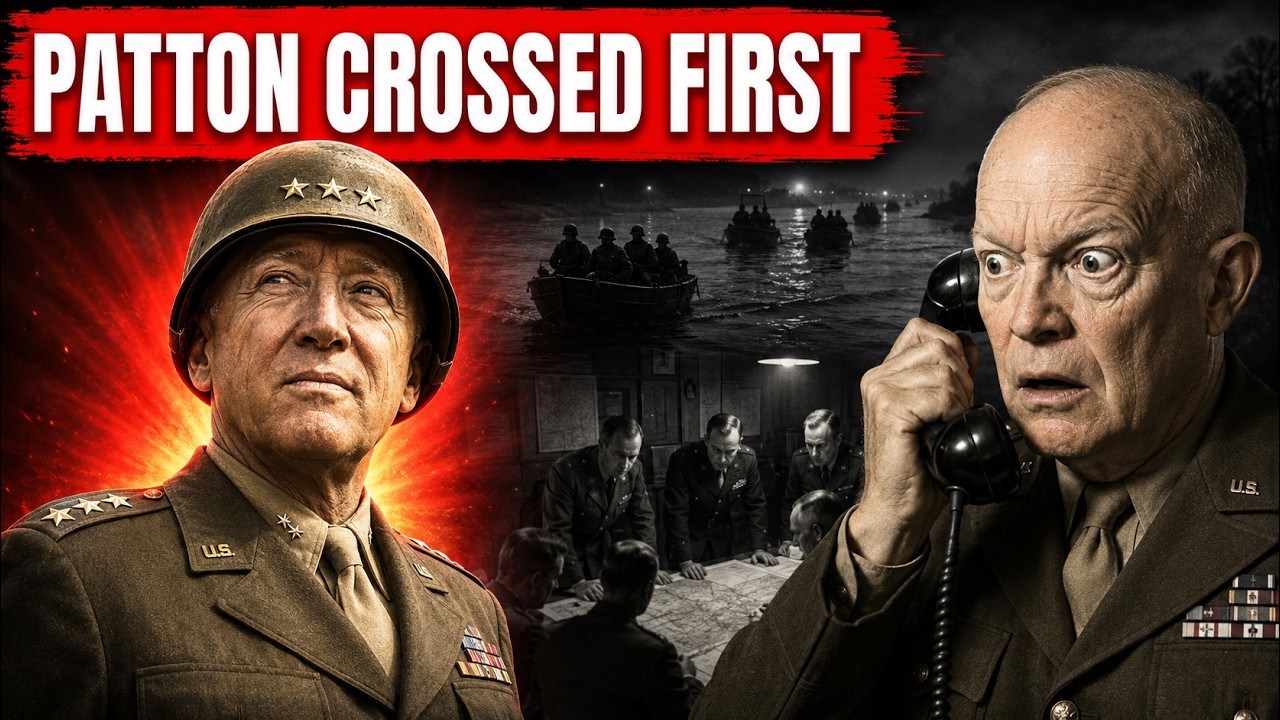
At the waterline, American soldiers carried assault boats across muddy fields in absolute silence. No engines, no artillery, not a single shot fired. Within an hour, the vanguard of General George S.
Patton’s Third Army was crossing Hitler’s most sacred river—a full day before the British were scheduled to attempt their own crossing. By morning, a phone call would reach the Supreme Allied Commander himself. It was a call that reportedly stunned Dwight Eisenhower, humiliated the most methodical general in the British Army, and forced Eisenhower into one of the most delicate diplomatic maneuvers of his career.
For more than two thousand years, the Rhine had been more than water. The Romans understood its significance—Julius Caesar crossed it in 55 BC not because his legions needed the land, but because the act of crossing and returning sent a message: Rome could reach them whenever it chose. In 1840, a schoolteacher named Max Schneckenburger wrote a poem called “The Watch on the Rhine,” which became an anthem sung by German soldiers marching to war for generations.
The river was a myth, a spiritual boundary, the last line between the homeland and everything that threatened it.
By March 1945, that myth had become something close to despair. Nearly every bridge across the Rhine had been dynamited by retreating German engineers. The eastern bank bristled with whatever artillery the Wehrmacht had left.
German planners had spent months studying where the Allies would cross next. They studied Wesel, Cologne, Düsseldorf. They built defensive plans for every militarily viable stretch of the river.
Oppenheim was not among them.
The town sat about 20 kilometers south of Mainz, surrounded by vineyards climbing the hills in neat green rows. The river here was barely 300 meters wide, with a manageable current and low, flat banks on both sides—the kind of geography that made crossing easy if no one was watching. The German garrison assigned to this sector consisted mostly of hastily conscripted factory workers and elderly men.
Many had fought in World War I as young men and never expected to hold a rifle again. They were exhausted, half-convinced the war was already lost, warming themselves by small fires and waiting for orders that grew vaguer each week.
To understand what happened at Oppenheim, you must understand the two men whose rivalry made it almost inevitable. In the north, Field Marshal Bernard Montgomery commanded the British 21st Army Group. He was short, non-smoking, deeply religious in his own way, and utterly convinced of his own genius.
He had rebuilt the shattered Eighth Army after the desert disasters and led it to victory at El Alamein. He commanded the ground forces on D-Day. By any logical measure, he was one of the most competent soldiers of the entire war.
He was also, by near-unanimous agreement among the American generals who served alongside him, exhausting.
Montgomery only moved when everything was ready—air superiority guaranteed, artillery in place, supply lines closed, troops trained to the finest detail. His caution had saved an army in the desert, but it made him difficult. Eisenhower, who had to keep the fragile alliance together, privately told his aides that Montgomery was the only man in either army he could not get along with.
For six weeks through February and March 1945, Montgomery had been preparing Operation Plunder, the great Rhine crossing he intended as the knockout blow of the entire war in the West. The numbers were staggering: more than a million men, roughly 4,000 artillery pieces, landing craft transported overland from the English Channel. A smoke screen had been burning along the river since March 16 to blind German reconnaissance.
Plans called for 14,000 paratroopers to drop east of the river on the morning after the crossing itself, in Operation Varsity—the largest single-day airborne drop of the entire war. Montgomery intended to cross at Wesel on the night of March 23. The whole world knew it was coming, because an operation that size could not be hidden.
Three hundred miles south, Lieutenant General George S. Patton read the same maps with entirely different eyes. He was 60 years old, with thinning silver hair and a high-pitched voice that surprised everyone who had only heard stories about him.
He carried two ivory-handled pistols on his hips and a helmet polished so brightly it looked ready for a parade rather than a battlefield. He prayed every morning and cursed with enthusiasm every evening. He believed, without a trace of irony, that he had lived before as a Roman legionary, then as a cavalry officer under Napoleon.
He had been relieved of command in 1943 after slapping a soldier in a Sicilian hospital, and won his way back through achievement. He had led the breakout from Normandy and, during the desperate days of the Battle of the Bulge, turned his entire army 90 degrees north in a matter of days to relieve the besieged defenders of Bastogne—a maneuver still studied as one of the great rapid repositionings of the war.
Patton had been told, in the precise diplomatic language armies use to avoid outright insult, that his role in the coming Rhine offensive would be secondary. He was to cross only after Montgomery’s main attack began in the north. He had no intention of waiting quietly for permission to arrive in its own time.
The push that set everything in motion came from General Omar Bradley, Patton’s immediate superior. Bradley, the quiet Missouri farmer who hid a fierce competitive streak behind his calm demeanor, reportedly told Patton around March 19 to seize any opportunity to cross the Rhine wherever and whenever he could. Historians still argue whether this was official authorization or willful blindness.
What is certain is that once Patton believed he had the green light, he moved with an intensity that had been building for years.
Patton had studied the history of the Rhine obsessively. He knew that no invading army had successfully crossed it in the face of enemy resistance in over a century. He wanted his name in that history.
He wanted the Third Army remembered as the force that broke Germany’s last natural wall. He already had a plan built around a stretch of river so unremarkable that no one on the other side had bothered to defend it properly.
The crossing was assigned to the 5th Infantry Division, known as the Red Diamond Division, commanded by Major General S. Leroy Irwin. These were veteran soldiers who had crossed more than 20 rivers through France and Germany.
When told that Patton wanted the crossing that very night, hours after the order came down, Irwin’s first reaction was to object—a planned, rehearsed crossing was impossible on such short notice. Then he added that he could still send some troops if necessary. For Patton, that was enough.
He did not need certainty. He needed a general willing to try.
The preparation was as much quiet deception as logistics. Pontoon sections and bridge equipment were distributed among ordinary supply convoys, hidden under canvas covers alongside rations and ammunition boxes. German reconnaissance planes saw only the same gray truck columns that had been using these roads for weeks.
Radio traffic was subtly manipulated to suggest a buildup in the north, reinforcing everything German intelligence already believed about where the next blow would fall.
The boats hit the water just after 10 p. m. They were not powered, not steered—they were simply carried to the edge of the current by men who had trained for this moment in whispers for days.
No fires, no voices above a murmur, no glowing cigarettes in the dark. Orders passed along the line from man to man, mouth to ear, until the last soldier in the column knew exactly what was expected without a single word being shouted.
The far bank was quiet. No tracer fire lit the darkness. No flares searched for targets on the river.
The current pulled the boats sideways, and the men leaned into their oars to correct the drift. The only sound across the water was the soft, steady knock of wood against the far bank. For the men in those boats, the crossing seemed to take far longer than the few minutes it actually took.
Every soldier who has ever crossed a defended river at night describes the same thing: a strange stretching of time, where the far bank never seems to get closer, where every sound behind you—every cough, every scrape of a boot on wood—seems loud enough to wake the entire German army.
They reached the eastern bank almost without incident. The German soldiers waiting there—tired old men and exhausted factory workers—had no artillery to speak of, no reserves close enough to matter, no effective way to call for help in time to change anything. A few shots were fired.
A few positions had to be cleared by hand in the dark, at close range. Entire sections of German trench line surrendered as soon as they realized what had happened, blinking in confusion at the American soldiers who had appeared from the river side.
By 2 a. m. , the entire 11th Infantry Regiment had crossed.
The 10th Infantry Regiment followed about six hours later as the sky over the vineyards began to gray with dawn. Six full battalions of American soldiers stood on the eastern bank of the Rhine. When the final count was made, the cost of seizing Hitler’s most sacred river was just over 30 killed or wounded for six battalions crossing a defended river at night.
The number was almost miraculous.
A bridgehead without a bridge is temporary. A group of men can be isolated and destroyed once the enemy regains enough strength to try. The task of turning this daring gamble into a permanent lodgment fell to a few hundred engineers from the 249th Engineer Combat Battalion.
Their mission was brutal: build a floating bridge more than 350 meters long across a flowing river in pitch darkness under combat conditions, as fast as human hands could manage.
They began work before the last infantry battalions finished crossing, assembling the bridge section by section while German positions sat less than 400 meters away. No loud commands were allowed, no unnecessary engine noise, no lights. Just men working in total darkness, passing cables and timbers hand to hand, racing against a clock only they could hear.
German artillery spotted the crossing site and shells scattered among the vineyards and riverbanks—close enough to cause panic, but not close enough to hit the bridge itself. Each explosion sent men flat against the bridge sections, waiting for the shockwave to pass, then rising to resume work because there was no alternative.
When the sun fully rose on March 23, less than 18 hours after the first pontoon touched the water, the Nierstein bridge was open. American tanks were already crossing, their engine echoes rolling across water that had been silent hours before. An invading army had attacked the Rhine and pushed through it before the enemy even absorbed the fact that the crossing had happened at all.
By any reasonable measure, it was one of the fastest major river crossings of the entire war.
The phone call that historians would argue about for decades came that same morning. Patton called Bradley directly, his voice low over the secure line, almost conspiratorial. “At this moment, Brad, don’t tell anyone,” he said, according to the account.
“But I’m across. I sneaked a division over the river last night. There’s no big concentration over there.
They don’t know what’s happened yet. Don’t announce anything. Well, we’ll see how it goes.”
Bradley’s reported reaction was almost comically understated: “Well, I’ll be damned. You mean across the Rhine?” Patton confirmed.
“I sneaked a division over last night.”
From there, word spread north. At Eisenhower’s headquarters, aides described him as outwardly calm but clearly surprised—he put down his cigar, then picked it up again as he absorbed the news. When he learned that Montgomery had not been informed, his response was short and decisive.
Later that same day, Eisenhower sent Patton a warm personal message praising the achievement in terms that left no doubt about his approval. But publicly, he had to be far more careful.
Montgomery was British, and Britain was the senior partner in an alliance Eisenhower had spent nearly two years holding together through patient diplomacy, often at the cost of his own health. He knew better than almost anyone how quickly a perceived insult could become a real crisis between allies who needed each other far more than either was usually willing to admit. If the Supreme Commander stood up and announced that one general’s improvised night crossing had achieved in hours what another general’s million-man operation was still preparing to do, the political damage inside the alliance would have been severe and lasting.
So Eisenhower praised both operations publicly, gave credit to both commanders, and managed the situation with the same weary tact he had applied to Anglo-American tension since the beginning. It was, in its quiet way, as demanding as anything that happened on the riverbank that week.
Patton had no restraint at that point. Once the element of surprise no longer mattered, he called Bradley again with a very different message: “Brad, tell the world we’re across. I want the world to know.”
Bradley complied without hesitation. The press release went out the same day. By the time Montgomery’s massive artillery barrage began thundering along the river that night, American newspapers had already published the news from the night before—news that made the British effort seem, fairly or not, like an attempt to catch up with something already decided.
Two days later, on March 24, Patton himself walked onto the Oppenheim bridge. He stopped mid-span, looked at the slow-moving water, and told the men around him this was a moment he had been waiting for his whole life. What followed has been described differently by different witnesses ever since.
Patton’s own memoirs describe the group stopping to spit into the river. Other accounts, along with a photograph taken on the bridge that day, suggest something more deliberate and more pointed. Whatever the literal truth, the gesture was unmistakably a message: a general marking his territory on a river that had repelled every invader for longer than anyone alive could remember.
That evening, Patton sent a message to headquarters that needed no embellishment: “I have just crossed the Rhine. Please send some gasoline.” It was the kind of message only a man who had just achieved what armies had failed to do since Napoleon could send.
Three hundred miles north, Montgomery had no idea what was happening. Operation Plunder launched on the night of the 23rd exactly as planned, and by every traditional military measure, it succeeded spectacularly. About 4,000 Allied guns opened fire in a barrage that shook the earth for miles in every direction.
The crossings near Wesel went largely as rehearsed—methodical, disciplined, exactly the kind of operation Montgomery had built his entire reputation on. The next morning, Operation Varsity dropped around 14,000 paratroopers east of the river in the largest single-day airborne operation of the war. The sky filled from horizon to horizon with parachutes and gliders.
German resistance in the north was stiffer and better organized, and it cost far more than the southern crossing. Casualties across Plunder ran into the thousands, with the Varsity airborne drop alone accounting for a significant share—one of the costliest days for Allied airborne forces in the entire war.
Both crossings succeeded. Both armies reached the eastern bank and advanced. But they represented two entirely different theories of how to fight a war, tested side by side within 48 hours.
Montgomery planned for weeks, massed overwhelming force, and paid a heavy price against an enemy that still had some fight left. Patton gambled on speed and surprise against a sector that was exhausted and demoralized, and paid almost nothing. Neither approach was wrong.
Montgomery’s doctrine existed precisely because river crossings against organized defenses usually cost enormous numbers of lives. Patton simply understood, correctly, that this particular stretch of river at this particular moment did not require following that doctrine to the letter. He knew the rules well enough to know when they could be safely ignored.
On the German side, the situation was desperate. Field Marshal Albert Kesselring, who had taken command of the entire Western Front just weeks earlier, asked his staff what could realistically be assembled to close the American bridgehead before it expanded. The answer was almost nothing.
Perhaps 60 tanks remained from the shattered 11th Panzer Division, positioned about 50 kilometers away with barely enough fuel and ammunition for one serious battle. Scattered artillery pieces with no unified fire coordination. No meaningful air support.
The Luftwaffe, which had once darkened the skies of Europe, was now just scattered squadrons flying obsolete aircraft on whatever fuel remained.
Kesselring attacked anyway, because that is what soldiers are ordered to do when no other option remains. Hitler’s response to a recommendation to withdraw had been four words: hold at all costs. The German tanks that rolled toward the American lines that morning crossed open farmland with almost no cover.
They were met by more than a hundred artillery pieces firing with full air observation. American fighter-bombers struck the scattered tanks in the open, leaving few to escape. Crews abandoned burning vehicles and dispersed on foot through the vineyards.
No German tank reached the bridge. By nightfall, it was clear to everyone on both sides that the counterattack had failed utterly.
By March 26, about 18,000 American soldiers had crossed at Oppenheim and Nierstein. By March 28, the bridgehead stretched more than 30 kilometers deep. German resistance along the central front did not just weaken—it collapsed.
Entire divisions surrendered in place. The Third Army captured Frankfurt on March 29 and reached Nuremberg in early April. By mid-April, Patton’s tanks were ranging through Bavaria.
The drive from the Rhine to the Austrian border, a campaign expected to take months, took less than four weeks. Germany surrendered on May 7, 1945, less than seven weeks after Patton’s men first crossed the Rhine in silence.
Patton did not live long to enjoy his triumph. On December 9, 1945, seven months after the war in Europe ended, he was riding in his staff car near Mannheim on his way to a pheasant hunt when it collided with an army truck at an intersection. The crash broke his neck and paralyzed him.
His reported reaction, in the same dry black humor that had carried him through most of his life, was that this was a hell of a way to die. He spent his final days in a hospital bed in Heidelberg, told plainly that he would never ride a horse again and never walk without assistance—a sentence that, for a man who had built his entire life around movement and audacity, must have been harsher than the accident itself. He died on December 21, 1945, at age 60.
He was buried on Christmas Eve in the American military cemetery in Luxembourg, among the soldiers of his Third Army who had fallen in the Battle of the Bulge.
Montgomery lived for decades afterward, long enough to publish lengthy memoirs of the war. His account of Operation Plunder runs for pages, detailing the planning, the bombardment, the airborne drop—exactly the kind of systematic documentation on which his entire career was built. His account of Oppenheim is confined to a single sentence, dismissing it as having only minor tactical significance.
It is a judgment most military historians have strongly disputed, and it reflects wounded pride more than the actual military record.
Eisenhower became the 34th President of the United States and remained publicly reticent about the Rhine crossing for the rest of his life. He never wanted to state publicly what those closest to him believed he thought privately. That was, in its own way, the same quiet diplomatic instinct that had kept his squabbling alliance of generals working together long enough to win the war in the first place.
Today, the river still flows past Oppenheim as it always has, and the vineyards still climb the eastern hills in the same neat rows they did in 1945. At Nierstein, a monument of granite and bronze marks the spot where the first American boat landed on the far shore. German and American flags stand side by side beside it.
The monument does not commemorate Patton’s crossing or his famous gasoline telegram. Instead, it honors the unit that made the bridgehead permanent: the 249th Engineer Combat Battalion. The men who built a bridge across the Rhine in 18 hours under enemy fire, most of whom went home afterward without talking much about it.
The inscription simply notes that their work helped shorten the war and thereby saved lives on both sides of the front line. It is a quiet memorial to one of the boldest nights of the war, in a small town known for its wine, passed mostly by tourists on their way somewhere else.