In September 2022, a house on Fort Myers Beach worth $180,000 was approved for $95,000 of flood repairs. Every dollar was verified. But the owner was never allowed to spend it. Under federal flood rules, that arithmetic triggered a single sentence: the house had to come out of the ground first.
Lifting it cost more than the house itself. Multiply that by roughly 3,000 buildings on one barrier island, and you have the reason the cheapest beautiful beach in Florida never came back. The rule is called the 50% rule. If the cost of repairing a flood-damaged building reaches half the depreciated value of the structure, the building is legally treated as new construction.
And new construction on a barrier island must sit above the base flood elevation. That is the whole rule. It killed more cottages on Fort Myers Beach than the storm did. The storm broke them; the rule stopped them being rebuilt, because lifting a small house costs between $150,000 and $400,000, and no insurance policy covers the cost of obeying the law.
There is one place on the island that never had to pay it. At the end of Connecticut Street, on a bluff that reaches 13 feet above sea level, stands a house built in 1906. When Hurricane Ian came ashore on September 28, 2022, and pushed the Gulf of Mexico across the island, that house lost almost nothing. The only part that flooded was an exhibit dug into the ground beneath it.
It survived because it stands on a hill. The hill is made of 2,000 years of garbage. The Calusa lived on Estero Island for close to twenty centuries. They ate oysters, whelks, and conch.
They threw the shells in the same place generation after generation until the pile was tall enough to keep a village dry. They solved the elevation problem for nothing. They solved it by having dinner. Everybody who has lived on this island since has had to buy height with money, and the price of height is the story of the whole place.
For a hundred years, Fort Myers Beach was the answer to a question American families asked every winter: Where can we afford the Gulf? The answer was here, and it was here because of decisions made by named people over a very long time. Robert Gilbert filed a claim on the shell pile under the Homestead Act of 1862, receiving a patent on 171 acres that included the mound. He built a Tudor-style house there in 1906 with a dock and a cistern, because there was no fresh water on the island.
He called it Mound Villa. The second patent went to James Bratt in 1895, who tried to farm 150 acres at Bowditch Point. The freezes of 1895 and 1899 took his crops both times. That failure mattered.
Estero Island would never be agricultural. It had sand, salt air, and a view. The only crop it could raise was people on vacation. Hugh McIvor worked that out first.
He homesteaded 112 acres in 1899 and cut it into roughly forty lots in 1907, selling them for about $40,000. On an island that could not grow an orange, a man had turned scrub and palmetto into cash by drawing lines on it. Everything that happened here for the next 120 years is a variation on that transaction. Then came William Case, credited with the first subdivision and the first cottage rental industry on the beach in 1911.
He invented not a hotel but a rental cottage with a kitchen, which an ordinary family could take for a week. That was the founding commercial idea of Fort Myers Beach, and it held for more than a century. In 1921, Tom Phillips put up a wooden drawbridge across Matanzas Pass, charging 54 cents to cross. Population that year: 62.
Within a decade, the island had casinos, hotels, a dance pavilion, and a land boom. The lesson about high ground arrived quickly. In 1926, a hurricane took out the bridge five years after it opened and cut a channel between the mainland and the spit north of the pass, creating what locals named Hurricane Pass. A concrete swing bridge replaced the wooden one in 1927, and the island rebuilt and kept selling lots.
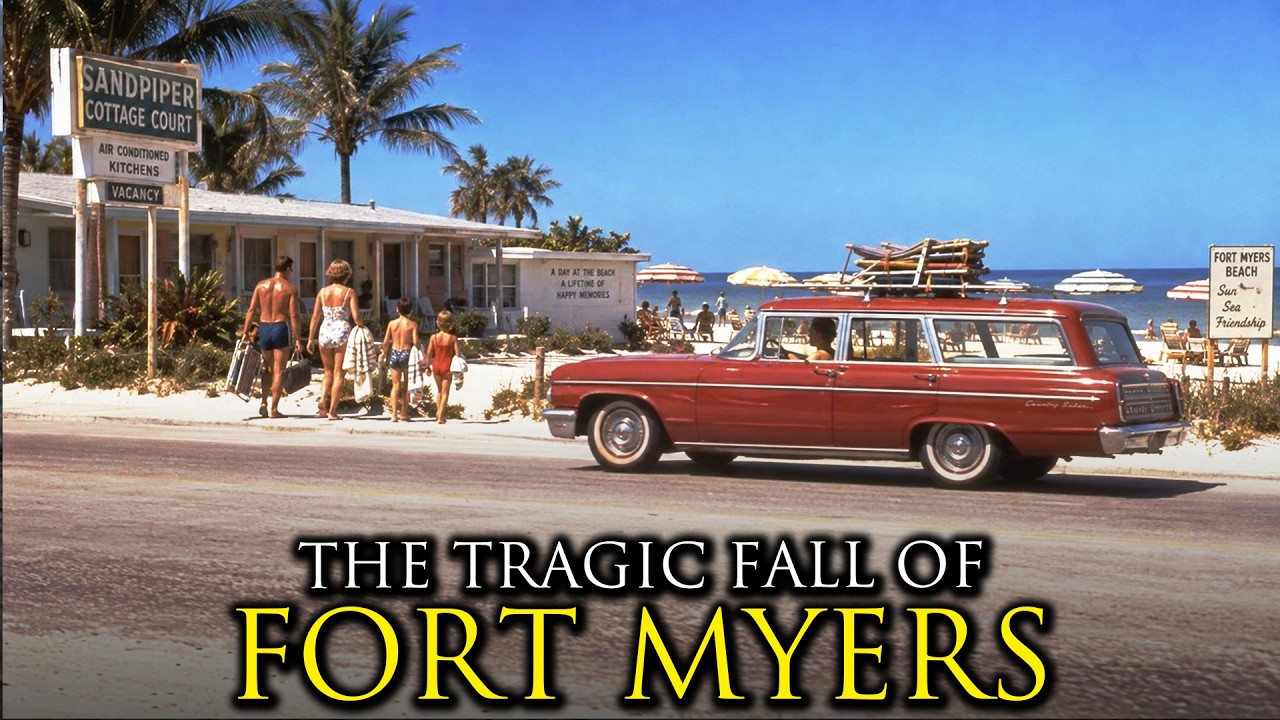
What it built was the cottage court: four to twelve small freestanding buildings around a patch of grass, usually one story, usually with a kitchenette, almost always within sight of the water. The first was called Silver Sands, four cabins with palm-thatched roofs. Through the 1930s and 40s, others joined it. None were grand.
None were meant to be. The arithmetic of a cottage court is why this beach stayed cheap: small buildings, local wood, sitting directly on the sand. In the early 1930s, somebody parked trailers on ten acres of beachfront and called it the Red Coconut Trailer Park. In 1933, Mina Edison, Thomas Edison’s widow, entertained a church group there.
The Presbyterians who met in the Red Coconut’s pavilion eventually built themselves a church, Chapel by the Sea, in 1938, the first on the island. St. Raphael’s followed in 1953. By 1948, the county had opened Beach Elementary.
A church, a school, a fish house. The island had stopped being a vacation and started being a town. Then, in 1949, somebody dropped a net in the wrong place at the right time and hauled up a fortune: pink shrimp. The catch was so rich and sudden that the local name stuck immediately.
They called it pink gold. Within a year, the fishery had rewritten what Fort Myers Beach was for. Population rose 50% between 1940 and 1950, reaching 711. By the early 1960s, more than 250 trawlers were based at the beach, tied six deep.
A working port assembled itself across the pass on San Carlos Island: ice houses, net lofts, repair yards, seven packing houses. A three-mile sandbar that could not grow a crop had accidentally acquired an export industry. The island filled up on its promise. Population hit 2,464 in 1960, more than triple the decade before.
In 1965, a second bridge opened at the south end, and the island was no longer a dead end. Then the model began to crack. In 1959, the Privateer went up, three stories on an island of one-story cabins, a cooperative where owners bought units instead of renting by the week. It worked.
In 1970, Leonardo Arms went up, the island’s first true condominium. By 1980, there were 15 condominium buildings. By 1986, there were 5,000 units. The island’s housing stock was rebuilt from the ground up inside a decade, and almost none of it was rented by the week with a stove in it.
The population told the story. Around 6,400 in 1980, about 6,844 in 2001 after 5,000 new units. The buildings were not for living in; they were for owning. By the 2020 census, the town had 9,460 housing units and 3,162 households.
67% of the housing was vacant on census day. Median age: 67. 8. An island that in 1958 had been full of children eating shrimp had become an extremely beautiful retirement community.
Then Lee County started approving high-rises. Diamond Head went up 12 stories, Ocean Harbor 16 stories, Caper Beach Club 12 stories. The grievance that built a town had arrived. Residents had talked about incorporating for decades, but the high-rise approvals ended the argument.
The only way to stop the next 16 stories was to become a government. They voted in November 1995, and the town of Fort Myers Beach came into existence on December 31, 1995. What they did with it was write a height limit, capping new buildings at four stories. The rule did an enormous amount of work that almost nobody credited.
A height cap is really a rule about the price of dirt. If the most anyone can build is four stories, then the most an acre can earn is four stories worth of rooms, and no buyer will pay more than that. Cap the height and the land value is capped with it. That is how Fort Myers Beach stayed affordable: by a number in a planning document that made it unprofitable to replace the cheap buildings.
While the town was learning to govern itself, its other economy was dying. The shrimp fleet peaked in the 60s and came under attack: Mexico closed its grounds in 1976, farmed shrimp arrived from overseas, fuel went up, federal rules required turtle excluder devices. By 2013, the fleet was down to around 40 boats, and the seven packing houses had become two. A veteran shrimper put it to a reporter in five words: “We’re a dying breed.
”
Picture Fort Myers Beach in 2014. Roughly 7,000 year-round residents, a four-story cap holding down the skyline, cottage courts from the 30s still renting, a 40-boat shrimp fleet across the pass, a 1906 house on a shell mound, and about 3,200 structures, nearly all low, old, and close to the sand. It was the last stretch of Gulf beach in Southwest Florida a schoolteacher could reasonably book. It was also, to a certain kind of buyer, the most obviously underpriced real estate in Florida.
In 2015, Tom Torgerson, who runs TPI Hospitality out of Wilmer, Minnesota, began buying Fort Myers Beach parcel by parcel. He showed the island what he intended to do: $250 million, 562 rooms in four hotels, a conference center, a pedestrian mall, and a boardwalk half a mile long that would double as a seawall. The comprehensive plan said four stories. His Hilton was eight.
He took it down to six, a genuine concession and still 50% over the limit. Residents formed an organization called Voice of FMB, with more than 500 active members within a month. Their objections were specific: density, traffic studies, the seawall, and the fact that the proposal did not comply with the town’s own plan. In April 2016, Torgerson pulled the plug.
He never filed the application. Both sides behaved properly. Nobody was cheated. In June 2018, Torgerson came back, this time with Margaritaville Holdings, to build a single 254-room resort at the entrance to the beach.
The town approved it. It was designed to a code almost nothing else on the island had been required to meet. Everything below the flood line was breakaway construction, walls engineered to fail on purpose so the structure above would survive. On an island of buildings sitting flat on the sand, a developer was putting up the only new thing in sight designed on the assumption the Gulf would eventually come inside.
It came on September 28, 2022, at about 3:00 in the afternoon. Hurricane Ian came ashore at Cayo Costa as a Category 4 storm with winds near 150 mph. The wind did not do the damage. The surge came at levels of 8 to 18 feet across the island.
Estero Island has 2. 9 square miles of dry land, nearly all of it low. The highest point is the Calusa shell mound at 13 feet. There was nowhere for the water to stop.
A wall of water crossed the beach, crossed Estero Boulevard, and kept going across the island and out into Matanzas Pass, taking with it the cottage courts, the motels, the trailers, the restaurants, the boats, and the cars. More than 3,100 of the island’s roughly 3,200 structures were destroyed or damaged. 97%. The mayor said 90% of the island was pretty much gone.
149 people were confirmed killed by Ian in Florida. 72 died in Lee County, close to half the state’s dead in a single county. Ian did more than $12 billion of damage, the costliest hurricane in Florida’s history. The Fort Myers Beach Pier, the front door since 1912, was demolished.
Times Square was leveled. Chapel by the Sea took 11 feet of water. The Seven Seas cottage, where Charles Lindbergh once stayed, was destroyed. The Red Coconut Trailer Park was washed away entirely.
Across the pass, the surge shoved most of the 40 boats of the shrimp fleet onto land. Grant Ericson lost three boats outright and paid roughly a million dollars of his own money to start putting it back. At the end of Connecticut Street, on 13 feet of shell, the 1906 house stood with almost nothing wrong with it. The only part that took water was the exhibit dug into the ground.
2,000 years of discarded oyster shells had just outperformed every engineering decision made on that island in the previous century. The same sorting happened inside a single construction fence. The Margaritaville site was 60% built when Ian arrived. Buildings 1, 2, and 3 came through with no significant structural damage.
The breakaway walls did exactly what they were designed to do. They collapsed, let the water through, and left the structure standing. One fence, two philosophies of construction, and the water went through them like a sorting machine. Then the paperwork started, and the paperwork is what actually ended the affordable beach.
The 50% rule measures against the depreciated value of the structure alone, no land. A beachfront house that would sell for $800,000 might carry a structure value of $180,000. The rebuild threshold sits at $90,000, not much after 15 feet of saltwater has been through a house. Elevating a slab house runs from $150,000 to $400,000.
The insurance payout does not cover it. And the people who lived there were retired on fixed incomes. A 74-year-old widow with a paid-off cottage cannot find $200,000 to raise a house she already owns. So she does not.
It gets sold or bulldozed. The people did not come back. Around 6,000 year-round residents before the storm, islanders estimated a third or fewer had returned. The census put it colder: 7,111 residents in 2018, 5,251 by 2023.
Beach Elementary had about 80 children before Ian. It reopened in December 2023 with 52. Then the 2024 season arrived: Helene in September, Milton a few weeks later pushing 3 to 4 feet of water through homes. The school closed again and stayed closed.
An island that built its third schoolhouse in 1948 now has none in use. On December 7, 2023, Margaritaville Beach Resort Fort Myers Beach opened its doors: 254 rooms, six restaurants, a full-service spa. Rooms run from around $400 a night to a thousand in season. In 2022, before the storm, taxable property in the town came to about $4.
5 billion. The year after Ian, it fell to $2. 6 billion. By 2025-2026, it was back to roughly $4.
6 billion, higher than ever before. Property values fully recovered and then some inside three years while population fell by a quarter. The town is worth more than before the storm and has about a quarter fewer people in it. The Red Coconut is the whole story in a single deed.
About a year after Ian destroyed it, Fran Meyers sold the 10 acres to Seagate Development Group for $52 million. The assessed value went from roughly $10 million under the Meyers family to roughly $35 million under the new owner. Nothing was built. Nothing had to be.
The land had simply stopped being a trailer park in the eyes of the assessor. That change of category was worth $25 million. The market split cleanly in two and stayed split. Older buildings not brought up to code sell essentially for the dirt under them.
New elevated construction sells for well over $4 million. There is no middle. In June 2026, the Fort Myers Beach Local Planning Agency voted unanimously to approve a 60-room hotel, 70 feet tall, on the site of the Silver Sands, the first cottage court ever built on the island. It required a height deviation and a parking deviation.
It got both. Torgerson explained he needed the additional height to complement Margaritaville. A former mayor objected that the project was too dense for a little street. After the vote, she said what a lot of people have been saying since 2023: anything and everything is being approved now.
Across the pass, the last shrimp dock is still working. Ericson and Jensen, at 1,100 Shrimpboat Lane, is the only place a local boat can unload. Grant Ericson had 11 boats before the storm and five working after. Anna Ericson, his daughter, is the fourth generation on that water.
Big Grandpa Carl came down from Montauk in 1950 in a wooden boat called the Malolo looking for pink shrimp. His great-granddaughter is still unloading them a quarter mile from where he tied up. The pier has still not come back. In April 2026, Lee County awarded an $11.
7 million contract to build a new one, longer and wider than the pier Ian took. On the stumps of the old pilings, visitors can walk 585 feet out over the Gulf. Then it stops. At the end of Connecticut Street, the old house is still open to visitors on its hill 13 feet up.
The path to the front door climbs a slope made entirely of oyster and whelk and conch shells that people threw away after supper, one meal at a time for 2,000 years. Underneath it is a room called Stories Beneath Our Feet, which has flooded twice in three years. It is the highest ground on Fort Myers Beach. It cost nobody anything.
It is the only part of the island that has never had to be rebuilt.