In 1955, a neurosurgeon from Connecticut named William Beecher Scoville walked into Manteno State Hospital in Kankakee County, Illinois. He was there to teach. The year before, he had operated on a young epileptic man named Henry Molaison, removing structures deep in both temporal lobes and destroying his ability to form new memories. At Manteno, he assisted in the same class of operation on a patient the literature records only as D.
C. —a bilateral medial temporal lobe resection combined with orbital undercutting. Nine months later, on February 18, 1955, a patient at that same hospital had her chart updated. Genevieve Polarski, a chemistry student from Chicago committed by her parents in 1944, had undergone extensive neurosurgery with bilateral removal of most of her frontal and temporal lobes.
The same entry noted she was now mute, totally dependent on commands. Then it asked: what was to be done next? An experimental course of electric shock treatment to see whether any change in her mood could be brought about. She was given seven more.
No document connects Scoville to Polarski. The chart does not name the surgeon. But the meeting of those two facts—the teacher and the mute and dependent patient—is the dark center of a hospital that was supposed to fix every asylum that came before it. Manteno was the tenth asylum the state of Illinois ever built, and it was built as the answer to the crowded, stinking institutions of the previous century.
The plan was called the cottage system. Instead of one enormous building with locked wings and every kind of patient in the same ward, you built a central hospital and surrounded it with small detached houses. You grouped people by what was actually wrong with them and by what they were capable of. The quiet did not live with the violent.
People who could work went outside and worked. The idea came from Richard Dewey, who had run the hospital down the road at Kankakee in the 1880s and argued that a person with a mental illness should live in a house in daylight with a job and a door that opened. Illinois went all in. In 1927, the state authorized a tenth hospital to take the overflow from Chicago and Kankakee.
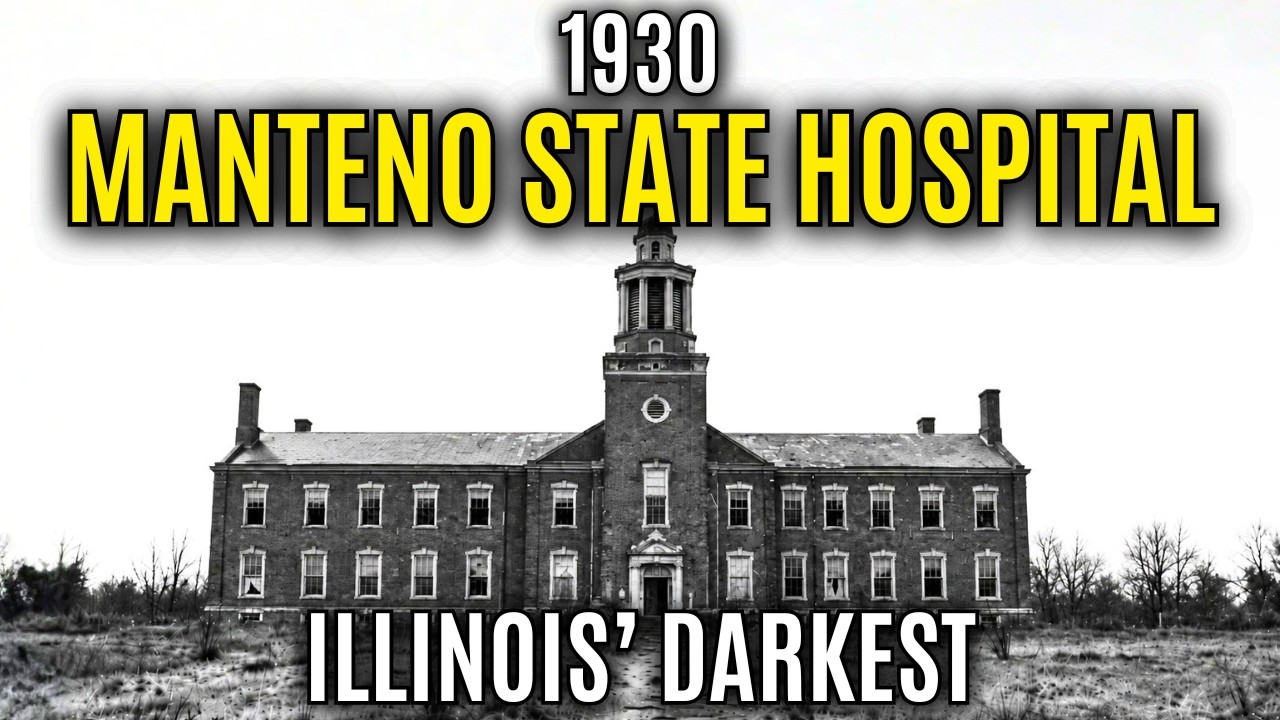
It bought 1,000 acres of flat black prairie in Manteno, a village named after a Potawatomi woman whose land was reserved by treaty in 1832, a few years before her nation was removed from the state. The contracts for the brick Georgian-style buildings were awarded in December 1928. On November 21, 1929, Governor Len Small laid the cornerstone of the administration building and read out what the state thought it was doing: this was a place of hope for the healing of the mind and body. The plan called for 100 cottages.
Thirty-eight were built. The hospital was designed to need nobody. It had its own police force, its own fire department, its own farm, its own power station, its own miles of paved road. It had its own wells, sunk 17 feet into a shelf of limestone under the prairie, giving the hospital its drinking water.
It had its own sewage plant handling a million gallons a day and discharging into the South Fork of Rock Creek. The wells and the sewers were laid into the same ground in the same years by the same contractors. That independence was sold as the highest form of care available. It was also the mechanism of the disaster, buried under the lawn before a single patient arrived.
The first patients arrived on December 27, 1930—100 men brought in by train from Kankakee and Chicago State. Fifteen staff stood on the platform to meet them. For about twenty years, the state could point to real achievements. The farm cultivated over 900 acres, growing grain, raising cattle and pigs, feeding the hospital out of its own dirt.
The powerhouse burned up to 225 tons of coal on the coldest days. The kitchens produced more than 10,000 meals a day. In 1966, the hospital opened a laundry that state officials believed was the largest in the world. In 1953, a young researcher named William Dement ran sleep studies at Manteno and found that chronic schizophrenic patients enter rapid eye movement sleep as often as anyone else; he went on to found the discipline of sleep medicine at Stanford.
In 1957, the hospital launched an annual patient art show called Art O’Rama. But the film crew came in 1953. The first note in the hospital’s own timeline about a severe shortage of beds is dated 1960. That is the gap between the state making a movie about how well the place worked and the state conceding it had nowhere left to put people.
Manteno was designed for 5,000 patients. In its first full year, it held about 800. By 1939, the census counted 5,385 people. Within nine years of opening, the relief hospital had crossed the line it was built to sit under.
By 1950, it was approaching 7,000. In 1955, it peaked somewhere around 8,272—the sources do not agree on the exact number, but nobody disputes the shape of the curve. Around that peak, the hospital ran with roughly 450 attendants, of whom 21 were registered nurses. That is one registered nurse for every 394 patients.
The cottages had been designed to break the crowd into households. What they became was a set of small buildings, each holding a crowd, joined by tunnels, so the crowd could be shifted between them. With that many people and that little staff, intensive treatment was being carried out on about 2,000 patients a year. Shock therapy and lobotomies.
You cannot talk 2,000 people a year through anything. You cannot give them occupational therapy or a job on the farm or a room in a cottage with a door, because there is no room and there is no staff. What you can do is treat them physically—something that takes one doctor, one piece of equipment, and twenty minutes. Something repeatable on a schedule.
Over roughly twenty years, Manteno ran through four ways of doing it. The first was water. The second was sugar. The third was electricity.
The fourth was a knife. Hydrotherapy meant a bath—being plunged in and out of ice water, or tied in a tub in unfiltered river water for fifteen hours, or wrapped in wet sheets and blankets, mummy fashion, and left there. Frank Smith, a Chicago Daily Times reporter who had himself committed to the neighboring hospital at Kankakee in 1935, described that room from the inside. He got himself into hydrotherapy on purpose by turning violent, because he wanted to see it.
Water did not stop because anybody concluded it was barbaric. It stopped because something faster arrived. The second tool was insulin coma therapy. You are injected with enough insulin to strip the sugar out of your blood.
Over the next hour, you sweat, become confused, then go under. You are held in the coma, sometimes for an hour, then brought back with glucose. Then it is done again—not once, but as a course. One patient was given forty of them.
Insulin was labor intensive, and it was replaced by something that took minutes. The third tool was electricity. Electroconvulsive therapy at Manteno was given as maintenance. The same patient who received forty insulin comas completed 187 electric shock treatments in a twice-weekly maintenance series by May 1953—close to 200 over her time there.
The fourth tool was a knife. By the late 1940s, the hospital was performing lobotomies as part of that 2,000 a year. The patient whose file survives all this is Genevieve Polarski, called Jenny by everyone who knew her. Born in Chicago on September 29, 1919, the daughter of Polish immigrants.
She went to the University of Illinois and completed three years of a chemistry degree. In 1944, at 25, she and her parents had a disagreement about where she was going to live. She had had episodes of what was then called manic-depressive disorder. Her parents committed her.
Her admitting physician wrote that she was neat, clean, and tidy, quiet, friendly, cooperative on the ward. Later, he charted that there were no active signs of pathology. She was put through hydrotherapy, plunged in and out of ice water. She was given forty insulin comas.
By May 1953, she had completed nearly 200 electric shock treatments. Then, in early 1955, somebody operated on her brain. After the surgery, she was mute, totally dependent on commands. She was moved from ward to ward, then from nursing home to nursing home for 43 years.
For the last twenty of them, she was incapable of any kind of human interaction. She died in a Chicago nursing home on September 23, 1998, six days short of her 79th birthday, a ward of the state of Illinois with no family and no friends left living. We know any of this for one reason: in November 1998, the Cook County Public Guardian, a lawyer named Patrick Murphy, read her file and wrote about her on the front page of the Chicago Tribune. The other name that survives from this hospital belongs to the man who tried.
Samuel Shapiro was the state’s attorney for Kankakee County in 1939, when the worst thing that happened at Manteno happened. The first case of typhoid fever was diagnosed on July 15. Typhoid had become rare in America by the 1930s, so one case looked like bad luck. Caroline Petroski died on August 26.
On the 31st, the Kankakee Republican News ran the words “typhoid epidemic” in a banner across the front page. Five patients and three employees were dead. Around 200 people were ill. The state chlorinated the wells and shipped in vaccine by the truckload.
It was already far too late. According to the report the state of Illinois published in 1945, 453 people contracted typhoid fever at Manteno State Hospital and 60 of them died. The count is disputed—Time magazine reported 384 sick and 47 dead, the Kankakee paper and the indictment used 53 dead—but nobody has ever reconciled the numbers. Investigators found that the population had outrun the water and sewage systems.
They found the hospital dump alive with maggots. Engineers concluded that contaminated water had seeped down through a small leak in the sewer tile, 17 feet through the limestone, into the drinking water of the institution built to need nobody. Shapiro asked for a special grand jury. It indicted four people for malfeasance in office: Archie Bowen, director of the state department of public welfare; Dr.
Ralph Hinton, the hospital’s managing officer; Hinton’s assistant; and the hospital dietician. Bowen was tried first, found guilty on June 27, 1940, removed from office, and fined $1,000. The conviction was overturned on appeal because the state had failed to show the epidemic was caused by polluted drinking water. The final legal position of the state of Illinois on those deaths was that nobody was responsible.
The place stayed open for another 46 years. Its ending was not an event but a sequence of memos. In March 1981, local officials discovered Springfield intended to close the mental health center and turn part of it into a prison. Around 700 residents came out to a protest meeting, and the prison plan was dropped.
In 1983, Governor James Thompson authorized the closure on budget grounds. On December 31, 1985, after 55 years, the doors were locked. The northern end of the campus went to the state’s veterans agency, which still operates a veterans home there today. The southern campus became an industrial park—warehouses, manufacturing plants, an assisted living home, a residential treatment center for young people, a golf course.
One surviving hospital building was rezoned in 2021 for loft apartments. The administration building, the one with the murals in the lobby, spent years as a bank branch and was most recently converted into a museum of vintage handbags staffed entirely by adults with disabilities. In the cemetery east of town, about 4,000 sets of remains lie under flat stones sunk level with the grass. Each stone carries a name, a number, and a single letter: C or P.
Catholic or Protestant. There is no third section, and nobody has ever explained what happened to anyone who was neither. The graves have never been lifted, and nobody has ever been assigned to lift them. The brick outlasted the doctrine.
The stone is outlasting the brick.