It is April 9, 1865. Appomattox Court House, Virginia. The war is over. Officers spill out of a small parlor into the afternoon light, dazed, emptied.
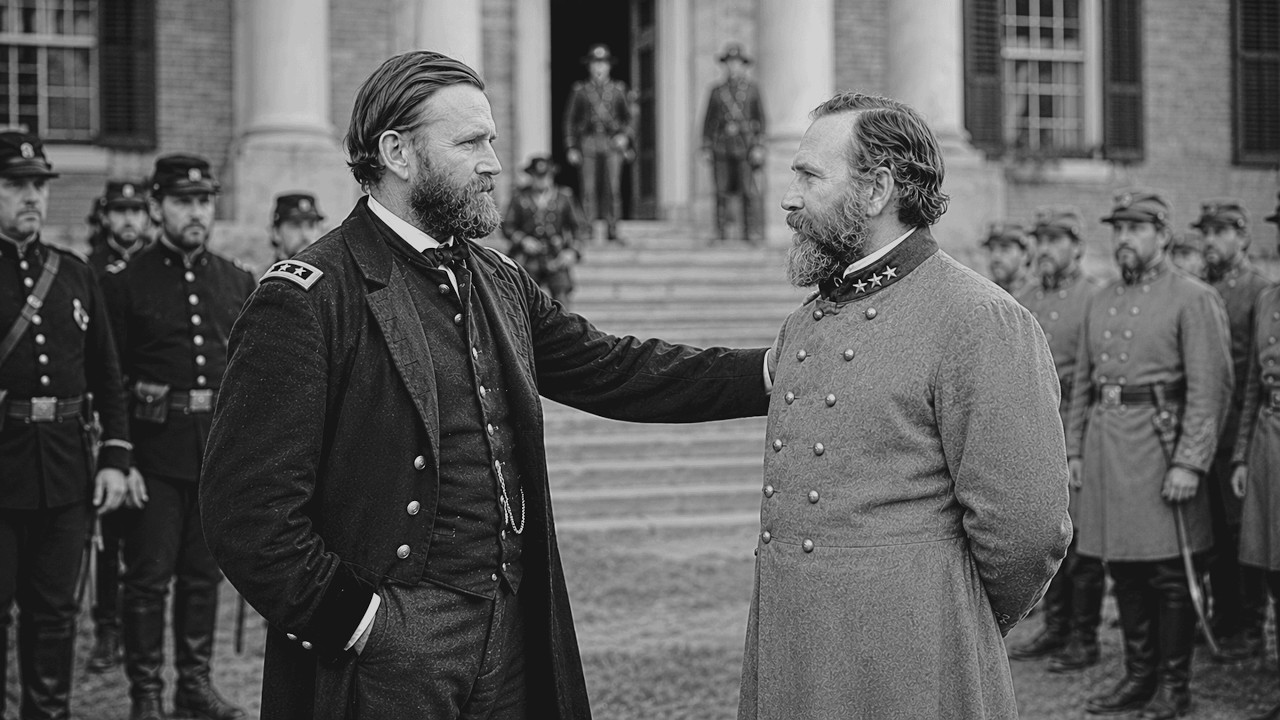
Then Ulysses Grant walks outside in his usual muddy campaign coat. He scans the yard and sees a face he has not seen since before the war: a broad, heavily built man in Confederate gray with a scar at his throat that will never fully fade. Grant crosses the yard. He does not call out a rank or a title.
He says one word. Pete. The old nickname from Jefferson Barracks, from card games and frontier posts and a world so small it feels like a different country, because it was. James Longstreet looks at him, and Grant says, “Pete, let us have another game of brag to recall the days that were so pleasant.
” Twenty-five years have passed. Five of them were at war. Six hundred thousand are dead. And the man who just won the Civil War reaches across all of it with a card game and a nickname.
Longstreet’s response, recorded in his memoirs decades later, contains everything: “Great God, why do men fight who were born to be brothers? ” He does not answer his own question. He already knows there is no satisfying answer. James Longstreet knew more about Ulysses Grant than any other officer in the Confederate Army.
He had known him for over two decades before the war. He knew what Grant would do when he came east in 1864, and he said so. He knew what Grant would offer at the end, and he said that, too. The Confederacy ignored him.
This is a story about what happens when one man sees the truth clearly and the people around him would rather be comfortable than correct. To understand what Longstreet saw in that yard, you must go back to a different world entirely. In 1840, Longstreet arrived at West Point two years before Grant. He was eighteen, tall, broad-shouldered, already built like the general he would become.
He graduated fifty-fourth in a class of sixty-two and did not especially care. He was there to become a soldier. The next year, a small, quiet young man from Ohio arrived. His paperwork read Hiram Ulysses Grant.
A congressional clerk wrote it down wrong, and the name became Ulysses S. Grant. They were not close at the academy. Their real world was smaller and stranger.
By the mid-1840s, both were junior officers in the Fourth US Infantry at Jefferson Barracks, Missouri. There was not much to do. Drill, ride, wait, eat with the same men, sleep in quarters so close you could hear your neighbor’s nightmares through the wall. At night, the officers gathered.
A bottle appeared. Cards came out. The game was Brag, an English ancestor of poker. Money moved, stories got told, boasts got made.
In those idle evenings, Longstreet started to watch the quiet man from Ohio. Grant did not boast. In a culture where young officers talked constantly about class rank and anticipated glory, Grant was conspicuously silent about himself. He did his work, did it well, and moved on.
There was something underneath the quietness. Longstreet noticed it first at cards. Grant played the way he did everything else: without theatrics, without wasted motion. He was patient when patience served and decisive when it did not.
When something difficult needed doing, Grant did it quietly, as if the cost had been privately calculated and accepted before he ever stepped forward. Longstreet was a natural judge of men. He paid attention. Here is the detail that almost never makes it into the history books.
Longstreet’s mother was a Dent. The Dent family owned a plantation called White Haven a few miles outside St. Louis. Through his mother’s side, Longstreet was connected to the household.
One afternoon, he took Grant there. He introduced his quiet Ohio friend to a young woman named Julia Dent, the daughter of the house. Lively, nearsighted, talkative where Grant was reserved. They began to spend time together.
In 1848, after both men had been through Mexico, Grant and Julia were married at White Haven. Longstreet was there. He stood in the room when Grant made his promises. Between Jefferson Barracks and the wedding, there was Mexico.
The Mexican-American War of 1846 to 1848 was the furnace where almost every major Civil War general was forged. Longstreet watched Grant in that furnace at Monterrey in September 1846. The fighting had come down to the streets and alleys. A unit was running low on ammunition.
Someone needed to carry orders through an approach swept by rifle fire. Grant stepped forward. He swung onto his horse and, instead of riding exposed down the center of the street, pressed the horse against the wall of a building and hung his own body off the far side, using the horse as a moving shield. It was the most practical solution to a deadly problem, calculated in seconds and executed without hesitation.
He delivered the orders. He rode back. That evening he sat down at the card table and said almost nothing about it. That moment lived in Longstreet’s memory for the rest of his life.
By the time the Civil War began, Longstreet had been building this file on Grant for nearly fifteen years. When war dispatches started arriving from the west, Fort Donelson, Shiloh, Vicksburg, he did not read them the way the rest of the Confederate high command did. They saw a capable general catching inferior Confederate commanders. Longstreet saw Monterrey scaled up across entire states.
April 1861. The country broke. Both men chose. Longstreet resigned his US commission and joined the Confederacy.
In Lee’s army, he became what soldiers called him, Old Pete. The steady core commander Lee leaned on in the hardest fights: Antietam, Fredericksburg, Gettysburg. He was not flashy. He was dependable.
Grant began the war as a volunteer colonel in Illinois. Then the data points started to arrive. February 1862, Fort Donelson. Grant surrounded a Confederate garrison.
The Confederate commander asked for terms. Grant’s reply was seven words: “No terms except an unconditional and immediate surrender. ” The North turned the phrase into a nickname, “Unconditional Surrender Grant. ” Longstreet read it differently.
He recognized the voice from Jefferson Barracks. April 1862, Shiloh. Grant’s army was surprised at dawn by a ferocious Confederate attack. The Union line buckled.
Men ran toward the river. Most generals would have pulled back and declared the position untenable. Grant stayed. Reinforcements arrived overnight.
On the second day, he attacked. By nightfall the Confederates were retreating. Lincoln’s reply to demands that Grant be removed was famous: “I can’t spare this man; he fights. ” 1863, Vicksburg.
Grant ran a campaign conventional military wisdom called reckless. He cut loose from his supply base, crossed the Mississippi, won five battles in eighteen days, trapped thirty thousand Confederate soldiers. Later that year at Chattanooga, he arrived to find a Union army on starvation rations, broke the siege, and sent Confederate forces tumbling off Missionary Ridge. In Richmond this was concerning.
In the camps of the Army of Northern Virginia, less so. The comfortable story ran: those were western campaigns against second-rate Confederate generals. Let him come east and face Lee, and things will look different. Longstreet did not tell himself that story.
He had known this pattern for twenty years. Grant did not stop. Every general the Army of Northern Virginia had faced had eventually stopped. They pulled back, regrouped, gave Lee time to recover.
Grant had never stopped, not once. That, not tactical brilliance, was what Longstreet understood and the rest of the Confederate high command did not. March 1864. Grant was promoted to lieutenant general, the first man since George Washington to hold that rank, and given command of all Union armies.
He would come east. The officers around Longstreet reacted the way they always reacted to a new Union commander: shrugs, mild jokes, comfortable contempt. Longstreet listened. He was still recovering from the bullet that had torn through his throat in the Wilderness the previous May, fired by his own men in the confusion of smoke and trees.
The wound stole his voice. So when Longstreet used that damaged voice to talk about Grant, the men around him listened. He told them Grant would not behave like Hooker or Burnside or Pope. He would not retreat after a bloody battle and spend three months rebuilding.
The warning was brutal. If this man comes east, we don’t get a reset button anymore. And there was one other thing Longstreet knew but did not yet say aloud. The Confederacy could not match that pressure indefinitely.
Grant knew it too. It was why he fought the way he fought. A long war was a war the Confederacy mathematically could not win. Lee listened to Longstreet’s warning.
He did not quite believe it. Grant had never fought in Virginia. But in the spring of 1864, that blind spot would cost more than anyone could imagine. On May 4, Grant crossed the Rapidan River with the Army of the Potomac and moved into the Wilderness.
The Battle of the Wilderness began on May 5. Two days of fighting in smoke and underbrush so thick that units lost each other in the trees. Fires swept through the forest. Men burned alive where they fell.
The Confederates held their lines. By the logic of every Virginia campaign since 1862, what came next was clear: the Union Army would retreat back across the Rapidan. On the night of May 7, Grant’s army moved. Soldiers in the dark column strained to see which way they were turning.
They were marching south, deeper into Virginia, toward Spotsylvania Courthouse. Men cheered in the darkness. They had never taken a beating this bad and been ordered forward instead of back. Lee moved fast and got to Spotsylvania first.
Nearly two weeks of brutal fighting followed, including the nightmare of the Bloody Angle on May 12, twenty-four hours of hand-to-hand combat in mud and rain. Grant bled heavily. He did not retreat. He moved again, south to the North Anna River, to Cold Harbor.
Cold Harbor, June 3, was the worst day Grant would have in Virginia. He ordered a frontal assault on prepared Confederate trenches and lost thousands of men in minutes. He would later say it was the one order he always regretted. But he did not call it off and go home.
Within two weeks he had secretly moved his entire army across the James River and begun the siege of Petersburg, cutting the railroads that fed Richmond. The siege lasted nine months, from June 1864 to April 1865. Confederate soldiers grew thinner by the week. Their lines got longer relative to the number of men left to hold them.
Supplies dwindled. Longstreet returned to duty by October 1864. His throat wound would never fully heal. He watched the siege with the same unflinching realism he had always brought to war.
He knew what the numbers meant. The question was no longer whether the Confederacy lost. It was how it lost and how many more men died before its leaders were willing to say the word. In the late winter of 1864 and 1865, Lee and Longstreet discussed approaching Grant for terms.
Lee took the idea to Jefferson Davis. What Lee told Davis, drawing on everything Longstreet had shown him, was this: Grant will accept nothing that does not mean full restoration of the United States over the whole Confederacy. Davis refused that reality. Every day he delayed added men to the butcher’s bill.
On April 2, 1865, Grant’s forces broke through at Petersburg. Lee ordered the evacuation of Richmond. The army began its last desperate march west. Longstreet watched the retreat and saw without surprise exactly what he had warned about in March 1864.
Grant being Grant, applying pressure without pause. The war was now simply a question of where the Army of Northern Virginia would be forced to stop. Morning, April 9, 1865. Lee gathered his senior officers near Appomattox Court House.
The army had tried to break out at dawn and run into Union cavalry and then Union infantry. There was nowhere left to go. Some officers spoke of scattering into the woods and continuing a shadow war. Others argued for one last charge.
When it was Longstreet’s turn, he was blunt. Further resistance accomplished nothing except more death. And then he added the part that drew on everything he had carried in his memory for twenty-five years. He told Lee, “Grant will be generous.
” He could not guarantee it. But he knew the man. He had watched him end Vicksburg with paroles instead of prison trains, with food for the garrison he had just spent forty-seven days starving. Grant wanted to finish, not to humiliate.
Lee accepted Longstreet’s judgment. He sent the note requesting a meeting. Grant, suffering from a migraine so severe he could barely see, pushed ahead anyway. They met in Wilmer McLean’s parlor, a man who had moved his family from Manassas specifically to escape the war and found that war had followed him.
The terms Grant offered were exactly what Longstreet had told Lee to expect. Parole for officers and men. They went home on their word. Officers kept their sidearms and horses.
Enlisted men who owned horses could keep them for spring planting. No mass imprisonment, no ritual humiliation. Union artillery began firing celebratory salutes outside. Grant heard it and ordered the guns silenced.
“The rebels are our countrymen again. ”
The documents were signed. The Army of Northern Virginia had ceased to exist. Officers spilled into the yard, some weeping, some standing very still.
Grant stepped outside, scanned the yard, and there was Longstreet in gray, older, heavier, a scar at his throat that would never let him forget the Wilderness. Grant crossed the yard without ceremony. He said, “Pete, let us have another game of brag to recall the days that were so pleasant. ”
After Appomattox, both men went home.
Grant became president. Longstreet became something the defeated South could not afford. In the years after the war, the former Confederacy built the story later called the Lost Cause: Lee as flawless Christian knight, the Confederacy as noble and doomed, defeated only by overwhelming numbers. It required clean heroes and useful villains.
Longstreet complicated it from the beginning. In 1868, Grant ran for president. Longstreet publicly endorsed him. He accepted federal appointments under the Grant administration.
He supported Reconstruction and commanded integrated Louisiana state militia units against white supremacist paramilitaries. To the men building the Lost Cause, this was unforgivable. So they attacked the man. Former Confederate officers led by Jubal Early built a mythology in which Longstreet’s reluctance at Gettysburg cost Lee the battle.
They ignored that Lee ordered the attack. They needed a villain, and Longstreet was perfect. He spent decades defending himself in print, pointing out that the scapegoating began only after he broke ranks and endorsed Grant. For a long time, the myth won.
Ask someone who lost Gettysburg in 1900, 1920, or 1950. The answer was Longstreet. James Longstreet died in 1904 at eighty-two. He had outlived Lee by more than three decades.
History has slowly caught up. Military historians now largely agree that Longstreet’s assessment of Grant was correct from the beginning. He read Grant’s character accurately. He understood that once Grant came east, the old pattern of one battle, one pause, one recovery was permanently over.
Longstreet did not understand Grant because he was smarter than Lee. He understood Grant because he knew him. He knew the man who hung off a horse in a Mexican alley without making a story of it. He knew the man who played cards without posturing.
He knew the man who made promises at White Haven and kept them for the rest of his life. He was right when it would have mattered. And then he stood in a yard in Virginia with a scar at his throat and listened to the man he had known for twenty-five years offer him a card game in place of everything that had happened between them.