On the morning of December 21, 1866, 81 men rode out of Fort Phil Kearny into the frozen Wyoming landscape. Within forty minutes, every one of them was dead. The U. S.
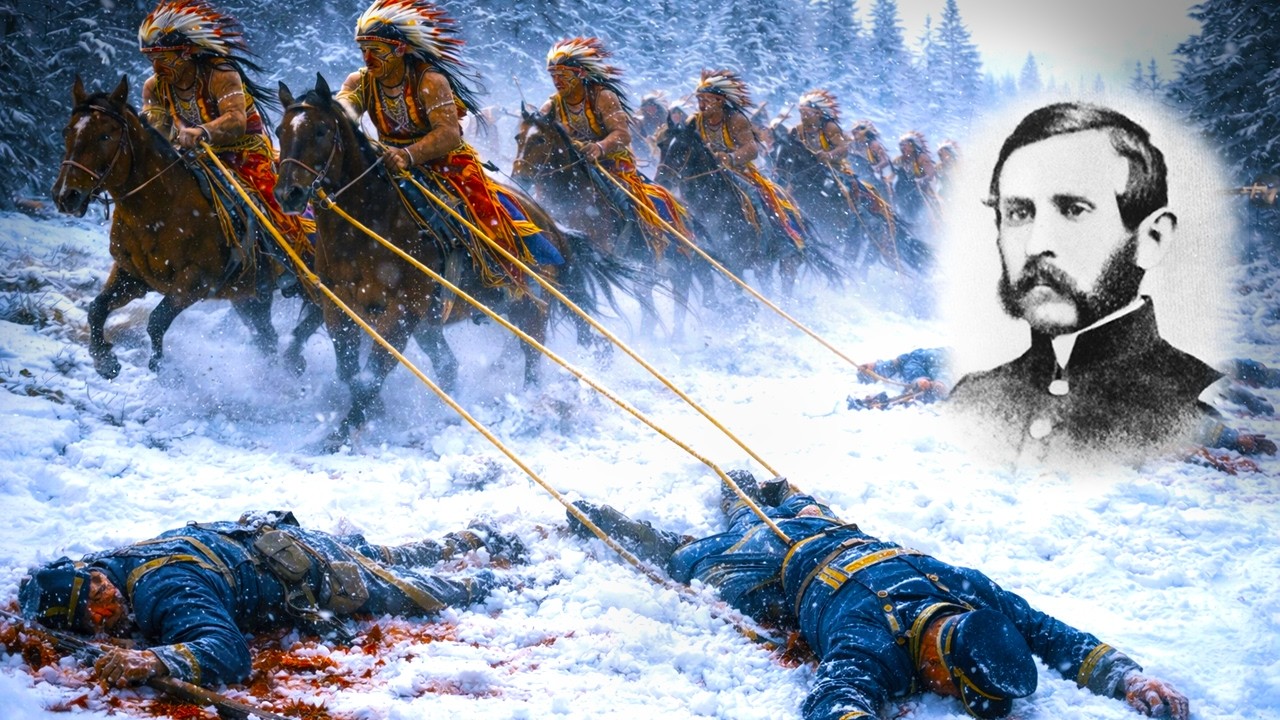
Army buried the truth almost as quickly as it buried the bodies, calling it the worst defeat ever suffered by its forces on the Great Plains. Not until George Armstrong Custer led his men to disaster at the Little Bighorn a full decade later would the army suffer a worse one. Eight-one soldiers, officers, and civilians were annihilated in a carefully planned ambush barely three miles from their own fort. When relief finally arrived, they found stripped, mutilated corpses scattered across a frozen hillside.
The army blamed a reckless commander. The Lakota, Cheyenne, and Arapaho called it something else entirely: a prophecy fulfilled. At the heart of the story lay a direct order, delivered face to face on that cold December morning, and the decision to defy it. Whether that defiance grew from arrogance or from something more complicated remains a question historians have debated for over 150 years.
There was also the prophecy. Before a single shot was fired, a holy man told the assembled warriors how many soldiers would die that day. He missed by one. To understand how 81 men walked into an inescapable trap just three miles from their fort, it is necessary to go back to a trail, a treaty, and a war that never should have begun.
The land had belonged to the Lakota Sioux by treaty. In 1851, the Fort Laramie Treaty guaranteed them an enormous expanse of grassland and river valleys across present-day northern Wyoming and southern Montana, a territory rich in buffalo that had sustained the Lakota for generations. The United States government itself recognized it as Lakota land. Then came gold.
In 1863, a man named John Bozeman blazed a trail straight through the heart of this territory, connecting the Oregon Trail to the Montana goldfields. It ran directly across Lakota hunting grounds as if drawn with a knife across a map signed by someone else. Settlers, miners, and wagon trains poured through without permission, without treaty negotiations, and without any regard for the people who had been promised they could remain there. By 1866, the U.
S. Army decided to formalize the occupation by building a chain of forts along the trail. The largest and most important was Fort Phil Kearny, constructed that summer in the shadow of the Bighorn Mountains, the most exposed military installation on the entire frontier. Red Cloud, a war leader of the Oglala Lakota, had attended the 1866 treaty negotiations at Fort Laramie, ready to listen.
But when he saw army troops marching north to build forts on the very land being negotiated before him, he rose, denounced the talks as deception, and walked out. He did not declare war formally. He did something more effective: he organized the most successful guerrilla campaign the U. S.
Army ever faced on the Plains. An alliance of Lakota, Cheyenne, and Arapaho warriors, united by a common enemy, answered his call. It was Red Cloud who would become the only Native leader of the Plains Wars era to fight the United States to a standstill, force the government to abandon its forts, and dictate terms in a treaty. But that victory was still two years away.
In the autumn of 1866, the war was just beginning. Colonel Henry B. Carrington commanded Fort Phil Kearny. He was an engineer and administrator, not a combat officer.
He had spent the entire Civil War organizing recruits in Indiana and had never led troops under fire. Now he was tasked with building and defending the weakest fort on the frontier, surrounded by an enemy he could neither see nor anticipate. Where his junior officers, many of them Civil War veterans who had charged through smoke at Shiloh and Antietam, saw caution as cowardice, Carrington saw only prudence. By autumn, the fort was under constant harassment.
Warriors raided wood-cutting parties, picked off soldiers, and stole livestock. The daily timber train required a full military escort every time it left the gates. The soldiers of Fort Phil Kearny were not invading land. They were trying to survive within their own walls.
This was not a war the Lakota had started, but one the United States had forced upon them. Inside the fort, frustration reached a boiling point. Captain William J. Fetterman arrived in November 1866, freshly promoted after Civil War service, and he openly despised both the Native warriors harassing the fort and Carrington’s defensive strategy.
Fetterman was the loudest voice among the aggressive junior officers who believed a single powerful strike would scatter the Lakota and end the siege. He was said to have boasted that he could ride through the entire Sioux Nation with 80 men. He would soon get exactly 80 men under his command. The irony would become legend.
Two weeks before the battle, on December 6, Carrington himself led an attack against warriors raiding the timber train. The plan was ambitious, a pincer movement designed to trap the warriors between two converging columns. It collapsed. Poor coordination, freezing conditions, and no decisive result.
The warriors withdrew, and Carrington’s troops returned to the fort with nothing to show. To Fetterman and the aggressive officers, this proved Carrington could not fight. To Carrington, it proved the enemy was far more skilled and disciplined than his subordinates believed. Both conclusions were correct.
Neither side listened to the other. The other key figures were now in place. Lieutenant George W. Grummond, an aggressive cavalry officer aligned with Fetterman’s faction, would lead the horsemen.
Captain Frederick Brown, not assigned to the relief force, volunteered to accompany it. Brown harbored a personal grudge and wanted one last fight before his scheduled transfer. He carried a pistol he would later turn on himself. Captain James Powell had originally been assigned to lead the relief column that morning, but Fetterman invoked seniority, claimed command, and Powell stayed behind.
Powell survived. Fetterman’s force assembled as follows: 49 infantrymen carrying single-shot Springfield muzzle-loaders, weapons requiring manual reloading after every round, slow and clumsy in bitter cold; 27 cavalrymen under Grummond, mounted and armed with carbines and revolvers; two civilian scouts, James Wheatley and Isaac Fisher, carrying Henry repeating rifles capable of sixteen shots without reloading, the most advanced weapons in the entire column. Three officers, two civilians, and 76 soldiers. Total: 81.
Facing them across the frozen terrain, Red Cloud’s alliance had gathered between 1,000 and 2,500 warriors from three tribes: Lakota, Cheyenne, and Arapaho. This was not a raid but a meticulously planned military operation, months in preparation. The warriors carried bows, lances, war clubs, and knives. Some had firearms, but most would fight at close range.
They possessed an advantage beyond numbers. They knew this terrain intimately and had a tactical plan refined over months of skirmishing with Fort Phil Kearny’s soldiers. Before the battle, a holy man named Crazy Mule performed a ritual that would forever mark the encounter in the alliance’s memory. He set out from the warriors’ camp.
He returned empty-handed once. Twice, the same. Three times, nothing. On his fourth journey, he returned holding something invisible between his fists and proclaimed to the assembled warriors: “A hundred in the hands.
” The meaning was understood immediately. One hundred enemy soldiers would die. The number became the name. The Lakota would call this battle the Battle of the Hundred in the Hands.
The prophecy ignited the alliance’s fervor. Warriors painted themselves for battle. The final preparations were complete. The ambush would be set along the ridge line north of Fort Phil Kearny, along the exact route the soldiers must take to relieve the timber train.
All they needed was for the soldiers to follow. Months of observation had taught them that soldiers always followed. Dawn on December 21 was cold and overcast. Lookouts on Pilot Hill raised the signal.
The timber train was under attack, and Captain Fetterman was about to get what he had asked for. Inside the fort, Colonel Carrington ordered Captain Powell to take a detachment and relieve the timber train. Fetterman stepped forward, asserted his seniority, and demanded command. Carrington relented.
But before Fetterman left the gate, Carrington issued a direct order. He looked him in the eye: “Under no circumstances pursue the enemy beyond Lodge Trail Ridge. The ridge is the limit. Beyond it, you will be out of sight of the fort, out of range of artillery, and with no hope of rescue.
Do not cross it. ” Fetterman acknowledged the order. He assembled his command: infantry, cavalry under Grummond, and the two civilians with their Henry rifles. Captain Brown joined the column uninvited, adding his name to the count.
Eighty-one men passed through the gates of Fort Phil Kearny. Carrington sent a mounted messenger after them, repeating the order: do not cross Lodge Trail Ridge. It was the last message he would ever send them. Fetterman’s force reached the timber train and drove off the attackers.
The immediate mission was accomplished. The timber train was safe. Then everything changed. A small group of warriors, perhaps a hundred, appeared on the slopes ahead, riding back and forth, shouting, waving blankets, making themselves impossible to ignore.
Among them rode a young Oglala Lakota warrior named Crazy Horse. He was twenty-four years old, and this was one of his first major battles in a legendary resistance. He rode fearlessly, close enough for the soldiers to nearly catch him, then veered away at the last moment, always keeping a safe distance from rifle range. Other warriors feigned injury, dismounted as if their horses were lame, staggered as if wounded.
Everything in their behavior sent one message: easy targets. They retreated slowly, always northward, drawing the soldiers toward Lodge Trail Ridge. Fetterman had accomplished his mission. The timber train was safe.
His orders were to return to the fort. But the decoys pulled him the opposite direction, north, toward the ridges, toward the one place Carrington had warned him not to go. He pursued. The infantry marched north.
The cavalry, mounted and faster, surged ahead. The column began to stretch and thin. The gap between infantry and cavalry widened with every passing minute. On the far slopes of the ridges, hidden in ravines, crouched behind rocks, stretched out in the tall brown winter grass, between 1,000 and 2,500 warriors waited in absolute silence.
The decoys had done their work. The trap was set. The moment the column crested the ridge and began descending the far slope, the decoys stopped retreating. They turned.
The world exploded. War cries erupted from every direction at once. The eastern slope filled first, cutting off any retreat across the ridge. Then the western ridge line, then the north.
The soldiers were surrounded, trapped on an exposed hillside with no cover, no fortifications, no exit. Grummond’s cavalry, already separated from the infantry by hundreds of yards of open ground, was cut off near the northern end of the ridge. The infantry, slower on foot, was trapped on the southern slope. The two halves of the command could see each other across the gap but could not reach each other.
The distance that had widened during the pursuit had become a killing ground. At the fort, the garrison heard two distant volleys carried by the cold air. Then silence. Carrington immediately ordered a relief battalion under Captain Ten Eyck, but his men would not arrive for over an hour.
By then, there would be no one to rescue. What followed was not a battle but an annihilation. In less than forty minutes, every man in the detachment was dead. The warriors converged from three sides in coordinated waves.
The eastern force closed the escape route. The western force pinned the soldiers in place. The northern force drove into the gap between cavalry and infantry, ensuring the two groups never reunited. The road that had brought the soldiers here was no longer a road.
It was the ground of a massacre. The infantry managed to form a primitive defensive cluster on the hillside, but there was nothing to hide behind: no walls, no timber, only knee-high grass and scattered rocks. The cavalry, several hundred yards north, wheeled in confusion, horses trampling the ground and bolting as arrows flew. Grummond tried to rally his men toward a cluster of large rocks on the northern hill, the only defensible ground in sight.
The two commands were now permanently separated. The infantry held their position to the south. The cavalry fought toward the rocks to the north. Between them, warriors flooded the open space, making any reunion impossible.
The cold air carried sound with unnatural clarity across the frozen landscape: every war cry, every rifle shot, every scream. Each group could hear the other fighting. Each could hear the other dying. Neither could help.
Twenty minutes separated the first war cry from the last heartbeat. Grummond’s twenty-seven cavalrymen reached the rocks on the northern hill, but the position was fatally exposed. The rocks provided cover on one side only, and the warriors simply went around them, pressing from every angle. The cavalrymen fired their carbines from horseback, trying to keep the advancing warriors at bay, but the Lakota and Cheyenne fighters stayed low, moved fast, and closed the effective range before the soldiers could reload.
Some warriors charged directly into the horsemen, pulling them from their saddles. The fight became hand-to-hand, and the warriors, trained in this kind of combat since childhood, were devastatingly skilled in it. Grummond fought his last battle from the saddle until he was overwhelmed and dragged down. The cavalry dissolved as a fighting unit.
The rocks on the northern hill became a graveyard. When relief forces later reached the site, they counted sixty distinct bloodstains frozen into the ground, surrounded by a forest of arrows stuck in the earth and in the dead. The infantry, forty-nine men under Fetterman, had gathered on the hillside in the tightest formation possible, a shrinking cluster of men with no cover beyond shallow scrapes in the frozen ground and a few miserable rocks. They could see the cavalry position to the north.
They could see that it had fallen silent. They understood what that silence meant. They were alone. The infantry fired volleys.
The sound carried three miles to the fort, the sound that forced Carrington to rush the relief column. But the Springfield muzzle-loaders were brutal to reload in that bitter cold. Frozen fingers fumbled with paper cartridges. Ramrods stuck to frozen metal.
Each man got one shot before he had to stand exposed for precious seconds to reload while warriors charged at full speed. The volleys came in heartbeats, not minutes. Two coordinated volleys, then the warriors were among them. What happened next is the detail that makes this battle uniquely horrifying in the records of frontier warfare: of the 81 dead, only about six showed bullet wounds.
Six. The rest were killed at close range, by heavy stone war clubs designed to shatter bone, by lances driven home, by knives cutting into desperate, entangled bodies. This was not a firefight but a slaughter at arm’s length. A group of soldiers standing back to back, swinging empty Springfields like clubs, surrounded on every side.
The circle tightened, men fell, and the circle shrank until there was no circle, only bodies in the frozen grass. The infantry dead were later found gathered within a 40-foot radius, the largest cluster of killed on the entire field. They died together in a space no larger than a modest room. In the final moments, the battle contracted to its smallest, most grisly scope.
Captain Fetterman was still alive. Captain Brown, the volunteer officer who should not have been there, stood beside him. Every other man in the command was either dead or dying. Fetterman fought to the end.
A Lakota leader named American Horse approached him amid the chaos and fought a ferocious duel with him, blade against blade. The wounds found on Fetterman’s body told the story: deep cuts to the chest and throat, delivered by a man who had faced him directly, at close range, and prevailed. Fetterman fell onto the frozen grass. Beside him, Captain Brown made a different choice.
Whether from despair or defiance or cold certainty of what awaited the dead on this ground, he placed his pistol under his chin and fired. Silence fell. Eighty-one men lay scattered across half a mile of ridgeline. The warriors moved among the dead, stripping them of weapons, clothing, and equipment.
Bodies were mutilated, a practice rooted in spiritual beliefs about weakening enemies in the afterlife, though the army would later use it as a weapon to inflame public outrage. The entire battle, from first war cry to final breath, lasted between twenty and forty minutes. A complete command had been erased. The Lakota, Cheyenne, and Arapaho warriors withdrew carrying their dead and wounded.
They left behind a silent hillside, a frozen landscape of death, and the beginning of a legend. An hour later, Captain Ten Eyck’s relief column crested the ridge and found a nightmare. The soldiers froze in horror at what they saw: forty-nine bodies visible, the infantry clustered on the hillside in an almost impossibly tight formation, stripped of everything. The condition of the corpses was so appalling that many of Ten Eyck’s men bent over in shock.
Others stared in stunned disbelief. Then they began the grim work of recovering the dead. The infantry came first, body after body loaded onto wagons, each one telling a story of violence no official report could fully convey. Then the column moved north toward the rocks where Grummond’s cavalry lay scattered.
Arrows pierced the frozen ground and the frozen bodies. Sixty bloodstains surrounded the defensive position that had held for mere minutes. Near the lone tree, they found Wheatley and Fisher. The piles of empty cartridges around their position spoke louder than any testimony.
These two men had rained fire on the advancing warriors with everything their Henry rifles could deliver. The marks of their stand were visible everywhere, but even the most advanced weapons on the field could not overcome what they faced. Fetterman and Brown were found side by side. Fetterman’s wounds, those from the direct duel with American Horse, contrasted starkly with Brown’s single self-inflicted wound.
Two officers, side by side, with completely different endings. The bodies were loaded onto wagons and returned to Fort Phil Kearny. The gates closed behind them. The fort entered a state of siege so complete that the garrison did not know for days whether relief would ever come.
For the Lakota and their allies, the outcome carried weight beyond military victory. Red Cloud’s prophecy had been fulfilled, not literally, but spiritually. The actual number fell short of the sacred number. Yet the power of Crazy Mule’s vision was confirmed in the alliance’s eyes.
This was not merely a tactical success but a spiritual one. The battle would remain etched in Lakota memory under that name long after the U. S. Army gave it another.
Alliance casualties were estimated at between 13 and 60 dead, a fraction of what they had inflicted. The overwhelming superiority of the ambush in numbers, terrain, and tactical surprise kept losses remarkably low. The warriors carried their dead and wounded from the field, a practice that makes precise counting impossible for historians. But the disparity was staggering: a casualty ratio of six to one or greater, achieved in under an hour against trained soldiers with firearms.
This was not a costly victory but a textbook lesson in military planning and execution. News of the disaster reached the eastern United States by telegraph and mail. The reaction was an explosive mix of horror, rage, and an immediate search for a scapegoat. The army found one with astonishing speed: Colonel Carrington.
Despite issuing the direct order not to cross Lodge Trail Ridge, despite months of written requests for reinforcements that went unanswered, despite all his warnings about the strength and capability of the Native alliance, Carrington was relieved of command. His career was effectively destroyed. The public narrative crystallized into something simple and satisfying: a reckless commander disobeyed orders and led his men to their deaths. That narrative is partially true, but it conveniently ignores everything surrounding that act of disobedience: an unnecessary fort, an impossible strategic mission, a trail that never should have been cut through the heart of Lakota territory, and a leadership culture that rewarded aggression and punished every instinct Carrington had.
He had warned them. He had begged them. They blamed him anyway. Years later, military investigations quietly exonerated him.
He spent the rest of his life defending his record and his decisions. The 81 men who died on that ridge never had that chance. The consequences of the Fetterman Fight extended far beyond the ruin of one officer’s reputation. The battle forced the United States to do something extraordinary, something it had rarely done before and would rarely do again.
The Fetterman Fight, combined with the relentless local resistance throughout 1867, shattered the government’s will to hold the Bozeman Trail. In 1868, the Second Treaty of Fort Laramie was signed. Its terms were remarkable by any standard of American frontier policy. The United States agreed to abandon all three forts along the Bozeman Trail, including Fort Phil Kearny.
The Powder River country was officially recognized as unceded Indian land. The trail itself was closed. The only war the United States ever definitively lost against the Plains Indians did not end with a battlefield surrender but with the government’s withdrawal. Red Cloud watched the forts burn before he signed.
He was certain about that. He refused to put his name on the paper until he saw the smoke rising from the walls of the forts built on his people’s land without their consent. Only then, with the ashes still warm, did he agree to peace. Yet the victory came with an expiration date no treaty could extend.
Within eight years, gold was discovered in the Black Hills, the sacred Lakota land protected by the very treaty Red Cloud had won. The U. S. government violated the 1868 agreement with the same disregard it had shown the 1851 treaty before it.
The cycle repeated, and in 1876, at the Little Bighorn River, another overconfident cavalry commander led his men into another devastating ambush against an alliance of the same tribes. The record that had stood until Custer’s fall was set ten years earlier on a frozen ridgeline outside Fort Phil Kearny. For over a century, the dominant narrative remained simple and direct: Fetterman was arrogant, disobeyed orders, and died. Cause and effect.
But modern historians have complicated that neat story. The pressure on Fetterman from his fellow officers was immense. The entire aggressive faction inside the fort expected bold action and considered anything less a disgrace. Carrington’s authority had been systematically undermined by his own subordinates for months.
The institutional culture of the post-Civil War army demanded offensive action as a matter of professional identity and treated caution as a character flaw. Fetterman may have been reckless, but he was also a product of a system that manufactured recklessness and then punished the men it consumed. The battlefield itself, now a quiet expanse of Wyoming grassland marked by stone memorials where the infantry fell, still offers evidence. Archaeological surveys have confirmed the dense clustering of the infantry dead, mapped the distribution of cartridges, and documented the physical evidence near the rocks where Grummond’s cavalry fought their last stand.
Every artifact confirms the same conclusion: the ambush was devastating in its speed, total in its execution, and planned with a precision the U. S. Army of 1866 was not prepared to face. Eighty-one men rode out of Fort Phil Kearny on the morning of December 21, 1866.
All of them died within sight of the ridge they were ordered not to cross. They crossed it anyway, drawn by decoys who vanished into a trap that had been waiting since before dawn.