The morning of April 15, 1912, began like any other spring day on Dismal Creek in Buchanan County, Virginia. Wesley Edwards, a 34-year-old farmer known throughout the mountain community for his integrity, was preparing to head to his upper pasture when the sound of horses announced nearly twenty armed men gathering in a semicircle around his cabin. Sheriff Thomas Garrett and eighteen deputies had come to arrest him on a charge of assault—a warrant obtained through the political influence of a lowland businessman named Harrison Blackwell, with whom Edwards had a dispute over timber rights. Edwards had merely refused to allow Blackwell’s men to trespass on his land.
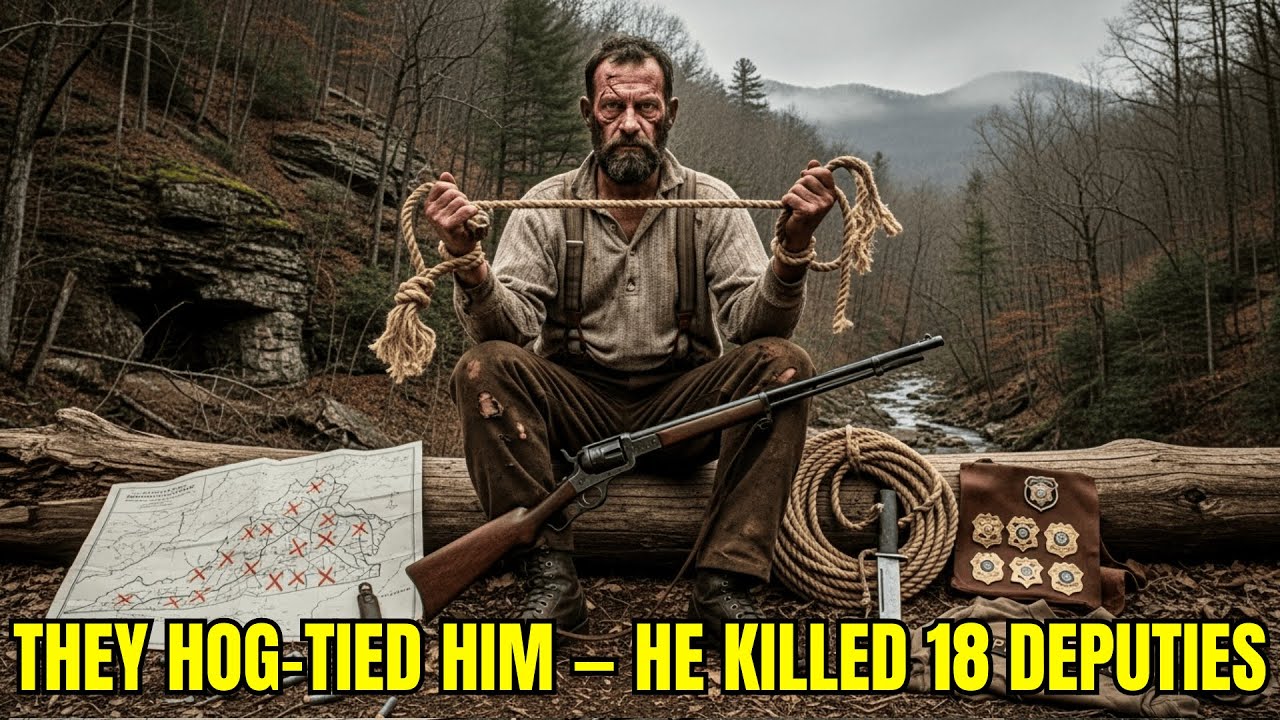
The charge was false, and everyone in the community knew it. Edwards offered no resistance. He asked to see the warrant, examined it, stated calmly that the accusations were fabricated, and expressed his willingness to accompany the sheriff through proper legal channels. What happened next was not an arrest but a public spectacle of brutality.
The deputies beat him without provocation, knocked him to the ground, and continued striking him even after he stopped resisting. Then Sheriff Garrett ordered his men to hog tie him. They bound Edwards’ wrists behind his back, bent his legs up behind him, and connected his wrists to his ankles with rope, forcing his body into an agonizing arch. They attached another rope and dragged him through the mud and manure of his own yard, laughing and making crude jokes as his wife Martha screamed from the porch and his five children watched through the windows.
The deputies paraded him through the community for miles, displaying him like a captured animal before hauling him to the county jail. The charges were dismissed within a week, the evidence so transparently fabricated that even a sympathetic judge could not sustain them. But Edwards had spent seven days in jail with his injuries untreated, his dignity destroyed, his reputation shattered. He returned to his farm and appeared broken, resumed his work, attended church, showed no outward sign of the rage consuming him.
But those who knew him well understood something fundamental had changed. For six months, he planned in silence. He learned the identities and habits of every deputy who had participated in his humiliation. He studied their routines, identified their vulnerabilities, and waited.
The first killing came in October 1912. Deputy James Fowler, one of the most enthusiastic participants in the brutalization, was found shot dead on a mountain road outside Grundy—a single rifle shot from a distance that demonstrated remarkable marksmanship. The second killing came three weeks later. Deputy Robert Patterson was shot through a window in his home outside Vansant while eating supper.
The third and fourth followed in quick succession in November, both deputies from Garrett’s force, both killed with the same precision. By winter, the sheriff’s department began to realize something was hunting them. The fifth deputy died in December, found floating in the Levisa Fork with a bullet wound in his back. The sixth was ambushed on a remote road in January, shot from a ridge nearly three hundred yards away.
The seventh and eighth were killed on the same night in February, in their own homes, in a coordinated strike that terrorized the remaining deputies. Some resigned. Others refused to patrol alone. Federal marshals were brought in but proved helpless against a man who knew every hollow and ridge in the county and who had the support of a community that viewed him as a hero rather than a criminal.
The ninth killing came in March 1913, targeting a deputy who had urinated on Edwards while he lay bound and helpless in the mud. The pursuit lasted two days, ending with the deputy cornered in a hollow. The condition of the body suggested the death had not been quick. The tenth and eleventh followed in quick succession, then the twelfth in May, the thirteenth in June, the fourteenth in July.
By summer 1913, fourteen of the eighteen deputies were dead, and the remaining four had fled the county entirely, seeking refuge in other states. Edwards found them anyway. The fifteenth died in Kentucky, shot through his boarding house window. The sixteenth was ambushed in West Virginia.
The seventeenth was killed in Tennessee, his body discovered in an alley behind a tavern. The eighteenth and final killing came on April 15, 1913—exactly one year after the arrest that had started everything. The target was Sheriff Thomas Garrett himself. Garrett had barricaded himself in his home in Grundy, surrounded by guards, confident in his precautions.
Edwards reached him anyway, bypassed the defenses, and entered the sheriff’s bedroom in the early hours of the morning. What passed between them was never recorded, but when Garrett’s body was found the next morning, the evidence suggested his death had been neither quick nor merciful. He had been hog tied, bound in exactly the same fashion he had ordered for Edwards a year before. He had been beaten, and he had been shot multiple times in places designed to cause pain rather than immediate death.
The final bullet came only after Garrett had experienced something of what Wesley Edwards had experienced. Three days later, Edwards was arrested. He did not deny what he had done. He seemed almost proud of it.
The trial became the most sensational criminal proceeding in Virginia history, drawing reporters from New York and Chicago and spectators from across the country. The defense, led by a lawyer who volunteered without fee, put the Buchanan County Sheriff’s Department on trial. Witnesses testified to the beating, the hog tying, the dragging through the mud, the fabricated charges, the corruption that had produced the warrant. The contrast between the dignified farmer sitting in the defendant’s chair and the animal he had been reduced to was stark and unavoidable.
The jury deliberated for five days and returned a verdict of guilty on eighteen counts of voluntary manslaughter with a recommendation for the minimum possible sentence. The judge sentenced Edwards to eighteen concurrent terms of five years each, with eligibility for parole after three. He served four years at the Virginia State Penitentiary and was released on parole in 1917 at age thirty-nine. He returned to Buchanan County, to the wife and children who had waited for him, and he never spoke publicly about his campaign again.
When asked, he would simply say he had done what needed to be done. He died peacefully in his sleep in 1952 at the age of seventy-four, outliving everyone directly involved in his humiliation, and was buried in the family cemetery on the ridge above the home place. His story passed into Appalachian memory and song, told and retold through the generations—a story with no easy answers, but one that forced its listeners to confront what happens when dignity is destroyed by those who should protect it, and when every legitimate avenue for justice has been closed.