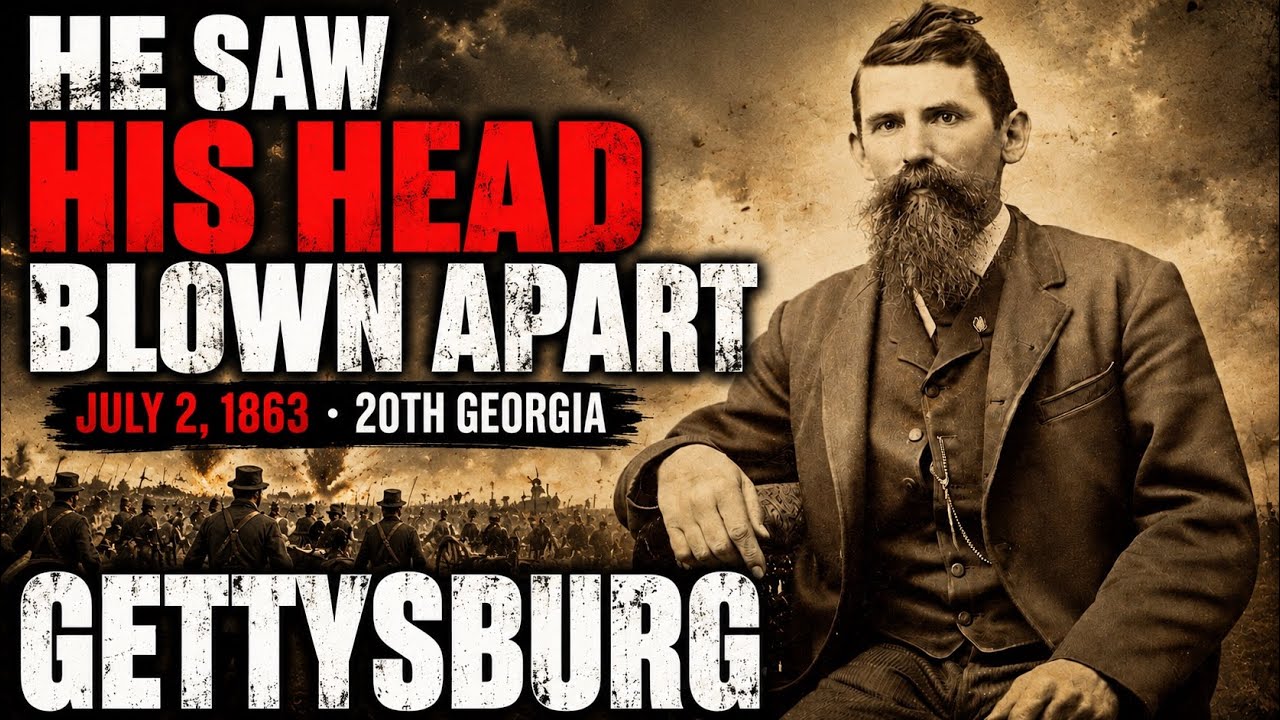
In the summer of 1863, an eighteen-year-old Georgian named John W. Lokey climbed a sun-scorched hillside at Gettysburg, Pennsylvania, straight into the teeth of Union fire. He had arrived there as part of the 20th Georgia Infantry, a regiment that had already spent the afternoon paying in blood for every yard of ground leading to the rocky height ahead. That height, a jumble of boulders and broken terrain, would come to be known as Devil’s Den.
And what Lokey saw when he reached the top would stay with him for the rest of his long life. Lokey had not started out as a soldier. In 1860, he was a fifteen-year-old boy living on a small farm near Columbus, Georgia, one of ten children in a household that also included a dozen enslaved people. He knew farming, and that was about all he knew.
When the Civil War broke out, the promise of adventure pulled him in. He enlisted on May 23, 1861, joining Company B of the 20th Georgia, and by the time of Gettysburg he was no longer a boy. He had already endured Antietam, his first experience of the war on northern soil, where he wrote of foraging for food from the haversacks of dead soldiers. By the time he reached Pennsylvania in July 1863, this teenager had seen more horror than most men would see in a lifetime.
But Gettysburg would test him in ways even Antietam had not. The fighting around Devil’s Den on July 2 was part of a larger Confederate assault against the Union left flank. Brigadier General Henry Benning’s brigade, which included the 20th Georgia, moved forward across the open fields south of Gettysburg, pushing through sharpshooters and militia who slowed their advance but could not stop it. The Confederates pressed on toward the Union position on the rocky heights, where artillery and infantry waited behind a small stone wall.
Lokey was part of the second or third wave climbing that hill, following behind men who had already died by the inch to gain the slope. The terrain was brutal, rough and uneven, with the enemy holding the high ground and pouring down fire. When the Georgians finally crested the hill, they broke the Union line, seized three cannon, and forced the Federal soldiers back. It was a moment of success, but it was also a trap.
From the moment they stood on those rocky heights, every artillery battery within range had a clear target. Shells began crashing into the boulders. Musket fire raked the position from below. The men who had just won the hill found themselves caught in a storm of lead and iron.
One of those men was Colonel Jack Jones of the 20th Georgia. In the chaos of the fight, a shell ricocheted off a rock, and a fragment tore through his head, killing him instantly. Benning himself witnessed it and later reported that Jones was standing one moment and dead the next. Lokey saw the aftermath with his own eyes.
Climbing toward the top, he came upon Jones lying on his back, about half his head shot away. He kept moving. Further up the slope, he passed a wounded soldier from Company K, sprawled on his back, who yelled to him that he had better not go up that hill or he would be shot. Lokey went anyway.
He made it to the crest, took aim, and then it happened. He was struck. He later described the feeling as lightning going up his hip. The wound was serious, and he was in a bad place, caught out in the open with the fight still raging around him.
A Union soldier, himself caught in the same deadly space, saw Lokey in trouble and came over to help. He told the young Georgian to put his arm around his neck and lean his weight on him so they could get out of the line of fire. In the middle of that chaos, Lokey managed a grim joke, telling the Union man that he was now his prisoner. They both understood the absurdity of it.
The two soldiers made it off the field safely, and Lokey survived the day. It was later thought that the Union soldier who had helped him may have belonged to the 4th Maine, though the record was never fully settled. The story of what happened at Devil’s Den survives because two men, from very different positions, recorded what they saw. Benning’s official report described Jones’s death with the cold precision of a commander accounting for his losses: the shell fragment glancing off the rock, the fatal wound to the brain.
Lokey, writing his memoirs much later, told the same story from ground level, the view of a private soldier who had to step past the body of his colonel to keep fighting. When read together, the two accounts confirm each other, one from the officer who saw the moment itself, the other from the man who saw the result. Lokey did not stop fighting after Gettysburg. He continued through the war, receiving a small promotion at some point and eventually surrendering at Appomattox in April 1865.
When it was over, he went home and returned to farming. The records of his later years are scattered. He farmed in Texas, returned to Georgia around 1900, and later held some kind of authority position in Oklahoma, where he died. But before his death, he wrote down what he remembered, composing an account of his company’s experiences in the war, drawing on the letters and details he had kept for decades.
Devil’s Den was far from the only place on that field where men died horribly in July 1863, and Lokey was not the only soldier who walked past the broken body of a man he knew. But his story survives because he wrote it down, because a commander’s report happened to confirm it, and because more than a century later, someone stood on that same Pennsylvania hillside and told it again. The fields around Gettysburg are filled with such stories, from both sides, of bravery and terror, of life and sudden death. In the end, the battle was just one more chapter in a war that went on killing until 1865, when it finally stopped.
John Lokey lived through all of it, carried the memory of that hill with him for the rest of his life, and made it home, which was more than Colonel Jones could say.