On the evening of September 23rd, 1952, the El Capitan Theatre in Los Angeles held an audience of one. A 39-year-old senator sat behind a desk, cameras rolling, his national career hanging on the next half hour. Six feet to his left sat his wife, Pat, in a wool suit, barely blinking. Senator Richard Nixon needed to explain to roughly 60 million viewers a secret fund of $18,000 collected by wealthy supporters.
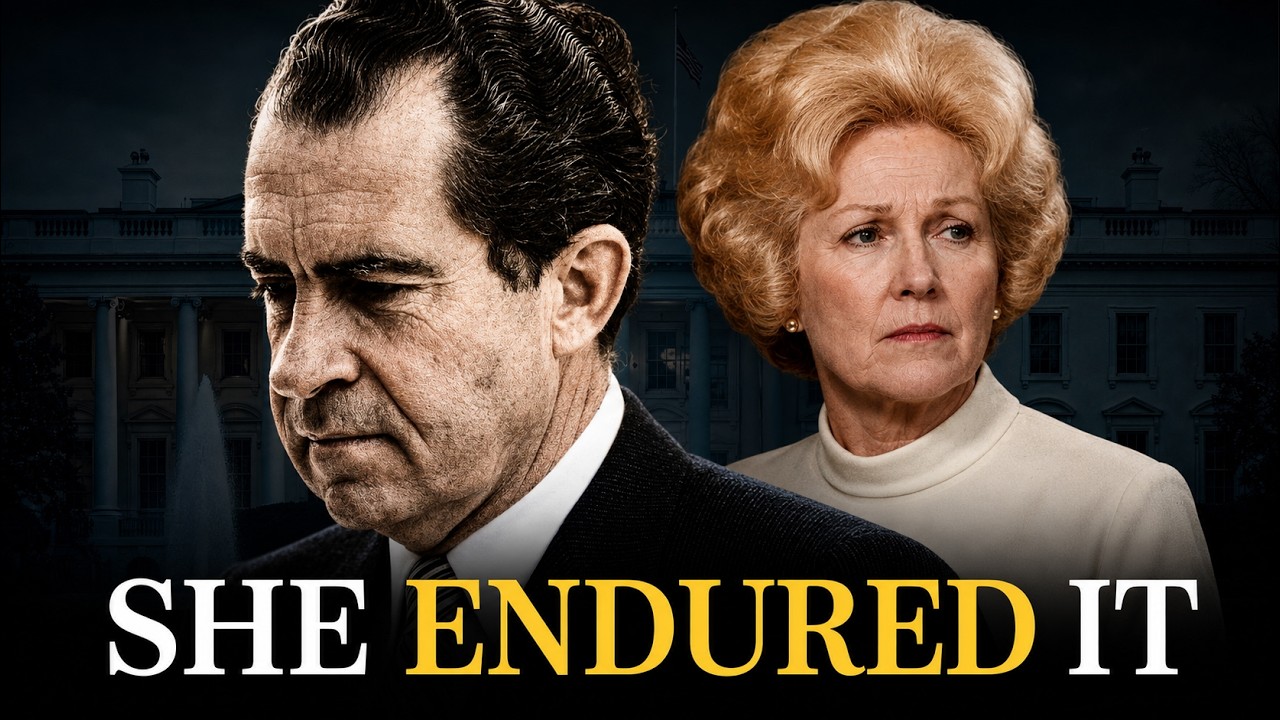
He chose to do it by reading his family’s private finances aloud. The mortgage on their Washington house, the mortgage on their Whittier house, the loan from his parents, the debt against his life insurance, the age of the family Oldsmobile, and the detail that his wife owned no mink, only a respectable Republican cloth coat. Pat learned the shape of the speech along with the rest of the country, as he spoke. The broadcast saved him.
Eisenhower kept him on the ticket, telegrams flooded the switchboards, and the phrase “Checkers speech” entered the language. But the woman six feet away loathed every minute of it. Biographers who reconstructed the night from her friends and family describe a humiliation she never entirely swallowed. Something shifted inside that theater.
Her husband discovered that their private life could function as a political instrument, and he never surrendered the discovery. The quiet ambition had begun years earlier. In 1938 Whittier, California, a 25-year-old lawyer with a thin practice attended a tryout for an amateur play. He noticed a red-headed school teacher across the room.
On the first evening of their acquaintance, before a proper conversation, before learning where she lived or what she read, he told Thelma Catherine Ryan that he intended to marry her. She laughed at him. She laughed for two years. Richard Nixon pursued her with grinding persistence, composing poems in longhand, arriving unannounced, bloodying his chin on a skating rink because she skated and he did not, driving forty miles on a weeknight for twenty minutes of her company.
Historian Will Swift, who worked through their private papers, describes a courtship running almost entirely in one direction. On weekend mornings, Nixon drove Pat into Los Angeles so she could date other men. Sunday afternoons, he waited outside to drive her home, knowing exactly where she had been and with whom. He drove her anyway.
He wanted more than she returned, and he kept accounts. Pat married him in June 1940. Colleagues later recalled that the bride seemed considerably less certain than the groom. His courtship letters, held by the Nixon Library, read as part love poem and part audition.
He worried on paper that he might bore her. He also made a promise: that the two of them together would do something for the world that mattered. Julie Nixon Eisenhower, the couple’s daughter, points to that ambition as the moment her mother yielded. Pat Ryan had buried her mother at thirteen and her father at eighteen, worked from childhood onward, and recognized ambition the instant she heard it described.
Her replies to his letters survive in far smaller numbers, written sparingly, teasing. He wrote and wrote. She answered when the mood struck, and the mood did not strike often. In 1946, a committee of Whittier businessmen sought a Republican willing to challenge the district’s five-term congressman.
Richard Nixon applied. Pat agreed on one condition, which she repeated to friends for the rest of her life: no political speeches. She campaigned, shook hands, drove the car, ran the office, counted leaflets, and for six years refused to stand at a microphone. She had wanted to marry a country lawyer.
She pictured a house, a garden, two daughters, a husband who returned for dinner. What she received instead was a red-baiting congressional race, a Senate seat won by innuendo, and a vice presidency at forty. Biographer Heath Hardinge Lee argues that Pat understood the trade she accepted, and that entering political life with open eyes cost her more than ignorance ever would. Understanding a bargain and enjoying it occupy separate rooms.
The Checkers speech taught its lesson in four words: personal exposure moves votes. The man who discovered this at thirty-nine would spend the next two decades locking his own intimacies in a drawer while spending his wife’s on national television. She never asked him to stop. No aid, daughter, secretary, or biographer ever recorded a single word of thanks from him for the loan of her private life.
The public read Pat Nixon as a supporting actress, the frozen smile beside the man at the podium. The private record suggests a marriage in which one partner spoke to the entire world and could not speak to the woman across the hall. She kept no diary. Historians reconstruct her interior life from the people who watched her.
After losing the presidency to Kennedy in 1960, Nixon ran for governor of California in 1962 and lost badly. The morning after, he told reporters they would no longer have Nixon to kick around. Pat believed him. She received the announcement with relief that bordered on joy.
The family moved to New York, and she unpacked with the expectation of staying. In 1968, he ran again. Nobody consulted her in the sense that consultation implies a possible refusal. She understood the conversation would conclude in exactly one direction.
The Nixons entered the White House in January 1969 and requested separate bedrooms. The arrangement itself proved nothing; presidents and their wives frequently sleep apart. The memos interested historians far more. Richard Nixon communicated with his wife by dictated memo, typed on White House paper, and delivered by an aide who walked it down the corridor.
Instructions about her schedule, notes about which guests would accompany her, matters a husband might mention across the breakfast table. Two people occupied the same house, the same floor, sometimes the same hour. One dictated a paragraph to a stenographer in the West Wing so a third party could carry it upstairs to the other. Chief of Staff H.
R. Haldeman ran the door. His diaries, released after his death, record a contempt for Pat Nixon that bordered on the pathological. He mocked her requests, rerouted her calls to the residence, and delayed her memos for weeks.
The woman who lived in the building needed clearance from a former advertising executive to speak with her own husband. Julie Nixon Eisenhower disputes this picture, arguing that her mother ran her own staff and carried a diplomatic portfolio through more than eighty countries. Both propositions survive the record intact. In July 1973, Alexander Butterfield told a Senate committee that the president recorded his own conversations.
Pat Nixon learned about the taping system from the news. Her husband installed the machines in February 1971 and never mentioned them to the woman sleeping down the hall. Pat delivered the only piece of political advice anybody records her giving: burn them. She regarded the tapes as private property.
Nixon refused. When the edited transcripts appeared in April 1974, Pat read what her husband sounded like behind a closed door: the flat managerial tone applied to hush money for Howard Hunt and to the obstruction of justice. According to her daughter, she recoiled, never opened the transcripts a second time, and never discussed a line of them with her husband. On the morning of August 9th, 1974, she stood in the East Room while he addressed the staff.
The cameras held on her face long enough that reporters in the room argued afterward about what exactly they witnessed. In April 1976, Woodward and Bernstein published *The Final Days*, claiming the couple shared no physical intimacy for fourteen years. Eleven weeks later, on July 7th, Pat Nixon suffered a stroke that paralyzed her left side. Doctors diagnosed a cerebral hemorrhage.
Correlation, not proof. Richard Nixon, on this point the biographers agree without argument, nursed her attentively and read to her in the afternoons. Staff members recall him weeping in the kitchen. A second stroke arrived in 1983.
She recovered less of herself that time. When she died of lung cancer in June 1993, Nixon wept openly at the graveside in front of cameras for the first time anyone present could remember. He outlived her by ten months. Between 1974 and 1980, Nixon labored at a single project: the reconstruction of his own reputation.
Pat declined to participate in any part of it. No interviews, no joint appearances, no contribution to the memoirs. She gardened, answered letters from strangers in her own handwriting, and watched her grandchildren swim. Reporters stopped calling.
Nixon, who knew exactly how a sympathetic wife at a podium looked, never once talked her back onto one. The marriage will never resolve into a verdict. The only person qualified to deliver one left no diary, no memoir, no unguarded interview, and no letter stating plainly what the arrangement cost her. What remains is the memos, the separate rooms, the two broken promises, the coat, the tapes she wanted burned, the eleven weeks between a book and a stroke.
Against all that, a daughter’s love. Set beside it, a box of courtship letters from a boy who drove her to other men and waited in the car. Pat Nixon guarded her silence till the end. The archive kept talking anyway.
The stone over her grave repeats a line drawn from her own words, about strangers recognizing love in a person’s heart even without a shared language. She spent fifty-three years beside a man who told the country everything about his household and almost nothing to the woman living inside it. The loneliness she never announced survives in the shape of the objects around her: a chair angled six feet from a desk, a memo carried down a hallway by a stranger, a bedroom door, a book she read in April, and a hospital bed she occupied in July.