On the morning of 30 July 1997, Dale Tryon had herself carried into her own dress shop on Beauchamp Place, the most photographed street in London. Paralyzed, publicly humiliated, and in the middle of a divorce, she picked up a telephone and asked the reporters to come. She wanted to be seen. Six weeks earlier, police had detained her under the Mental Health Act after her husband told journalists she had “flipped.
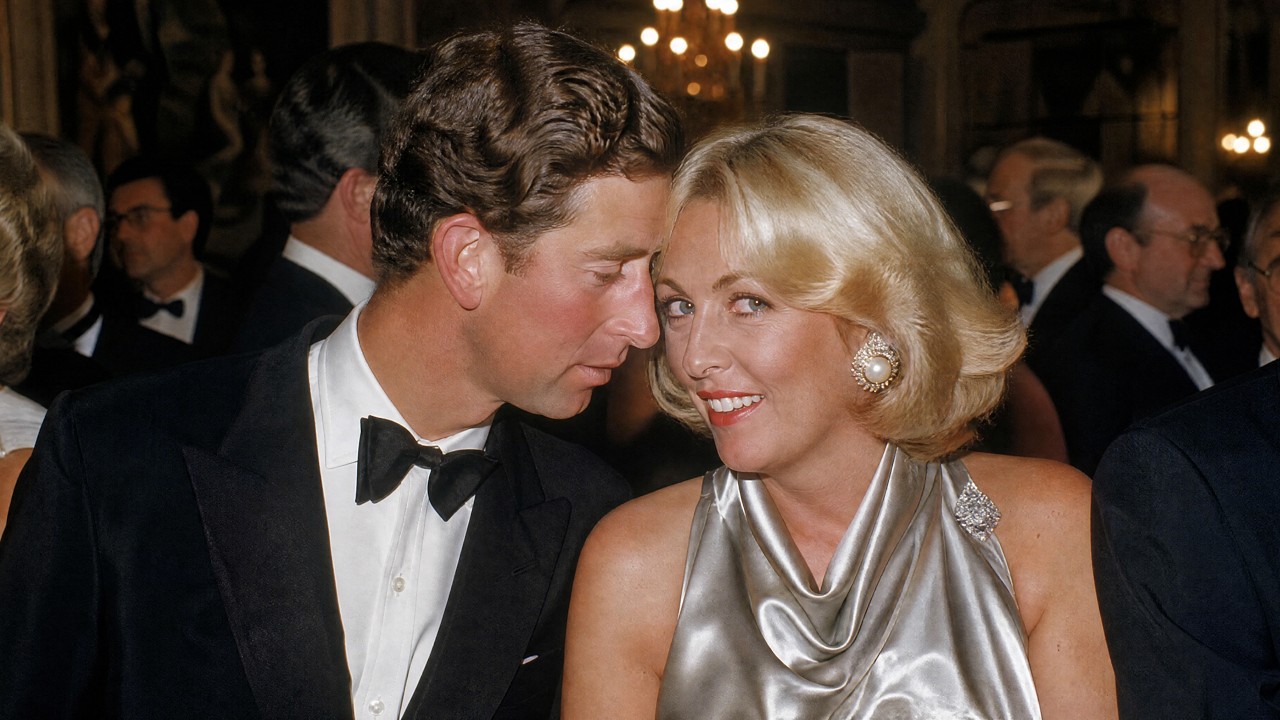
” Eleven weeks after Diana died in Paris, Dale Tryon died too, aged 49, divorced, using her maiden name again, buried in a grave whose location was never recorded. She had spent her whole life reaching for the cameras. In the end, they looked away. She was born Dale Elizabeth Harper on 3 January 1948 in Melbourne, the eldest of three children of Barry Harper, a wealthy printing and publishing magnate.
She was born with spina bifida and did not take her first steps until she was nine. The restlessness that marked her entire adult life—the fishing, the four fashion collections a year, the weekly dinner parties—grew directly out of those years spent unable to move. Her working life began in the trade that would eventually destroy her: she became a society reporter for the Australian Women’s Weekly, learning precisely how a private detail becomes a public paragraph, how a life is turned into copy that sells. The reporter would one day become the reported.
In 1969 she moved to London and within two weeks had met the man she would marry. Anthony Tryon, born in 1940, was a merchant banker at Lazard Brothers, a captain in the Wessex Yeomanry, and already a member of the Prince of Wales’s inner circle. His father, Charles Tryon, had been keeper of the privy purse to the Queen for 19 years; Anthony himself had been a page to the Queen. This was a family woven into the private machinery of the monarchy.
On 13 April 1973, Dale married Anthony in the Chapel Royal inside St. James’s Palace, an honour granted because of the family she was joining. As she walked down the aisle, she later said, she felt on a crest, as if she could never be happier. The family settled at Aughbury House in Wiltshire.
A signed photograph of Prince Charles stood beneath an inherited clock in her drawing room, and she was happy for a magazine to describe it. Four children followed: Zoe in 1974, Charles in 1976, and twins Edward and Victoria in 1979. Prince Charles stood godfather to the boy, christened at St. Andrew’s Church in Great Dford.
The friendship lived most truly on the water. Every summer the Tryons fished a river in northeast Iceland, the Hofsá, far from the London press; a pool on that river still carries the prince’s name. Dale was a genuine angler in her own right, skilled enough to be written up in a book about women and salmon. In December 1977, aged 29, she sat down with the magazine that had once employed her and talked warmly and at length about her friendship with the future king.
She guarded the location of the river, saying she could not say where it was because the prince went there too. Yet in the same breath she volunteered the nickname he used for her, Kanga, the godfatherhood, and the fact that he was one of her husband’s five closest friends. She thought she was being discreet. She was drawing her line in precisely the wrong place: she protected the geography and gave away the relationship.
A woman who had been a professional journalist knew what a quotable line looked like, and she gave them freely. In 1983 she opened a shop called Kanga on Beauchamp Place, a short strip of pavement that had become one of the most watched in London because Princess Diana regularly dined at San Lorenzo a few doors along. Diana’s couturier had premises on the same pavement. The entire commercial logic of the shop depended on proximity to the royal world.
At its height, the business turned over more than one million pounds a year. But somewhere in the recession of the early 1990s, in a single clause of a single newspaper, it folded. The set around the Prince of Wales prized one virtue above all others: discretion. Its members could be trusted to know things and never say them.
According to one biographer, exclusion from the circle came quietly as silence rather than confrontation: the prince would simply stop speaking to a person, the small courtesies falling away, followed by total social exclusion with no farewell. Dale’s place in that circle had always been borrowed, held through her husband. When it came time to close the door, there was no need for a scene. The people who had shared her table simply stopped answering.
The most famous sentence about her—that she was “the only woman who ever understood him”—cannot be traced to the man supposedly said to have spoken it. It first appeared in print in 1989, hedged with the words “he was said to have described. ” It surfaced in a tabloid around 1987, in the middle of a press frenzy inventing stories about the Prince and Princess of Wales’s marriage. It entered books with no source, became an obituary fact by 1997, and was still being printed a quarter of a century later.
Nobody ever produced a date, a place, or a witness. In the early summer of 1996, at a confidential clinic in the Surrey woods, Dale fell from a window. The spinal condition that had kept her from walking as a child had returned, bringing several painful operations. In 1993 she had been treated for cancer of the uterus.
She was in chronic pain, on heavy medication, and, in the careful words of her obituary, given to the unwise consumption of vodka and champagne. The press could not agree how far she fell: one report said 25 feet from a third-floor window, another said a first-floor window. No inquest into the fall or into her death could be found. She suffered a fractured skull and a broken back, and from that summer she was paraplegic, spending ten months in the spinal injuries unit of Salisbury District Hospital.
On Saturday 14 June 1997, her husband returned from a fishing trip to Russia and told her he wanted a divorce. Days earlier she had been told her cancer had not returned. On Tuesday 17 June, she telephoned a news agency herself to say she was shocked and distraught. That afternoon she sat in the garden of the Black Horse Inn in her wheelchair with the actress Sarah Miles, had nothing to drink, and left shortly after two.
At about 2:20, police were called to a house in the village. They spoke to her and she made what the inspector called spurious allegations, saying she felt her life was in danger. The officers formed the impression she could be detained under the Mental Health Act, and she was brought to Salisbury Police Station, a lawful place of safety in 1997. Psychiatrists began an assessment.
She was discharged one month later. The day after she was detained, her husband stood on the manor lawn and told the reporters his wife had flipped. He blamed months of odd behaviour. His mother, the dowager Lady Tryon, said the family was brokenhearted and appalled for the grandchildren’s sake.
Dale answered publicly, protesting that he had falsely accused her of being mad and an alcoholic. Twenty years earlier she had told a magazine her husband was so gentle, but so strong and such an honourable person, and that she would never hurt him. The gap between those two statements is the marriage itself. Her marriage ended in law on 1 September 1997, the day after Diana died in Paris.
She reverted to her maiden name and became Dale Harper again. She flew to Australia to be with her mother, and from there went to Delhi for treatment from a doctor who had been introduced to her by the Prince of Wales. Even weeks from the end, he was still trying to find her a doctor. She became seriously ill in India, was flown home at the start of November, and was admitted to the London Clinic with complications from severe bed sores.
On 15 November 1997, she died of septicaemia. She was 49. Her four children and her brother were with her. She had left the prince’s letters lying about so that visitors would recognise his spider handwriting.
Shortly before she died, those letters disappeared; one family source suggested her husband may have posted them back to the prince. They never turned up in the belongings the family sorted through after Lord Tryon’s own death years later. Her funeral was private; where she is buried has never been publicly recorded. No public statement, tribute, or reference of any kind to Dale Tryon by Charles, as prince or king, can be found anywhere.
The only remark ever attributed to him about her is the sentence no one can prove he said. Her elder daughter went to live in the rainforest of the Ecuadorian Amazon among an indigenous people, working for their land against the oil companies, as far from the society pages of London as a person can get. On Garter Day in June 2024, a ten-year-old boy named Guy Tryon, Dale’s grandson, served as a page of honour to King Charles, the fourth generation of his family to serve in the royal household. He walked behind the king, and it is a fact and only a fact.
She had been born unable to walk, and she died unable to walk. Between the two she crossed the world, married inside a palace, fished the same rivers as a king, built a business with her own name above the door, and was broken by the one appetite she could never master: the need to be seen. She had said it herself years before the end, in the plainest words she ever spoke: happiness comes from within; you cannot rely totally on another person to make you happy. She had spent her whole life reaching for the cameras.
In the end, they looked away.