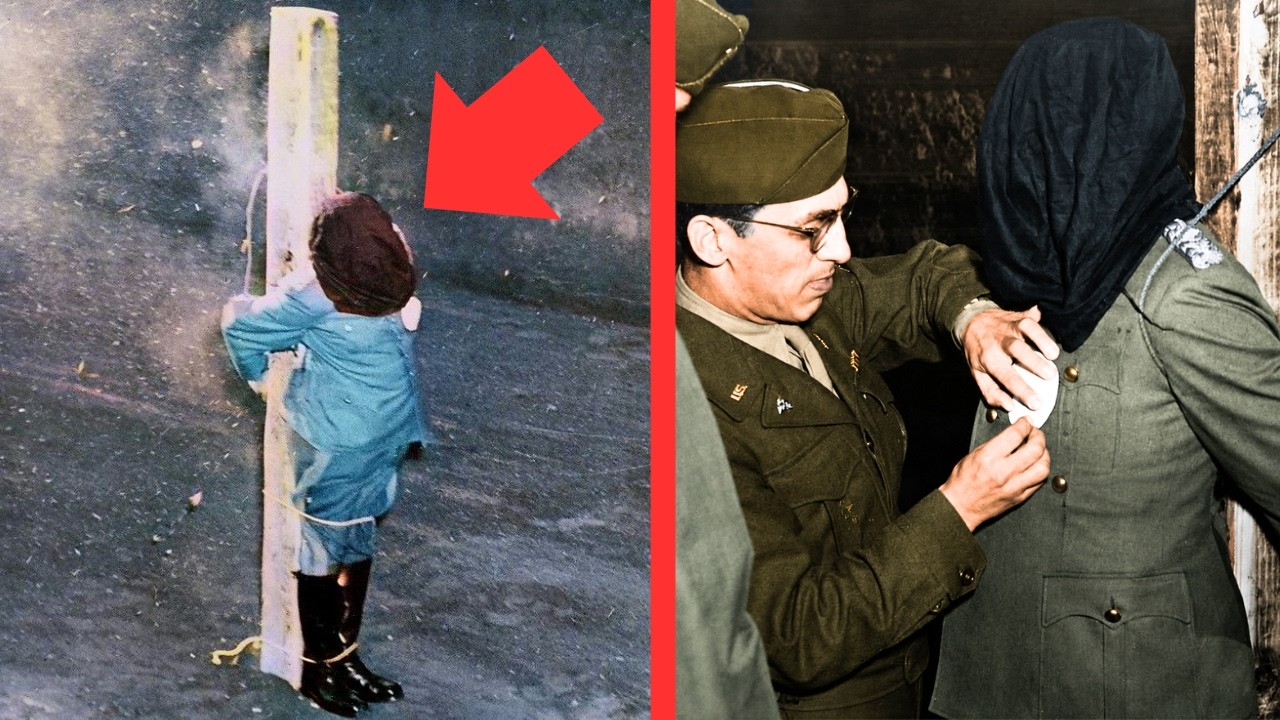
At dawn on December 1, 1945, Anton Dostler was led from his cell to a firing range in the Italian city of Aversa. Waiting for him was a thick wooden stake, surrounded by earthworks and ringed by hundreds of American soldiers and military officials. Photographers stood ready to record every moment. The condemned man was an officer of the old German army, a general with four decades of service who had risen through the ranks of two world wars.
Now he was about to become the first German general executed by an American firing squad. Dostler’s path to that stake had been long and, for most of it, unremarkable. Born in 1891, he joined the German military as a teenager and served as a junior officer on the Western Front during the First World War. When Germany’s army was reduced to just 100,000 men after the Treaty of Versailles, Dostler remained in uniform, one of the professional core that survived the postwar cut.
When Hitler began rearming in the 1930s, experienced officers like Dostler were needed to shape the new, expanding forces. From the beginning of the Second World War, he served in staff and command positions: chief of staff for the Seventh Army, commander of the 57th and later the 163rd Infantry Divisions, and eventually commander of the 75th Army Corps near the Italian coast. The crime that sealed his fate occurred in March 1944. Fifteen American soldiers landed on the Italian coast near La Spezia, behind German lines.
Their mission, codenamed Operation Ginny II, was to demolish a railroad tunnel at Framura and disrupt the vital supply line between La Spezia and Genoa. All fifteen men wore their proper American field uniforms. They were not disguised as civilians or enemy troops. This detail would become critical.
The operation went wrong almost immediately. The men were dropped at the wrong location, struggled to recover, and were forced to hide while waiting for extraction. An Italian fisherman spotted their rubber boats and alerted a local fascist militia, which in turn informed the Germans. German forces swept the area and soon captured all fifteen Americans hiding in a nearby barn.
The prisoners were taken to the headquarters of the 135th Fortress Brigade for interrogation. During questioning, one of the Americans admitted they were on a commando raid to blow up the tunnels. The information, including the word “commando,” reached General Dostler. He passed it up the chain to his superior, Field Marshal Albert Kesselring.
Kesselring ordered the execution of the Americans under Hitler’s infamous Commando Order of 1942, which demanded that all enemy commandos and saboteurs be shot immediately without trial. Dostler passed the order down. The man on the ground, Colonel Almers, was uneasy. The prisoners had been captured in their own uniforms, which should have granted them the protections of prisoners of war under international law.
He tried to delay the executions. Dostler insisted they be carried out. On March 26, 1944, the fifteen Americans, still in their uniforms, were lined up on a rocky outcrop overlooking the sea. A German firing squad shot them all.
They were buried in a mass grave. When the war in Europe ended, Dostler fell into American hands. Investigators soon learned what had happened to the fifteen soldiers. Within days of the German surrender, Dostler was put on trial in Italy.
It was the first war crimes trial conducted by the Americans. His defense rested on two claims: that he had only relayed an order from Kesselring, and that the executed men were legitimate targets as commandos or saboteurs. Both arguments collapsed. The men had worn American uniforms when captured, making them prisoners of war under the protections of the Geneva Conventions.
Commandos and saboteurs in civilian clothes or enemy uniforms could be legally shot, but men captured in their own army’s uniform could not. And Dostler had done more than relay an order. He had personally pressed for the executions when the officer on the ground hesitated. The order was illegal, and he knew it.
The court found him guilty of war crimes and sentenced him to death. Months passed while his appeals for clemency were filed and rejected. Finally, on the morning of December 1, 1945, an hour before eight, he was taken to his execution. The Americans granted him small mercies.
He was not dragged to the stake; he walked there steadily, freely, his hands unbound. The division chaplain walked beside him to hear his final words. He was permitted to wear his German general’s uniform, his officer’s cap still on his head. The execution was a military affair, and he would die as a soldier.
When he reached the wooden post, his arms were pulled behind him and bound around the stake. A white cloth was pinned to his chest to give the firing squad a clear target. A thick black hood was placed over his head, blocking his view of the men who would kill him. His last words were: “Long live Germany.
”
Twelve soldiers stood ready. One rifle was loaded with a blank round, so no man in the squad could be certain he had fired the fatal shot. Half the squad knelt in front, the rest stood behind. At the command, they fired.
The bullets tore through Dostler’s body with such force that they split the wooden stake behind him. Smoke rose from the holes in his back. No final mercy shot to the head was needed. His body slumped against the post, and the hood slipped partially from his face under the violence of the volley.
His body was lowered, placed in a coffin before the assembled witnesses, and later buried in a German war cemetery near Lazio. The execution of Anton Dostler remained an unusual case. The Americans rarely executed enemy officers by firing squad at the end of the war; most condemned Nazi leaders were hanged as common criminals, as were those tried at Nuremberg. The photographs of Dostler’s final moments, released to American media, showed the brutal reality of his death: the bullets piercing his body and splitting the wood behind him.
It was swift justice, and it was severe. But Dostler had been no mere messenger. He transmitted an order he knew to be unlawful, and he enforced it over the objections of the very officer responsible for carrying it out. For the fifteen American soldiers who died in their uniforms on that rocky shore, the law demanded an account.
In the end, Anton Dostler answered it, bound to a wooden stake on a firing range, facing his death blindfolded but walking toward it with steady steps.