In October 2000, a nineteen-year-old college dropout named Shawn Fanning stared out from the cover of Time magazine. His company, Napster, had eighty million registered users and was adding new ones faster than any internet service in history. Fourteen thousand songs were being downloaded through it every minute. Yet just eighteen months earlier, the application had not existed.
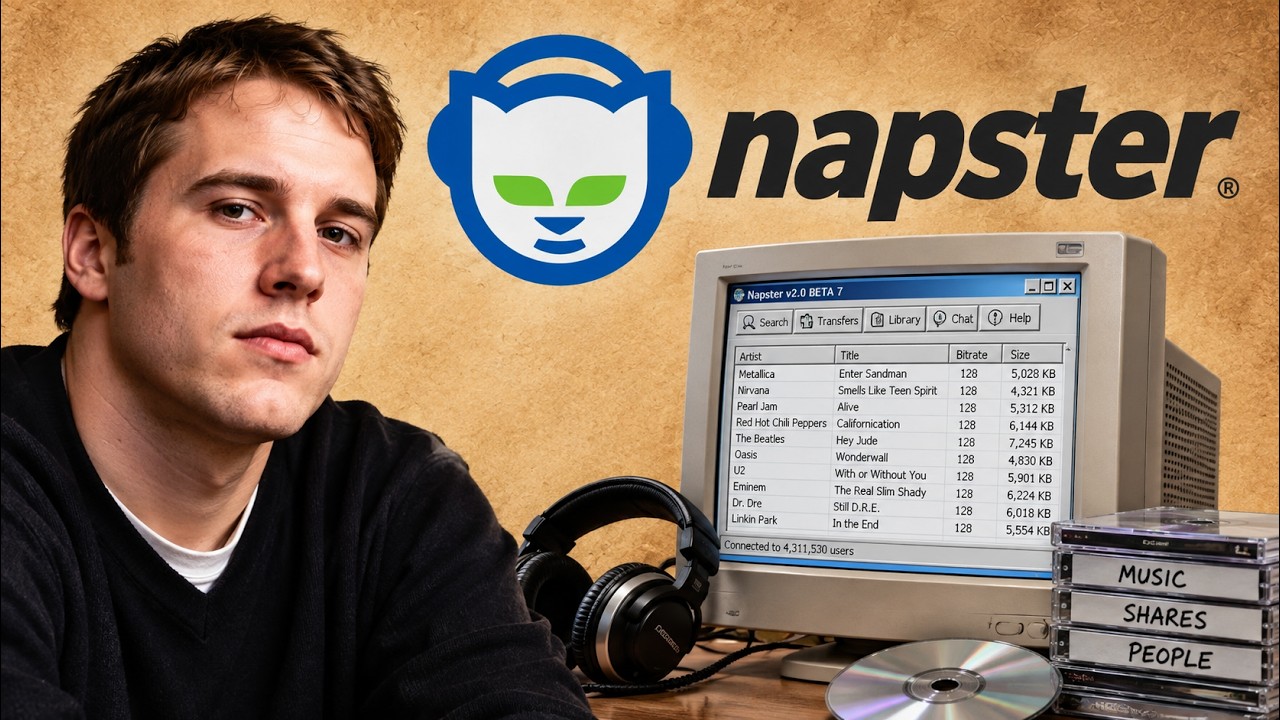
Fanning had coded the first version on a borrowed PC in his uncle’s office in Massachusetts. By June 2002, Napster had filed for bankruptcy. By November, everything the company owned—its name, its technology, its trademarks—sold at auction for $5. 3 million, less than the price of a single house on the hillside above the San Mateo office where the company had once operated.
A service that had reached more people faster than television, the telephone, or the web itself had been dismantled in just over two years by the industry it threatened. Fanning was born in 1980 and raised by his mother in a working-class neighborhood south of Boston. His uncle, John Fanning, a restless entrepreneur, gave him his first computer and became a father figure. Fanning taught himself to code, spent summers at his uncle’s internet company, and honed his skills in IRC chat rooms under the handle Napster, a nickname derived from the texture of his hair.
There he met two people who would shape everything: Shawn Parker, a seventeen-year-old with an instinct for deals, and Jordan Ritter, a twenty-year-old dropout and paid security hacker. In 1998, Fanning enrolled at Northeastern University, but what consumed him was a frustration every internet user of the late nineties understood: finding music online was miserable. MP3 files existed, but the tools for finding and downloading them were broken and scattered. Fanning saw the gap and started writing code to fix it.
The American recording industry of 1999 was at the zenith of its power. Record labels sold compact discs at prices that had climbed to eighteen and nineteen dollars, while the cost of manufacturing each disc had dropped below a dollar. Total revenue had reached $14. 6 billion, the highest in industry history.
No one inside those corporations believed a teenager with a modem posed any threat. Over the winter of 1998 and into the spring of 1999, Fanning sat at a borrowed PC in his uncle’s office and wrote code for roughly three months. The application combined three things that had never been put together: a search engine that could scan the music libraries of every connected user, a peer-to-peer file transfer protocol that let users send songs directly to each other, and an instant messaging system that let them talk while they did it. Ritter took over the server-side architecture.
Parker found investors and secured roughly $50,000 in seed money. In June 1999, Fanning distributed a test version at Northeastern. The spread was immediate. You typed a song title into a search bar, saw which users had it, clicked, and within minutes you had the song.
For the first time in the history of recorded music, the full catalog was accessible to anyone with a computer and an internet connection. By the summer of 1999, the three had relocated to San Mateo, California, sharing a room at a Marriott Residence Inn because they could not afford anything else. By fall, without a single dollar spent on advertising, Napster had 150,000 registered users and four million songs. The Recording Industry Association of America filed its lawsuit on December 6, 1999, barely six months after the service launched.
The suit alleged contributory and vicarious copyright infringement. The message was clear: this was a killshot. Venture capital firms ran. Ron Conway, a veteran Silicon Valley angel investor, placed a $200,000 bet anyway.
Then came the weekend that nearly killed the company before the courts could. During the Webbys in the spring of 2000, Hummer Winblad, the firm in talks to lead a major funding round, pulled back while Parker and Fanning celebrated, unaware. Conway found them, told them the money was evaporating, and helped re-engage the firm. The round closed in May 2000 at $15 million, the only major venture investment Napster would ever receive.
By the summer of 2000, Napster had twenty million active users. Universities felt the traffic immediately; some banned the service outright, others upgraded bandwidth just to keep up. The service was no longer a product. It was a phenomenon running on servers held together by engineers who had not slept properly in months.
The pivot in Napster’s story is a decision: to keep fighting, take the venture money, hire lawyers, and try to survive long enough to become legitimate. Hank Barry, the new CEO, hired David Boies, the most famous litigator in America, fresh from the government’s antitrust case against Microsoft. In July 2000, the Senate Judiciary Committee convened a hearing on digital music. Chuck D of Public Enemy testified in Napster’s defense.
Lars Ulrich of Metallica testified against it. The hearing settled nothing, but it crystallized the battle lines. In October 2000, Thomas Middelhoff, the CEO of Bertelsmann, which owned BMG, did something no other music executive had the nerve to do. He loaned Napster $20 million and announced a partnership to convert the service into a legitimate paid subscription platform.
He believed the other major labels would follow. They did not. Sony, Warner, EMI, and Universal saw the move as a betrayal. Middelhoff was exactly right about what the future would look like.
He was four years too early, and he was alone. That $20 million bet was the closest Napster ever came to survival. Napster’s growth was driven by three forces the industry had spent a decade ignoring. The first was the MP3 format, developed in Germany in the early 1990s, which compressed a song to a tenth of its original size.
The second was broadband internet, which arrived on American college campuses before it reached American homes. On some campuses, 61 percent of all external network traffic was MP3 transfers. The third was the industry’s own pricing strategy: no legal digital storefront, no download service, no streaming option, and an $18 price tag for an entire album when you wanted one song. Napster did not create the demand for free digital music.
The demand was already there, vast and unmet. Napster was simply the first application that served it competently. The lawsuits arrived in waves. On April 13, 2000, Metallica sued, triggered by an unreleased track that had appeared on Napster before the band had finished mixing it.
The band identified 335,000 usernames sharing its music and demanded every account be blocked. College students, the same demographic that had made Metallica one of the best-selling rock bands in the world, turned on the band with fury. Then came the central case: A&M Records versus Napster, before Judge Marilyn Hall Patel. In July 2000, she granted a preliminary injunction ordering Napster to stop facilitating the sharing of copyrighted music.
The appeals court stayed the ruling for six months, but on February 12, 2001, a three-judge panel upheld it. Napster was liable for contributory and vicarious copyright infringement. Eight days later, Napster made a final offer: $1 billion, structured as $150 million per year paid directly to the major labels. Sony called it nonsensical.
Warner, EMI, and Universal rejected it. Only BMG supported the deal. The industry had decided Napster would die. No amount of money was going to change that verdict.
The company tried to comply with the court order, hiring fifty temporary workers to manually search file names, but the task was impossible at scale. Every song removed reappeared under a different name within minutes. On July 1, 2001, Napster’s senior director of technology shut off the servers. The network went dark.
Napster filed for Chapter 11 bankruptcy in June 2002. A proposed acquisition by Bertelsmann was blocked by the bankruptcy court. In November 2002, Roxio, a company best known for CD-burning software, purchased Napster’s name and technology at auction for $5. 3 million.
The brand was relaunched, sold to Best Buy, absorbed by another company, renamed, and sold again. Each buyer hoped to extract something from the ghost of a company that had been dead for over a decade. Fanning left to found a series of startups, none of which had the cultural force of the thing he had coded on a borrowed computer. Parker became the founding president of Facebook.
Ritter went on to co-found Cloudmark. The three young men moved on. The thing they had built together could not. After Napster died, its users did not stop downloading music.
They moved to decentralized networks that had no central server to subpoena and no company address to serve with a lawsuit. The music industry responded by suing individual users, filing tens of thousands of lawsuits against college students, single mothers, and in at least one documented case, a deceased grandmother. The strategy changed almost nothing. On April 23, 2003, Apple launched the iTunes Music Store, selling individual songs for 99 cents each.
It was in nearly every functional respect the legal version of what Napster had built. The labels, humbled by four years of piracy and plummeting revenue, agreed to terms they would never have considered in 1999. In 2011, Spotify launched in the United States, offering the full-catalog streaming model that Napster and Bertelsmann had proposed a decade earlier. The global recorded music industry, driven almost entirely by streaming revenue, has since surpassed its 1999 peak.
The model that replaced the compact disc is the model a teenager demonstrated twenty-five years ago: search, find, listen. The industry just had to destroy Napster first before it was willing to build it.