In 1920, America was astonished by an unexpected success story. Moxie, a distinctive soda born from the ashes of the Civil War, had not merely challenged Coca-Cola—it had decisively outsold it across the entire nation. The humble nerve tonic from Lowell, Massachusetts, had toppled the Atlanta cola giant. Ninety-eight years later, the ultimate corporate irony unfolded.
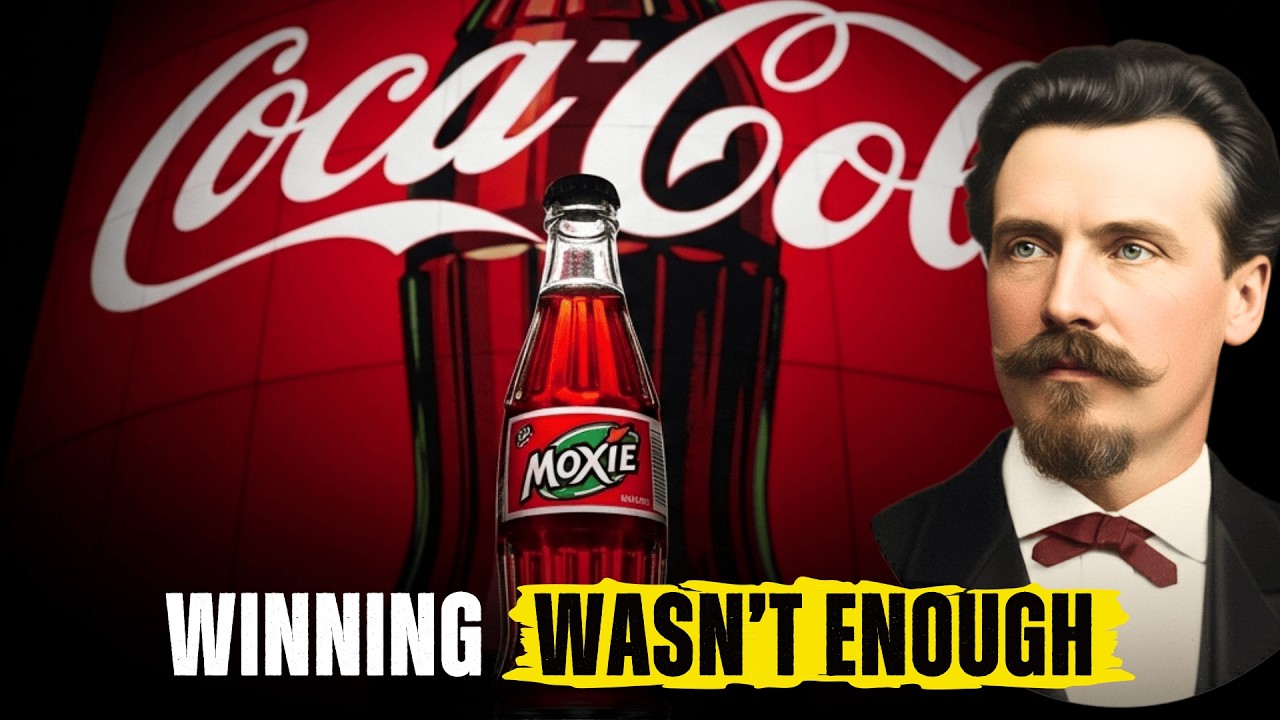
Coca-Cola, the behemoth that Moxie had once humiliated, bought its old rival. The drink that had sat on the throne of American beverages was reduced to a historical footnote, a trophy claimed by the very competitor it had defeated. Yet even as the defeated company absorbed the brand’s physical empire, its spirit found an unexpected refuge. Today, open any dictionary, and you will find that “moxie” is defined not as a beverage but as energy, vitality, courage, and determination.
The drink may be a fading memory on store shelves, but the word lives on in the American vernacular—a monument to a brand that refused to die quietly. The origins of this saga lie in the scars of a physician and the promise of a miracle root. In 1876, America was still recovering from its internal strife. Dr.
Augustin Thompson returned from the horrors of the Civil War, haunted by field hospitals, agonizing amputations without anesthesia, and the screams of soldiers. The war had officially ended eleven years earlier, but for Thompson and countless others, the damage persisted. He diagnosed his own condition as nervous exhaustion. In the unregulated medical era of the nineteenth century, the line between visionary healer and cunning huckster was blurred.
Thompson wove a tale that the name was inspired by his friend, Lieutenant Moxie, who had supposedly discovered a miracle plant in South America. Historians now know that Lieutenant Moxie never existed. It was Thompson’s first great marketing ploy, a fabrication designed to lend exotic appeal to a bottle of bitter roots. In 1876, post-war America teemed with exhausted men and women.
Factory workers collapsed from fatigue, railroad laborers suffered chronic exhaustion, and women, whose ailments were dismissed as hysteria, endured silent weariness. Thompson believed he had found a remedy not in traditional medicine but in the quiet power of nature: the gentian root, bitter and distinctive. He extracted and concentrated its essence, mixed it with pure water, and sold it as a tonic in pharmacies throughout Massachusetts. He named it boldly: “Moxie Nerve Food.
” Its claims were anything but subtle. It would cure nervous exhaustion, restore lost manhood, and treat mental disabilities. In the freewheeling spirit of 1876, few questioned such assertions. Within a year, Moxie was available in every pharmacy in Lowell.
Within three years, its distinctive brown bottles adorned shelves across Massachusetts. Its bitter taste was celebrated as proof of efficacy; customers nodded wisely that medicine shouldn’t taste good—if it was bitter, it was effective. By May 1884, as popularity grew, Thompson made a fateful decision that changed the course of his creation and the entire beverage industry. He decided to stop selling medicine and start selling refreshment.
The core formula remained, but the marketing shifted radically. “Moxie Nerve Food” was simplified to simply “Moxie. ” The bold medical claims faded. Carbonation increased, bottles grew larger, transforming from small medicinal vials to thirst-quenching containers.
Thompson understood something essential that Coca-Cola, still clinging to its semi-medical roots, would not grasp for a decade: Americans didn’t really want medicine disguised as a drink. They wanted an excuse to feel good about enjoying something delicious. The first dedicated Moxie bottling plant opened in 1885. Production doubled annually, and by 1890, Moxie had established strong distribution networks across New England.
As the brand expanded into the Midwest, its dominance became undeniable, spawning a flood of imitators. By 1907, the threat from copycats reached a critical point, forcing the company into historic legal battles. By 1910, Moxie’s fame had reached as far west as California. The bitter taste that originally distinguished it as medicine now served a powerful new purpose: it made Moxie unique.
While Coca-Cola offered familiar sweetness, Moxie’s bold flavor created intense loyalty. From President Theodore Roosevelt to major league baseball heroes, endorsements poured in. By 1915, Moxie had transcended being merely a beverage; the phrase “you’ve got moxie” had become a compliment signifying courage and daring. Then, in 1920, Moxie achieved what no one imagined: it outsold Coca-Cola nationwide.
Dr. Augustin Thompson, then 73, had built a magnificent empire from a simple bitter root. But he had also placed a clear target on his back. The Coca-Cola giant was watching from Atlanta, preparing to respond with force.
In the spring of 1923, Robert Woodruff, a man whose name would become synonymous with Coca-Cola’s global dominance, walked into his first board meeting as the company’s new president. At 33, he was considered controversially young. Whispers surrounded him—too young, too inexperienced, but undeniably ambitious. Woodruff cut through pleasantries with one piercing question: why are we losing to a medicinal drink from Massachusetts?
No one had a satisfactory answer. Coca-Cola boasted superior distribution, a powerful bottling network, and stronger trade relationships. Its product was sweet and appealing, requiring no acquired taste. Yet the company was losing.
Woodruff spent his first six months studying Moxie with obsessive precision. He analyzed their distribution patterns, their marketing messages, their regional strongholds, their pricing strategies. His analysis was revolutionary: Moxie had not triumphed through superior operations or logistics, but through its identity, its very name, the powerful idea that drinking Moxie expressed something profound about one’s character. Coca-Cola was just a drink.
Moxie was selling personality. But that carefully cultivated identity was expensive to maintain. It required constant reinforcement, a continuous flow of innovative marketing. Woodruff reviewed Moxie’s public financial reports and noted they spent roughly $100,000 annually on advertising—a substantial sum for a regional brand.
He proposed Coca-Cola spend one million dollars on advertising. The board hesitated. “We’re not advertising the product,” Woodruff said calmly. “We’re advertising an identity, one bigger than theirs, one that will redefine what it means to be American.
” The board reluctantly agreed. From the summer of 1923 through 1925, an intense advertising campaign began. Coca-Cola suddenly became ubiquitous. Billboards lined highways, glossy magazine ads appeared, the company sponsored baseball games, struck partnerships with soda fountains, and flooded public events with free samples.
The new campaign highlighted something deeper: depictions of cohesive American families sharing Coca-Cola, smiling soldiers returning home to a cold Coke, factory workers bonding during breaks. The implicit message was clear: Coca-Cola was what all Americans shared—a unifying force, not a drink for the uniquely strong or distinctive. It brilliantly turned Moxie’s greatest strength, its distinctiveness, into a weakness. If Moxie was exclusively for those with unique character, what did that say about millions of ordinary Americans who simply wanted a refreshing drink?
Coca-Cola’s ads offered the reassuring, inclusive answer: you don’t need a special character. You’re American enough. Coca-Cola is for you. The scale of Coca-Cola’s advertising budget was overwhelming.
What began as a 10-to-1 spending advantage quickly escalated to 15-to-1, then a crushing 20-to-1 by 1925. Moxie tried to respond, increasing its budget to $200,000 in 1925, but Coca-Cola spent $1. 5 million that same year. The math was impossible.
Advertising was only the first weapon in Coca-Cola’s arsenal. Woodruff demanded a bottle so distinctive one could recognize it in the dark by touch alone—the iconic contour bottle, a marketing weapon Moxie’s plain glass could not match. There was a fatal flaw in Thompson’s strategy compared to Woodruff’s genius: Moxie sold function, promising to calm nerves. Coca-Cola sold feeling.
When the government tightened its grip on false medical claims, Moxie’s entire identity became untenable. Coca-Cola was immune—you can regulate ingredients, but you can’t regulate feeling. Coca-Cola offered bottlers irresistible terms: higher profit margins, free equipment upgrades, comprehensive training programs. Moxie, already struggling, simply couldn’t match these offers.
And in the crucial soda fountain market, where most soft drinks were consumed, Coca-Cola began offering exclusive contracts. By 1926, they had secured exclusive fountain agreements with major chains nationwide—pharmacies, department store restaurants, train station kiosks. Places where Moxie had once dominated now offered only Coca-Cola. The sales impact was immediate.
In 1923, Moxie proudly outsold Coca-Cola nationally. By 1924, Coca-Cola matched them. By 1925, Coca-Cola pulled ahead significantly. By 1926, they led by a wide margin—a swift, decisive reversal of fortune.
Woodruff made a strategic decision that was almost brutal: Coca-Cola was willing to accept lower profits, even operational losses, for five full years to permanently eliminate Moxie’s national presence. The board resisted, protesting the massive losses. Woodruff replied calmly: “We’re not losing money. We’re acquiring permanent market dominance.
” He was correct. By 1927, Moxie’s leadership faced an impossible choice. The company was losing money steadily. Maintaining a national distribution network was too costly, competing with Coca-Cola’s advertising war chest was financially ruinous.
They could continue fighting nationally, a futile effort that would inevitably lead to bankruptcy within five years, or they could strategically retreat to their ancestral stronghold of New England. The decision came after a grueling six-hour board meeting, resolved by grim financial data. In 1928, Moxie began its painful withdrawal from western markets—California, Oregon, Washington—followed by the Midwest, and finally the South. By 1930, the once-national brand had shrunk almost entirely to its New England home.
On paper, it seemed a safe haven. In reality, it was a trap. Regional brands face enormous economic disadvantages. Smaller production volumes inevitably lead to higher unit costs, which translate to less competitive pricing, which means lower sales volumes.
From 1930 to 1935, Moxie suffered terribly. The second half of the battle was fought in the hearts of a new generation. By 1932, a deep demographic divide had emerged. The loyal generation that carried Moxie to national dominance was aging, their consumption declining naturally.
For every five aging Moxie drinkers, only one new young consumer was recruited. Coca-Cola invested millions ensuring its brand was synonymous with youthful American energy, professional sports, and Hollywood glamour. For the children of the Great Depression, Coca-Cola was the taste of the future. Moxie was perceived as a drink from their grandparents’ era.
The bitter taste, once Moxie’s distinguishing feature, became its greatest weakness. In a rapidly changing market, consumers gravitate toward products requiring the least effort to enjoy. While Coca-Cola offered instant gratification with sweetness, Moxie required several sips to appreciate—an impossible cost for acquiring new consumers in a world of shrinking disposable income. By 1935, Moxie was no longer a competitor in the mass market.
By 1939, the founding family, the direct descendants of Dr. Thompson, had reached financial and psychological breaking point. Internal records showed net income had declined nearly 80% since the mid-1920s. The sale of the company to a Boston investment consortium in 1939 marked the end of Moxie as a family-owned enterprise.
The new owners, financiers with no operational experience in beverages, treated Moxie as an asset to be stripped. Mistaking consumer loyalty for inelastic demand, they altered the core formula, replacing expensive natural extracts with synthetic alternatives and diluting the gentian root concentration. Longtime drinkers in Maine and Massachusetts noticed the betrayal immediately. Their beloved drink had been replaced with what they described as sweetened water.
By destroying the integrity that gave the brand its residual value, the Boston group destroyed its future. When World War II erupted, it tested American industry harshly. Woodruff launched a public commitment: a five-cent Coca-Cola for every soldier wherever they were, whatever it cost the company. By portraying Coca-Cola as essential to troop morale, Woodruff ensured his company received preferential treatment, bypassing sugar and metal rationing imposed on civilians.
The U. S. government funded and transported sixty-four overseas bottling plants during the war. While Moxie was confined to New England by rationing, Coca-Cola was building a global supply chain with taxpayer money.
Millions of young American soldiers spent their formative years in environments where Coca-Cola was their only available link to home, creating a powerful unconscious emotional bond. When those soldiers returned in 1945, they returned with lifetime loyalty to cola. Moxie, stagnant in New England and unable to export due to transportation constraints, lost its connection to the American national identity. The 1942 sugar rationing dealt a severe blow to small regional brands.
Lacking Coca-Cola’s essential status, Moxie was forced to either halt production or compromise quality. The Boston investment group chose the latter, substituting high-quality cane sugar with inferior sweeteners and diluting the expensive gentian root extract. By 1944, distributor reports indicated a complete collapse of consumer trust. The product arriving in boxes no longer matched the product described in advertisements.
The sale of the Moxie brand to Monarch Beverage of New York in 1942 was the market’s final judgment on Moxie’s national viability. By 1945, Coca-Cola’s bottling network was so vast and technologically advanced that its unit cost was far lower than Moxie’s. The calculations were brutal: Moxie was a regional brand trying to compete in a world where the military-industrial complex had raised the barriers to national distribution. The postwar boom of 1946 should have been a triumphant rebirth.
New owners, an investment group promising to restore authenticity, faced a phenomenon known as industrial path dependency. By 1947, the cost of manufacturing a craft-quality drink like original Moxie had risen astronomically compared to mass-produced, chemically homogenized colas. To return to its original formula, Moxie would have to price itself as a luxury item, far above the standard five-cent bottle consumers expected. If they raised prices, they would lose their working-class customer base.
If they kept prices low, they would suffer crippling losses on every bottle sold. The owners chose an erosion-based middle approach, continuing the cost-cutting measures they had publicly sworn to eliminate. By 1948, the Moxie sold in Boston was a faint memory of the drink that had conquered America in 1920. The late 1940s saw the rise of suburbs and the birth of the supermarket era.
These new retail giants demanded nationally distributed products supported by massive television and radio campaigns. Moxie, confined to a few Northeastern states, lacked the media influence to secure placement in these new national chains. By 1949, Moxie’s physical presence had vanished from the American Midwest and South, retreating to a defensive pocket of Maine, New Hampshire, and Massachusetts. The killing blow was the cultural colonization of American taste.
Returning veterans, raised on government-supported Coca-Cola, imposed their consumption habits on the baby boomer generation. For these young parents, Moxie’s medicinal bitterness represented the hardship of the past—the taste of Depression and war. Coca-Cola represented the American way of life: sweetness, prosperity, global victory. By 1950, a clear generational taste gap was entrenched.
Children of the fifties not only chose Coca-Cola over Moxie; they were growing up in a world where Moxie had disappeared entirely. Through the 1950s, Moxie entered a phase analysts describe as brand embalming: the external appearance—the distinctive logo, the unique bottle—remained intact while the internal essence was extracted and replaced with cheaper, inferior components. In 1954, the brand saw its fourth major ownership change when Frank Archer, a Boston investor, acquired it. Unlike the distant financiers of the previous decade, Archer was genuinely devoted to the product, viewing himself as a guardian of New England industrial heritage.
But emotional devotion was no substitute for capital intensity. Archer inherited a company suffering from industrial obsolescence. His bottling equipment dated to the early twentieth century. To compete, Moxie needed an injection of over $500,000 to modernize—but its shrinking market share made that return on investment statistically impossible.
Without new machinery, his unit costs remained double his competitors. Meanwhile, supply chain betrayal accelerated. Archer was forced to continue efficiency improvements, most damagingly the gradual replacement of pure cane sugar with high-fructose corn syrup. The gentian root extract required a heavy natural sugar base to balance its medicinal sharpness; when replaced with lighter, cheaper syrups, the flavor deteriorated completely.
For the working class of New England, this was a personal insult. In 1960, an unexpected event changed Moxie forever: the FDA banned sassafras, citing carcinogenic concerns. For Moxie, this was a sensory catastrophe. Sassafras had provided its warm, herbal notes.
The forced reformulation produced a product that was legally compliant but culturally unrecognizable to loyal drinkers. The map began to shrink; distribution centers closed. Yet in 1962, an unexpected cultural phenomenon provided a strange lifeline: the counterculture magazine Mad began inexplicably featuring the Moxie logo in its pages as a running joke, even introducing a girlfriend for Alfred E. Neuman named Moxie.
Sales rose 10% in 1963. But this was an anomaly, not a trend. The counterculture embraced the logo as a symbol of American kitsch, but never made the drink a consumption habit. By 1966, Frank Archer’s passionate project reached its financial end.
Facing personal bankruptcy, he sold to another entity named Monarch Beverage. The new owners saw Moxie as a diminishing income stream. Through the late 1960s and 1970s, the company’s contraction reached its peak. Historical facilities closed sequentially: Chicago in 1968, New York in 1975.
By 1978, Moxie was a local curiosity. The internal deterioration of the product reached its final stages; gentian flavor concentration was reduced to the bare legal minimum, carbonation levels adjusted to mask the heavy corn syrup base. By 1980, the number of states where Moxie was sold had dropped from eighteen in 1960 to just eight, mostly small independent stores driven by local pride rather than profit. In 1982, a pivotal strategic shift occurred with the founding of the Moxie Festival in Lisbon Falls, Maine.
By transforming the drink into a cultural event, the brand’s custodians shifted marketing costs onto third parties. The community, driven by local pride, undertook the promotion the company could no longer afford. The festival kept the name alive in public memory even as the product disappeared from 99% of American retail shelves. By the early 1980s, bottling equipment was not merely outdated but dilapidated.
The company was stripped of its last industrial independence, production moved to multi-product plants where Moxie was treated as a secondary item. By 1985, Moxie was available in only three states: Maine, Massachusetts, and New Hampshire. Major store managers in Portland and Boston began pulling the product from their listings, the shelf space occupied by a product selling ten cases a year better allocated to a seasonal Pepsi selling five hundred cases a month. In the rapidly changing retail environment of the mid-1980s, sentiment had no value.
Moxie was being mathematically erased from the American scene. The final, most destructive layer of human loss was the industrial extinction of the independent producer. James Patterson, a third-generation beverage bottler in Manchester, New Hampshire, inherited his factory in 1995. His production line, a massive assembly of steel and gears dating to 1968, was an industrial fossil.
Without economies of scale, his unit costs were 40% higher than competitors. Between 1995 and 2007, his annual volume dropped from 12,000 cases to just 4,500, creating a spiral of fixed costs. The final collapse came in late 2007. His seven-year-old daughter looked at the hard, low-profit work and saw no future.
In January 2008, Patterson bottled his last case of Moxie. He didn’t just close a business; he closed an entire industrial chain. He now works as a truck driver for the very Coca-Cola distributor that displaced him, delivering daily the drink that destroyed his family’s dream to the same stores that once proudly displayed Moxie. On October 3, 2018, a century-long industrial siege ended.
At 9:47 a. m. Eastern Time, a press release issued from Coca-Cola headquarters in Atlanta announced the complete acquisition of the Moxie company. The statement was just 93 words.
The press release described Moxie as a beloved heritage brand with deep roots in New England. In the language of mergers and acquisitions, “heritage” often means commercial stagnation, “deep roots” signals regional confinement. By framing the acquisition as an act of preservation, Coca-Cola transformed the narrative from exploitative takeover to noble cultural rescue. Financial indicators revealed a darker picture: Moxie’s annual revenue was approximately $2 million, representing just 0.
006% of Coca-Cola’s 2018 revenue of $31. 8 billion. The purchase price, undisclosed, was estimated by industry experts between $3 and $7 million—for Coca-Cola, the cost of a morning’s marketing on a secondary product. Why would a dominant global corporation bother acquiring such an insignificant brand?
The answer lies in the concept of narrative monopoly. In the history of American capitalism, Moxie represented the only notable entity that had successfully beaten Coca-Cola nationally, as it did in 1920. Coca-Cola wasn’t buying a revenue stream; it was buying the trophy, closing the only open loop in its history of complete market dominance. As long as Moxie remained independent, it was a living reminder that Coca-Cola’s dominance was not inevitable.
By absorbing Moxie, Coca-Cola ensured that the story of this defiant underdog became its own. Instead of investing the hundreds of millions needed to revive the brand, Coca-Cola adopted a strategy of strategic freezing. By owning the brand, they ensured Moxie would remain what it was: a small regional product. They would maintain enough production to satisfy the dwindling New England base, but never allow the brand to grow to threaten their core products.
All remaining independent logistics and production contracts were terminated; Moxie was folded into the North New England Coca-Cola bottling system. Moxie became not a product with independent identity but a set of production specifications applicable to any line during surplus capacity. Reactions across New England ranged from resignation to bitter irony, with a dominant metaphor of commercial embalming. A widely circulated reply captured the sentiment: “Preserved as in embalmed.
Looks alive, but it’s dead. ” The public instinctively understood that a brand owned by its primary competitor was no longer a brand in the traditional sense but a ghost. The corporation that spent a century dismantling Moxie’s national presence now pretended to be its savior. The human impact was illustrated in families that carried the brand’s memory across decades.
Sarah Morrison, daughter of lifelong devotee Bob Morrison, felt the news as a personal shock—arriving just nine months after her father’s death. When she tried to convey the event’s significance to her 28-year-old son, she faced the greatest obstacle: generational indifference. For Bob Morrison, Moxie was a ritual. For Sarah, it was a legacy.
For the grandson, it was merely a disgusting old-person’s soda. His comment, “I guess Coca-Cola won after all,” was a passing observation of complete commercial and cultural surrender. Without a living connection to the product, the history of the 1920 triumph was as irrelevant to the youth of 2018 as a medieval war. Frank Anicetti, founder of the Moxie Festival, understood with cold realism that capitalism is the ultimate narrator.
Owning the brand, Coca-Cola now owned the festival, the logo, and the story he had fought to protect. The festival would continue, but as a sanitized corporate heritage event. The social verdict was clear: the public saw through the preservation narrative, recognizing that Moxie had been transferred from the market to the museum. Six years after the acquisition, in 2024, Moxie still exists.
Technically. In the beverage industry, there’s a term for this: zombie brand. A giant buys a niche favorite not to grow it but to freeze it. By owning Moxie, Coca-Cola secures valuable New England shelf space that might otherwise go to a fierce new competitor.
They keep the brand on life support—alive enough to satisfy old loyalists, dead enough to never threaten the main red can. Production continues on a small scale at a contracted bottling plant in New Hampshire, the same plant that bottles other regional sodas. Moxie gets the production line every third Tuesday of the month for just four hours, producing barely enough to maintain its limited New England distribution for three months. That’s all.
Distribution remains essentially in Maine with some selected locations in Massachusetts—specialty stores, tourist shops selling maple syrup and lighthouse keychains. Marketing efforts are virtually nonexistent. The brand exists quietly in the background, at the minimum necessary to continue. The formula reportedly remains unchanged, though longtime consumers claim it doesn’t taste the same.
Coca-Cola insists it’s identical. The truth likely lies somewhere between. The Moxie Festival still runs annually in Lisbon Falls. Coca-Cola sends a representative, sometimes donates products, and gives a short speech about heritage preservation.
Attendance in 2024 was about 1,800 people—a stark contrast to the 18,000 at its peak. The average age of attendees is now 67. Frank Anicetti, 85, still organizes the festival, its forty-second year, continuing because stopping would mean admitting irreversible defeat. In 1920, Moxie outsold Coca-Cola.
In 2024, Coca-Cola owns Moxie. The journey from stunning success to complete acquisition took 98 years. But the result, in hindsight, was inevitable. Capital defeats courage, distribution defeats loyalty, and scale defeats spirit every time.
Americans still say “you’ve got moxie,” meaning courage and determination. But perhaps it should mean something else entirely: fight fiercely, win once, and lose in the end, be bought by the very thing you defeated, then become a mere footnote in someone else’s far greater, far longer story. The word survives, but the thing that gave it meaning is owned, controlled, preserved behind glass—an artifact not to be touched.