In the winter of 1899, a surveyor from the Missouri State Land Office rode into the Gasconade hills to inspect a mountain tract owned by a family the locals refused to name. Two days later, his horse returned to the county seat without him. The saddle was still cinched, the rifle still in its scabbard. A notebook was tied to the saddle horn with a strip of fresh rawhide that had not been there when he left.
Inside, every entry about the land had been struck through with a single line. On the bottom of the last page, in handwriting that was not his, a single sentence: “We do not sign, we do not sell, and we do not forget the men who come to measure what is ours. ” The surveyor was never found. The horse was sold at auction, returned within a month because it refused to eat or sleep and screamed every night after moonrise.
The land was struck from the tax rolls that spring. It was never sold, never timbered, never surveyed again. To this day, more than 120 years later, the tract still appears on the Pulaski County plat map as a single unshaded rectangle, no owner, no assessed value, with a small note in the margin added by a clerk in 1914: “No Entry. ”
These are the Gasconade hills, a rugged limestone country in the heart of the Missouri Ozarks.
Unlike the gentle postcard Ozarks, these are old hills, twisted, flinty, full of dry sinkholes and blind hollows, with slopes so steep that a wagon road built in 1872 remained the only reliable way in or out of some settlements for thirty years. The soil is thin. The trees are stunted oak and shortleaf pine growing from a layer of dolomite that in places sits only inches below the surface. Farmers who tried to work the land in the 1860s and 1870s mostly gave up within a decade.
Logging crews arrived in the 1880s, cut the best accessible pine, then left too, because the ground was too rough to drag timber across, and because they reported losing men, singly and in pairs, in what they called the endless hollows. A sawyer from Rolla wrote to his brother in 1886 that he entered one hollow at dawn to mark trees and did not come out again until near nightfall. When he emerged, he was five miles from his point of entry and could not, try as he might, explain either the lost hours or the lost distance. The logging company that employed him went bankrupt within two years.
The land reverted to the county for unpaid taxes, came up for sale, and drew no buyers. In the spring of 1889, a man named Isaiah Gathers bought the entire tract, 640 acres of the worst hill in three counties, for one dollar and other valuable consideration, and moved his family onto it. The Gathers were not from the Ozarks. The oldest surviving census record places them in the coal country of eastern Kentucky in 1870, where a census taker wrote “hunter” beside the father’s occupation, and then, in different ink, as if added later, “other.
” No one knew what was meant by “other. ” By 1889, they had settled on the hill in the Gasconade country. From that year forward, for nearly a decade, they became the most feared family of hill people in three counties. Seventeen Gatherses lived on the hill in 1890; by 1899, according to an unofficial count by a Pulaski County deputy sheriff, there were between thirty and thirty-five.
No one knew the exact number. No one was ever allowed to walk the full property and count them. No family member attended church, voted, or registered births or deaths with the county. They came into the general store in Waynesville only on the first Tuesday of each month, always a group of four adults, always on foot, same hour, same purchases, paid always in old coins, Spanish some, pre-war some, none federal after 1865.
The storekeeper, a man named Elias Cordell, kept a private record of these visits, which survives today. The list is constant: salt, coffee, black powder, lamp oil, and twice a year, in spring, two uncut lengths of unbleached muslin. There is also an item Cordell noted in the margin in his own shorthand, underlined every time, which historians believe referred to a request the family made privately that Cordell never wrote down plainly. Whatever it was, he fulfilled it every month for nine years, and when he died, he took it with him.
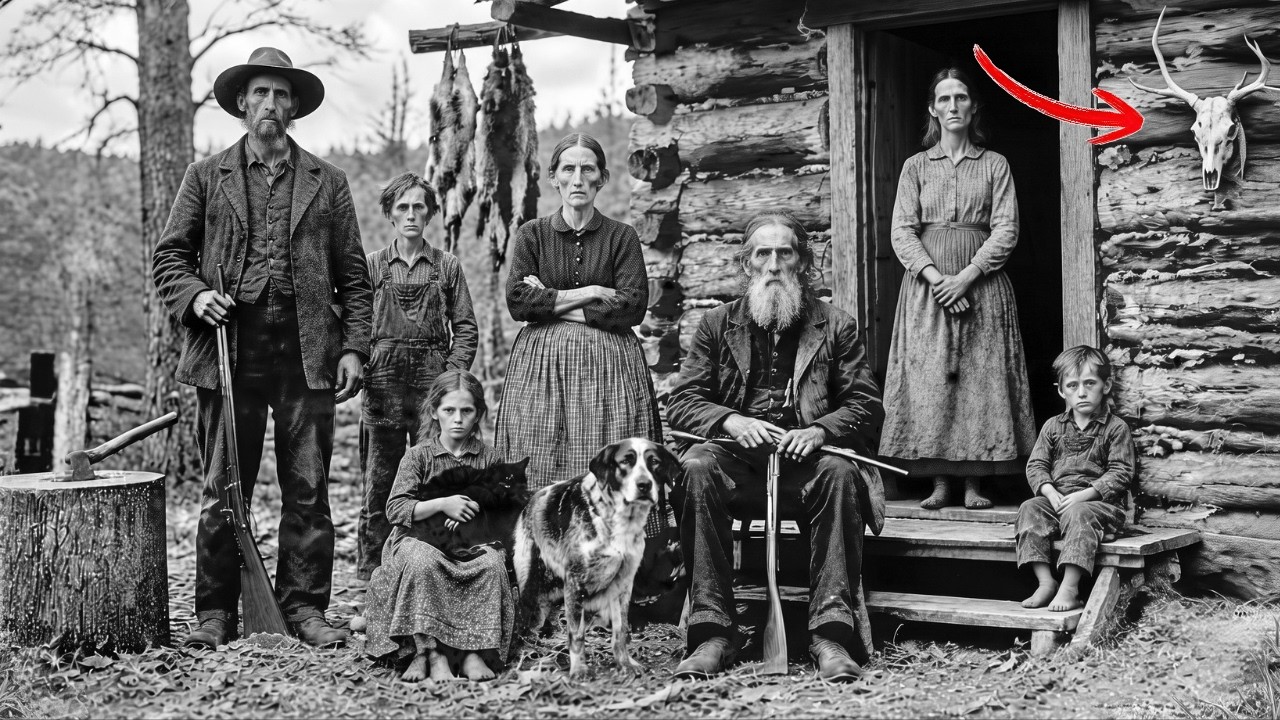
The physical description of the family, as recorded by the few outsiders who saw them and lived to write about it, is remarkably consistent. The men were tall, all over six feet, most closer to six and a half, with long arms, narrow shoulders, and a gait described by one Waynesville schoolteacher as like a man wading through knee-deep water even on dry ground. Their hair was uniformly black and never grayed. Their eyes were pale, so pale that a circuit preacher who tried to visit the hills in 1894 described the eyes of the man who met him at the property line as having no color at all, nothing but a shifting gray like weather.
The women were shorter and heavier, with a stillness between steps noticed by many witnesses. The children did not play. They stood and watched, and when they moved, they moved together as a group, turning their heads at the same moment, stopping at the same moment. One man who saw a group of Gathers children at the treeline in 1896 wrote that he felt he was not looking at a group of individual children but at one living creature composed of eight smaller parts.
None of this, by itself, would have made the family notorious. What set the Gatherses apart, what drove three counties to agree among themselves that something had to be done, was the pattern of what happened to people who crossed onto their land. Beginning the moment Isaiah Gathers signed the deed, people who set foot on the hill began to disappear. Not all at once, but steadily, and at a rate that defied any other explanation the counties could offer.
By the winter of 1899, a journalist from Rolla who tried to compile a list counted forty-one people missing, men, women, and children over the age of ten, on a single 640-acre tract. One missing person for every fifteen and a half acres. The first to vanish was an eleven-year-old boy named Toby Rawlings, sent to find a strayed cow in November 1890. The tracks of both boy and cow ended on an open ridgetop about twelve yards from the Gathers wall, in a bare area with no cover, no hole, no ravine, no trees.
The tracks did not fade or weather away. They simply stopped. On the second day, the boy’s father approached the eastern gate, the only gate in the wall, and called through it. A woman came from inside but did not open it or speak.
After a full minute of silence, she reached into a small pocket at her waist, took out a single object, and pushed it through the opening to the ground outside. It was the boy’s shirt, folded carefully, clean, no blood, no tears. Inside was a small braid of the boy’s hair, tied at both ends with red thread. The boy was never seen again.
His body was never found. His father sold his farm at a loss the following spring and moved to Kansas. The disappearances continued through the decade. A peddler named Silas Marsden cut across the northeastern corner of the property to save half a day’s walk; his pack was found six weeks later hanging from a hook driven into the top course of the wall, his goods sorted, his correspondence filed, his money counted and stored in a leather pouch that belonged to no one in the county.
The sheriff who demanded explanations from two tall, pale-eyed men at the gate received only this from a man he identified as Isaiah’s eldest son, Absalom: “We have not seen him. The pack came to the wall of its own accord. We hung it so its owner could find it. He did not come.
That is not our concern. ” A revenue agent sent from Jefferson City in 1894 never returned to the inn for his belongings; his horse was found three days later, tied to a fence post half a mile away, calm. No further federal agent was ever sent to the Gasconade hills for any purpose. A young woman named Lila Overbeck, fascinated by the family, vanished in the summer of 1895; her mother received a small parcel wrapped in unbleached cotton containing a lock of her hair, her grandmother’s wooden comb, and a note written in the same hand that would later appear in the surveyor’s notebook: “She is with us now, she will not return, and it is better that you do not ask why.
”
By 1896, with the unofficial count at twenty-three, the counties of Pulaski, Maries, and Phelps began quietly consulting one another. The meetings were informal, held in back rooms and on porches. The consensus, reached with great difficulty over months of discussion, was that there was nothing to be done. The family had committed no provable crime, left no bodies, broken no written law, owned their land outright, paid their taxes on time every year without fail, and had been in all their dealings with the outside world polite and legal.
The state would not intervene. The federal government had effectively withdrawn. The sheriffs, individually, did not have the manpower to assault a fortified perimeter defended by more than twenty armed adults. So the counties turned to the only remaining tool: the neighbors.
In the spring of 1897, an informal agreement was reached among the farmers whose land bordered the Gathers tract. Henceforth, they would have no commercial dealings with the family, no conversation, no sale of grain or livestock or seed or tools, no permission to cross their land under any circumstances, no acknowledgment of their existence. The idea was to starve them out. It did not work.
In April 1897, the Gatherses stopped coming to town entirely. Then silence. The hill, for years a place where smoke could be seen rising from the chimney or a distant hammer heard, became utterly still. No smoke, no sound, no shapes, only the wall and the trees and the silence.
And the disappearances continued, but not at the same rate. The new cases were all, without exception, people who had participated in the decision to enforce the boycott. A cousin of the mill owner who proposed it, vanished on a road miles from the property. A schoolteacher who endorsed it at a church meeting, gone from her home.
A deputy sheriff who had helped draft the agreement, found sitting upright against a tree, no mark, cause of death undetermined. The county doctor wrote “natural causes” on the certificate, and in his private notebook wrote, “This man was killed and I do not know how, and I shall not look further, and may God preserve us all. ” Two more members of the boycott movement died that spring, each found arranged as if by a mourner, and beside each corpse, a small braid of hair tied with red thread. By the summer of 1898, the boycott had collapsed.
Farmers began quietly leaving food at the base of the wall at night. Some abandoned their farms entirely. The mill owner sold his mill, moved to Arkansas, and refused until his death to answer any question about the hills, saying only that some doors, once opened, should not be discussed because discussion itself is a form of opening them further. The storekeeper Elias Cordell received a small folded paper once a week, slipped under his door after closing, every Thursday evening beginning October 2, 1898.
Each contained a single line in that same hand. “We remember those who did not join us. ” “We remember those who tried to feed us. ” “The winter shall decide it.
” “Be at your window at midnight on December 22, and you shall hear its beginning. ” He waited. On the night of December 22, standing at his window, he heard a sound coming from the hills seven miles north, which he later described as the sound of many voices singing very softly at once, in an unearthly key. The winter of 1898–1899 was the coldest ever recorded in Missouri.
The river froze solid bank to bank for over forty miles. Cattle died in the fields standing. For the last week of December and the first two weeks of January, the sky over the Gathers wall took on a color no one had seen before, a pale greenish gray close to the horizon, directly above the family’s chimney. The killings began on Christmas Eve.
Eleven people died between then and the end of January. All were residents within a five-mile radius of the wall. In every case, no wounds, no signs of struggle, no apparent cause of death. In every case, a small bundle of dried herbs tied with red thread found near the body.
In every case, death occurred between midnight and four in the morning, on a night when the wind came from the hills, and when, according to the weather record kept by the schoolmaster in Waynesville, the greenish-gray color over the chimney was at its strongest. Some victims were found in the posture of mourners, hands folded, arranged with care. One man was found sitting at his kitchen table, mouth open as wide as a human mouth can open, no wound, no sign of entry. The door was locked.
The fire had burned to coals but not gone out. The new sheriff of Pulaski County was a man named Otis Craddock. A veteran of the Spanish-American War, a man of reputation who did not tolerate unsolved crimes, he studied the pattern for eight days. On February 2, 1899, he sent letters to the sheriffs of Maries and Phelps announcing his intention to form a posse and go to the hill to end this.
He spent three weeks assembling thirty-one armed men from the three counties, mostly veterans, all with rifles. The plan was simple: ride in single file at dawn on February 28, approach the eastern gate, demand the family come out unarmed for questioning. If they refused, breach the wall and take them by force. Craddock estimated the operation would be over by noon.
He was wrong about that, but he was right about one thing: it would be over. On the morning of February 28, 1899, a clear, bitterly cold dawn, 11 degrees below zero, no wind, the snow frozen hard enough to bear a horse. The thirty-one men assembled at the edge of the trees, a quarter mile from the eastern gate. Craddock rode at the front.
His deputy, a young man named Perry Whitlock, rode at the rear. Whitlock was, by coincidence no one in the posse paid attention to at the time, the grand-nephew of the surveyor Bertram Whitlock whose hair had turned white on the hill seventy-five years before. When the column emerged from the trees, every man saw that all their preparation had been for nothing. The eastern gate was open, and the family was not inside.
The family was outside. They stood in a single line in the open ground before the gate, facing the trees, facing the posse, waiting. There were forty-two of them: twenty-one men, fifteen women, six children. All dressed for the weather.
All motionless. All unarmed. Craddock halted the column about 150 yards away. For a time that survivors would later dispute, two minutes or closer to ten, the two groups faced each other in silence.
Then Craddock, Whitlock, and two other men advanced slowly across the open ground. When they were about thirty feet from the family, Absalom Gathers, tallest of them all, standing in the exact center of the line, stepped forward and raised one hand, palm outward, in the age-old gesture of halt. He said, “We have been waiting for you. ” Craddock replied that he came in the name of the State of Missouri, and that the family must surrender and walk to Waynesville without resistance.
Absalom Gathers said, “We know why you have come, and we know what you believe, and we know what you are prepared to do. Now you must know what we are prepared to do. ” Craddock asked what he meant. Absalom Gathers did not answer.
He turned his head slowly and looked at the sun, which was rising over the eastern hills behind the family. He watched it for about thirty seconds. Then he turned back to Craddock and said, “You will leave this place today, and you will not come back, and you will forget that you came. Or you will not leave at all, and it will not matter what you forget.
”
Craddock, not the type to be threatened, drew his revolver. The moment he drew it, every one of the four men close enough to see what happened next agreed: all forty-two Gatherses opened their mouths at once, as if they were a single body, and kept them open. From those forty-two open mouths came a sound that Whitlock, in his written account, described as the sound of wind coming from inside the earth, moving up through the throats of forty-two people at once, out into the winter air as a low, continuous note with no source, no direction, no end. The horses went wild.
Craddock’s horse reared and threw him. Whitlock’s horse spun and fell, pinning his leg. The two other men were thrown clear. The twenty-seven men waiting at the trees saw all this, heard the sound, and did what any group of armed men would do.
They panicked. They opened fire. They fired more than four hundred rounds in about ninety seconds. They fired from the trees across the open ground at the line of forty-two people standing before the wall.
They fired until their rifles and pistols were empty, and many reloaded and fired again. When the shooting stopped, when the smoke cleared, when the four men in the open ground got to their feet, and the sound from the forty-two open mouths finally ceased, every one of the thirty-one men in the posse looked across the frozen field. Where the Gathers family had stood, there was nothing. No bodies.
No blood. No tracks leading away. The snow before the wall was undisturbed except for a wide arc of footprints, forty-two sets, leading from the eastern gate to the line where the family had stood, and stopping there. As if the family had been lifted straight into the air.
Craddock looked at the empty ground, at the open gate, at the empty compound behind it, and said one thing only before riding back to Waynesville: “We did not kill them. They are gone, and they will return. ” He was wrong about the second part. They never returned.
The compound was empty. The house was empty, the barns empty, all the stoves cold, all the tables bare, all the beds made. No personal possessions, no clothing, no papers, no tools, no food, no livestock, no evidence that anyone had ever lived there except the wall and the buildings, and one other thing. A small object found centered on the kitchen table in the main house, placed there deliberately.
When Sheriff Craddock saw it, he ordered it burned on the spot, without discussion, and would not allow any other man to examine it closely. No one in the posse recorded what it was. Whitlock referred to it only as “the thing on the table” and left the description blank. When a journalist asked Craddock about it two years later, he replied that some things a man sees in the line of duty need not be described, because description itself is a form of bringing the thing back into the world, and he had done his best to take that thing out of the world and did not intend to undo his work.
In the spring of 1899, the county moved quietly to seize the Gathers tract for unpaid taxes. The property was advertised for public auction, as required by law, on the second Tuesday of May. No one bid. This was not unusual for this particular tract; it had been ignored in three previous auctions before Isaiah Gathers bought it in 1889.
But no one bid at the second auction in June, nor the third in July, nor the fourth in August, nor at any of the eleven further auctions the county attempted over the next six years. In 1909, the county tried to give the land away: first to the State of Missouri, then to the federal government, then to a private logging company that had expressed interest in cheap timberland. All three refused. The state cited difficulty of access.
The federal government cited unspecified concerns about the title history. The logging company, in a letter that survives in the archives of the Missouri State Land Office, cited a single sentence: “Our field agent made a circuit of the property perimeter and reported that no member of this company should, under any circumstances, be permitted to cut timber on the tract in question, and we must therefore decline the gift with thanks. ” The name of the field agent was not recorded. The report he made does not exist in the files.
But somewhere between the county’s offer and the company’s refusal, a man walked around the full two-and-a-half-mile perimeter of the Gathers wall in the autumn of 1899. Whatever he saw or heard on that walk was enough to induce the third-largest lumber company in Missouri to refuse a free, permanent gift of 640 acres of standing timber. The tract has remained in an unresolved legal status ever since. It could not be sold, could not be given away, and under the tax laws of the time, the county could not simply abandon it without an official act of the state legislature, which no legislator was willing to introduce.
So, in the fall of 1914, a clerk in the Pulaski County Recorder of Deeds office, working late on the annual plat map update, made a decision that became the most famous administrative act in county history. The clerk, a man named Millard Beam, who by all accounts had no personal connection to the events of 1899 and no particular interest in the tract’s history, simply drew a single unshaded rectangle on the plat map at the coordinates of the Gathers land. He did not write an owner’s name. He did not write a parcel number or assessed value.
He wrote in the margin beside the rectangle, in small precise letters, three words: “No Entry. ” He put down his pen, closed the plat book, and went home. He never explained his decision. He worked in the office for another twenty-three years.
When his grandson once asked him about it, he said only, “Some parcels of land do not wish to be owned, and when you encounter one, the kindest thing you can do is stop asking anyone else to try to own it. ”
The tract remains exactly as Millard Beam described it. No survey has been conducted since 1899. No records have been filed.
No one has entered it in any official capacity for more than 120 years, according to any surviving record. The wall still stands, examined by satellite in the early 2000s as part of a survey of unlisted structures in the Missouri Ozarks. The house still stands, or at least its ruins are clearly visible in the center of the site, and the chimney is still upright, its red color not faded in twelve decades, which geologists who examined the images say is nearly impossible for a clay chimney in a Missouri climate, and which no one has been able to explain. Local people still know exactly where the tract is.
They will point to the hill from a distance if asked. They will not drive on the two-lane highway that passes within a mile of the wall after dark if they can avoid it. They will not, under any circumstances, enter the tract itself. In the century and a quarter since, three documented incidents have occurred of people attempting, out of curiosity, defiance, or simple ignorance of local history, to cross the Gathers land.
All three ended the same way. In 1931, a geology graduate student from the University of Missouri entered the tract from the south, spent the afternoon taking rock samples, and returned to his inn in a state of obvious shock, unable to speak, eat, or explain what had happened. He was put on a train to St. Louis the next day.
He recovered physically within a month. He never returned to the geology program, never did fieldwork again, worked as an accountant for the rest of his life. Among his papers, in a sealed envelope addressed to his eldest son and marked not to be opened until after my death, was a single sheet of paper with one sentence in his own hand followed by his signature: “They are still there. They have been there all along, and they are waiting.
” In 1967, three teenage boys from Rolla, all familiar with the local stories and all determined to debunk them, parked a car about a mile from the wall and walked onto the hill carrying flashlights and a bottle of whiskey. Two of the boys returned to the car three hours later. The third never did. The two survivors refused for the rest of their lives to say what happened on the hill, where the third boy went, or why they left him behind.
The third boy was never found, his body never recovered. The search by the county sheriff’s department was called off after two days when the search dogs, according to the official report, refused to cross the line of the wall. In 1994, a documentary film crew obtained written permission from the county to fly a small plane over the tract and photograph the ruins from the air, with the explicit condition that no crew member attempt to land or enter the property. The flight was made on a clear October day.
The pilot reported that the aircraft’s instruments behaved abnormally over the tract: the compass spun continuously, the altimeter read 200 feet lower than the actual altitude, and the engine, running normally before and after, sputtered in an irregular pattern directly over the wall. When the film was developed, it showed the wall, the house, and standing in a straight line before the house, looking directly at the plane, 42 people. Twenty-one taller, fifteen shorter, six smaller. The crew first assumed it was a laboratory joke, then a defect, then a light anomaly.
When all explanations were exhausted, they simply froze the footage, cancelled the project, and returned the investors’ money. The footage has never been shown publicly. The producer stated in his only interview that he intends to keep it in a private storage facility for the rest of his life and have it destroyed after his death, and he considers that decision the most important one he has made in his career. Drivers passing the section of highway nearest the tract at night, for years, have reported a consistent experience.
The engine loses power for a few seconds. The headlights dim for no reason. The radio, if on, produces for five or six seconds a sound that is not a station and not static, but closer to a sound of very soft murmuring voices at once, in an unearthly key. Then the road rises from the hollow, the engine regains full power, the headlights return, and the radio resumes its broadcast.
Local drivers do not speak of it, and do not take that road at night. The question of what happened on the hill on the morning of February 28, 1899, has been asked in various forms by every historian, folklorist, journalist, and amateur researcher who has ever come across the Gathers story. Some say the entire family entered the cave network beneath the hill the night before, knowing the posse was coming, that their appearance was a feint, and that they made their way out through the underground drainage to the river and from there to some other quiet valley, under other names. Some say the family never left the hill at all, that the wall was not built to keep the world out but to keep something in.
Some say the family was never really there, that Isaiah Gathers and his kin were beings that came up from the hills to meet the world for a decade and then returned, taking with them the 41 people recorded missing, the 11 people who died without explanation, and the ability of Pulaski County to describe what its own official map shows. I do not know which of these answers is correct, and I do not know if any of them are. What the records show is this: a family of unknown origin bought the cheapest tract of land in three counties in the spring of 1889, built a wall around it, lived behind that wall for ten years, during which time 52 of their neighbors either vanished without a trace or died in ways no county doctor could explain, and on the morning of February 28, 1899, the entire family came out through their gate, stood in a line before 31 armed men, made a single unified sound, and vanished under a hail of gunfire. No bodies were ever found.
The tract has never been resolved. A county clerk wrote three words in the margin of a map 15 years later. And in every decade since, when someone has tried to cross into that tract, something on that tract has responded. The response has been constant.
It remains embedded in memory. It is avoided. The land, for all practical purposes, still belongs to the family that bought it, even though they have been out of sight for 126 years. The land is not for sale, and it has made that clear.
The wall still stands, the chimney is still red, the rectangle on the plat map is still empty. And somewhere in the Pulaski County Recorder of Deeds office, in a plat book copied and updated many times over the years but never with that note deleted, three carefully written words still warn every successive generation of the same thing Millard Beam warned his own in the fall of 1914. No Entry.