In the autumn of 1793, when Horatio Nelson arrived at the Bourbon court of Naples, he carried the weight of a career that had already cost him an eye, and he was about to meet the woman who would cost him his reputation. Nelson, by then a leading admiral in the British Royal Navy, had come to southern Italy to gather reinforcements for the renewed conflict against revolutionary France. It was a task born of the immense political upheaval that had swept across Europe since 1789, when the revolution in France had toppled King Louis XVI and, by 1793, brought about his execution. France had become the enemy of every major European power, and Britain, above all, was now locked in a long and exhausting naval war.
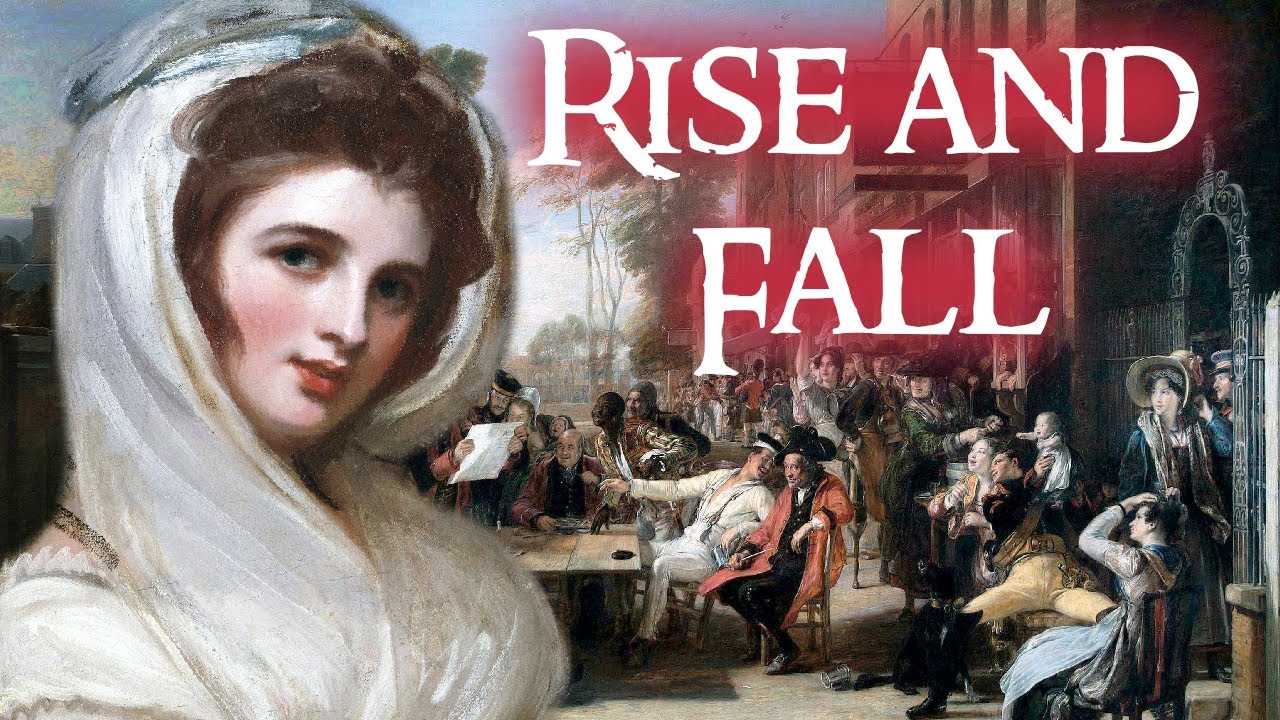
Emma Lyon was born at Swan Cottage in Cheshire, England, on the 26th of April 1765, the daughter of a blacksmith who died within seven weeks of her birth. Her family was poor, and Emma entered domestic service as a maid by the age of twelve, a common fate for working-class children in early industrial Britain. In her teenage years, she changed her name to Emma Hart. By 1785, she had ended a four-year relationship with Charles Greville, a member of Parliament and antiquarian, who sent her to his uncle, Sir William Hamilton, the British envoy at the Neapolitan court.
Emma arrived in Naples in 1786 and married Hamilton five years later. As a hostess at the court, she charmed some of Europe’s leading literary figures and became the subject of celebrated portraits by artists such as Gavin Hamilton, Elizabeth Vigée Le Brun, and Angelica Kauffman, who painted her as Medea, Ariadne, and Cleopatra. Her beauty and her talent for imitation made her famous throughout the continent. When Nelson arrived in Naples in 1793, he met Emma through her husband, Sir William.
Nelson was married to Fanny Nisbet, a devoted wife who had waited for him through years of sea duty. The attraction between Emma and Nelson was immediate. The Hamiltons invited Nelson to stay at their official residence while he drummed up support for British efforts in the Mediterranean, and when he left several days later, a lasting impression had been made by both sides. The matter might have ended there, but in late September 1798, Nelson returned to Naples.
The French, under a brilliant young general named Napoleon Bonaparte, had become ascendant throughout continental Europe, but Nelson had solidified his dominance at sea with a monumental victory over the French fleet at the Battle of the Nile in August of that year. When he stopped in Naples on his way back across the Mediterranean, Emma may well have been shocked by his appearance. He had lost his right arm since their first meeting and was prematurely aged by years at sea. The Hamiltons again made him their guest, and soon a full-blown affair was underway between the thirty-three-year-old Emma and the forty-year-old admiral.
Lord Hamilton, for reasons not entirely clear, chose to turn a blind eye to his wife’s infidelity. It seems likely that Hamilton was sterile, and guilt at being unable to give Emma children may have contributed to his willingness to accept the relationship. By November 1798, word of the affair had reached the British newspapers. Emma and her famously injured lover became the subject of sustained media scrutiny in England.
Some of their actions generated mere casual interest, but most of British high society was appalled. The obsession with the pair only grew when the Hamiltons and Nelson all returned to England in 1799, following a popular upheaval in Naples that led Napoleon to impose a new French royal family there. When they reached London in November 1800, tensions arose immediately. Nelson’s wife, Fanny, quickly realized that Emma was pregnant with Nelson’s child, and unlike Lord Hamilton, she would never accept the affair.
Fanny delivered an ultimatum, forcing Nelson to choose between her or Emma. Shortly before returning to active naval duty in 1801, he commenced formal separation proceedings with Fanny, a far more unusual act in the early nineteenth century than it is today. In late January 1801, Emma gave birth to a daughter, whom they named Horatia. While Nelson was absent at sea, Emma attempted to court English high society in an effort to win public sympathy.
During one of her social events, the Prince of Wales, future King George IV, became infatuated with her, though nothing came of his pursuit. That autumn, on Emma’s advice, Nelson purchased Merton Place in Wimbledon, where he lived openly with both Emma and Lord Hamilton after his return to England. When the Treaty of Amiens briefly ended the war between Britain and France in March 1802, Lord Hamilton died in April 1803, finally dampening some of the criticism leveled against the unusual household. But Emma and Nelson could not enjoy a conventional married life.
Nelson, who had survived so many injuries, succumbed to his final one in 1805. Peace had lasted barely a year. In May 1803, the War of the Third Coalition broke out, with Britain, Russia, Sweden, and Austria combining against France and its satellite states. One of Napoleon’s major strategies was to attempt an invasion of Britain, but to do so he needed to bring the French navy, stationed largely in the Mediterranean, through the Strait of Gibraltar and into the English Channel.
When the attempt was made in 1805, Nelson was tasked with preventing it. On the 21st of October, the British Royal Navy, led by Nelson, defeated a joint Franco-Spanish fleet at Trafalgar, off the coast of southwestern Spain. No invasion force could now pass from France to Britain, but Nelson’s greatest victory was his last. He was seriously wounded during the engagement and died just three hours later.
Emma was distraught. When news reached England, she took to her bed in grief for several weeks. But the long-term problem soon became the matter of Nelson’s will. The British state was determined to exclude her as much as possible, and Nelson’s own wishes that his lands and wealth be divided evenly between Emma and his legitimate family were ignored.
Emma received a payment of two thousand pounds, the house at Merton, and an annual allowance of five hundred pounds. But the cost of maintaining Merton Place far exceeded that income, and the annuity itself became the subject of legal struggles with Nelson’s family. By 1808, she was more than fifteen thousand pounds in debt, and efforts to sell Merton were unsuccessful. The culmination of her decline came in 1812, when she was briefly imprisoned for failing to meet her debts.
A succession of health problems followed. Eventually, friends raised enough money to allow Emma and her daughter to escape to Calais, France. She died there just a year later, at the age of forty-nine, having increasingly succumbed to alcoholism and obesity in her final years. A tragic end for a woman once famed throughout Europe for her beauty.
She has been remembered in books, songs, and films in the twentieth century, including the 1973 film *That Hamilton Woman* and Susan Sontag’s 1992 novel *The Volcano Lover*—but her life ended far from the courts and admirals who had once made her name known across the continent.