Behind the closed doors of Buckingham Palace, Princess Diana believed she had found an ally in her father-in-law, Prince Philip. His secret letters, signed with affection, seemed to offer the validation she desperately craved. But those hidden messages were not a lifeline.
They were the foundation of a psychological trap designed to force her silent compliance within a broken marriage.
When Diana rebelled and threatened the crown’s stability, the comforting patriarch unmasked himself as a cold-blooded executioner. He personally stripped her royal title and condemned her to a ruthless exile. The root of Philip’s uncompromising pragmatism was planted long before he met the young Princess Elizabeth.
Unlike the British royals born into the safety of London palaces, Philip was born into chaos. In 1922, the Greek royal family was violently overthrown. Philip was just 18 months old when his family fled for their lives.
The geopolitical reality of the 1920s was a graveyard for European monarchies. Just four years before his birth, his relatives, the Romanovs, were slaughtered by Bolshevik revolutionaries.
When the Greek military arrested Philip’s uncle and his father, execution seemed certain. Only the intervention of the British Navy spared them. Philip was carried onto the HMS Calypso, sleeping in a makeshift cot built from an orange crate.
This early trauma shaped the architecture of his entire mind. He learned that a throne is not a permanent divine right but a fragile piece of furniture that can be violently kicked out from under you.
His family disintegrated in exile. His mother suffered a severe mental breakdown and was committed to a psychiatric asylum. His father abandoned the family, moving to the south of France with a mistress.
By the time Philip was 10, he had no country, no home, no money, and no parents. He was effectively a royal orphan, passed around between wealthy relatives like inconvenient luggage.
When a journalist asked him what language he spoke at home during his childhood, Philip replied with a blunt question: “What do you mean at home?” He did not understand the concept of a safe harbor. He learned that vulnerability was a luxury he could not afford.
He was shipped off to Gordonstoun, a notoriously harsh boarding school in the Scottish Highlands. The school emphasized physical endurance, cold showers, and extreme self-reliance. Philip thrived.
He then joined the Royal Navy, distinguishing himself in combat during the Second World War. The military became his surrogate family, teaching him that survival depends on absolute discipline, emotional suppression, and unwavering obedience to the chain of command.
When he married the future Queen Elizabeth II in 1947, he brought this naval rigidity directly into the heart of the British monarchy. To marry Elizabeth, Philip renounced his Greek and Danish titles, abandoned his religion, and relinquished his family name. When Elizabeth ascended the throne in 1952, the power dynamic shifted permanently.
At her coronation, Philip was forced to kneel before his own wife, swearing to be her liege man.
He was the only man in the country not allowed to give his own children his name. He complained to friends that he was nothing but a bloody amoeba. Denied the role of co-monarch, Philip demanded absolute authority over the internal affairs of his family.
Elizabeth ruled the Commonwealth, but Philip ruled the Windsors. Inside the palace walls, he tolerated no weakness, no tears, and no rebellion.
This militaristic approach set him on a collision course with his eldest son, Prince Charles. Charles was a sensitive, introspective, emotionally fragile child. Philip viewed these traits with contempt.
In his survivalist worldview, softness in a future king was a fatal vulnerability. Philip bullied his son to toughen him up, forcing Charles to attend Gordonstoun. The school became a nightmare for the young prince, who later described it as a prison sentence.
By the late 1970s, Charles was over 30, unmarried, and entangled in a long-term affair with Camilla Parker Bowles, a married woman entirely unacceptable as a future queen consort. Charles’s refusal to settle down created a public relations crisis. Philip watched with mounting anger.
The monarchy relies on the illusion of moral superiority. An unmarried philandering king-in-waiting was a target for Republican sentiment.
The urgency was violently accelerated by the assassination of Lord Louis Mountbatten in August 1979. Mountbatten was Philip’s uncle and Charles’s idol. When the IRA blew up his fishing boat, Charles was devastated.
Philip stepped firmly into the power vacuum. With Mountbatten gone, Philip was the undisputed patriarch. He took absolute control of the succession strategy.
The parameters for a suitable royal bride were brutally specific. The crown required an aristocratic bloodline, a virgin to ensure no disputes about legitimacy, and youth. A young bride could be molded before her civilian identity had fully calcified.
When 19-year-old Lady Diana Spencer entered the royal orbit, she exceeded all criteria. The Spencers were one of the oldest aristocratic families in Britain. Diana was fresh-faced, photogenic, and untouched by scandal.
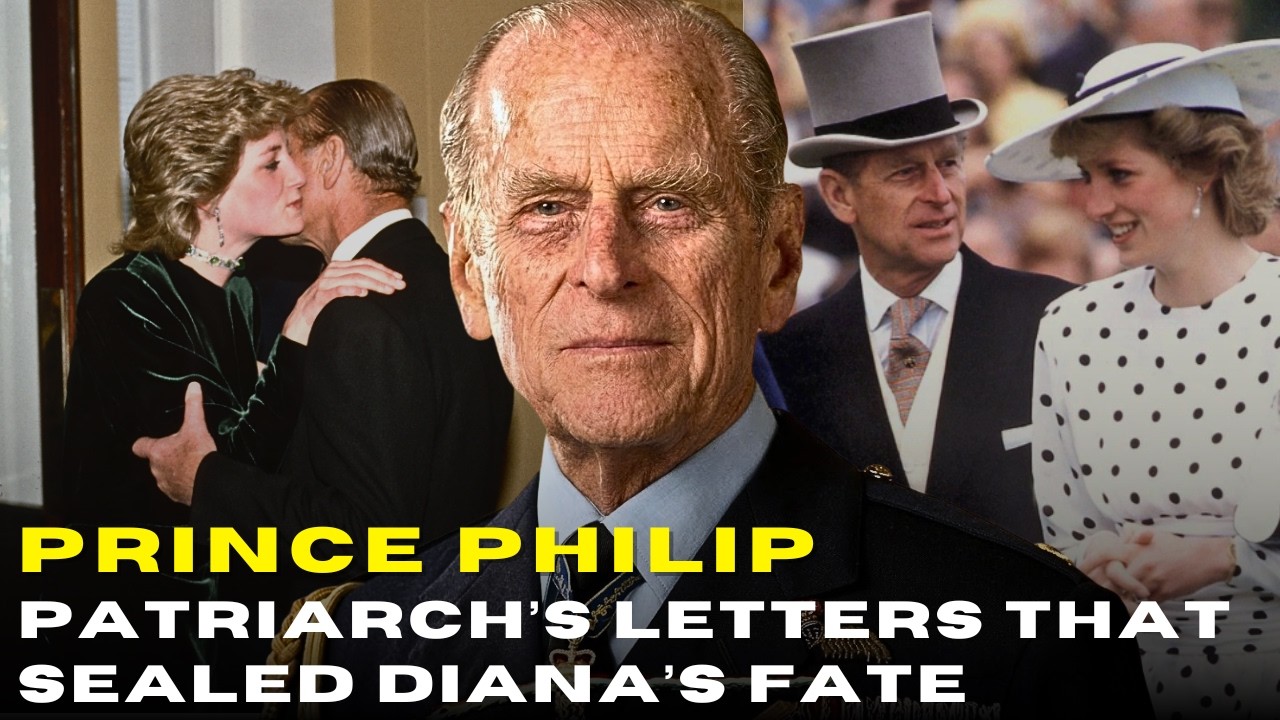
Philip did not evaluate her as a human being with complex emotional needs. He assessed her as a perfect physical asset. He saw a solution to the Camilla problem, a mother for the next generation, and a public relations coup.
The psychological chasm between the candidates was ignored. Charles was a brooding man in his 30s who read Jung and craved intellectual companionship. Diana was a teenager who read romance novels and carried the deep wounds of a fractured childhood.
Her mother had abandoned the family when Diana was seven, leaving her with a desperate hunger for validation.
In a healthy family, a father might have recognized that pairing a traumatized teenager with a detached man in love with someone else was a recipe for disaster. But the House of Windsor is not a healthy family. It is an institution.
Philip did not believe in psychological trauma. He belonged to a generation that viewed emotional distress as a failure of discipline.
As the media caught wind of the courtship in late 1980, the pressure on Diana became unbearable. Charles vacillated, refusing to commit. Philip drafted a letter to his son.
He told Charles that Diana’s reputation was being compromised by his indecision. He advised his son to either propose or release her. Philip believed he was offering clear guidance, but he completely miscalculated the psychological frailty of the man receiving the order.
To Charles, the letter was not advice. It was a threat. Decades of bullying had conditioned him to interpret any directive from his father as an absolute mandate.
He felt backed into a corner. Instead of defying the system, Charles surrendered. He proposed to Diana in February 1981.
When a journalist asked the newly engaged couple if they were in love, Diana instantly replied, “Of course.” Charles added the devastating caveat: “Whatever in love means.” That chilling phrase laid bare the emotional bankruptcy of the arrangement.
But the machinery of the state had already been activated.
In the weeks before the wedding, Diana discovered a bracelet Charles had made for Camilla. She wept. She suffered from bulimia.
She told her sister she could not go through with it. Her sisters told her it was too late because her face was already on the tea towels.
On July 29th, 1981, Diana walked down the aisle of St. Paul’s Cathedral. Charles stood at the altar, reportedly scanning the congregation for Camilla.
Philip stood proudly in his naval uniform. From his perspective, the operation was a magnificent success. He had secured the perfect biological vessel.
The immediate threat to the succession had been neutralized.
But Philip’s reliance on logic contained a fatal blind spot. He underestimated the destructive power of human emotion. He had locked a deeply traumatized young woman into a loveless marriage.
The honeymoon was the first battleground. Diana’s bulimia spiraled violently. Charles retreated into his books.
The marriage was broken before it began.
Within a year, Diana produced the required heir and a spare: Prince William in 1982 and Prince Harry in 1984. Philip’s biological directive had been fulfilled. He expected the couple to settle into a polite, distant arrangement.
But Diana was not a creature of the old world. She was a modern woman who demanded to be loved, seen, and heard.
By the mid-1980s, the marriage had devolved into a grotesque pantomime. Charles had returned to Camilla. Diana, starved of affection and battling eating disorders, was rapidly unraveling.
Philip watched the collapse with the cold alarm of a structural engineer noticing a crack in a dam.
To the traditional aristocratic mind, an unhappy marriage was not a crisis. It was an occupational hazard. But Diana refused to play by the rules.

Her pain was loud and dangerously visible. Philip despised emotional confrontation. To manage her, he chose a medium he could control: pen and ink.
Philip initiated a secretive correspondence with Diana. He signed his letters “Fondest love, Pa.” For an isolated young woman who felt surrounded by enemies, this was devastatingly effective.
Philip positioned himself as her sole ally. He openly condemned his own son, stating that Charles was foolish to risk his family for Camilla. For Diana, reading these words felt like salvation.
But this validation was a Trojan horse. Once he established trust, the tone shifted. Philip began to lecture her.
He critiqued her jealousy and her volatile temper. He argued that her emotional outbursts were driving Charles further into Camilla’s arms. He was using the language of affection to enforce strict royal compliance.
Philip projected his own sacrifices onto her. He had surrendered his country, his religion, and his naval career to serve the monarchy. He could not understand why this privileged young woman could not tolerate a mistress for the same cause.
The unspoken ultimatum was clear: put on your dress, smile for the cameras, and suffer in silence.
For a few years, the anesthetic worked. Diana clung to the correspondence. But the reality of her existence shattered the illusion.
“Fondest love, Pa” did not stop Charles from seeing Camilla. It did not cure her bulimia. Diana slowly realized the terrifying truth.
Philip was not an ally. He was a prison warden using affection as the lock on her door.
In the summer of 1992, Diana breached the palace walls. She smuggled tape recordings out of Kensington Palace to journalist Andrew Morton. The resulting book, Diana: Her True Story, detonated a structural bomb beneath the British establishment.
Diana had exposed the future king as a callous adulterer and the palace as a cold, unfeeling prison.
Philip’s reaction was visceral. He did not see a desperate cry for help. He saw a calculated military strike against the institution he had sacrificed everything to protect.
The comforting sign-off vanished. Philip’s letters became brutal indictments. He cross-examined her like a hostile witness.
He blamed the victim for the collapse of the marriage. He weaponized her mental health against her, suggesting she was suffering from paranoia.
The letters did not intimidate Diana. They liberated her. In November 1995, she smuggled a BBC camera crew into her sitting room.
In her Panorama interview, she uttered the infamous phrase: “Well, there were three of us in this marriage, so it was a bit crowded.” She then crossed the ultimate red line by publicly questioning Charles’s fitness to be king.
The interview was broadcast to 23 million people. The palace was in a state of absolute panic. This was the moment the patriarch transitioned into the executioner.
Philip pushed the queen to instruct Charles and Diana that an immediate divorce was constitutionally necessary.
During the divorce negotiations in 1996, the most fiercely contested battleground was Diana’s title. Charles was reportedly willing to allow Diana to retain the style of Her Royal Highness. Philip was adamantly opposed.
He insisted the title be stripped.
To the civilian world, the loss of three letters might seem petty. But in the British establishment, the HRH is everything. It is a demarcation of privilege, a diplomatic shield, and a guarantee of state protection.
Without it, Diana was officially severed from the royal family. She lost her state-funded protection detail. She was reduced to the style of Diana, Princess of Wales.
The most psychologically cruel consequence was internal protocol. Diana was now required to curtsy to her own children and her ex-husband. Philip had activated the institution’s immune system.

He had isolated the diseased limb, severed it, and cauterized the wound.
Philip believed he had successfully defended the fortress. But he failed to realize that by casting Diana out of the palace, he had removed the only cage that could contain her. The exiled princess was now entirely untethered.
When Diana’s Mercedes plunged into a concrete pillar in the Pont de l’Alma tunnel in Paris on August 31st, 1997, the immediate reaction of the Windsor patriarch was rigid adherence to protocol. Diana was no longer a member of the royal family. She was a private citizen.
Philip and the queen ordered the young princes to attend church as usual. They ordered the flagpoles at Buckingham Palace to remain bare.
But the British public reacted with unprecedented hysteria. The grief mutated into visceral rage directed squarely at the House of Windsor. Headlines demanded to know where the Queen was.
For the first time in her reign, Elizabeth II faced a genuine existential threat.
Philip recognized the scent of revolution. He knew that an angry mob does not care about constitutional protocol. The crown needed to engineer a visual spectacle powerful enough to disarm the public.
The public was weeping for a mother. Therefore, the crown had to present them with the image of her orphaned sons.
A vicious logistical war erupted over the funeral arrangements. Diana’s brother, Charles Spencer, was adamantly opposed to the young princes walking behind their mother’s coffin. Philip intervened, his voice reportedly booming through the speakerphone.
The boys had to walk. The optics of the monarchy depended on it.
Prince William was fiercely resistant. Philip approached his grandson and issued the famous ultimatum: “If you don’t walk, I think you’ll regret it later.” William replied, “If I walk, will you walk with me?”
Philip ensured William’s participation. He drafted his grandsons into royal duty on the most traumatic day of their lives.
On September 6th, 1997, the world watched as five men walked behind the gun carriage bearing Diana’s remains: Prince Philip, Prince Charles, Earl Spencer, Prince William, and Prince Harry. Harry would later describe the experience as an absolute trauma. No child should ever be asked to do such a thing.
But from Philip’s perspective, the operation was a flawless triumph. The sight of the young princes marching silently neutralized the public’s rage. The media narrative shifted from condemning the coldness of the royal family to praising their stoic dignity.
By sacrificing the mental well-being of his grandsons, Philip stabilized the throne.
The true legacy of the Iron Duke is far darker than the public memory of his gaffes and his loyalty to his wife. Philip was not a civilian father. He was the apex predator of a survivalist system.
His cruelty was born of absolute terrifying pragmatism.
He was a man who had stared into the abyss of historical irrelevance as a stateless refugee. He knew that a monarchy is not sustained by magic or divine right. It is sustained by continuous brutal human sacrifice.
When Diana Spencer was selected, she was the fuel required to secure the bloodline. Philip treated her as a valuable asset, using letters and affection as tools of operational control.
The moment Diana turned her artillery on the palace, she ceased to be an asset. She became an existential threat. Philip did not hesitate.
He stripped her of her honor, expelled her from the safety of the perimeter, and legally classified her as an enemy of the state.
When her death threatened to bring the mob to the gates of the palace, Philip coldly calculated the next required sacrifice. He looked at two grieving children and marched them into the psychological slaughterhouse of the global media to buy the institution another generation of survival.
The story of Prince Philip and Princess Diana strips away the velvet robes and the diamond tiaras. It exposes a terrifying bloodless reality. The highest echelons of power do not function on love, empathy, or familial loyalty.
They operate exclusively on the discipline of blood. In the eyes of the royal patriarch, the life, the sanity, and the pain of a single individual could never be placed above the survival of the crown.