On the afternoon of August 23rd, 1972, Rosemary Loomis pressed a dime into her daughter’s hand before Jodi rode away on her white ten-speed bicycle. The instruction was simple: call if you’re going to be late. It was not a warning, not a weapon—just a coin meant for a phone booth. Jodi Loomis, twenty years old, headed toward a stable six miles from her home outside Bothell, Washington, where her horse, Saudi, was boarded.
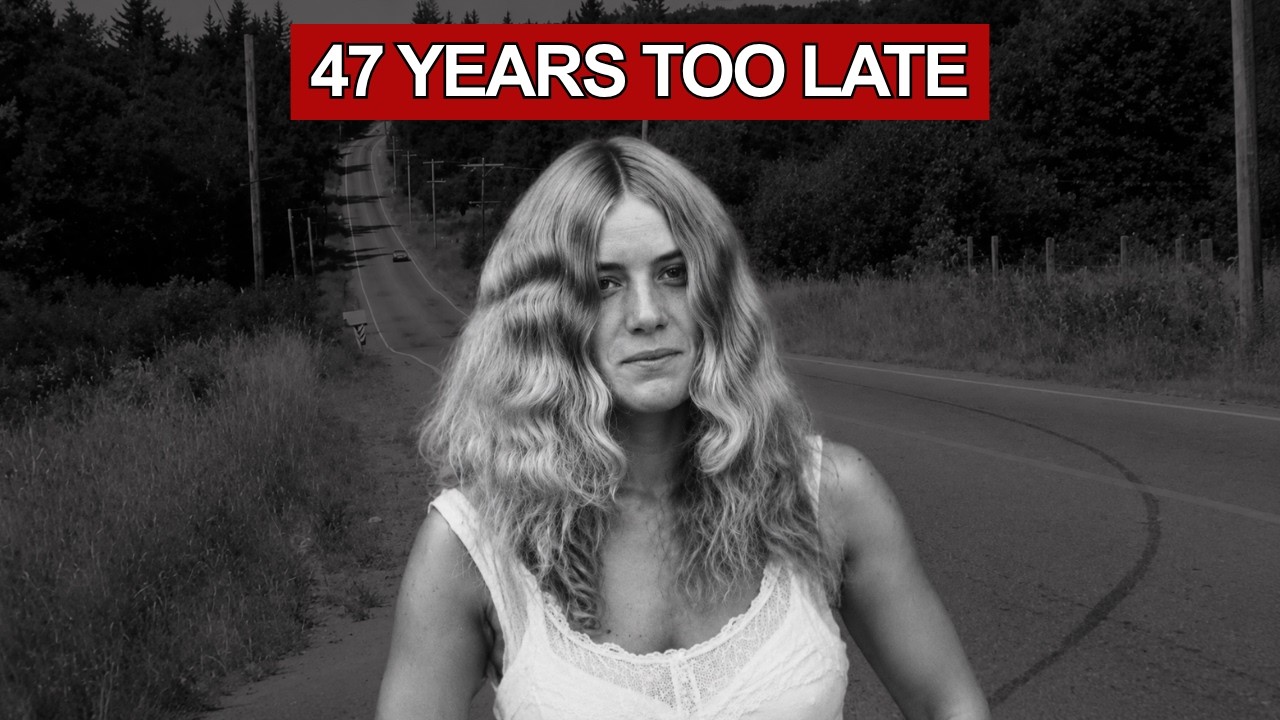
She planned to check on him. A simple ride, six miles there and six miles back. She never reached the stable. The dime was found later, near her body.
Jodi was known by those who loved her as someone who stopped for injured animals, who nursed them back to health without being asked. She loved painting and had covered her bedroom walls with a mural of running horses. She lived on Winesap Road between Mill Creek and Bothell with her parents, John and Rosemary, her twelve-year-old sister Jana, and her fiancé Jim Roberts. Most days, her parents drove her to the stable.
That afternoon, she chose the bicycle instead. On her way out, she stopped at the home of her friend Linda Hook, who was packing to move to California and couldn’t join her. Jodi continued alone. A fourteen-year-old girl selling apples by a fruit stand along the Bothell-Everett Highway later remembered seeing a young woman on a bicycle wearing boots, pausing for an unusually long time before continuing toward Penny Creek Road.
Reports placed her crossing the highway around five o’clock. Within roughly half an hour, she was found in the woods, about 300 yards south of Penny Creek Road, near where 164th Street Southwest meets the Bothell-Everett Highway. Today that stretch sits within Mill Creek. She never saw her horse.
Two people unrelated to any of this had driven down that wooded dirt road looking for a place for target shooting. Walter Morris was behind the wheel; eighteen-year-old Kathy Gogle sat in the passenger seat. They came upon a fallen tree blocking the road. Morris got out to check it and saw a young woman lying near the tree, alive but barely, unable to speak.
His car, a two-seat Saab Sonett, was small. He thought she wouldn’t fit and told Gogle he would go for help while she stayed behind. Gogle refused, afraid whoever had done this was still in the area and believing there was no time to wait. Somehow, neither could fully explain how afterward, they got Jodi into that tiny car.
There was no time to fix her clothing. Gogle did what she could to cover her as Morris drove. They reached Stevens Memorial Hospital in Edmonds at 5:45 p. m.
Jodi Loomis died shortly after arriving. She had suffered a gunshot wound to the right side of her head, just above the ear, from a . 22 caliber bullet. She had also been sexually assaulted.
Investigators later theorized—a theory never confirmed—that she may have been on the ground trying to put her clothes back on when the unidentified man stood over her and fired the fatal shot. Her bicycle was found later, about 180 feet away, thrown down into a ravine. A bridle she had brought for Saudi was never recovered and remains missing to this day. In 1972, forensic DNA profiling did not exist.
Investigators had a violent crime, a small amount of physical evidence, and no way to extract a genetic fingerprint from any of it. They interviewed witnesses and followed leads until they ran out of places to look. The case went cold, not from lack of effort but from lack of tools. It was not forgotten.
In 2008, Jodi’s face appeared on the ten of hearts in a deck of cold case playing cards produced by the Snohomish County Sheriff’s Office. The cards featured unsolved cases from across the county and were distributed to inmates in local jails and the state prison system. Investigators hoped someone might recognize a crime or remember something they had heard. No breakthrough came from the cards.
The real breakthrough had been waiting inside the evidence room all along: a pair of boots. Jodi had been wearing waffle stomper style boots the day she died, borrowed from her twelve-year-old sister Jana. When the Washington State Patrol Crime Lab reexamined them in 2008, they found a small stain on the left boot. Testing confirmed it contained semen.
For the first time in thirty-six years, there was a genetic profile connected to the person responsible for Jodi’s death. The profile was entered into CODIS, the national DNA database used to match crime scene evidence to known offenders. There was no match. Whoever left that stain had never been arrested for a crime requiring a DNA sample.
A decade more passed. In 2018, forty-six years after Jodi died, investigators tried forensic genetic genealogy, the same technique that had recently cracked the Golden State Killer case. Instead of searching for an exact match, genealogists looked for distant relatives sharing fragments of DNA with the unknown suspect and built out an entire family tree until one name remained at the center. The profile from the boot was sent to Parabon NanoLabs.
Genealogist Deb Stone took the case and narrowed the search to a single family with six brothers. One of them was Terrence Miller, a retired heavy equipment operator who had lived in Edmonds for most of his life, about five miles from where Jodi was attacked. Court records showed this was not the first time Miller’s name had come up in connection with sexual offenses. According to court papers, he had allegedly been accused of sex crimes on five separate occasions: 1968, 1978, twice in 1990, and once in 1999.
Only one led to a conviction for lewd conduct. One resulted in a deferred prosecution. Two were never charged, reportedly because the girls involved later said the contact could have been accidental. The last was declined due to statutes of limitation.
Allegations are not convictions, but the record was enough to make Miller a serious person of interest. Genetic genealogy could point toward a name but could not put handcuffs on someone. Investigators needed a direct DNA sample, ideally one Miller discarded without knowing detectives were collecting it. They began watching him.
In August 2018, detectives followed him to the Tulalip Resort Casino, where he threw away a coffee cup. The detective retrieved it and sent it to a lab. The DNA on the cup matched the profile from the stain on Jodi Loomis’s boot. On April 10th, 2019, Terrence Miller was arrested at his home in Edmonds.
He was seventy-seven. Prosecutors charged him with first-degree premeditated murder. He pleaded not guilty, appearing by video monitor. Bail was initially set, then lowered, then raised again after prosecutors accused Miller of planning to violate release terms by taking his wife bowling.
For Jodi’s family, watching the accused man move in and out of custody over a bowling trip was its own kind of injury. The two-week trial opened in Snohomish County Superior Court in late October 2020, presided over by Judge David Kurtz. A jury of seven women and five men was seated. DNA was the centerpiece of the prosecution’s case.
The defense pushed back, questioning how nearly five-decade-old biological evidence had been stored and handled, noting lost samples, and asking why the stain on the boot had not been found sooner. Defense attorney Laura Martin told the jury plainly: “The pieces just don’t fit. ” The defense also raised questions about Walter Morris, who had owned a . 22 caliber rifle and had allegedly given shifting explanations over the years for why he and Kathy Gogle had been on that road.
Morris had died by the time of trial and could not respond. Gogle testified, despite being in treatment for metastatic breast cancer. The prosecution’s counter was direct: none of the alternative theories explained why Terrence Miller’s DNA was on the boot Jodi wore when she was assaulted and murdered. Jurors also heard a recorded jail call between Miller and his wife.
On it, Miller said he believed he was going to prison, that the case was, in his words, “unwinnable” because it was a DNA case. The defense argued it was not a confession, just a frightened man convinced he would be wrongly convicted. Closing arguments wrapped on November 6th, 2020. The jury began deliberating that Friday afternoon and was sent home for the weekend.
Deliberations were set to resume Monday morning. They never got that far in the way anyone expected. Just before ten o’clock on Monday, November 9th, Miller’s wife called 911. Terrence Miller had shot himself at home.
He did not survive. The Snohomish County Medical Examiner ruled the death a suicide. The jury did not know. They gathered at the courthouse that morning to begin a second day of deliberations with no idea the defendant was already dead.
Hours later, they returned to the courtroom. The judge told them what had happened and let them deliver their verdict anyway. After three more hours, they came back with it: guilty of first-degree murder. Terrence Miller was seventy-eight years old.
He never heard the word. Because Miller died before sentencing, his attorneys argued the guilty verdict should not stand. There was no clean precedent for a defendant dying between deliberation and verdict. In December 2020, on what should have been sentencing day, Judge Kurtz held a hearing to sort it out.
Jodi’s sister Jana Loomis Smith spoke first, addressing the court on behalf of her sister. The judge ruled against the defense. Miller could not be sentenced, but the judge signed something significant: a formal finding that Miller’s guilt had been proven beyond a reasonable doubt. Prosecutor Craig Matheson put it simply: “We got an answer whether Mr.
Miller was there or not. It wasn’t a sentence, but it was an answer. ”
Jodi’s father John died in 2005, never knowing who killed his daughter. Her mother Rosemary, who had handed her that dime, died in January 2019, months before Miller’s arrest.
Jana, whose boots Jodi had borrowed that day, carried the case to its end. After the verdict, she thanked the investigators, prosecutors, genealogists, and scientists who kept working until the evidence finally spoke. “Truth never dies,” she said. “They thought it was going to die.
They thought it was so old that we wouldn’t be able to follow through with the truth. ”
A tiny biological stain survived for decades on a pair of borrowed boots. That is what it took to answer a question a family had been asking since 1972. The gap in this case was not a mistake anyone made.
It was a technology that had not been invented yet, and an unidentified man who lived inside that gap for almost half a century.