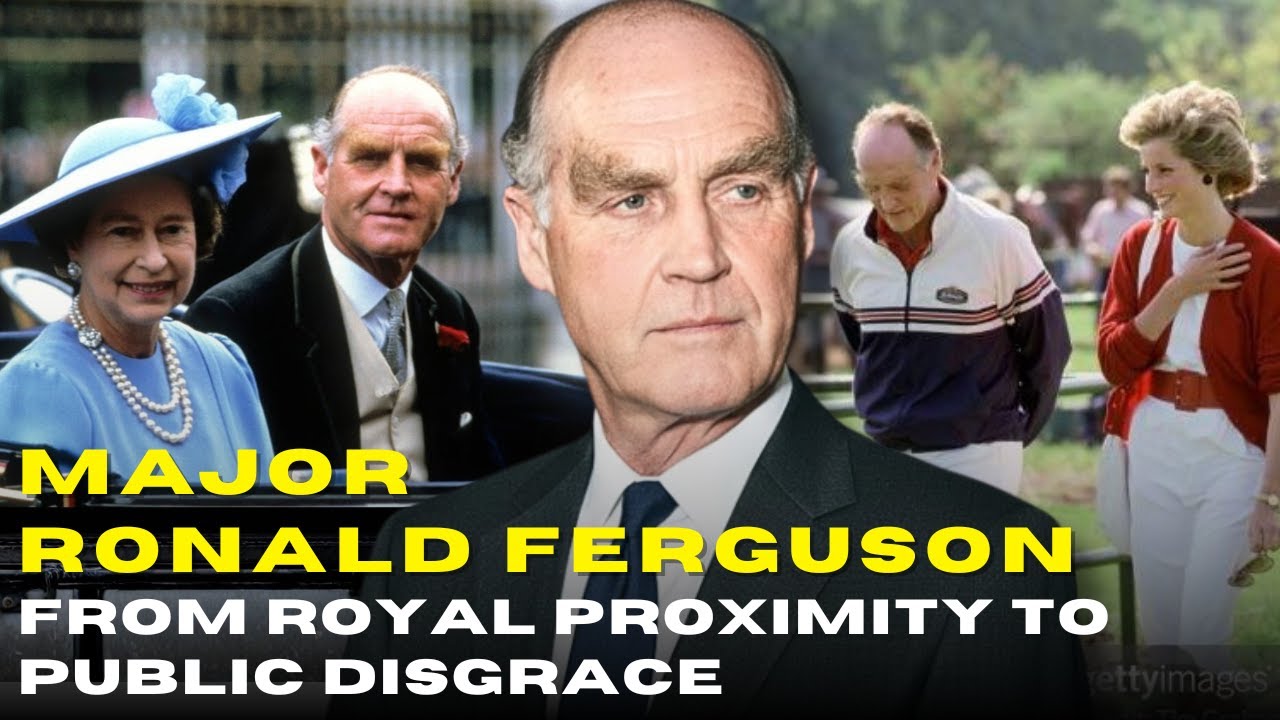
Major Ronald Ferguson spent his days as the ultimate royal insider, a man who gave orders to Prince Charles and stood shoulder to shoulder with the Queen. By night, he traded the immaculate lawns of Windsor for a neon-lit doorway in London’s West End. This is the story of how the father-in-law of the Queen’s favorite son slid from the royal box to VIP visits at an illegal massage parlor.
Ronald Ivor Ferguson was born in London in 1931, but his spirit belonged to an older century. He came from a line of men defined by their bond with horses and service in the higher regiments of the British Army. From the moment Ronnie could walk, he was put in the saddle.
In pre-war upper-middle-class England, riding was not just a hobby. It was a language. If you could ride well, you belonged.
If you could control a 1,000-pound animal with subtle weight shifts, you were seen as having the character to lead men.
Ronnie did not just ride. He dominated. He was powerful, with good hands, determined but sensitive.
He grew up in a world of strict discipline, boarding schools, and emotional suppression, where feelings were considered weakness and physical courage was the only measure. He attended the Royal Military Academy at Sandhurst, and upon graduation, there was only one place for him: the Household Cavalry.
The culture of the Household Cavalry in the 1950s was a club of tough men, hyper-masculine, fueled by tradition, alcohol, and adrenaline. They wore the most extravagant uniforms, guarded the monarch, and lived a life of hard riding by day and heavy drinking by night. Chasing women was practically a competitive sport.
The young Ronnie Ferguson thrived. He was loud, confident, and physically imposing. He was no intellectual, but he had a powerful charisma that men respected and women found overwhelming.
It was in these early years that cracks began to form in his character. In the Guards, arrogance was a virtue. The belief that rules applied only to civilians was built into the regiment’s DNA.
Ronnie learned early that with enough charm and the right uniform, you could get away with almost anything.
His military career was solid, but his true genius lay in networking, and his networking instrument was polo. Polo was more than a rich man’s game in royal circles. It was a refuge.
On the polo field, a prince was just a player. He could be shouted at, pushed, and cursed. For men like Prince Philip and later Prince Charles, who lived their lives in a gilded cage of protocol, the brutality of polo was a relief.
Ferguson understood this. He was not the richest man on the field, but he was the best organizer. He made himself indispensable to Prince Philip, who saw in him a kindred spirit, a blunt, no-nonsense military man.
By the mid-1970s, Ferguson had reached a unique position of power. He became manager of the Guards Polo Club. Managing the club meant managing the Queen’s social calendar.
Ronnie decided who played, who watched, and who got access to the royal enclosure.
It was here that he built the most important relationship of his life, not with a woman, but with the heir to the throne, Prince Charles. Charles was a sensitive, somewhat awkward young man, burdened by his destiny. He loved polo but lacked the natural aggression the sport required.
Ronnie became his mentor. On the field, Ronnie was the only one allowed to shout at the future king. Charles relished it.
He saw Ronnie as a paragon of strength, a real man who treated him like a soldier, not a prince.
They traveled the world together, Argentina, America, Australia. Ronnie organized the ponies, protected the prince from the press, and screened the endless stream of people trying to enter the royal circle. By the early 1980s, Major Ferguson was so deeply embedded in the royal machinery that he seemed untouchable.
While Ronnie conquered the social heights of Windsor, his private life was quietly collapsing. He had married Susan Wright in 1956. On paper, it was the perfect match.
But Ronnie was not made for monogamy. His infidelity was chronic. He treated women the way he treated horses, admiring their beauty but ultimately viewing them as objects to be conquered.
In aristocratic circles of the time, a “don’t ask, don’t tell” policy was the norm. But Ronnie pushed it to the extreme, often humiliating Susan.
They had two daughters, Jane and Sarah. Sarah, the youngest, adored her father. She was a tomboy, temperamental and energetic, desperately seeking his approval.
In 1974, Susan could no longer take it. She fled to Argentina with a polo player. The divorce was bitter.
Ronnie gained custody of the teenage girls, a rarity in the 1970s.
Despite his failings as a husband, he was a devoted, if demanding, father. He raised Sarah and Jane at Dummer Down Farm in Hampshire. He instilled in Sarah a fierce loyalty and a desperate desire for love.
She grew up watching her father charm the world, navigating royal courts with ease. She wanted to be part of that world. And Ronnie, ever the strategist, saw an opportunity.
In the mid-1980s, Prince Andrew was the most eligible bachelor in the world. He was handsome, a war hero, and notorious for his exuberant character. Ronnie looked at his daughter Sarah and at Prince Andrew and saw the perfect match before anyone else did.
Sarah was not a wallflower like the young Diana Spencer. She was loud, funny, red-haired, and resilient. Ronnie helped engineer the romance, using his position at the polo club to ensure they met at the right occasions.
The engagement in 1986 was the crowning achievement of Ronald Ferguson’s work. The wedding day, July 23, 1986, was his pinnacle. He walked Sarah down the aisle at Westminster Abbey, bursting with pride.
He was no longer just the polo manager. He was family. The press loved him, calling him the Galloping Major.
He gave interviews, perhaps too many, sharing his down-to-earth wisdom on love and marriage. He had won. He had secured his legacy.
But winning is dangerous for a man like Ferguson. Victory leads to complacency. With Sarah married and his status assured, Ronnie, now in his mid-fifties, began to drift.
He had remarried in 1976 to Susan Deptford, a much younger woman, and had three more children. But the pattern of his first marriage repeated itself. Domestic routine bored him.
He was getting older. He needed a new source of adrenaline.
London in the late 1980s was changing. It was an era of excess and hidden vices. Ronnie began hearing rumors about places in the West End.
Massage parlors. The term offered a degree of denial. A man with back problems from years of polo could legitimately need a massage.
He began traveling to London regularly, telling his wife he had business meetings. He drove his BMW into the city, parked a few streets away, and walked to 22 Wigmore Street. Inside, he was not the famous Major Ferguson.
He was just a client. And that anonymity was intoxicating.
But he forgot one thing. He was not anonymous. He was one of the most recognizable faces in Britain.
And in the shadows of Fleet Street, tabloid editors were sharpening their knives.
The Wigmore Club did not advertise itself as a brothel. It presented itself as a wellness studio offering executive massages. But past the reception, the illusion collapsed.
The rooms were cubicles separated by thin partitions. This was a brothel, fast, functional, and cheap. The women who worked there were often young working-class girls.
It was into this world that the father-in-law of Prince Andrew came week after week.
The most baffling aspect was Ferguson’s arrogance. A man in his position should have been terrified of being seen. Instead, he walked straight through the front door.
He used a pseudonym, often calling himself Mr. Charles. The staff knew exactly who he was.
His face was constantly on magazine covers. They treated him with a strange mix of reverence and mockery. He was a demanding client, paying for extras, a euphemism for sexual acts.
He peeled crisp banknotes from a thick roll he kept in his pocket.
For a long time, silence was maintained. In the London underworld, you do not betray your clients. As long as the Major paid and caused no trouble, his secret was safe.
Or so he thought.
By 1988, the media landscape had changed. Fleet Street’s old system of deference to the monarchy was being replaced by a new breed of hungry tabloid journalists. The royal family had become characters in a soap opera.
By 1988, the honeymoon period for Fergie was over. The Duchess of York was being mercilessly attacked by the press. They mocked her weight, her clothing, her exuberance.
They began sniffing around the Ferguson family, and they caught wind of Ronnie’s visits to the Wigmore Club.
The People newspaper planned an operation like a military campaign. They hired a young, attractive female reporter. Her cover was simple: she was a new girl who had just started at the club.
She was wired with a hidden tape recorder in her handbag. A photographer was stationed outside. For days, nothing.
Then, on a Tuesday afternoon, the call came. Target is on site.
Major Ferguson walked down Wigmore Street in his trademark blazer. Inside, the undercover reporter positioned herself near the reception. She heard him greet the madam.
The transcript of the tape later released was damning. There was no seduction, no romance. It was a business transaction.
“Is the girl’s name available?” the Major asked. He negotiated the price.
He discussed the menu. The reporter had caught him offering to pay for sex. Outside, the photographer captured the crucial shot.
The Major left the club, checked his watch, and walked away, unaware he had just entered the history books.
The period between the undercover operation and publication was a terrifying silence. The People spent weeks verifying everything. They decided to publish on a Sunday, the holiest day for British tabloids.

On Saturday night, the customary calls for comment were made. Imagine the scene at Dummer Down Farm. The phone rings.
Ronnie answers. An editor tells him they have photos and recordings of him at the Wigmore Club. The blood must have drained from his face.
He tried to deny it. He bluffed. He threatened.
But the editor read him the transcript. Ronnie hung up. He knew what was coming.
In May 1988, the headline was not subtle. It covered the entire front page. The article left nothing to the imagination.
It described the frequency of his visits, quoted the girls describing his preferences, and mocked his physique. The reaction was immediate. At Windsor Castle, the Queen read the headlines.
Prince Philip threw the paper down in disgust. Prince Charles felt the cold dagger of betrayal. For Sarah, it was the end of the world.
Her father, her hero, had become the source of their greatest shame.
The establishment closed ranks. The drawbridge went up, and Major Ronald Ferguson stood on the wrong side of the moat. Ronnie waited for the call from Prince Charles, believing their bond was strong enough to survive this.
He did not understand the fundamental rule of royalty: loyalty flows upward, never downward. The call never came. Instead, communication went through intermediaries.
The prince is disappointed. Her Majesty is concerned. It might be best if you kept a low profile.
Charles took it personally. He had entrusted his sporting reputation to Ferguson. The news made Charles look foolish.
His reaction was icy fury. A few days after the scandal broke, it was announced that Major Ferguson would step down as manager of the Guards Polo Club and as Prince Charles’s polo manager. The official reason was laughable: it was presented as a planned retirement due to his age.
He was 57. Everyone knew it was a lie. He had been fired.
The person who suffered most was Sarah. She loved her father deeply, but she was also fighting for her survival within the royal family. She tried to balance, not condemning him publicly but privately furious.
Prince Andrew was caught in the middle. He was fond of Ronnie, but he could not publicly support a man who was the butt of every joke in Fleet Street. An icy chill descended on the relationship.
The public devoured him. The Galloping Major nickname changed from a term of endearment to a mockery, now referring to his libido. He tried to defend himself, giving interviews denying the worst accusations.
He claimed he had undergone therapeutic massages for polo injuries. It was a mistake. Every time he opened his mouth, he dug his own grave deeper.
By 1989, the dust had settled, but the landscape was forever changed. Ronnie had lost his purpose. Without the polo club and the royal connection, who was he?
He watched from the shadows as the marriage he had arranged for Sarah and Andrew began to crumble. When they separated in 1992, Ronnie must have felt guilty. Had his scandal weakened her position?
But fate was not finished with Ronald Ferguson. The Wigmore Club was only the first blow. More secrets were buried in the Major’s closet, secrets about to be dug up by a woman named Leslie Player.
In the years after the Wigmore scandal, investigative journalists discovered that during his first marriage, Ronnie had fathered a child out of wedlock. The revelation was damaging, painting a picture of a man who left a trail of emotional damage. But Ronnie, with characteristic stubbornness, weathered it.
Then came Leslie Player. She was a glamorous blonde society figure who moved in the same polo circles as the Fergusons. She was a polo club manager herself.
Ronnie met her in the mid-1980s, when his second wife Susan was pregnant with their third child. The affair was passionate, intense, and reckless. Ronnie wrote her letters, made promises, and complained about his marriage.
But like all Ronnie’s affairs, the excitement eventually faded. He retreated back to the safety of his marriage. He expected Leslie to disappear quietly.
She did not.
In 1992, she decided to write a memoir. The book was serialized in the tabloids, and the content was explosive. She described Ronnie not as a charming lover but as a man obsessed with his own masculinity.
She revealed the timeline, making clear that while Ronnie posed for photos with his pregnant wife, he was sneaking off to be with her. She described him calling her from royal residences. Most damaging was the publication of his love letters, stripping him of any remaining dignity.
The true victim of this second wave was Susan Ferguson. She had supported him through the Wigmore scandal, believing his promises that it was a one-time mistake. Now she read in the national press that her husband had been having a long-term affair with a woman she knew, a woman she had socialized with while pregnant with his child.
Incredibly, Susan stayed with him. Her loyalty remains the great mystery of this story.
1992 was the year Queen Elizabeth II called her “annus horribilis.” The monarchy was on fire. Windsor Castle literally burned.

Charles and Diana separated. Anne divorced. Andrew and Sarah separated.
In August 1992, photos were published of Sarah Ferguson sunbathing in the South of France while her financial advisor sucked her toes. The timing was catastrophic. Father and daughter were now embroiled in scandals.
The press drew direct parallels. So father, so daughter, screamed the headlines.
By the mid-1990s, Ronald Ferguson had completed his transformation from royal insider to national joke. He was relentlessly parodied. But the tragedy was that Ronnie did not see himself that way.
In his own eyes, he was still the Major. His finances began to suffer. The lucrative speaking engagements dried up.
He retreated further into Dummer Down Farm.
Then, as if the scriptwriter of his life decided he had not suffered enough, his body began to fail him. In 1996, he was diagnosed with prostate cancer. The disease attacked the biological center of his masculine identity.
The treatment involved hormone therapy that weakened his body and effectively ended the libido that had driven him for forty years. For the first time, the Major was forced to be vulnerable.
To his credit, Ronnie faced this fight with a different kind of courage. He went public with his illness, campaigning for prostate cancer awareness. He spoke openly about the humiliation of the disease.
It was a moment of redemption. For the first time, the public saw him not as a seedy caricature but as a frightened, aging man trying to warn others.
As his health declined, Ronnie found his greatest ally in the person most like him: his daughter Sarah. By the late 1990s, the Duchess of York was also in exile, divorced, in debt, and mocked by the press. Father and daughter were two outcasts clinging to the wreckage.
Their relationship, strained by the scandals, deepened in these final years.
The most remarkable figure in this last act remained his wife, Susan. Despite the Wigmore Club, despite Leslie Player, despite the secret son, Susan stayed. She nursed him.
She took him to chemotherapy. She protected him from the worst of the press. Whatever the reason, she ensured that the man who had spent his life chasing other women did not die alone.
The new millennium brought no relief. The cancer spread to his bones. Then came skin cancer, then heart problems.
By 2002, the man who once instilled fear in young Guardsmen sat in a wheelchair. He spent his days surrounded by photos of his former glory, photos of him with Prince Philip, photos of the wedding day. It was a museum of a life that no longer existed.
In March 2003, his heart finally gave out. He suffered a massive heart attack and died on March 16, at the age of 71. The Galloping Major had run his last race.
The funeral was a surreal piece of British theater. The question on everyone’s mind was who would attend. Would the royals who had abandoned him return for the final tribute?
Prince Charles did not come. The man Ronnie had mentored, the man who had once been like a son to him, stayed away. He sent a representative, a formal gesture that met the requirements without offering the warmth of physical presence.
Prince Philip did not come. But Prince Andrew did, standing at the grave of his former father-in-law.
The service was militarily precise. The Household Cavalry provided a guard of honor. The coffin was draped in the British flag.
Trumpeters played the Last Post. For a brief hour, dignity was restored. There was no talk of massage parlors or mistresses in the church.
There was only the liturgy of death.
But as the mourners dispersed, the newspapers were already printing the obituaries. Every major paper made the same choice. They began with the scandal.
Even in death, he could not escape the Wigmore Club. It was the tattoo on his legacy that could not be erased.
Looking back, Ronald Ferguson was a man of contradictions. To his friends, he was a loyal, tough guy, a relic from a time when men supported each other. They saw him as a victim of a ruthless new media culture.
To his critics, he was a symbol of aristocratic decay, representing a class of men who believed their lineage entitled them to exploit women and maintain a double standard.
Perhaps the most accurate description is that he was a dinosaur who did not see the meteor coming. He lived his life by the rules of the 1950s, where appearances were everything and private vices were ignored. He crashed headfirst into the world of the 1990s, where transparency reigns and hypocrisy is the ultimate sin.
He was not a bad man. He was not a criminal. He was, in many ways, a weak man masked by a strong uniform.
He was a father who loved his daughters but humiliated their mother. He was a courtier who served his prince but embarrassed his king.
His life serves as a warning about the fragility of reputation. It took him forty years to build his position as a pillar of the establishment. It took one Sunday morning to destroy it.
He spent his life trying to be a great man, important, influential. In the end, he became something far more recognizable and far more tragic: a fallible human being who got lost in the dark. The Galloping Major has come to a stop.
The dust has settled. All that remains is the silence of the farm and a story that reminds us that the higher you climb, the harder you fall.