On September 2, 1945, in Tokyo Bay, the world’s cameras focused on the deck of the USS Missouri. General Douglas MacArthur stepped toward the microphone. Behind him stood a man who looked as though he had already died once.
His uniform hung loosely on his frame, his face was skin stretched over bone, but his posture was straight. His name was Lieutenant General Jonathan Wainwright. Within minutes, he would witness Imperial Japan sign the end of the war.
Three years earlier, Wainwright had raised the white flag over the last American stronghold in the Philippines. It was the largest surrender of U. S.
forces in history. Newspapers called him the general who lost the Philippines. Washington had written him off as a soldier who cracked under pressure.
How did a man at the lowest point of American military history come to stand on that deck, close enough to touch the table where Japan surrendered?
The answer begins not on a battleship, but in a jungle peninsula called Bataan, where 80,000 men were starving, and one general made a choice no one in Washington expected him to keep.
To understand what Wainwright faced, you must return to December 8, 1941, hours after the attack on Pearl Harbor. Japanese bombers appeared over Clark Field in Luzon, the main U. S.
Army air base in the Philippines. What they found stunned their own pilots. Rows of B-17 bombers sat parked wingtip to wingtip on the runway, fueled, with cold engines.
News of the attack on Hawaii had reached Manila. There was time to launch the planes, disperse them, and prepare. Somewhere between command and airfield, the warning never became action.
The bombs fell in precise lines. Fuel turned each parked aircraft into its own funeral pyre. Ground crews watched from their trenches, counting columns of black smoke rising into a sky that had been theirs an hour earlier.
In one afternoon, MacArthur lost half his air force on the ground.
On December 22, Japanese Lieutenant General Masaharu Homma landed 43,000 troops at Lingayen Gulf, supported by 80 warships. MacArthur’s forces retreated under the assault. Some Filipino units had been in uniform only weeks.
Within days, MacArthur ordered a full withdrawal to Bataan, a narrow strip of jungle and mountains guarding the entrance to Manila Bay. The plan was simple: dig in, hold the line, wait for the fleet and reinforcements Washington promised.
There was a problem. In the chaos of withdrawal, vast stockpiles of rice, canned goods, and medical supplies were left behind Japanese lines. Warehouses full of food were abandoned.
It was not sabotage, not one man’s error. It was the arithmetic of a retreat executed too quickly across unforgiving terrain. The result was the same: 80,000 soldiers had to hold a jungle peninsula with a fraction of the food they needed for a long siege.
In Washington, Chief of Staff George Marshall had already made his calculations. Germany was the priority. The Atlantic first.
The Pacific would get what could be spared after Europe was served. The convoys promised to the soldiers, the fleet they scanned the horizon for every morning, would never come. No one told them.
They kept believing because belief was the only thing that made the hunger and the dwindling ammunition make sense.
Into this collapsing situation stepped Major General Jonathan Wainwright, age 58, a West Point cavalry graduate from the class of 1906. He was thin to the point of gauntness even before the siege began. His men called him “Skinny.”
It was not an insult. It was affection. He had spent his entire career among horses and hard posts, from the Texas border to fighting Moro insurgents in the southern Philippines to the trenches of France in World War I.
He held one conviction: an officer who does not eat what his men eat and sleep where they sleep does not deserve to command them.
While MacArthur directed the defense from the fortified tunnels of Corregidor, an island fortress a mile off Bataan’s coast, Wainwright led the actual front line. He inspected trenches before dawn. He sat in the dirt beside soldiers who had not had a hot meal in weeks.
One of his officers put it plainly years later: “You always knew where Wainwright was. He was wherever the fighting was worst. The men noticed.”
By early January, rations were cut in half. They kept shrinking. The men supplemented rice with whatever the jungle offered: monkey meat, snakes, iguanas.
Temperatures exceeded ninety degrees by mid-morning. Men who had not eaten a full meal in days dug trenches, stood guard, and carried heavy equipment through rough terrain. Then came the cavalry horses.
For a cavalry officer like Wainwright, a man who built his career and identity around horsemanship, this was a sacrifice of a special kind. He personally issued the order to turn them over to the quartermaster for slaughter. There was nothing else left to give the men.
Every night, Japanese radio operators broadcast a popular tune directly at American and Filipino positions in Bataan. The title needed no translation: “Waiting for Ships That Never Come.” Night after night, the melody drifted over the treetops.
Most soldiers did not speak of it aloud. Everyone understood the meaning, and everyone chose, night after night, to keep believing anyway.
Wainwright watched what six weeks of hunger, disease, and false hope did to 80,000 men. He made a decision that would define the rest of his life. He would stay on that line.
He would not leave any of them behind.
On the evening of March 11, 1942, MacArthur’s chief of staff summoned Wainwright to Corregidor. MacArthur was leaving that night on a torpedo boat. President Roosevelt had personally ordered it.
MacArthur was needed in Australia to organize the counteroffensive. The Philippines and everyone still fighting for it would have to continue without him.
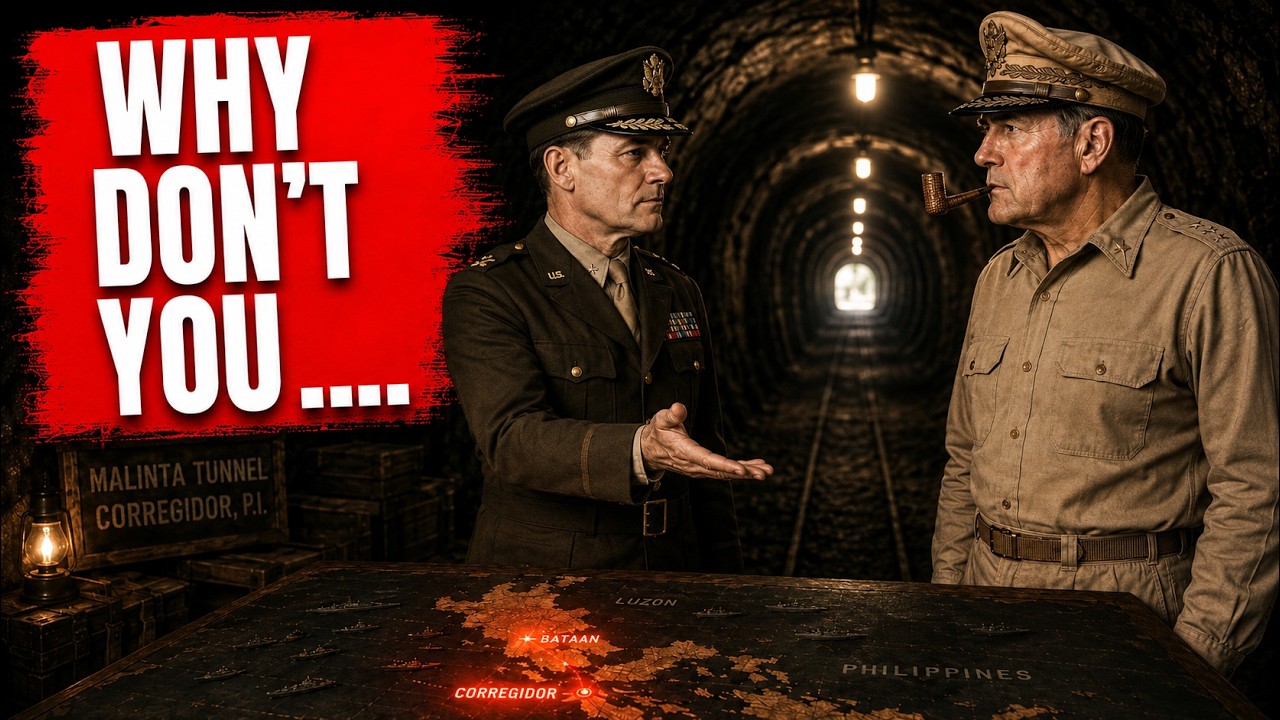
MacArthur found Wainwright before he left. The two men stood together in the dim, damp light of the Malinta Tunnel. MacArthur said, “Goodbye, Jonathan.
When I return, if you are still in Bataan, I will promote you to lieutenant general.” Wainwright answered without hesitation: “I will be in Bataan, if I am still alive.” There was no bitterness in his words, no false comfort either.
That night, MacArthur slipped out of Corregidor on four PT boats. Four days later, he stood before microphones in Australia and delivered the phrase history would remember: “I came out of it, and I shall return.”
Back in Bataan, the news reached the men by radio. Some understood exactly what it meant. Others did not want to.
One soldier wrote home that the men felt let down, even betrayed. Wainwright did not have the luxury of writing such letters. He had just inherited command of every remaining American and Filipino soldier in the Philippines, a command senior officers in Washington secretly considered hopeless.
Wainwright sent a telegram to Washington in plain language: “My men will starve into surrender unless food arrives before April 15.” Washington received the message. Washington did not reply.
Wainwright folded the telegram, put it aside, and returned to the front lines.
By late January, the standard combat ration required about 4,000 calories a day for a man carrying a rifle in jungle heat. The men in Bataan were getting less than a thousand. Some lost fifteen pounds in a month.
Others lost twenty-five. By late March, men stopped losing weight, not because their bodies adapted, but because there was nothing left to lose. The jungle provided what it could: boiled monkey meat, snake meat, iguana roots eaten raw.
Cavalry horses were slaughtered for meat. The men ate without complaint because there was nothing else.
Then came disease. Malaria first, spread by mosquitoes. Then dengue fever, then dysentery.
Then beriberi, a direct result of malnutrition, swelling men’s legs until walking was agony. The field hospitals ran out of quinine by February. Surgeons operated by flashlight, often without sufficient anesthesia.
Men bit on leather straps while doctors worked because morphine was reserved for the most severe cases. By March, disease was killing more men in Bataan than Japanese bullets. Yet day after day, they held their lines.
Jonathan Wainwright went out with them every morning. Not behind a desk in Corregidor, but in the mud, inspecting gun positions, sitting beside men who had not slept properly in days. One of his officers summed it up simply: his presence on the front line was what kept them going.
Not orders, not speeches, just his presence among them.
On Good Friday, April 3, 1942, the Japanese launched their final assault on the Bataan line. General Homma had spent weeks waiting for reinforcements from Japan. Now they had arrived: fresh troops, heavy artillery, full stomachs, abundant ammunition.
The artillery bombardment that opened the attack was the heaviest concentration of firepower the Japanese used anywhere in the Philippines campaign. Hour after hour of shelling aimed at breaking what remained of the defensive line.
Wainwright committed every reserve unit he had, using cooks, clerks, and support troops to fill gaps where combat units had ceased to exist as organized formations. It was not enough. It could not have been enough.
Day after day, the Japanese pushed south through the peninsula. Units that had held together for months simply dissolved under the pressure of the enemy and their own physical collapse.
On the morning of April 9, Major General Edward King, commanding the forces still fighting in Bataan itself, made a decision that would haunt him for the rest of his life. He looked at nearly 75,000 men under his command, most sick or too weak to fight effectively, out of food entirely, nearly out of ammunition. He realized that continuing resistance would not change the outcome.
It would only add more corpses to a battle already lost. King made the decision without informing Wainwright beforehand. He sent word to the Japanese that Bataan would surrender.
It remains the largest surrender of American forces in history.
What followed became one of the darkest chapters of the Pacific War. Some 75,000 American and Filipino prisoners, most sick, hungry, and physically exhausted, were forced to march north out of the peninsula toward prison camps. The journey stretched about 65 miles on foot in tropical heat with little food and almost no water.
Guards beat stragglers with rifle butts. Men who collapsed and could not rise were beaten, bayoneted, or shot where they lay. Filipino civilians who tried to offer food or water risked being beaten themselves.
Thousands died before reaching the camps. History would know it as the Bataan Death March.
Wainwright, still on Corregidor, did not witness the march directly. But he understood what surrender to this enemy might cost. That understanding would weigh on every decision he made in the days remaining to him as a free commander.
Corregidor was a small fortified island of barely two square miles of volcanic rock and reinforced concrete, controlling the entrance to one of the best deep-water harbors in the Pacific. The Japanese needed that harbor. As long as Corregidor held, they could not take it.
Now that Bataan had fallen, the Japanese turned every gun toward the island. The bombardment became nearly continuous. Artillery by day, bombers whenever weather allowed, mortar shells targeting the beaches at night.
The defenders lived underground in the Malinta Tunnel, a network of reinforced concrete passages carved directly into the island’s rock. Hundreds of soldiers, nurses, and command staff worked, slept, and tried to breathe in air thick with diesel fumes, antiseptic, and unwashed bodies packed into tight space. Water itself was rationed by the cup.
The heat trapped underground made breathing feel like hard labor.
Wainwright moved through all of it, from tunnels to surface and back, inspecting gun positions, talking to exhausted crews, acting like a man who truly believed the island could hold. On May 1, he sent a radio message directly to President Roosevelt. He wrote: “There is a limit to human endurance, and that limit has long since been passed.”
It was not a complaint. It was a diagnosis offered quietly and clearly, for the last time.
Four days later, on the night of May 5, the Japanese came ashore. Just before midnight, landing craft crossed the dark water toward Corregidor’s beaches. The exhausted defenders met them with everything they had left.
Machine gun crews, barely fed for weeks, poured fire into the crowded boats with a ferocity that surprised even their own officers. The first wave of Japanese troops took heavy casualties. Burning landing craft lit the beach enough for defenders to see silhouettes moving in the water.
For a few hours in the darkness, it seemed the island might hold.
It did not. More landing craft came behind the first wave, then more. Wave after wave of fresh troops against defenders with no reserves left.
By the morning of May 6, Japanese tanks were pushing inland from the beachhead. Wainwright knew the end had come.
He walked through the Malinta Tunnel for the last time as a commander. Wounded men lay on stretchers lining both walls, packed so tightly that medics had to step carefully to avoid them. Army nurses still worked in the half-darkness, changing bandages, holding soldiers’ hands.
Wainwright looked at what remained of his command and made his decision. He sent two officers forward under a white flag to begin contact with the Japanese. Then he faced the enemy commander himself.
He would not send another man to do this part for him.
Before the surrender was completed, American soldiers moved quickly through the tunnel, performing one last duty. Code books were thrown into makeshift fires. Secret documents burned page by page.
Regimental flags, which had flown over American positions in the Philippines since before the fighting began, were torn from their staffs and burned rather than allowed to fall into Japanese hands intact. Wainwright watched them burn. He knew the word the newspapers would use to describe what he was about to do.
Surrender. He accepted that this was the word history would attach to his name. What he could not accept was walking out of that tunnel and leaving the wounded and exhausted to be slaughtered for nothing.
Wainwright formally surrendered the remaining forces on Corregidor at 1:30 in the afternoon of May 6, 1942, less than five months after the first Japanese bombs fell on Clark Field. He did it to prevent men from dying for a cause already decided.
What followed was a test of a different kind. The Japanese moved him through a series of prison camps: first in the Philippines, then to Formosa, and finally to a remote compound deep in Manchuria. As the highest-ranking American officer captured in the entire Pacific War, Wainwright received no privileges.
He stood in the same lines as the other prisoners, ate the same thin soup, slept on the same hard wooden boards. Manchurian winters brought cold most of these men had never experienced. His weight, already lost during the siege, continued to drop until the man who was once thin but strong weighed about 125 pounds.
Inside the camp, Wainwright traded everything of value he still owned — a fountain pen, his wristwatch, whatever possessions survived the surrender — for scraps of information about the real course of the war. He had no reliable way to know if any of it was true. He did not know that the U.
S. Navy had broken the Japanese fleet at Midway in June 1942, weeks after his surrender. He knew nothing of Guadalcanal or the long, brutal island-hopping campaign.
He knew one thing with certainty: day after day, he was still alive. As long as he was alive, he considered himself still a soldier in the United States Army.
Men who survived those camps later said Wainwright was the reason many of them held on through the worst conditions. Not because he gave rousing speeches. He was never that kind of officer.
But because every morning he stood straight, present, refusing to dissolve into the anonymous suffering around him. He called roll in the morning formation. He maintained the formations the guards allowed, insisted on basic military discipline among the prisoners themselves, and clung to the small rituals of military life.
He understood something the guards never grasped: the moment a man stops acting like a soldier in his own mind, he stops being one. If the prisoners lost that last part of themselves, they would have almost nothing left.
There was also a hidden fear that rarely spoke aloud. Wainwright knew how the news of the Bataan and Corregidor surrenders had been received at home, at least in the early reports. He had no way of knowing whether history and his own army would ultimately judge him a failure, or a commander who made the only choice available.
That uncertainty accompanied him through three winters in a Japanese prison camp.
For three years and three months, Jonathan Wainwright kept going, waking each freezing Manchurian morning and choosing to stand on his feet in whatever small way was still available to him.
In August 1945, the war finally came looking for Jonathan Wainwright. Soviet forces sweeping through Manchuria reached the compound where he was held. American intelligence officers racing to locate every high-ranking prisoner before the surrender was completed had tracked him down days before Japan capitulated.
For the first time in three years and three months, Jonathan Wainwright was a free man.
On August 31, he was flown to the New Grand Hotel in Yokohama to meet Douglas MacArthur, the man who had left him in command of a hopeless defense three and a half years earlier. MacArthur entered the room and stopped almost as soon as he saw him. The man standing before him had white hair now, a face so thin the bones showed through, and a body that needed a cane just to remain upright.
MacArthur’s eyes went to that cane, and something changed in his expression. He recognized it. It was the same cane MacArthur himself had given Wainwright before the war, then a ceremonial stick, a small symbol of rank and confidence between two professional officers.
For three years in prison camps across the Philippines, Formosa, and Manchuria, that cane was what physically kept Jonathan Wainwright standing. MacArthur, the man rarely at a loss for words before any audience, found himself unable to speak. The two men simply embraced for a long moment.
Two days later, on September 2, 1945, Wainwright was helped aboard the USS Missouri in Tokyo Bay. When he reached the deck, despite his weakness, he insisted on standing straight. The Japanese delegation came aboard shortly after nine in the morning.
They signed the surrender document first. Then MacArthur stepped toward the small table on the deck. Standing directly behind him, close enough to touch his shoulder, was Jonathan Wainwright, whom MacArthur himself had invited to witness that moment from that specific position.
It was a deliberate choice. Among all the officers who could have stood in that place of honor, MacArthur chose the man he had once left behind in a losing battle. The choice was both an apology and a quiet tribute.
MacArthur signed the document using several different pens, a common practice for occasions meant to be memorialized. When he finished, he turned and handed two of those pens to the officers standing directly behind him. One went to British Lieutenant General Arthur Percival, who had been forced to surrender Singapore to the Japanese in 1942 and had been held in the same Manchurian camp as Wainwright.
The other pen went to Wainwright himself. The man once branded in American newspapers as the general who lost the Philippines now held one of the pens used to accept the unconditional surrender of Imperial Japan.
Eight days after the Missouri ceremony, on September 10, 1945, President Harry Truman received Wainwright at the White House and personally presented him with the Medal of Honor. The official citation described a man distinguished by brave and resolute leadership against enemy forces vastly superior in numbers, who risked his life repeatedly beyond the call of duty through his constant presence on the front lines. Three days later, New York City held a ticker-tape parade in his honor.
Thousands lined the streets, cheering for the man the same newspapers had once described as the general who lost the Philippines. The transformation was complete. The failure of 1942 had become, in the public eye, one of the defining examples of endurance and quiet courage to emerge from the Pacific War.
Wainwright remained in the army for two more years, serving in a series of senior command positions before retiring in 1947 with the rank of full general. He spent his remaining years quietly, appearing occasionally at veterans’ events with particular attention to the care of former prisoners of war. He rarely gave lengthy interviews about his captivity.
When he spoke publicly about the war, he tended to direct attention toward the men who served under him rather than his own ordeal.
Jonathan Wainwright died on September 2, 1953, in San Antonio, Texas. He had lived long enough to see the country that once called him a failure regard him as one of the most respected soldiers to survive the Pacific War. The date was not coincidence.
It was exactly eight years to the day after he stood behind Douglas MacArthur on the deck of the USS Missouri and watched the Japanese Empire sign the end of the war that had cost him everything. He was buried with full military honors at Arlington National Cemetery.
The question of what Wainwright did when MacArthur left him to die in the Philippines has an answer more complex than either side of the common framing allows. MacArthur did not personally choose to abandon Wainwright. He left on a direct, explicit order from President Roosevelt, who judged that MacArthur’s experience was more valuable to the overall war effort leading a counteroffensive from Australia than as a prisoner of war.
It was a defensible strategic decision made at the highest levels of the American government. Wainwright himself never publicly blamed MacArthur.
What Wainwright did in the years and decades that followed was answer a much harder question through his personal choices. Given command of a battle senior officers in Washington secretly considered lost, he chose to stay on the front lines with his men through five months of starvation and siege. He chose to surrender personally rather than delegate that burden to another officer, and accepted whatever judgment history might pass on him for it.
He chose to remain inside a Japanese prison camp for three years and three months, maintaining his conduct as a soldier and officer even after every external reason for doing so had vanished, because he understood that the alternative was losing the last thing the men who still watched him had to hold on to.
The men who survived Bataan and Corregidor, alongside those who did not, bought something with their suffering that the rest of the Allied world ultimately spent at Midway, Guadalcanal, and across the hundreds of small island battles that followed, and finally on the deck of a battleship in Tokyo Bay on a September morning in 1945. Jonathan Wainwright did not know in the darkest months of 1942 that any of this would happen. He knew only that he had made a promise to stay with his men until the end, whatever that end might be.
He kept his promise, one impossible day at a time: through the famine, the siege, and three years in a prison camp most Americans could not locate on a map, until the day came when the whole world watched him stand straight again on the deck of a battleship, holding a pen that had just ended the war he was once told, quietly and without ceremony, to survive on his own.