On a freezing night in late November 2017, Sophie Winkleman lay trapped in the twisted wreckage of a car on a dark country road. Her spine was fractured in three places. Her abdomen had been torn open.
She was certain she was dying.
Seventy miles away in London, her husband, Lord Frederick Windsor, waited by the phone. In that moment, the gilded cage of royal life snapped shut around him. Unlike his famous cousins William and Harry, Frederick lived in the foggy space between privilege and instability.
He was expected to bow like a prince but forced to struggle like a commoner. No state security protected him. No sovereign grant cushioned the blow.
As he faced the possibility of his wife's paralysis, he was not worrying about protocol. He was confronting the brutal arithmetic of survival.
Frederick was born carrying a weight far heavier than a title. His father, Prince Michael of Kent, is a cousin of Queen Elizabeth II, descended through his mother, Princess Marina of Greece and Denmark, from the Romanovs. He is a direct descendant of Tsar Alexander II.
Frederick was raised as a living link to lost European grandeur. But unlike the senior royals, the Kent branch received no income from the civil list. They had a title, a grace-and-favour apartment in Kensington Palace, and little else.
Frederick grew up playing in the Kensington Palace gardens with William and Harry. They attended the same kinds of schools and moved in the same social circles. But inside the homes, the atmospheres were different.
In the Wales household, money was effectively unlimited. In the Kent household, money was a constant, gnawing worry. The Kents worked for their living.
They sat on boards, wrote books, attended events for fees. They were working royals with no official job title or salary.
His mother, Princess Michael of Kent, born Baroness Marie-Christine von Reibnitz, stormed into the British royal family in the 1970s as a Catholic, divorced, foreigner. The press dubbed her "Princess Pushy." She compensated for the family's lack of money with an excess of extravagance and hauteur.
For Frederick, being her son meant being the target of constant scrutiny. Every misstep she made, and there were many, reflected on him. He learned to be quiet, to read the room, to become the calm, dutiful son.
The Kents were determined to give Frederick the best education. He attended Wetherby School, then Sunningdale, then Eton. At Eton, he was surrounded by boys who would inherit vast estates and fortunes.
He was a lord who would have to work. The unspoken motto in the Kent household was: we are not the heirs. You must have a career.
Frederick was intellectually gifted. He excelled in classics, literature, and music. He was a talented pianist.
He won a place at Magdalen College, Oxford, where he studied Latin and Greek. He graduated with a very good degree. By the late 1990s, he was the model of a young prince: educated, handsome, titled, and cultured.
But the gap between university and real life proved treacherous. In late 1990s London, Frederick became a fixture of the club scene. He was photographed at Boujis, Mahiki, and China White.
The press loved him for all the wrong reasons, portraying him as a party prince. In 1999, the story took a darker turn. Frederick was involved in a cocaine scandal.
He admitted to taking the drug. The headlines screamed shame. For Princess Michael, who had spent decades trying to prove her family's superiority, it was a crushing blow.
For Frederick, it was a cry for help. He was trapped by the expectations of his lineage, the financial anxiety of his parents, and the absence of a clear purpose. What was a lord supposed to do in the 21st century?
He withdrew, humiliated. Then he made a radical choice. He got a job.
Frederick turned his back on the bohemian lifestyle and entered the world of finance. He started as a financial analyst. He worked long hours.
He joined J. P. Morgan, the American banking giant.
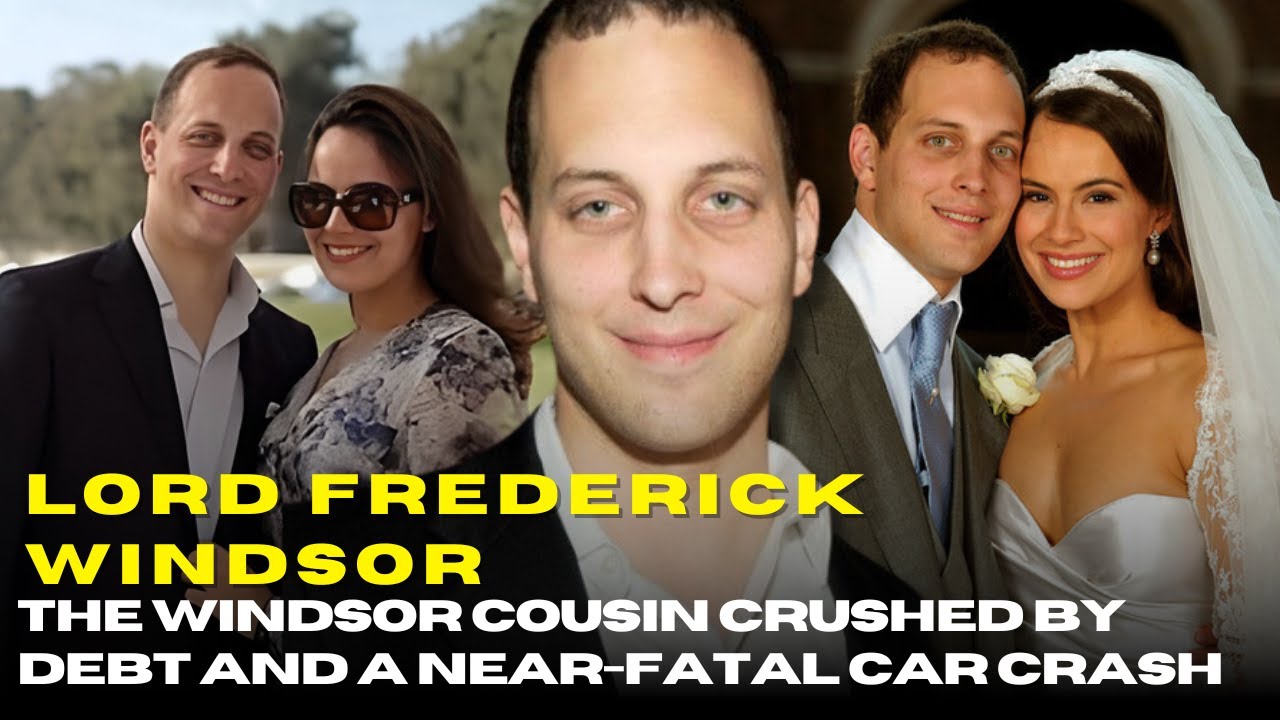
For the first time in his life, he had an identity entirely his own. He was not Princess Michael's son. He was Frederick Windsor, vice president.
He earned a salary. He paid taxes. It gave him stability and independence.
The most important development of that period was not his career. It was his heart. In the mid-2000s, Frederick met Sophie Winkleman.
She was an actress, the daughter of a publisher and a writer, educated at Cambridge. She was intelligent, fiercely independent, and known for her role as Big Suze in the comedy series Peep Show. She was the antidote to Frederick's royal life.
She did not care about protocol. She cared about him.
They married at Hampton Court Palace in 2009. Shortly after, they moved to Los Angeles. It was a practical decision.
Sophie's acting career was rising, and Frederick could transfer his skills to J. P. Morgan's California offices.
They enjoyed the privacy. In Los Angeles, a lord was a curiosity, not a piece of constitutional furniture. They could walk down the street unrecognized.
Their daughter Maud was born there in 2013. Frederick was an active, hands-on father.
They returned to London in 2016, establishing their own independence. Sophie continued her work, landing a role in Danny Boyle's series Trust. Frederick continued in finance.
By late 2017, they had a second daughter, Isabella. They were the golden couple of the extended royal family. They had built a fortress of stability.
Then chaos arrived.
On the night of November 23, 2017, Sophie was filming at Audley End House in Essex. Late after filming, she got into the back of a car driven by a chauffeur for the journey home. Near Saffron Walden, a deer appeared from the darkness.
The driver swerved instinctively. The car lost traction, launched into the air, and collided head-on with an oncoming vehicle.
Sophie was conscious, trapped in the wreckage. Her abdomen had been torn open. She could feel the bones in her back moving.
She thought calmly: I am dying. Her spinal cord was being compressed by shattered bones. If she moved the wrong way, she would never walk again.
Frederick received the call in London. He rushed to Addenbrooke's Hospital in Cambridge. Sophie was broken.
Her foot was shattered. Her back was fractured in three places. For three days, she had no feeling in her lower body.
The doctors were serious but optimistic. The recovery would be long.
Sophie survived. Miraculously, the paralysis was not permanent. After weeks of painful care, she was allowed home.
But home was no longer a home. It became a rehabilitation centre. Sophie could not walk, stand, or hold her children.
For a mother of two young girls, this was a special kind of torment.
Here, the gilded cage closed fully. In the public imagination, when a royal falls ill, a battalion of nurses and nannies surrounds them. For Frederick and Sophie, there was no battalion.

There was only the two of them. Frederick faced an impossible equation. His wife needed full-time care.
His daughters needed a father. And he had a boss at J. P.
Morgan. In the high-stakes world of finance, sympathy has a short shelf life. He could take a few days off for a family emergency, but not months to become a full-time nurse.
The financial panic set in quickly. They were a dual-income family living in one of the most expensive cities in the world. They had a mortgage, school fees, and living expenses that looked aristocratic but were middle-class in structure.
If Frederick stopped working, the income stopped. If Sophie could not act, her income stopped too. They were on the edge of a cliff.
A title cannot pay a mortgage. A place in the line of succession cannot be traded for groceries.
For weeks, they struggled in silence. Frederick became a ghost. He woke up, cared for the children, cared for his wife, tried to manage his work remotely, then collapsed.
The strain was devastating. There is an ingrained pride in the nobility, especially among the less wealthy like the Kents. You do not ask for help.
You do not admit you are drowning. So Frederick said nothing. He cooked.
He cleaned. He carried his wife, risking his own back. He was fighting a war of attrition against costs and finances, and he was losing.
Sophie watched her husband wither under the pressure. She saw the exhaustion in his eyes. She realized the modern royal experiment, the idea that they could live without state assistance, was failing under the weight of an ordinary tragedy.
They were isolated. The senior royals had no idea what it meant to worry about laundry or dinner while recovering from a spinal fracture. Frederick would not ask for help.
He was Princess Michael's son. He had spent his life proving he was not a burden.
Then, just before Christmas 2017, word reached Prince Charles. He did not send an official memo or a get-well card. He sent a chef.
Charles ordered his staff at Clarence House to take over feeding the Windsor family. Fresh, nutritious meals were prepared daily in his own kitchens and delivered across London to Frederick and Sophie's door.
For Sophie, lying in bed unable to stand, the arrival of these meals was a lifeline. She spoke of the intervention with reverence. Prince Charles felt we were struggling, she said.
He was wonderful. His staff embraced the family with support. It was not just food.
It was the message: you are not alone. You are under my protection.
For Frederick, the feelings were more complex. To be in his forties, a vice president at a major bank, and to rely on his cousin's charity to feed his children was humiliating. But he swallowed his pride.
He accepted the boxes of food from Clarence House with the grace of a man who knows he has no other choice. This was not a time for vanity. It was a time for survival.
The intervention bought them time. It eased the immediate daily pressure, allowing Frederick to focus on his wife's care and his career. By spring 2018, Sophie was walking again.
The steps were hesitant, painful, and slow, but she was on her feet. The family emerged from their fortress changed. The polish had gone.
They had faced their mortality and their financial fragility. They made a conscious decision to step further away from the spotlight.

Frederick, in particular, seemed to embrace a new role: the invisible man. He became the opposite of Harry. While his cousin began his loud public break from the family, complaining about the traps of royal life, Frederick quietly went about his business.
He took the Tube to work. He picked his children up from school. He did not write a memoir.
He did not appear on Oprah. He simply went to his office, did his job, and came home to the wife he had almost lost.
The contrast between the two cousins could not have been starker. Harry chose the path of the famous victim, profiting from his grievances. Frederick chose the path of the silent survivor, containing his struggles within himself.
While Harry demanded state-funded security, Frederick took the Tube to his office at J. P. Morgan.
He represented the old-school virtue of simply getting on with it.
In February 2024, the mirror shattered. Frederick's sister, Lady Gabriella Windsor, lost her husband, Thomas Kingston. The 45-year-old financier was found dead at his parents' home in the Cotswolds.
A gun was found at the scene. It was a suicide. There had been no public warning signs.
The shock was seismic.
For Frederick, it was a devastating re-traumatization. Seven years earlier, he had sat by a hospital bed, terrified of losing his wife. He had been given a second chance.
Now he watched his beloved sister face the same scenario, but with a final, absolute ending. He saw Ella become a widow at 42. He saw the devastation in his parents' eyes.
This time, Frederick was not the one needing help. He was the one providing it. In the days after the death, he became the primary pillar.
At the funeral, he was the example of composure and calm. He did not speak to the press. He simply stood there, a silent guardian protecting his family's grief.
The inquest later recorded a verdict of suicide, with evidence suggesting the act was reckless, possibly the result of an adverse reaction to medication prescribed for work-related stress. The details stripped the tragedy of any noble meaning, leaving only the cruel randomness of chemistry. For Frederick, it was another reminder that the line between having everything and losing everything is terrifyingly thin.
In the months that followed, Frederick made a subtle but significant shift. He began working with James' Place, a charity dedicated to saving the lives of men in suicidal crisis. It was not a glamorous patronage.
It was hard, necessary work. A man who had seen the horror of male suicide up close was using his platform to say: I know. I have been there.
Lord Frederick Windsor will likely never get a statue. He will never be king. History books may relegate him to the margins of chapters about his more famous relatives.
But his life tells a more compelling story than the fairy tales we are often given. It is the story of a boy born inside a museum who stepped out to discover the real world, a dangerous and cruel place. It is the story of a man humiliated by a car accident, insulted by financial circumstances, and heartbroken by a loved one's suicide.
Yet he refused to let those things define him.
Today, if you pass the J. P. Morgan offices in London, you might see a tall, dark-haired man in a grey suit walking toward the Tube station.
He looks like any other banker, worried about markets, checking his phone for a message from his wife. You would not know his great-grandfather was a king. You would not know his father is a prince.
That is precisely the point. Lord Frederick Windsor spent the first half of his life trying to live up to his name. He spent the second half proving he did not need it.
He is no longer the royal who went bankrupt. He is simply Frederick. In the end, that is the noblest title of all.