On November 24, 1963, two days after President John F. Kennedy was assassinated in their home city, sixty members of the Dallas Cowboys walked into Cleveland Municipal Stadium as the most hated men in American sports. Fans spat on them. Hotel staff refused to touch their luggage.
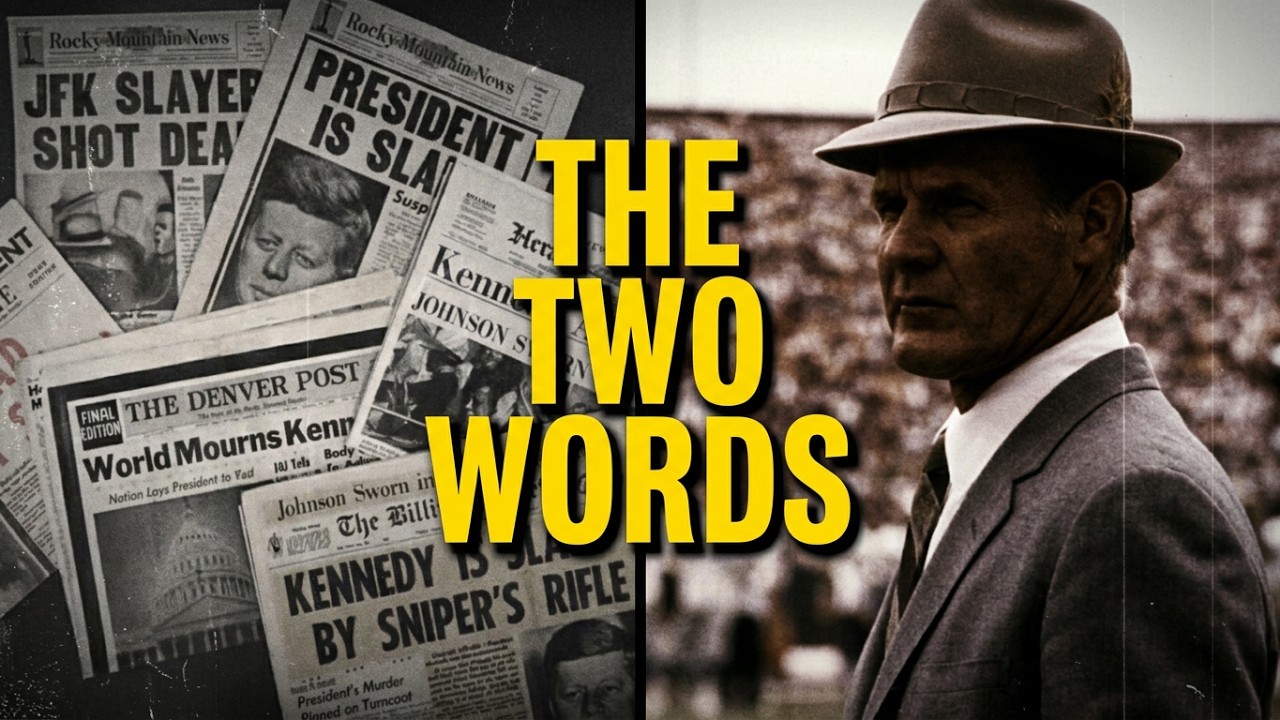
One player asked whether he should keep his helmet on to avoid being shot from the upper deck. Their coach, a stoic Texan in a fedora named Tom Landry, stood at a chalkboard in the hostile visitors’ locker room and held sixty terrified men together without once raising his voice. What happened in that room shaped the franchise for decades. Yet almost no one wrote about it for forty years.
The story of how Dallas went from the most reviled city in America to the home of “America’s Team” does not begin with a Super Bowl trophy. It begins on a practice field on a bright November afternoon, with sirens in the distance and a young defensive tackle wondering whether someone was going to shoot him on a football field. His name was Bob Lilly, and the only thing standing between him and that fear was a man whose face never revealed what he was carrying. The Cowboys were only three years old as a franchise in 1963, still searching for an identity and still trying to convince Dallas that professional football was worth caring about.
Practice was scheduled at their facility near Yale Boulevard, a few miles north of downtown. Bob Lilly was twenty-three, in his third season, just beginning to understand the kind of player he might become. Most of the Cowboys had supported Kennedy. Some had tried that morning to find a way to watch the presidential motorcade before practice.
It did not work out, so they laced up their cleats and went to work. They had been on the field for about ten minutes when the locker room door flew open. Trainer Clint Houy came sprinting across the grass screaming that Kennedy had been shot. Don Meredith would later say that everything went kind of crazy from that point, and it stayed crazy.
The bright autumn day turned cold in an instant. Players stood in clusters, not knowing what to do with their hands. Bob Lilly looked south down North Central Expressway and heard sirens before he could think of anything else. He said years later that he had never heard so many sirens in his life.
It was a terrible sound. Tom Landry called the team in. He told them what he knew. The president and the governor had been shot two miles away.
The city was in chaos. Nobody yet knew what came next. Then he gave them the only thing he had to give. He said they were going to finish practice and prepare to go to Cleveland.
No speech, no attempt to explain the inexplicable. Just a direction. Just a next step. He had learned long before, in the co-pilot seat of a dying aircraft descending through French fog, that the worst thing a leader can do in a moment of collapse is pretend he has answers he does not have.
What he can do is give people somewhere to put their feet. So he gave them somewhere to put their feet. They finished practice, barely. The decision to play that Sunday came from NFL Commissioner Pete Rozelle, who ordered the full schedule of games to be played.
He would later call that decision the single biggest mistake of his entire career. The rival AFL canceled its games out of respect. The NFL did not. So the Dallas Cowboys were told to board a plane and fly into a country that had decided, fairly or not, that their city had killed the president.
Gil Brandt, the team’s vice president of player personnel, remembered the flight in one word: quiet. Everyone was in a stupor. Everyone except Tom Landry, who sat with a yellow legal pad on his tray table and drew formations in silence for most of the journey. But there was something nobody on that plane knew.
Dallas was not just Tom Landry’s employer. Dallas was his city. He had moved there in 1960 with his wife and children, built his life there, and poured three years of work into trying to make something out of a franchise nobody believed in. Now the city’s name was being spoken on television sets across America in the same sentence as murder.
Every city the Cowboys would visit for the rest of the season would greet them as representatives of that name, and Tom Landry was the face those cities would see first. He never said a word about it on the plane. He drew his formations and let his coaches sleep. Somewhere over Ohio, he put down the legal pad and looked out the window for a long time.
Nobody asked him what he was thinking. Nobody was going to ask Tom Landry what he was thinking. But Bob Lilly saw it. He was sitting a few rows back and watched his coach stare out that window in a way he had never seen before and would never see again.
Not fear. Not grief. Something quieter than both. The look of a man doing the math on something very heavy and deciding without drama that he would carry it anyway.
When the bus pulled up to the hotel in Cleveland, there were no bellhops waiting. The staff turned their backs. The Cowboys carried their own bags through the lobby in silence. Landry told them not to go to restaurants and announce they were with the Dallas Cowboys, not to travel in large groups, to stay inconspicuous.
These were not the instructions of a football coach preparing for a game. These were the instructions of a man trying to keep sixty people alive in a city that had already decided how it felt about them. Bob Lilly said plainly years later that not a man on the team wanted to go to Cleveland. Their spirits were totally dashed.
He was personally very apprehensive, wondering if they might be assaulted. Defensive end George Andrie spent the entire game wondering whether there was someone in the upper deck with a rifle taking aim at the sideline. Before kickoff, Landry told every player to keep his helmet on and his parka zipped while standing on the sideline. He suspected things would be thrown at them.
He was right. The public address announcer at Cleveland Municipal Stadium could not bring himself to say the words “Dallas Cowboys. ” He introduced them simply as the Cowboys. The crowd was smaller than usual and angrier than usual, and they made sure the men from Texas understood exactly where they stood.
Then, forty minutes before kickoff, in a small visitors’ locker room that smelled like concrete and disinfectant, it got worse. Tom Landry was at the chalkboard. His voice was level. His hands were steady.
He was going through assignments, explaining what Cleveland liked to do on third and medium, where their linebacker cheated on play action. Around him, sixty men were suiting up in silence. Bob Lilly sat in his stall, shoulder pads half on, staring at the floor, thinking about sirens. The door burst open.
A security guard came in fast, out of breath, and said the words that turned the room to stone. They had just killed the man who killed Kennedy. Lee Harvey Oswald had been shot on live television in the basement of the Dallas Police Department, right back in the city these men had left two days earlier. Nobody moved.
Bob Lilly looked up from the floor, looked at his teammates, looked at his coach. Tom Landry paused. He looked at the security guard. He said, “Thank you.
” And he turned back to the chalkboard. Two words. A quarter turn. The sound of chalk on a board.
Gil Brandt was standing near the back of the room. He said someone leaned over to him immediately afterward and whispered that they should not be playing there that day. But Bob Lilly said something different. He said that when Landry turned back to the chalkboard, something changed in that room.
Not the grief. The grief was still there, every pound of it. But something else arrived alongside it, something that had been missing all weekend. Lilly called it, years later, simply the feeling that they were going to be okay.
Two words had done that. Not because they solved anything. Not because they answered anything. But because the man they belonged to had looked at the worst possible moment of a catastrophic week, absorbed it completely, and shown sixty frightened men that there was still a next play.
That the work was still the work. That there was still somewhere to put their feet. They lost the game 27 to 17. They flew home to Dallas and played out the rest of the season.
For years afterward, tight end Pettis Norman would say quietly that they did not feel welcome anywhere in the United States for quite a while. Other cities let them know they had not forgotten and were not going to let them forget. Dallas was called the city of hate. It was in the newspapers.
It was on television. It was the first thing people thought of when they heard the name for years. Fifteen years later, that same franchise was called America’s Team. Not because of a marketing campaign.
Not because of a championship ring. Because of what they represented year after year, Sunday after Sunday, in a city that needed something to believe in. Owner Tex Schramm was asked for years why Dallas, of all places, had built that kind of following. His answer never changed.
People felt that way about the Cowboys because they could see Tom Landry standing there with his hat and everything he stood for. Bob Lilly was the first Dallas Cowboy inducted into the Pro Football Hall of Fame. At his induction, he talked about what it meant to play for Tom Landry. He said that to him, Landry was invincible.
A rock in your life. Not a motivator. Not an entertainer. Not a man who gave speeches in locker rooms.
A rock. The thing you hold on to when everything else is moving. The thing that does not shift when the ground does. That is what Tom Landry built in Dallas over twenty-nine years.
Not just a football team. Not just a winning record. He built proof that a city could survive being called the worst thing in America and come out the other side as something worth believing in. He did it without a press conference, without a redemption narrative, without ever once using the word redemption.
He did it the same way he did everything else. By turning back to the chalkboard. By staying in the work.
By giving people every single Sunday somewhere to put their feet.