For nineteen years, Rome hunted Hannibal Barca, and the hunters wrote everything down. The diplomatic cables survive, the spy reports from every port between North Africa and the Black Sea survive, and the names of the Roman envoys sent east survive. From the man they chased, almost nothing remains—no memoir, no treatise, no letter in his own Punic tongue. The story that came down through the ages belongs to the hunters, and they told it well.
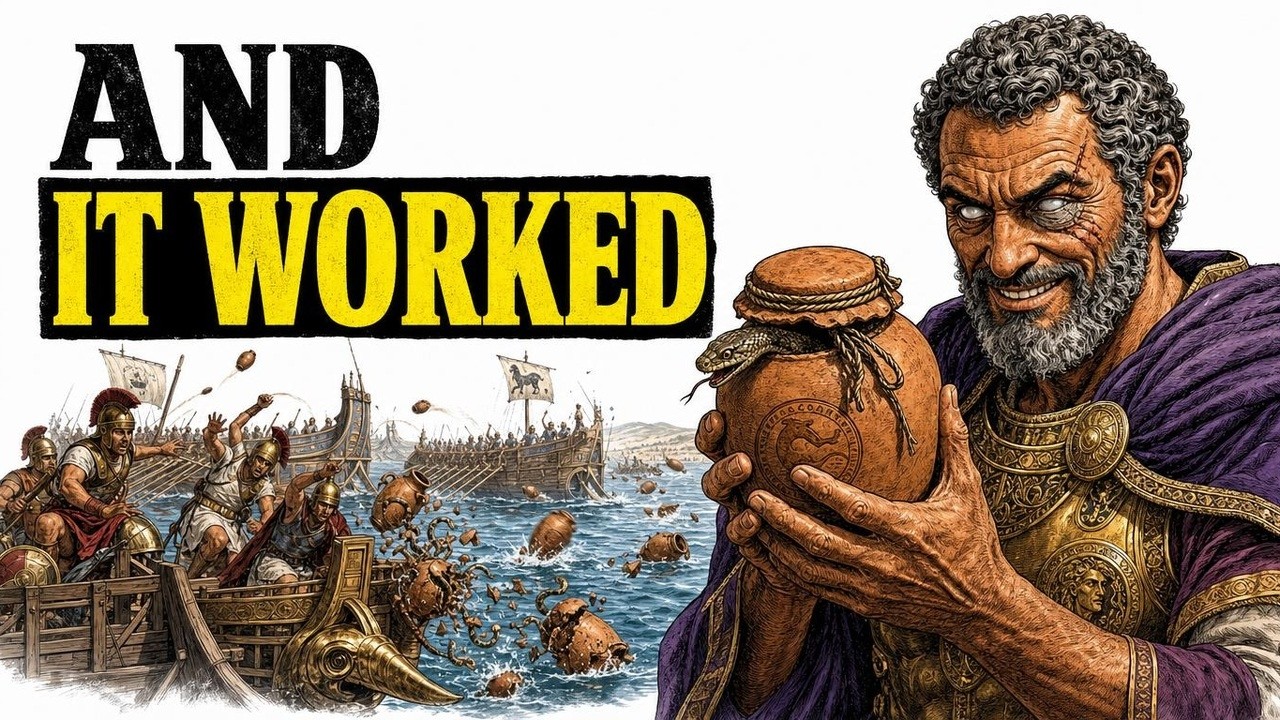
Their version casts Hannibal as the uninvited guest at every royal table, murmuring plans for a second invasion into the ears of ambitious kings, the one man who could pull a scattered world into a single alliance against Rome. But the truth sits not in a battle report, but in a financial ledger. The longest and costliest manhunt of the Republican era did not begin with news of a war. It began with an audit.
Rome did not pursue Hannibal because he was forging swords for revenge. It pursued him because he balanced a budget. The version Rome told for two thousand years opens at Zama in 202 BC, where the Second Punic War finally ended in the dust of North Africa. Seventeen years of fighting had cost Rome a fifth of its fighting-age men, including some fifty thousand fallen in a single afternoon at Cannae in 216 BC.
After that day, the Senate forbade the women of Rome to weep in public because grief on that scale would have stopped the city from functioning. Gold rings stripped from the Roman dead were shipped to Carthage by the bushel and poured out on the floor of the Carthaginian Senate as proof. At Zama, Carthage was stripped bare: ten warships kept, the rest burned in the harbor where the whole city could watch; every war elephant handed over; no army raised without Roman permission; and ten thousand talents of silver paid across fifty years. This was not a fine.
It was a chain forged to a length, one link for every year a Carthaginian child would grow up owing money to Rome. In the Roman telling, Hannibal never bowed to Zama. He read the treaty as a pause between rounds and spent his years in Carthage scheming a third war. But something happened that the storytellers hurry past.
In 196 BC, the citizens elected him Suffete, the highest civil post in the city, roughly what a consul was in Rome. He put down the sword and picked up the ledger. His first act was a law of almost brutal simplicity. The court of 104, the supreme judges of Carthage who had become a state hiding inside the state, appointed for life and answerable to no one, would now stand for election every year.
No man could hold the seat two years running. One vote stripped the lifetime grip of the merchant families who had used the bench to crush rivals, protect their trade routes, and quietly drain the public purse. When Hannibal summoned a minor treasury official to explain the books and the man refused because he belonged to the judges’ faction, Hannibal had him dragged before the assembly and laid out the whole scheme in the open air. It was a revolution conducted on parchment and in the noise of the marketplace, and it earned him enemies far more patient and dangerous than any Roman on horseback.
Next, he came for the money. As Suffete, he ordered a full audit of the state’s finances. The clerks followed the money line by line and found not petty theft but a system. The oligarchs were diverting whole rivers of public income—port duties, taxes on the rich farmland of the Cape Bon Peninsula, levies on the caravan trade from the desert—straight into private strongrooms.
The republic was bankrupt while its judges lived in houses like temples. Remember the indemnity: ten thousand talents of silver, roughly 260 tons of metal, stretched across fifty years. At an early payment, Roman treasury clerks tested the silver, found it below required purity, and demanded the shortfall be made good on the spot. Carthaginian envoys had to borrow money in Rome itself to cover the gap.
That was the depth of the hole the oligarchs had dug. After the audit, Hannibal stood before the assembly and said something no one expected. He could pay Rome the entire remaining debt—settled without borrowing, without melting temple treasures, without laying one new tax on a single citizen. The silver had been there the whole time, sitting in the wrong hands behind the wrong doors.
That announcement tells you what the real danger was. It was never a new army. It was a good example. A Carthage that was solvent, reformed, calm, and led by the most beloved man in its history was a thousand times more threatening to Rome than a Carthage on its knees.
A broke Carthage was a client. A rich, well-run Carthage could one day be a rival again. The official spark for Roman intervention was a letter. A delegation of Carthaginian nobles, drawn from the very faction Hannibal had just stripped of power and cash, sailed to Rome and warned that Hannibal was in secret contact with Antiochus the Great, preparing a new war.
These men were not patriots ringing an alarm. They were the embezzlers he had exposed and unseated. They could not beat him with Carthaginian politics, so they reached for Roman fear, the deep unhealed dread of the name that had once camped within sight of Rome’s walls. The letter was read aloud in the Senate, and the room went cold.
Old men had lost sons in those years. Some had voted as boys to keep fighting when Hannibal camped three miles from the city. One voice pushed back. Scipio Africanus, the man who had beaten Hannibal at Zama and therefore knew his mind better than anyone in that room, argued it was beneath the dignity of the Roman people to wade into the factional quarrels of Carthage.
He saw the accusation for what it was: a political killing subcontracted to the republic. But he was voted down. The fear of Hannibal outweighed the judgment of the one Roman who had actually defeated him. The Senate sent a commission to Carthage.
The commission’s arrival trapped Hannibal in a box with no honest exit. He had broken no clause of any treaty. He had made it possible for Carthage to meet its obligations faster than anyone believed possible. But he knew none of that would save him.
The envoys had not come to weigh evidence. He would be arrested on invented charges of treason, shipped to Rome in irons, marched through the streets, and finished quietly in the Tullianum. He had two roads: stay and trust a justice he knew was already sold, or run. He played the last move like a general covering a retreat.
By day he moved through the city as if nothing were wrong. He rode out in the evening toward his country estate in full view with servants, then turned for a tower where a ship stood fitted and waiting. He kept fresh horses staged along the road and crossed the whole distance in a single night. At dawn, the Roman commissioners came for him and found the house empty.
He boarded his ship at first light and turned east. So what was Rome actually afraid of? Their own agents in the east reported year after year that Hannibal had no army and no king who would listen. The pursuit rolled on, not because the man was dangerous, but because they were chasing a memory.
The engine behind the pursuit was a wound in the Roman mind that had never closed. To understand the obsession, sit with one number: fifty thousand, the careful low estimate for the Roman dead in a single day at Cannae. The men who finally ran Hannibal to ground in Bithynia were the children of that morning. The nineteen-year hunt was never really a policy.
It was an exorcism. They needed to watch the thing killed by a Roman hand because the alternative was unbearable—that he might grow old and die warm in his own bed, and that their fathers’ terror had meant nothing. The end at Libyssa was not the cornering of a wild animal. It was a transaction.
In 183 BC, the Senate sent Titus Quinctius Flamininus to the court of Prusias of Bithynia, ostensibly to settle a border dispute with Pergamon. His real errand was understood by everyone at the table. Over dinner, Flamininus remarked lightly that it seemed strange for a king to shelter the most famous enemy Rome ever had. No fist on the table, no drawn sword, just a sentence delivered the way only a superpower can make a sentence land.
Prusias, a small functionary in a world now run on Roman memoranda, understood at once. His kingdom or his guest, which was no choice. Soldiers moved up the coast road toward Hannibal’s house, a village on the shore between the water and the hills. He was sixty-four years old.
The house had been built with seven separate exits, hidden passages cut so that no single blocked door could trap the owner. The architecture of a man who woke every morning for nineteen years knowing he was being hunted. Seven doors had not been enough. A servant went to the nearest exit and came back with his face saying everything.
Hannibal went himself from door to door and found the king’s men, now working as Rome’s hand, ringing the whole property. Every route out was already full of soldiers. He walked back to the center of the house he had chosen for its seven ways to leave. For the first time in nineteen years, there was no eighth.
He kept the poison in a hollow ring on his finger, the last scrap of sovereignty in a world that had stripped him of everything else. His final words, preserved by the historians, named the thing that had hunted him all his life: “Let us relieve the Romans of their long anxiety, since they cannot bear to wait for an old man to die. ” Then he drank. In that same year, the man who had beaten him at Zama was also dying in exile.
Scipio Africanus had been dragged through the courts of Rome by smaller men who resented his fame, hounded over accusations of skimming the spoils of the eastern war. He withdrew bitter to a villa on the Campanian coast and refused to set foot in the city again. On his tomb, tradition says, he had them carve a single line: “Ungrateful fatherland, you will not even have my bones. ” The hunter and the hunted, both consumed and discarded by the same political machine within a season of each other.
Rome’s engine could devour its own champions as readily as its enemies. The machine did not stop with them. It ran on another thirty-seven years until Scipio’s adopted grandson stood on the burning hill of Byrsa in 146 BC and watched Carthage die street by street. Fifty thousand survivors were sold into slavery.
The ground sown with ruin. The corrupt oligarchs who had summoned Rome to remove one honest reformer had bought their city only a handful more decades before the same power came for every one of them. Hannibal’s true monument was never raised. His grave at Libyssa was lost so completely that centuries later a Roman emperor, himself born on the old Punic coast of North Africa, ordered a tomb of white marble built over the spot.
The general’s own books, the histories he wrote in Greek, are gone without a trace. The voice was silenced so thoroughly that every word we have about the man reaches us through the mouths of the people who wanted him dead. The clerk who balanced the books of Carthage left no ledger of his own, only theirs. And yet Rome gave him the one tribute that outlasted marble.
For centuries after he was ash, whenever an enemy army moved on the city, a phrase would run through the streets and the Senate House like cold water: Hannibal at the gates. The man had been dead for generations. They never stopped checking the locks.