Kathleen “Kay” Halle died in 1997 in a quiet house in Georgetown, a 93-year-old woman alone with her memories. She had reportedly turned down 64 marriage proposals and outlived every lover and close friend, watching the men who shaped the twentieth century lowered into the ground one by one. She had old money and striking beauty, yet she died with no husband and no children. But Kay Halle was never a fragile socialite.
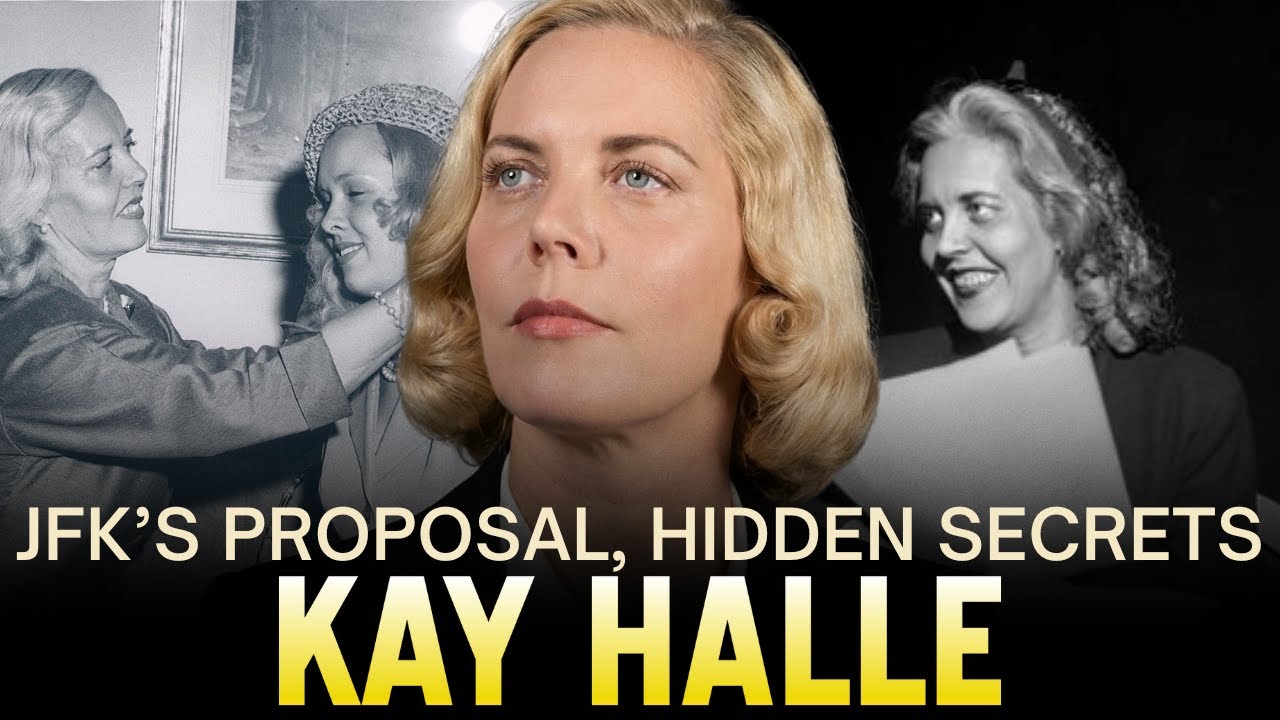
She was a political force who operated without a single official title, steering the hands of Winston Churchill, the Kennedys, and the spies of wartime Washington from her own living room. She was born on October 13, 1903, in Cleveland, Ohio, into a world of industry and ambition. Her father, Samuel Horatio Halle, co-founded the Halle Brothers Company with his brother in 1891, building it into the heart of Cleveland’s retail scene. The store smelled of expensive perfume and employed white-gloved staff, and its profits gave Kay the financial independence that would define her life.
Her mother, Blanche Murphy, was an Irish Catholic woman of sharp wit, and her marriage to a prominent Jewish businessman defied the social rules of the era. From her father, Kay inherited a head for analysis and organization. From her mother, she inherited a gift for storytelling and politics. She grew up on Millionaires’ Row, watching titans like John D.
Rockefeller build empires from steel and oil, and she learned that power was something you created rather than inherited. The world expected Kay to follow the standard path for wealthy young women: private education, a debutante ball, and marriage to a banker or lawyer. She enrolled at the Laurel School, then at Miss Wheeler’s finishing school in Providence, where other girls dreamed of marrying Harvard men while Kay read about the suffragette movement and the Great War. At Smith College, one of the Seven Sisters, she found the academic world too theoretical and detached.
She famously complained that she did not want to study history—she wanted to be history. She dropped out and returned to Cleveland, telling her parents she was enrolling in the School of Life. The 1920s gave her room to maneuver. She threw herself into the cultural explosion of the Jazz Age, studying at the Cleveland Institute of Music and developing a glamour that was accessible rather than aloof.
She could talk to a jazz musician in a smoky club as easily as she could a senator at a garden party. In the early 1930s, she pushed her way into journalism, writing a column called On the Boulevard that turned society reporting into sharp observation. Then she discovered radio. While the elite dismissed it as vulgar, Kay saw it as the ultimate instrument of connection.
She pitched a political and cultural commentary show to WGAR called Know Your City, becoming one of the first women to act as a political commentator on air. In 1940, she flew 18,000 miles around South America, broadcasting her experiences back to Cleveland. As intermission commentator for the Cleveland Orchestra, her voice was beamed via shortwave radio to soldiers in Europe and sailors in the Pacific, who wrote to her that she sounded like civilization. The year 1931 brought the arrival of the Churchills.
Winston Churchill, then in his political wilderness years, was on an American lecture tour with his nineteen-year-old son, Randolph. When Randolph met Kay at a Cleveland dinner, he became obsessed with this American woman eight years his senior who matched his wit blow for blow. He proposed, but Kay looked past the glamour and saw a volatile young man crushed under his father’s shadow. She valued her freedom too much.
She said no. Randolph threatened suicide, but Kay stood firm, and the rejection earned his eternal respect. He introduced her to his father. Winston Churchill, notoriously difficult to please, was enchanted.
He saw a razor-sharp intellect wrapped in American warmth and, more importantly, a political mind. Kay became a fixture at Chartwell, the Churchill family estate, where she watched Winston rail against the rising threat of Nazi Germany years before the world woke up to it. She was no longer just reporting on history. She was in the room where it was being written.
When Pearl Harbor shattered American isolation in December 1941, Kay packed her bags for Washington. The capital was a boom town of soldiers, spies, and dollar-a-year men, and the government had a unique use for her. She was recruited into the Office of Strategic Services, the precursor to the CIA. Her file was perfect: wealthy and therefore hard to bribe, widely traveled, and connected to everyone who mattered.
Her greatest asset was her gender, because in the 1940s, men did not suspect that a woman in a couture gown holding a martini could be a threat. She established a salon, hosting lavish dinners for generals, senators, and foreign attachés. She created an atmosphere of total relaxation, then listened. Officers fueled by alcohol bragged about deployments.
Neutral diplomats from countries like Spain and Argentina prowled for intelligence. Kay would lean in, light a cigarette, ask a gentle question, and the men would talk to prove their own importance. Each morning, a typed report landed at OSS headquarters. She was nicknamed Mata Halle, but unlike the famous spy, she was not selling secrets—she was hoarding them for Uncle Sam.
She also served as an unofficial back channel between the British and American governments, passing messages when official channels clogged. Amidst the war’s shadows, a young naval officer began to make his presence felt. John F. Kennedy was the son of the American ambassador to Britain, a war hero with a smile that could disarm a spy.
Kay was roughly fourteen years older than Jack. He treated her not as a conquest but as a peer. He was drawn to her mind, her encyclopedic knowledge of politics, her ability to analyze a Senate bill as effectively as she critiqued a symphony. He reportedly proposed marriage.
Kay said no again. She knew about his debilitating back pain and Addison’s disease, secrets guarded ferociously from the public. She knew about the women. She had no intention of becoming a long-suffering political wife.
She chose influence over title, equality over subordination. The rejection cemented her place in his life. She became what historians have called his spiritual sister, the one woman he could truly talk to. Throughout the 1950s, as Jack climbed from congressman to senator, Kay was his sounding board.
When he wrote his Pulitzer Prize-winning Profiles in Courage, she was one of the intellects he consulted. She helped smooth his path among the old guard of Washington, vouching for his character to skeptics. When he ran for president in 1960, her most defining moment came during the review of his inauguration guest list. She looked at the standard list of donors and party hacks and told him it was rubbish.
She advised him to invite the creators, the poets, the scientists, the Nobel Prize winners, the actors, to show the world the White House valued the mind. She curated a golden list of 155 leaders from the arts and sciences, including Robert Frost and John Steinbeck. That decision injected intellect and culture into the Kennedy years and birthed the aura of Camelot. During the thousand days of the Kennedy presidency, Kay’s Georgetown home at 3001 Dent Place became an extension of the West Wing.
She was one of the few people who could see the president without an appointment. She protected him from dangerous secrets, including an affair with Inga Arvad, a Danish journalist suspected by the FBI of being a Nazi spy, a scandal that could have destroyed his career before it began. She knew about Marilyn Monroe and the mob connections, and she navigated the minefield, steering conversation away from danger. Her Sunday suppers became legendary.
She carefully seated a stubborn southern Democrat next to a charming liberal, served excellent wine, and created a demilitarized zone where enemies saw each other as human beings. Deals were struck on her sofa that never could have been struck on the Senate floor. November 22, 1963 broke her world. When the news came from Dallas, Kay had not just lost a president.
She had lost a man she had loved, mentored, and guided for twenty years. Even in grief, she was practical. She was instrumental in early discussions about the Kennedy Center for the Performing Arts, wanting a living memorial to the cultural spirit she had helped inject into the presidency. She remained close to the family through the assassination of Bobby Kennedy in 1968 and the endless scandals that followed.
Publishers circled, knowing she had diaries and letters, knowing she knew everything. They offered millions for a memoir. Kay refused. She believed privacy was a virtue, not a product.
She reportedly said she had not lived her life to sell it. She burned personal letters rather than risk them falling into the hands of biographers. Her most ambitious political project in her later years was making Winston Churchill an honorary citizen of the United States. It was a legislative nightmare.
The country had never granted honorary citizenship to a living foreign national; the only previous recipient was the Marquis de Lafayette, posthumously. The State Department opposed it, fearing a precedent. Kay launched a one-woman lobbying blitz, calling in markers from her OSS days, charming the press, and badgering senators. She worked directly with President Kennedy before his death.
In 1963, the proclamation was signed. Kay then managed the creation of the Churchill statue outside the British embassy, insisting it stand on the boundary line, one foot on British soil, one on the American sidewalk—a physical manifestation of her own life straddling two worlds. As the decades passed, Kay watched everyone die. Winston, Jack, Randolph—all gone.
The Sunday suppers became smaller. The phone rang less often. She remained impeccably dressed, read five newspapers a day, and mentored young journalists, teaching them that a scoop was less important than truth and that access was a privilege, not a right. She watched the rise of the Clinton era with a critical eye, lamenting the public nature of its scandals and the loss of dignity in public life.
On August 7, 1997, she died of heart failure at ninety-three. Her obituaries hailed her as a socialite, a label that described the casing but not the power inside. After her death, archivists descended on her estate expecting a treasure trove of secrets that would rewrite the history of the Kennedy assassination or the secret diplomacy of World War II. They found order.
Kay had curated her own legacy. Her papers, now housed at the John F. Kennedy Library in Boston, are extensive but sanitized. The deep confessions, the dangerous intelligence, the human frailties of the great men she loved—gone.
Whether she destroyed them or simply never wrote them down, she performed one last act of loyalty. She took the truth with her, leaving history with the legend she helped create. She held no office, commanded no troops, yet she shaped the Churchill legacy, injected culture into the Kennedy presidency, and extracted intelligence that saved lives during the war. She proved that the most important person in the room is often not the one speaking into the microphone, but the one who introduced the speaker.
Sixty-four times she said no to marriage. She chose loneliness over subservience, the difficult path of autonomy. She was the woman who knew everything and told nothing, and in an age of noise, her silence was the most thunderous legacy of all.