On June 28, 1876, three days after the gunfire stopped, a burial detail from the Seventh Cavalry climbed a dusty low hill in Montana Territory. The stench hit them before anything else. The temperature was 100 degrees Fahrenheit, and the bodies had been baking under the brutal sun since Sunday.
What they found on the hillside would haunt some of these men for the rest of their lives.
Soldiers lay stripped naked, scalped, missing fingers, their eyes gouged out. One skull was so shattered that a brother could not recognize him. Arrows protruded from his chest like a strange garden.
A lieutenant named John Bourke later wrote that human remains were scattered across the hill like wreckage after a storm.
Then, near the top of the hill, they found him. George Armstrong Custer lay on his back, naked except for his socks, with two gunshot wounds: one in the chest and one in the temple. That was all.
He had not been scalped. His body had not been mutilated. His face, according to the men who found him, looked calm, almost natural.
One officer later said Custer looked as if he were merely sleeping.
In the middle of a massacre, one body had been left nearly intact. That single strange detail, that his corpse was left alone while nearly everyone around him was torn apart, is where this story begins. For 150 years, it has quietly rewritten everything we think we know about the most famous battle in American history.
This is not just a story about a battle. It is a story about a corpse, and what it can tell us that the legends cannot.
To understand why Custer's body matters, you have to understand who Custer was before he became a corpse on a hill. He graduated dead last in his class at West Point. He was last among 34 cadets and accumulated more demerits than nearly anyone in the academy's history.
He snuck out, swore, and broke rules that everyone else seemed to follow without complaint. By every normal measure, George Armstrong Custer should have faded into obscurity.
Instead, the Civil War broke out. Chaos turned out to be exactly the environment Custer needed. He was reckless in a way that terrified his superiors and excited the newspapers.
He led cavalry charges from the front rather than the rear. Horses were shot out from under him, 11 by his own count, and he kept charging. At 23, he became a general, the youngest in the Union Army.
War correspondents loved him. He had long golden hair, a flashy uniform of his own design, and an instinct for being the center of attention.
After the war, that same recklessness followed him west. In 1868, Custer led an attack on a Cheyenne village on the Washita River. His superiors later described it as a massacre.
Women and children were among the dead. By 1876, Custer was 36, ambitious, controversial, and, in the view of some historians, desperate to reclaim a national reputation that was fading. There were even whispers of presidential ambitions.
A decisive victory over the northern tribes could put him back in the spotlight.
There was also genuine tension between Custer and the political leadership above him that year. Earlier in 1876, Custer testified before Congress about corruption in the Indian trading post system, implicating people close to President Ulysses S. Grant.
Grant, furious, briefly tried to remove Custer from command of the upcoming campaign entirely. Custer had to beg to be reinstated. He rode toward the Little Bighorn that spring not just as a soldier pursuing a military objective, but as a man who needed a victory.
He had to prove, publicly and decisively, that his marginalization had been a mistake.
By the spring of 1876, thousands of Lakota, Northern Cheyenne, and Arapaho had gathered along a river the Lakota called the Greasy Grass. White settlers and the U. S.
Army called it the Little Bighorn. This was no small camp. Estimates suggest between 6,000 and 10,000 people were living along the river valley, one of the largest gatherings of Indigenous people in North America in that era.
Two men would forever be linked to what was about to happen. Sitting Bull, a spiritual leader who had recently dreamed of soldiers falling into the Lakota camp like grasshoppers dropping from the sky. And Crazy Horse, a war leader whose tactical brilliance was about to be tested against the United States Army.
Imagine the scene from above, as Custer's scouts saw it from the surrounding hills. A valley completely covered with lodges, stretching in some accounts for about three miles along the river. Smoke rising from hundreds of cooking fires.
Thousands of horses grazing in loose herds on the slopes. Children playing near the water. This was not a war camp preparing for battle.
It was a community. Families had gathered for the summer after the buffalo hunt, largely unaware that a column of 600 soldiers was approaching from the east.
Custer's regiment, the Seventh Cavalry, numbered about 600 men. It was part of a three-pronged military campaign aimed at forcing the northern tribes onto reservations. Custer's mission was simple in theory: locate the camp, then either besiege it or push it toward the other columns coming in.
His scouts found enough to alarm him. Some warned that the camp was far too large for the Seventh Cavalry to handle alone. One Crow scout reportedly told Custer that the Lakota in that valley outnumbered the soldiers' ammunition.
Custer did not wait for reinforcements. On the morning of June 25, 1876, feeling the element of surprise slipping away, he divided his regiment into three battalions. One under Major Marcus Reno, one under Captain Frederick Benteen, and a third of about 210 men that he kept for himself.
That was the last time anyone in the U. S. Army saw those 210 men alive.
A few weeks before the battle, Sitting Bull had performed the Sun Dance, an exhausting daytime ritual involving fasting and self-sacrifice. During it, he had a vision: soldiers falling upside down into the Lakota camp like grasshoppers dropping from the sky. He told his people this meant a great victory was coming, and that soldiers who could not hear would be delivered into their hands.
Whether you call it prophecy, coincidence, or a leader's careful reading of his people's mood, it is worth considering. Days before the worst defeat the U. S.
Army ever suffered in the Plains Wars, the man at the spiritual center of that camp had already told his people it was coming.
Reno's battalion attacked the southern end of the village first and was quickly beaten back, retreating in disorder across the river to the top of the bluffs, where his surviving men dug in and held out until the end of the battle. Benteen's battalion arrived late and unsure of the situation, eventually joining Reno on the bluffs instead of pushing forward toward Custer.

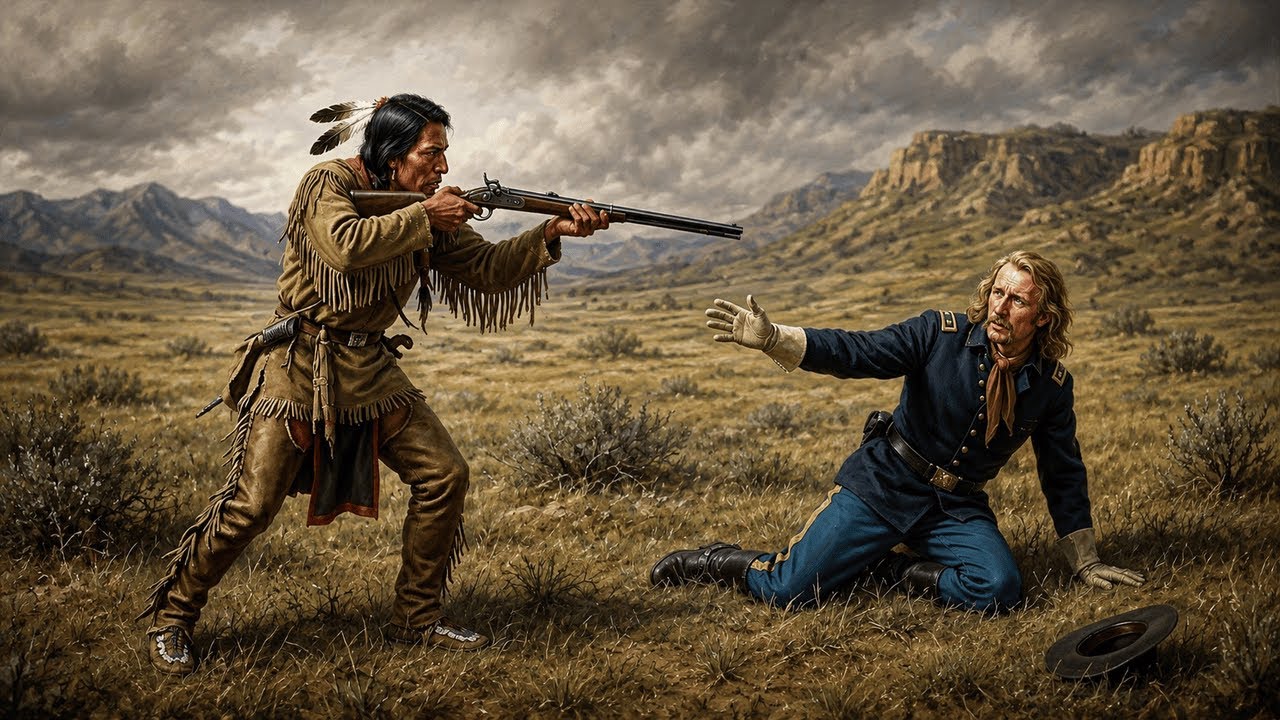
Meanwhile, Custer moved north along the ridgeline on the other side of the river, apparently trying to find a place to cross and strike the village from a different direction. Indigenous accounts describe warriors, at first a handful, then hundreds, pouring out of the village to meet him, led by war leaders including Crazy Horse and Gall. What followed was not a single desperate stand in one place, but a running battle that stretched for nearly a mile along the ridgeline, as Custer's companies were pushed back, isolated, and overwhelmed one by one.
Some men may have fought on foot behind their dead horses, using them as makeshift barricades. Others tried to flee and were run down. Imagine the scene from the top of the hill: thick dust kicked up by thousands of hooves, so dense that soldiers only a few hundred feet apart could not always see each other.
The sound alone would have been overwhelming: gunfire, war cries, horses screaming, officers shouting orders that dissolved in the chaos before they could be carried out. Indigenous accounts describe warriors advancing from multiple directions at once, the soldiers' formations collapsing gradually, not all at once, but company by company, as ammunition ran out and horses fell.
The last group of survivors ended up at the highest point of the hill, later named Custer Hill or Last Stand Hill. Here the fighting ended, and here, three days later, the burial detail found what remained.
Now we return to where this story began. That hill three days later, and the body that looked like nothing else on it. Nearly every other soldier on that hill had been stripped, scalped, and mutilated.
This was not random cruelty. In many Plains cultures, mutilating an enemy's body in battle had spiritual significance. The belief was that a mutilated body would be disabled in the afterlife, unable to fight or move freely in the next world.
It was, in its own brutal logic, a way to cripple an enemy who had committed atrocities against your people.
Yet Custer, arguably the most hated man in that valley, the officer responsible for the attack years earlier, was left almost completely alone. Captain Edward Godfrey, one of the officers present at the burial, described it clearly. Custer had been shot in his left temple and his left side of the chest.
There were no powder burns or signs of mutilation. In an article written years later, Godfrey noted that Custer's face and expression looked natural, untouched, while nearly everyone around him had been brutalized.
So why? Here the body itself becomes a witness. And here historians have spent a century and a half arguing about what it really says.
The prevailing theory is almost anticlimactic: they did not know it was him. Before the campaign, Custer had cut his famous long hair. The golden locks that made him instantly recognizable, and that had earned him the nickname Long Hair among Indigenous warriors, were gone.
He was also balding by 1876. On the day of the battle, he wore a buckskin jacket instead of a uniform, making him visually blend in with many of the other officers and scouts. To warriors who had heard stories of a long-haired military leader, the dead man on that hill may not have looked like Custer at all.
He looked, according to multiple accounts, like an ordinary dead soldier. By the end of the fighting, with dozens of bodies scattered across a mile of battlefield, there may have been no reason to single him out.
There is another less obvious piece of evidence supporting this. Custer's brother, Tom Custer, fought in the same battle, and his body was so badly mutilated that soldiers could only identify him by a tattoo on his arm. If the warriors had known which body belonged to the commander, it is hard to imagine his brother, who fought right beside him, being treated differently.
In other words, the exceptional respect shown to Custer's body may not have been respect at all. It may have been a case of mistaken identity in one of the bloodiest days of the Indian Wars.
If the lack of mutilation is the first mystery of Custer's body, the second is stranger. It concerns the blood. Custer had two wounds.
A bullet in the left side of his chest near the heart, and a bullet in his left temple. Either wound would have been enough to kill him almost instantly. Here is the detail that has intrigued historians and forensic researchers for decades.

When the body was examined, there was heavy bleeding around the chest wound, while bleeding around the head wound was minimal, if it existed at all.
Wounds bleed because a living heart is still pumping blood through the body. A wound inflicted after death, once the heart has stopped, tends to bleed far less because there is no pressure pushing blood through the vessels. This pattern, according to a number of historians who have studied the case, suggests that the chest wound came first, either killing Custer or nearly killing him, and that the head wound was inflicted later, while he was dying or already dead.
This raises an obvious question: who shoots a corpse in the temple? There are several conflicting answers, none of which can be definitively proven, because the witnesses were on the losing side of history, a side that white American historians and writers paid little attention to for the next century.
One theory is that it was simply a fact of the battlefield. In the chaos of a desperate fight, with soldiers and horses falling across the ridge, a fallen soldier may have been shot again by another warrior moments later, unaware or unconcerned that he was already dying. In a battle with that much firepower flying, a second unnecessary shot at a fallen man is not mysterious at all.
It is ordinary.
The second theory is the one that refuses to fade no matter how hard historians try to bury it: that Custer did not die at the hands of his enemies, but that, wounded and facing capture, he ended his own life, or someone close to him did. This is the theory that captures people's attention. Many Lakota oral accounts, passed down through generations, describe soldiers on that hill taking their own lives in the final minutes of the battle.
It was a desperate reaction to what many understood awaited captured soldiers: torture and slow death. Some accounts specifically suggest that Custer himself may have been one of them, either shooting himself or being shot by a comrade in a kind of battlefield mercy killing rather than being taken alive.
It is a genuinely dramatic possibility. It also has a stubborn problem. Custer was left-handed.
Shooting oneself in the left temple with the left hand is anatomically awkward. Not impossible, but rare enough that most historians treat the theory with great skepticism. Still, unusual does not mean impossible.
Some researchers have pointed out that assisted suicide, a soldier ending another's suffering at his request in the chaotic final seconds of a collapsing battle, would bypass the left-handed problem entirely. Other Indigenous accounts describe numerous soldiers on that hill committing suicide near the end, suggesting that whatever happened to Custer, he may not have been the only man there who chose that ending rather than facing what was to come.
What remains, in the end, is a pattern of wounds that tells us something happened. A bullet in the chest, then a bullet in the head of a man who may have already been dying, without us knowing who pulled the trigger or why.
No account of Custer's body would be complete without addressing the stories that grew up around it in the decades that followed. The story of Custer's body did not end on that hill in 1876. It had another strange chapter.
The initial burial, done hastily by exhausted soldiers under threat of renewed attack, was shallow and poorly marked. The ground was hard, digging tools were scarce, and the men doing the burying naturally wanted to leave a battlefield that was still dangerous.
A full year passed before a dedicated military detail returned to officially collect the officer's remains for burial back east. What they found when they arrived was a gruesome revelation. Wolves and coyotes had disturbed the grave for 12 months.
Custer's shallow grave had been dug up, and his bones were scattered. When the detail tried to identify his remains, they initially assembled an entirely wrong skeleton. The error was only discovered when a note in a jacket pocket revealed that the bones actually belonged to a corporal, not a general.
When Custer's actual remains were collected, or what was believed to be his actual remains, definitive identification was nearly impossible, according to several accounts. He was eventually buried with military honors at West Point in 1877 in a ceremony befitting a national hero. But the uncomfortable truth acknowledged by more than one historian since then is that no one can say with absolute certainty that the bones buried at West Point belong exclusively to George Armstrong Custer.
After a year of exposure to the elements, scavenging animals, and a rushed and chaotic collection process, what was placed in that coffin may not have been a complete body so much as an approximation of one. Even in death, certainty was something Custer's story was never allowed to have.