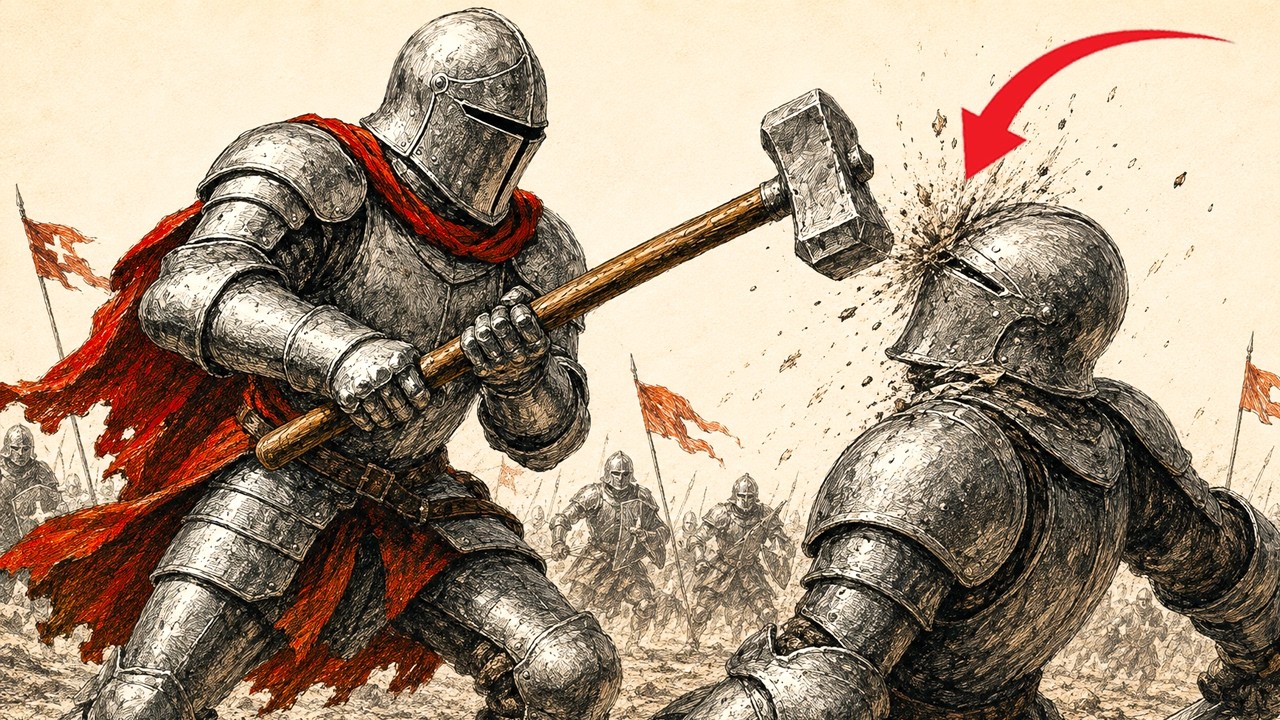
In the dust and roar of a late medieval battlefield, two men meet not in a duel of honor but in a brutal struggle for survival. The man on the ground, Guillaume, is a nobleman in his mid-thirties, a second son trained since childhood to believe the sword was the noblest weapon in Christendom. Above him stands Robert, a veteran of six campaigns, a professional who long ago learned what the romances would never admit: the sword, for all its beauty and symbolism, was nearly useless against a knight in full plate armor. The setting is the heart of European warfare between roughly 1350 and 1500.
During this era, armor had become so advanced that weapons had to become more brutal to match it. A complete harness of Milanese or Augsburg steel, worth as much as a small farm, could turn aside sword blows with ease. The blade would glance off curved, hardened plates, leaving only scratches. Against such protection, the sword was not a battlefield weapon but a sidearm, a status symbol worn at court and blessed by bishops.
The real work was done by tools that looked more like implements from a blacksmith’s shop than anything hung above a hearth. Three weapons dominated this deadly trade. The pollaxe, a five-foot weapon combining an axe blade, a hammer face, and a spear point, was the most feared close-combat weapon of the era. The war hammer, about three feet long with a steel head weighing roughly two and a half pounds, could concentrate tremendous force onto a single square inch of an enemy’s helmet.
One side was a flat striking surface; the other bore a sharp curved beak designed to pierce weakened armor or hook into a visor and drag a man’s head down. There was also the bec de corbin, a heavy, blunt weapon that transmitted shock through the armor into the body beneath. The reality of killing a fully armored knight was not the clean cinematic thrust through the breastplate. It was a slow, exhausting, and vicious affair fought at grappling distance.
Robert had seen swords bend and slide harmlessly off shoulders and helmets. He had watched men who trusted their blades end up in the mud, finished off by a common soldier with a dagger. So on the morning of battle, he made a choice his class would have considered a quiet admission of failure: he left the beautiful sword behind and carried the ugly, practical hammer into the fight. The battle begins with the charge.
Lancers lower twelve-to-fourteen-foot ashwood lances, braced under their right arms. The full momentum of horse and rider drives the steel point forward. It is a weapon designed for one use, perhaps two, shattering on impact. A solid lance could punch through mail and sometimes plate, but after that first collision, only a splintered shaft remains.
The fight then becomes something entirely different. The horses die first. Any competent infantryman aimed not at the armored man above but at the animal beneath him. A dead horse fell on its rider; a wounded one threw him into the dust and confusion.
A knight who had seemed invincible three seconds earlier became a man inside expensive metal, disoriented and vulnerable. When the charge collided, the sound was not a single crash but a series of impacts, dozens, then hundreds of individual lance strikes. Dust rose so quickly that within a minute visibility dropped to about ten feet. Banners disappeared, formations dissolved, and men found themselves alone in a swirling chaos of hooves and unrecognizable heraldry.
One French chronicler wrote that the field was so full of dust and the din of weapons that a man could not see his own hand before his face, and knights struck at anything that moved, killing as many friends as enemies in the first press. Robert is now on foot. His horse was shot from under him by an arrow in the neck, a standard and effective tactic. He rolled clear before the animal fell.
His shoulder aches from the impact, but the hammer is still in his hand, because he trained from adolescence to keep it there no matter what happened to the rest of his body. Inside his helmet, his breath fogs the steel an inch from his eyes. He can hear his own heartbeat above the din of battle. He cannot turn his head more than about thirty degrees without turning his whole body.
He is not thinking of honor or his coat of arms. He is thinking of breathing and of the next man he sees through his visor slit. This is the melee, a term that once simply meant “mixing. ” In this press of hundreds or thousands of armored men packed into a space too small for their bodies, the armor decides everything.
A man in full plate can cut through unarmored opponents almost with impunity, but when he faces another man in full plate, his weapons fail him too. The fight becomes wrestling, exploitation of gaps, and killing at very close range. Robert sees Guillaume through the dust and recognizes a man with a sword, a beautiful sword whose hilt catches what little light remains. Robert has seen this scene half a dozen times and knows how it ends.
He advances quickly, hammer raised, closing the distance. Guillaume strikes first, a classic diagonal cut aimed at Robert’s neck. The blade lands on the curved shoulder plate and does exactly what such blades had done thousands of times before: it glances off, leaving a scratch. Guillaume feels the shock travel through the sword into his wrist.
For one long second, the second that decides everything, he hesitates. The move he had practiced ten thousand times had failed. Robert steps inside the reach of the sword and strikes the outside of Guillaume’s left knee with a short, violent arc. The joint is armored, but by physical necessity it is a point of articulation, where two plates must move independently, meaning the steel is thinner and the shock travels straight to the bone.
Guillaume’s leg collapses. He staggers, shifting his weight, and in a fight between fully armored men, losing balance is nearly equivalent to losing. Robert closes the remaining distance, drops his hammer, and grapples. He seizes Guillaume by the upper chest and the wrist of his sword arm.
He hooks his right foot behind Guillaume’s already failing left leg and throws him to the ground. The impact of armored back hitting hard earth is loud enough that Robert feels it through his boots. Guillaume’s sword hand is pinned beneath his body. His left arm is trapped against Robert’s leg.
A man in full plate armor who is on his back with an opponent on top of him does not get up. Robert reaches for the small blade at his waist. Every armed man carries one. It is called a rondel, a stiff, narrow dagger with a needle point, more like a thick awl than a knife.
It is not for cutting. It is for one purpose only: finding the gaps in an enemy’s armor, the visor, the armpit, the groin, the space between helmet and gorget. This is the weapon that actually kills armored men. Robert’s left hand goes to the visor of Guillaume’s helmet.
He does not try to open it; quality visors are designed not to open from the outside. He hooks his thumb into the slit. That is enough. He pulls the visor up, or at least tries.
Some visors moved, some did not. The fencing masters were explicit about this. If the visor moves, the fight is over. If it does not, the dagger goes to the armpit.
The blade enters the gap between the visor and the lower part of the helmet. It does not go deep, and it does not need to. The steel is stiff enough not to bend and narrow enough to enter. It reaches soft tissue almost immediately, whether the eye or the cheek into the brain or the throat.
The sources describe the result the same way. Guillaume stops moving after about four seconds. This is what it looked like to kill an armored man. At Agincourt in 1415, thousands of Frenchmen died, but many were not killed during the charge.
They were killed exactly the way Guillaume was killed, on the ground in the dust, by English soldiers who walked among the fallen knights and finished them with daggers through visor slits. Some of those English soldiers were not knights at all. They were archers, commoners. The idea that France’s noble warriors were killed in noble combat by their social equals is one of the greatest lies medieval Europe promoted about itself.
Robert stands. His breath is ragged, his helmet filled with sweat. He is not thinking of victory or glory. He looks through his narrow visor slit for the next armored man, because the battle is not over and the hammer is somewhere on the ground behind him.
The fifteenth-century Burgundian chronicler Jean de Wavrin, who witnessed several major engagements of the Hundred Years’ War, wrote after one of them that the nobles of France were slaughtered, a great part of them killed by the basest of the English who finished them off with knives while they lay on the ground unable to rise. After the fighting ends, the second half of the battle begins, the part no painting ever showed. The first men to enter the field were not medics or priests. They were looters, sometimes soldiers of the victorious side, sometimes camp followers, sometimes local peasants who had watched from the woods and now came with knives to take what the armored men no longer needed.
A dead knight in full armor was worth a fortune. His armor alone could sell for years of a laborer’s wages. The wounded who could not prove they were worth a ransom were killed. This was not a rumor.
It was documented at nearly every major battle of the era. It was not personal. It was economic. The ransom system was the true economic engine of medieval knightly warfare.
A captured nobleman was not a prisoner in the modern sense. He was a valuable asset. His captor became his host, feeding him and sometimes allowing him to move freely while messengers rode to his family with a bill. The sums were enormous.
Entire estates were mortgaged to bring home a captured son. The most famous ransom of the Middle Ages was paid for King John II of France after the Battle of Poitiers in 1356: three million gold crowns, roughly double France’s entire annual royal revenue. John died before it was fully paid. The same logic applied at every social level.
If you could afford armor, you were probably worth ransoming. This is why the war hammer mattered. A skilled fighter could drop an opponent to the ground unconscious, crippled, or with a broken limb, then decide in that quiet moment after the blow whether the man on the ground was worth more alive or dead. The sword offered no such distinction.
It was a killing tool or a useless one. The hammer was a tool of control, and the dagger was the final arbiter. The knights of the late Middle Ages did not fight the way history has remembered them. The largest surviving body of instructional material about how knights actually fought is not about sword dueling.
It is about wrestling, dagger work, and fighting in armor. Fiore dei Liberi, Hans Talhoffer, Filippo Vadi, and the anonymous authors of German fight books devoted roughly half their content to unarmed wrestling, dagger combat, and how to defeat a fully armored opponent by throwing him to the ground. The masters who trained knights spent as much time teaching them to struggle in steel as they did teaching them to swing a sword. Robert survived his campaigns.
Men like him usually did, if they were experienced, if they chose the right weapon, if they maintained their armor, and if they were lucky. He died in his fifties in his own bed, of an illness his physicians could not name. His hammer went to his nephew. His sword, which he barely used in twenty years of fighting, was buried with him, because tradition demanded it, and by then, tradition mattered more than the truth about what had kept him alive.
The story of medieval knightly combat that most people know today is not a medieval story at all. It was created in the nineteenth century, between roughly 1820 and 1900, by writers, painters, and antiquarians like Walter Scott and the Pre-Raphaelites, who took the raw material of the Middle Ages and reshaped it into a world of shining swords, elegant jousts, and moral clarity that medieval knights would barely have recognized. The real knight was a professional worker in violence, wearing expensive mechanical engineering on his body. He carried the sword for status and the hammer for work.
He fought on foot as much as on horseback. He killed with a nine-inch blade through a two-inch gap in another man’s helmet, kneeling on that man’s chest in the dust, with sixty pounds of sweat-soaked steel plates pressing on his shoulders. The sword was never the story.
The hammer was the story, and the dagger was the story, and that was the war.