The 1967 film turned Bonnie Parker and Clyde Barrow into romantic icons of rebellion, but the reality was far darker. The two outlaws left a trail of violence across the American South during the Great Depression, and their story is one of brutality, desperation, and tragedy.
Clyde Barrow grew up in the poorest part of West Dallas, Texas. His family had almost nothing, and the hardship shaped his worldview. While still young, he was sent to Eastham Prison Farm, a place infamous for its brutality.
Inside, he suffered abuse that stayed with him for the rest of his life. People who knew him afterward said he came out a different man. His anger was not aimed at one specific guard or inmate.
It was aimed at the entire state, the laws, and the way the system treated poor people. His family said his obsession was not getting rich. It was getting revenge on the Texas prison system.
Every robbery and every escape carried that history behind it. Years later, he even helped plan a break into Eastham to free prisoners.
Bonnie Parker was a young woman from Texas with a notebook full of poems. At school, she won writing and public speaking contests, and everyone thought she was going places. She married at 16, but her husband soon ended up behind bars.
Left alone, she started waiting tables at a small cafe in Dallas while continuing to write poetry. In 1930, she crossed paths with Clyde Barrow. The chilling detail came later.
In a poem called "The Trail's End," Bonnie described how the two of them would end up hunted down, cornered, and killed side by side. She wrote it before it happened, and that was exactly how the end came.
In 1932, Clyde was serving time at Eastham Prison Farm. Work in the fields started before sunrise, and the guards showed no mercy. That was when Clyde made a shocking decision.
With the help of another inmate and an axe, he had two of his own toes chopped off. The logic was simple. A crippled man was no good for forced labor.
But just a few days later, he was granted parole. Had he waited a little longer, he would have left prison with his foot intact. Clyde walked with a limp for the rest of his life and often drove barefoot so he could feel the pedals better.
Many people picture Bonnie and Clyde blowing open the vaults of major banks. The truth is very different. During the Great Depression, the so-called Barrow Gang made a living from small-time robberies.
They targeted roadside grocery stores, gas stations, and little shops in small towns. In many jobs, they got away with only a few dozen dollars. Real bank robberies were the exception, not the norm.
What made their names famous was not the money they stole, but the violence and their endless escapes across rural Texas and neighboring states. They drove stolen cars, slept outdoors, and traded gunfire with police along the way.
The Barrow gang left around nine police officers dead between 1932 and 1934, not counting civilians who crossed their path at the wrong time. Most of those deaths did not come from movie-style face-to-face shootouts. They came from ambushes.
When an officer walked up to check out a parked car, it was often already too late. They were cornered people, armed to the teeth, willing to kill to avoid going back to prison.
The Grapevine massacre changed public opinion. On Easter Sunday, April 1st, 1934, near the small town of Grapevine, Texas, two young highway patrolmen spotted a car parked on the side of the road. They thought the driver needed help and approached without suspicion.
One of them, H. D. Murphy, was only 24 years old and just days away from getting married.
When they got close, Bonnie and Clyde's gang opened fire. The two young men fell before they could even draw their guns. Until that day, many people still saw the couple as a kind of hero.
But killing two officers on Easter Sunday changed everything. Sympathy turned into hatred, and the entire country wanted the couple behind bars or dead.
In April 1933, Bonnie and Clyde were hiding out in an apartment in Joplin, Missouri. Police surrounded the building, a shootout broke out, two officers were killed, and the gang made a run for it. In the rush, they left behind a roll of film that had never been developed.
When the film was developed, everything changed. In one photo, Bonnie was holding a revolver with a thick cigar in her mouth. Newspapers across the country published it, and overnight that young woman became the face of crime in America.
But Bonnie did not smoke cigars. She smoked Camel cigarettes. The cigar was just a joke for the picture.
Few people know that Bonnie spent the last months of her life barely able to stand. On June 10th, 1933, near Wellington, Texas, Clyde was behind the wheel and did not see signs warning that a bridge was under construction. The car plunged down an embankment and rolled over.
The gas tank caught fire and battery acid leaked out, badly burning her right leg. Her leg was partially paralyzed, and Bonnie limped everywhere. Clyde often had to carry her in his arms from place to place.
When the two were caught in the ambush in May 1934, she was still dragging that injured leg.
Before becoming a famous outlaw, Clyde had served time at Eastham Prison Farm and left full of hatred. He swore he would come back. On January 16th, 1934, with guns hidden inside the prison the day before, Clyde organized a rescue and helped several inmates escape, including his old partner Raymond Hamilton and Henry Methvin.
A guard was shot and later died. The escape was a slap in the face to Texas authorities. Lee Simmons, the head of the prison system, hired Frank Hamer, a tough former Texas Ranger, with one goal: hunt down Bonnie and Clyde and put an end to it.

Frank Hamer did not just go around shooting. He studied the couple the way someone studies a map. He noticed they always traveled the same route, returning to visit their families on certain dates.
He spent nearly four months on their trail, sleeping in his car and predicting their every move. On May 23rd, he and five other men set up an ambush on a road in Louisiana. Within seconds, it was all over.
In 1967, a Hollywood movie portrayed Hamer as a fool who had been humiliated by the gang. His family took the matter to court and won.
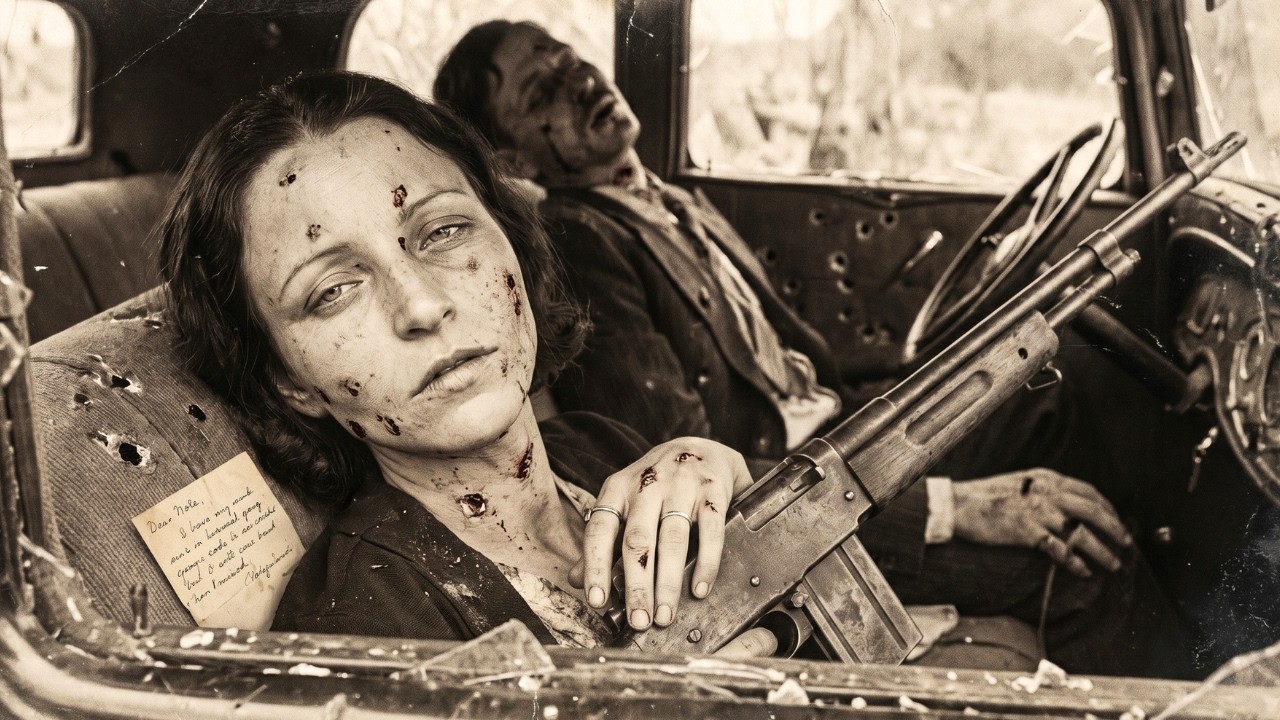
On the morning of May 23rd, 1934, on a dirt road near Gibsland, Louisiana, six lawmen waited hidden in the bushes. When Clyde's stolen Ford V8 came around the bend, the men gave no warning and no chance to surrender. They all opened fire at once.
In just a few seconds, more than 130 bullets tore through the car's body. Bonnie Parker and Clyde Barrow died almost instantly, without even having time to draw the guns they carried beside them. The bullet-riddled car became a gruesome attraction, and people from all over the country paid just to take a look.
The car Bonnie and Clyde died in still exists. It was a 1934 Ford V8, stolen from a homemaker in Kansas just a few weeks before the end. The car came to a stop riddled with more than 160 bullet holes.
Instead of being turned into scrap metal, that Ford went back on the road as an attraction. For decades, it traveled to fairs and amusement parks across the country, and people lined up and paid just to stick their fingers into the bullet holes. Today, that same Ford is on display at a casino in Prim, Nevada.
Just minutes after the shooting stopped, that dirt road in Louisiana turned into a circus. People from all over started showing up to see the Ford where Bonnie and Clyde had just been killed. As soon as the bodies were removed, the crowd rushed in.
Some people tried to cut locks of Bonnie's hair, still stained with blood. Others tore off pieces of her dress, buttons, and shards of glass shattered by the bullets. Some even tried to cut off a finger just so they would have something to show their neighbors later.
In life, Bonnie and Clyde were inseparable. After all that, you would think they would stay together forever. That is not what happened.
Bonnie made it clear that she wanted to be buried near Clyde, but her family never accepted that relationship. Bonnie's mother said no. In the end, Clyde was buried at Western Heights Cemetery next to his brother.
Bonnie was laid to rest a few miles away at Crown Hill. The couple who became legendary for never being apart ended up separated by just a few city blocks.
The image of Bonnie and Clyde as rebellious heroes did not come from the dirt roads of 1930s Texas. It came straight from Hollywood. In 1967, the movie starring Warren Beatty and Faye Dunaway turned the two into symbols of freedom right in the middle of the American counterculture.
What almost no one talks about is that while they were alive, Bonnie and Clyde were not admired. They were feared, and as time went on, increasingly hated.

The Barrow gang began to fall apart in July 1933. Near the town of Dexter, Iowa, more than 100 armed men surrounded a small campsite in the woods. Buck Barrow, Clyde's older brother, already had a bullet lodged in his head from a shootout days earlier in Platte City, Missouri.
He was shot again and captured. Five days later, he died at a hospital. His wife, Blanche, was arrested with shards of glass embedded in her face.
She lost sight in one eye and was sentenced to 10 years in prison. Only Bonnie, Clyde, and the young W. D.
Jones escaped on foot.
W. D. Jones was only 16 years old when he went down in history as one of Clyde Barrow's accomplices.
Decades later, in a 1968 interview, he said those months with the gang were a never-ending nightmare and that they sometimes chained him to the car so he could not run away. He took part in robberies, traded gunfire, and was shot more than once. He was eventually arrested in Houston in November 1933.
He served his sentence, got out, and lived for more than 40 more years. He was shot to death in Houston in 1974.
Raymond Hamilton rode alongside Clyde Barrow in the early days of the gang. But the friendship did not last. The two had a bitter falling out over money and women.
Humiliated, Hamilton kept robbing on his own. The police arrested him, and he managed to escape death row, but he was caught again. On May 10th, 1935, almost a year after Bonnie and Clyde were killed, he was taken to the electric chair at Huntsville Prison in Texas.
He was only 21 years old.
The deaths of Bonnie and Clyde did not come from a brilliant investigation. They came from a deal made behind closed doors. Henry Methvin was one of the younger members of the gang, and his father, Ivy Methvin, would do anything to get his son out of the line of fire.
Louisiana authorities offered Henry a pardon in exchange for helping set up the trap. On May 23rd, 1934, old Ivy's truck was left parked as if it had broken down. It was the bait.
When Clyde stopped to see what had happened, the lawmen hiding in the bushes opened fire.
Just a few weeks before dying, Clyde Barrow reportedly did something hard to believe. He sat down and wrote a personal letter to Henry Ford. It was not a threat.
It was a thank you note. Signed Clyde Champion Barrow, the letter praised the Ford V8 and said he only drove Fords when he needed to make a getaway. The gang always stole Ford V8s because no police car could keep up with that engine.
In a twist of fate, Bonnie and Clyde ended up dying inside a stolen 1934 Ford V8 Deluxe riddled with bullets on a road in Louisiana. To this day, historians still debate whether the letter was real. But one thing no one denies: without meaning to, an outlaw turned the car he stole into the best advertising Ford ever had.