On the morning of April 14, 1999, Jane Calder left the bakery on Henderson Street in Hawick at six o’clock, as she had done on roughly five hundred previous mornings. She was forty-four years old, single, and lived a quiet life built on routine: she worked the early shift, walked home along the same route past the post office and over the bridge, tended a garden her late mother had planted, and shared Sunday dinners with her sister Margaret without exception for twenty years. She had a dog named Douglas and a sister three streets away. In Hawick that year, walking home alone at dawn was not regarded as dangerous.
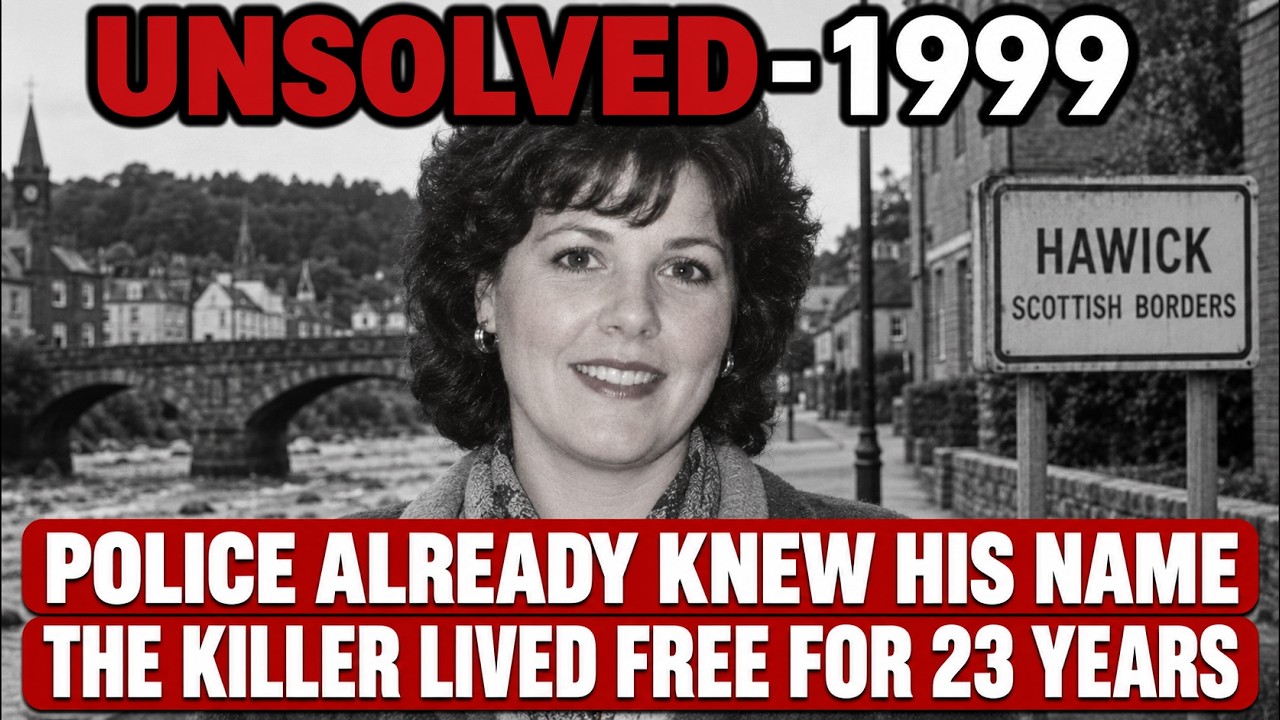
By eight o’clock, she was dead. Hawick sits in the valley of the River Teviot in the Scottish Borders, a town of about fifteen thousand people with a long industrial history in knitwear and wool. The mills had declined through the 1980s and 1990s, but the rhythms they imposed remained: people kept early hours, knew each other’s shifts, and noticed when something was different. Jane Calder had been born in Hawick in 1954 and had returned in 1980 after a brief spell in Edinburgh, taking a job at the Rozalyn bakery where she stayed for nineteen years, eventually running the morning production alone.
On the morning she died, a delivery driver saw her cross the Teviot bridge around 6:35. She was alone, walking at her usual pace, and raised her hand in greeting because she knew his truck. At 8:00 that morning, her sister Margaret received a call from the bakery: Jane had not answered a delivery inquiry, which was unusual. Margaret walked to Jane’s home in Portree Place.
The front door was open. Douglas the dog was inside, agitated, not yet taken out. Jane was not there. Margaret called the police at 8:17.
The body was found at 11:43 that morning in a narrow passage between a garden wall and the riverbank. She had been attacked from behind. The forensic pathologist placed the time of death between 6:45 and 7:15. Jane had been dead for less than ninety minutes when Margaret opened her front door.
Detective Chief Inspector Robert Fyfe of Lothian and Borders Police led the investigation with the care the case deserved. Within the first forty-eight hours, his team interviewed sixty-one residents, identified the delivery driver who had seen Jane on the bridge, and canvassed every property along her route. On the fourth day, a name emerged. Two independent witnesses came forward within twelve hours of each other.
A retired teacher named Agnes Turnbull told an officer she had seen a man she knew standing near the entrance to a lane at around 6:50 on the morning of the murder. She gave his name. A man working at the petrol station on Stirling Road told a different officer that the same man had come in that morning, unusual for a weekday, appeared agitated, bought cigarettes, and left without waiting for his change. The name he gave was the same: Thomas Mickle.
Thomas Mickle was forty-eight, a Hawick man who had worked for fifteen years as a caretaker and odd-job hand for several properties in the area, a kind of work that placed him within the community without anchoring him to any single place. He was known for a sharp temper, but not as dangerous. He drank at the Buccleuch on Friday evenings. He had a brother in Galashiels.
DCI Fyfe interviewed him six days after the murder. Mickle said he had been at home on the morning in question, denied any knowledge of Jane Calder beyond the way everyone in a town of fifteen thousand knows everyone else, was calm and cooperative, and voluntarily provided a DNA sample. The sample was processed. It did not match biological material found at the crime scene.
Thomas Mickle was eliminated from the inquiry. Agnus Turnbull’s statement was filed. So was the petrol station worker’s account. The investigation continued, examining eleven other persons of interest over four months, none yielding enough evidence to charge.
The crime scene material matched nothing in available databases. In November 1999, seven months after Jane Calder was killed walking home from work, the active investigation was closed. The file was transferred to the cold case unit. The case was recorded as unsolved.
The officer who had taken Agnes Turnbull’s statement was a twenty-six-year-old constable named Carol Dale, in her third year of service. She had handed the statement to her supervising sergeant the same morning she took it and was told it had been noted. She was not told that the statement had been corroborated by a second independent witness until she read it in an investigation summary two weeks later, by which time Thomas Mickle had already been eliminated. That, she was told, was that.
Carol Dale remained in the police for another eighteen years, rising to detective sergeant before retiring in 2017. Throughout those years, she thought about Agnes Turnbull’s statement repeatedly, certain of something she could not properly name. She said nothing because her superior had closed the line of inquiry, because she was twenty-six with three years of experience against his sixteen. She never stopped thinking about it.
In 2017, Scotland established a formal cold case review unit within Police Scotland. Twenty-three years after Jane Calder left the bakery on Henderson Street, a two-person team was assigned to conduct a full review of the Calder file, not because it was the oldest or most prominent case in the system, but because the unit’s principle was that every unsolved case file is reviewed in rotation until an answer is found. The lead reviewer was Detective Inspector Fiona Garrett, forty-one, who had joined the unit after fourteen years in major crime. She was known for reading everything, not summaries, and had previously caught two serious errors in older cases by reading original witness statements that had been summarized inaccurately in case files—small discrepancies between what a person said and what the summary recorded, the kind that might mean everything or nothing.
She always checked. She read Agnes Turnbull’s original statement on a Tuesday morning in the third week of the review. Turnbull had died in 2009. The statement was handwritten, two pages, signed at the bottom.
It described the man she saw at the lane entrance, gave the timing, and gave the name Thomas Mickle. In the margin of the second page, in handwriting Garrett matched to the supervising sergeant who had received the statement in 1999, were four words: no further action. Garrett read those words and sat still for a long time. She knew something not widely available to investigators in 1999: familial DNA from a relative can, under certain sample conditions, produce a partial match strong enough to exclude the direct contribution of one brother while leaving the other’s intact.
She requested reanalysis of the 1999 biological evidence using modern forensic methodology. That same afternoon, she searched current records for Thomas Mickle. He was still alive, seventy-one years old, living in sheltered accommodation in Jedburgh, twelve miles from Hawick. He had a brother, Robert Mickle, sixty-eight, living in Galashiels.
The reanalysis results came back after six weeks. The biological material from Jane Calder’s crime scene did not match Thomas Mickle. It was consistent with a first-degree male relative of Thomas Mickle. A familial match.
The DNA had excluded the wrong man. Robert Mickle had lived in Galashiels for thirty years, known there as a quiet, solitary man who paid his rent on time, had some acquaintances at the bowling club, worked as a laborer and later, when his knees deteriorated, as a night watchman at a storage facility. He had never married. His adult daughter had moved to Canada in 2010, and contact was minimal.
He had no criminal record. Police had never questioned him in any case. In April 1999 he had been thirty-eight, living in a rented room in Hawick, on a street overlooking the bridge over the Teviot, less than one hundred meters from the passage where Jane Calder’s body was found. Investigators requested a voluntary DNA sample.
Robert Mickle refused. A warrant was obtained. The sample matched the biological material from the crime scene with a probability greater than one in a billion. Fiona Garrett ordered his arrest on October 22, 2022.
He was taken quietly on a Tuesday evening by two officers at the door of his sheltered accommodation. He said very little. Shown the evidence across the table in an Edinburgh interview room, he said only, “I was hoping this would not happen. ” That was all.
At sentencing, the judge noted that Robert Mickle had lived freely for twenty-three years while Margaret, Jane’s sister, had attended every cold case advocacy event in Scotland, written to the Crown Office seven times demanding review, and carried the weight of an unanswered question through the deaths of both parents and the loss of her closest friend. The judge noted that the 1999 failure to identify Robert Mickle was not deliberate misconduct but a failure of forensic science that was not then as advanced as it should have been, combined with the assumption that a negative result was a final result, when in those circumstances it was not. Robert Mickle was sentenced to life imprisonment with a minimum term of seventeen years. He was seventy-one at sentencing.
He will not be released. Through his lawyer, Thomas Mickle issued a single statement: he said he had known for twenty-three years that something was wrong, that he knew where his brother had been living in April 1999, that he had wondered, and that he had said nothing because he convinced himself he could not be certain, and because the police had said the DNA cleared the family. And he said he could not bring himself to believe it about someone he loved. The people of Hawick said little publicly.
A community that notices when a delivery driver raises his hand in greeting does not handle this kind of truth noisily. But Carol Dale, the retired sergeant who had taken Agnes Turnbull’s statement at twenty-six, who had kept the file and carried the question for twenty-three years, gave a single interview to a Scottish newspaper. She said she had made no mistake. She said she did everything she should have done.
She said they told her it had been resolved, and she believed them because she was twenty-six and had no reason not to. She said none of that made her feel better. She said she was glad for Margaret Calder, and she meant it. She said she hoped Agnes Turnbull knew somehow.
Jane Calder would have been sixty-nine years old. She would likely still have been tending the climbing roses on the back wall. She would have had firm, detailed opinions about how the high street had changed, and whether the new bakery two doors from the old Rozalyn’s was worth a visit. Her sister Margaret, now in her mid-seventies, tended Jane’s garden for several years after her death before her health made it impossible.
A neighbor took over. The roses were still there last spring. The case was closed not by forensic science alone, though science is what closed it, but because one investigator read everything. In 1999 the system reached a conclusion before it had finished asking questions.
The DNA was correct, but it simply had not gone far enough, and no one at the time knew enough to ask whether it had. Fiona Garrett did. Justice found its way to Jane Calder after twenty-three years, because one person read the original statement, checked the margin, and asked what everyone else had accepted.