In 1968, Henson Cargill stood at the pinnacle of country music. His song “Skip a Rope” had not merely topped the charts; it had cracked the pop mainstream and earned two Grammy nominations. He was hailed as the honest voice of a fractured nation. Within a few years, he was gone—not faded, but erased, running a nightclub in Oklahoma, a ghost of his own success.
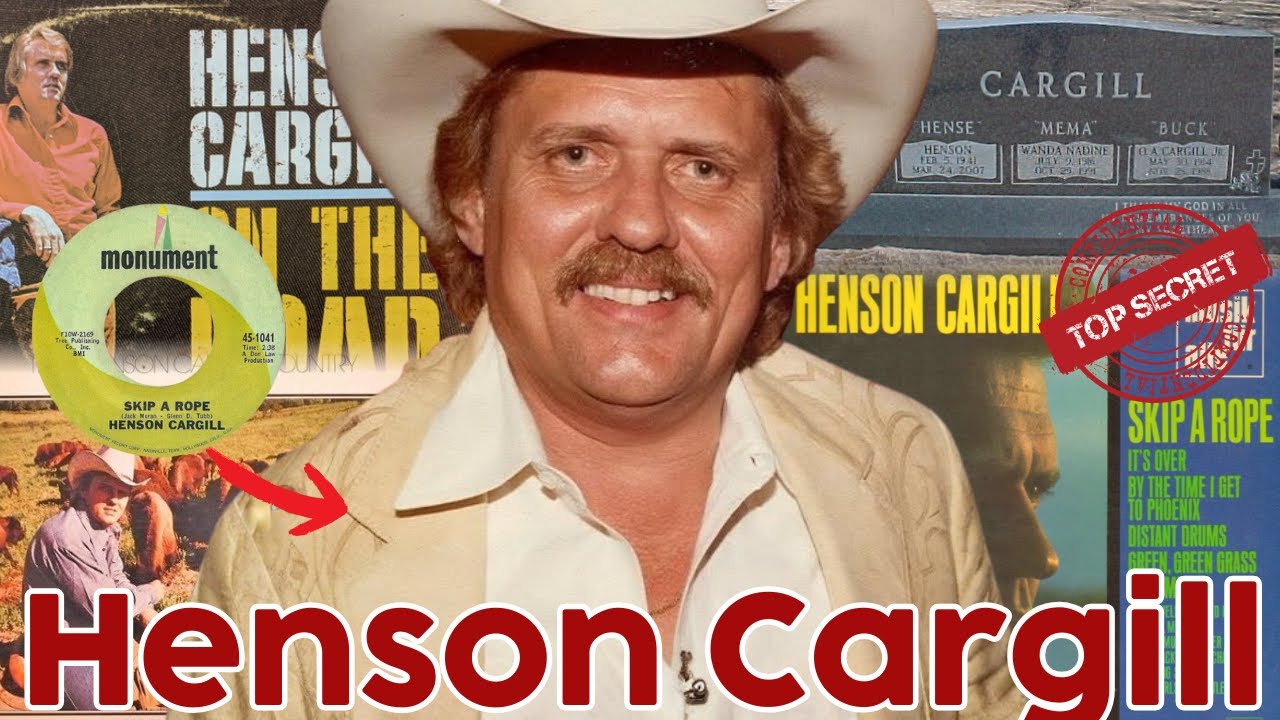
This was no slide into scandal or addiction. It was a systematic career execution, and the crime was telling the truth. America in 1968 was tearing itself apart. The Tet Offensive in January shattered faith in the Vietnam War.
In March, President Lyndon B. Johnson announced he would not seek another term. In April, Martin Luther King Jr. was assassinated, and over one hundred cities erupted in riots.
In June, Robert F. Kennedy was shot dead in Los Angeles. That summer, police battled anti-war protesters in the streets of Chicago during the Democratic National Convention. The country was suffocating under violence and division.
Country music offered an escape. Nashville in the 1960s was an industrial empire built on control. After rock and roll stole the youth audience, producers like Chet Atkins and Owen Bradley engineered the Nashville Sound, a deliberate formula to strip the genre of its raw, hillbilly roots. They removed fiddles and steel guitars, replaced them with string sections, smoothed out the singers’ twang, and polished the harmonies.
The result was a safe, sophisticated product: beautiful pop songs with a slight southern accent. It was immensely profitable. The industry sold a fantasy of a stable, moral, patriotic America that did not really exist. The Grand Ole Opry enforced the code: sing about lost love, cold beer, and the flag, but never about racism, domestic violence, or hypocrisy.
The audience wanted anesthetic, not truth. Cargill was an outsider. Born in Oklahoma in 1941, he came from the hard, windswept land of the Dust Bowl, not the polished studios of Nashville. He had once served as a deputy sheriff in Oklahoma County.
He had answered the calls, stepped over broken glass, and seen the terrified faces of children. He was a conservative man, a believer in law and order, who had realized that the rot lay not in the streets but behind the closed doors of respectable homes. He moved to Nashville, paid his dues, and signed with Monument Records, an independent label with a maverick streak. In 1967, a song landed on his desk.
Written by Jack Moran and Glenn Tubb, “Skip a Rope” had been passed over by every major artist in town. It was too dark, too controversial, unreleasable. The song used the innocent rhythm of a children’s jump-rope game to deliver a brutal indictment of the adult world. It accused a prominent businessman of teaching his son to cheat on taxes, a mother of deceiving her absent husband, and a neighbor of beating his child and wife.
The final verse linked private violence to racial hatred: “Yelling dirty words about another man’s skin. ” The children’s chorus drove it home: “They’re learning how to hate and how to kill. ”
It was an atomic bomb aimed at Nashville’s carefully constructed fantasy. Cargill, the ex-deputy sheriff who had seen it all firsthand, was the only man with the courage to record it.
Monument agreed to release it. The recording was urgent and sinister, driven by a haunting bass riff. Cargill’s deep baritone delivered every word like a judge reading a verdict, and a children’s choir sang the devastating accusations. It stripped away all comfort.
Released in late 1967, “Skip a Rope” exploded. It climbed to number one on the Billboard country chart and held the spot for five straight weeks. It crossed over to pop radio and reached number 25 on the Hot 100. It sold over a million copies.
The industry that had rejected the song was blindsided. Cargill received two Grammy nominations and won the Country Music Association’s Single of the Year award. He appeared on The Ed Sullivan Show and The Tonight Show. For a brief moment, he was king.
But behind closed doors, the industry was terrified. He had proven that the public was starving for the truth, an existential threat to a business model built on selling pleasant lies. The word went out through quiet nods, private lunches, and discreet phone calls: he was trouble, uncontrollable, a loose cannon who must be contained. There was no official ban.
The radio programmers suddenly found his new singles hard to place. The TV bookers decided he was too heavy for audiences. And the invitation to join the Grand Ole Opry, which should have been a certainty after the biggest hit of the year, never came. He followed “Skip a Rope” with “Row, Row, Row,” a satirical comment on conformity that reached the top five, and then the ballad “The Emptiest Arms in the World,” which reached the top twenty.
But the slide was clear. The machine had turned against him. The outlaw movement that rose in the following years—Willie Nelson, Waylon Jennings, Tompall Glaser—fought for artistic control, for their own bands, for recording outside Nashville. Their rebellion was about process and image, and Nashville learned to sell it.
Long hair, leather, and a bad-boy attitude were marketable costumes. Cargill’s rebellion was about substance. He called his audience hypocrites. He sang about child abuse and racism.
That could not be packaged, and it could not be forgiven. The outlaws became millionaires, celebrated as brave rebels. None of them, it seems, ever mentioned the man who had done it first and lost everything. Cargill lost his contract with Monument and bounced between smaller labels.
Radio would no longer play his songs, so his recordings barely existed. He did not self-destruct. He maintained his dignity, remaining a family man. In the mid-1970s, he left Nashville and returned to Oklahoma.
He opened a nightclub called Henson’s Nashville South—a defiant declaration that he would build his own kingdom, and a painful admission of exile. He spent his thirties and forties singing to hundreds in a smoky club while men with half his talent sang to millions. For nearly thirty years, he lived a dual life: a local hero and a national ghost. He watched the industry celebrate other rebels, watched lesser artists inducted into the Hall of Fame, watched history rewrite itself without him.
He became a cautionary tale, a boogeyman used to scare young artists: don’t make trouble, remember what happened to Henson Cargill. The invitations never came. The Country Music Hall of Fame never called. In March 2007, at age 66, Cargill was admitted to a hospital in Oklahoma City for what was described as an elective but necessary procedure.
Complications arose after surgery. He slipped into a coma and lay suspended for eleven days. His family kept vigil. In Nashville, the industry that had once shaken him to its core was silent.
On March 24, 2007, he died. The wire obituaries read the same across the country: “Henson Cargill, ‘Skip a Rope’ singer, dies at 66. ” His courage, his time as a deputy sheriff, his willingness to sacrifice a superstar career for a single unbearable truth—all reduced to a one-hit wonder. The industry wrote his epitaph, and they used the same reductive language that had blacklisted him in the first place.
He was not a one-hit wonder. He was a one-truth wonder. He told one truth so large and so uncomfortable that it ended his career. Nashville loves a redemption story, but to be redeemed, you first have to be wrong.
Johnny Cash and Willie Nelson were forgiven because their failings were personal. Cargill’s sin was different: he had been right. He had exposed the hypocrisy the industry was built on selling. They could not welcome him back without admitting their own lie, and that was never going to happen.
Today, country artists sing about difficult truths more freely, but the door that was slammed shut on Cargill cracked open only after his death. He was the pioneer who paid the price, the man who led the genre to the edge of social honesty and was never allowed to enter himself. He deserved to be remembered not as a footnote, but as a star and a truth-teller who lost everything for it.