In the winter of 1861, William Tecumseh Sherman was dragged home in disgrace. Newspapers called him insane. His own generals believed he had lost his mind. Just months into the Civil War, one of the Union’s most promising commanders had been relieved of his post in Kentucky and sent back to Ohio, a broken man who could not sleep, could not eat, and paced hotel corridors muttering about phantom Confederate armies.
Sherman’s collapse did not come from nowhere. In 1857, he was a bankrupt banker in San Francisco, hunched over ledgers while creditors pounded on the windows. A West Point graduate who had resigned his commission, he had failed at banking, failed as a lawyer in Kansas, and watched his reputation crumble. When Louisiana seceded in 1861, he resigned his post as superintendent of a military academy, warning bitterly, “You people of the South don’t know what you are doing.
” He understood that war would be catastrophic, and the weight of that knowledge broke him. By the fall of 1861, Sherman was a brigadier general tasked with defending Kentucky, a border state torn between North and South. He was consumed by dread. By day, he paced the Galt House Hotel in Louisville, coat unbuttoned, cigar ash trailing, his hands trembling so violently that whiskey sloshed from his glass.
By night, he stalked the corridors, ranting that the Union needed two hundred thousand men to hold the line. When Secretary of War Simon Cameron visited and heard Sherman’s dire predictions, he left alarmed. The press soon branded him “Crazy Sherman. ” One journalist wrote that he was “a bundle of nerves strung to their highest tension.
”
By November, Sherman was relieved of command. His wife, Ellen, raced south to collect him. What she found was chilling. He had not slept or eaten properly for weeks.
His uniform hung loose. His feverish eyes darted at shadows. He believed the nation was doomed and himself a failure. “I find myself riding a whirlwind, unable to guide the storm,” he confessed.
“This nearly makes me crazy indeed. I may be so now. ”
Ellen had seen this darkness before, after his bank collapsed in California, and in the haunted eyes of his melancholic uncle. It was more than stress.
What doctors then called melancholia, and what would later be recognized as bipolar disorder, ran in his family. She took him home to Ohio. No doctors, no medicine. Just silence, sleep, and the works of Shakespeare.
Night after night, she read him King Lear, a tragic mirror to his unraveling. For three weeks, she anchored him. By December, a flicker of the old Sherman returned. He reported to Missouri for a desk job, organizing supplies.
It was there that he met Ulysses S. Grant. Grant, battling his own demons and whispered accusations of drunkenness, saw past Sherman’s stigma. Over shared whiskey, the two damaged men formed an unspoken bond.
Grant needed a logistician for his Tennessee campaign, and Sherman seized the chance. At Shiloh in April 1862, all doubts shattered. Confederate troops surged from the woods and overran Union camps. Sherman’s division was blindsided.
A Minié ball tore through his hand, bone glinting white in the mangled flesh, yet he kept fighting. Another bullet grazed his shoulder, soaking his uniform in blood. But instead of crumbling, he rallied his men, shouting, “Hold the line. We can whip them.
” He rode back and forth under fire, cool and decisive. By day’s end, his shattered glasses and wounded hand had become symbols of resilience. Grant was impressed, writing that Sherman had saved the day. The man labeled insane months earlier had become Grant’s rock.
What changed? Sherman’s breakdown had forged a terrifying clarity. He no longer saw the Civil War as a chess match between gentlemen. He saw it as a psychological siege.
“War is cruelty,” he would say. “The crueler it is, the sooner it will be over. ” His manic energy now had direction: break the South’s will to fight. This was total war.
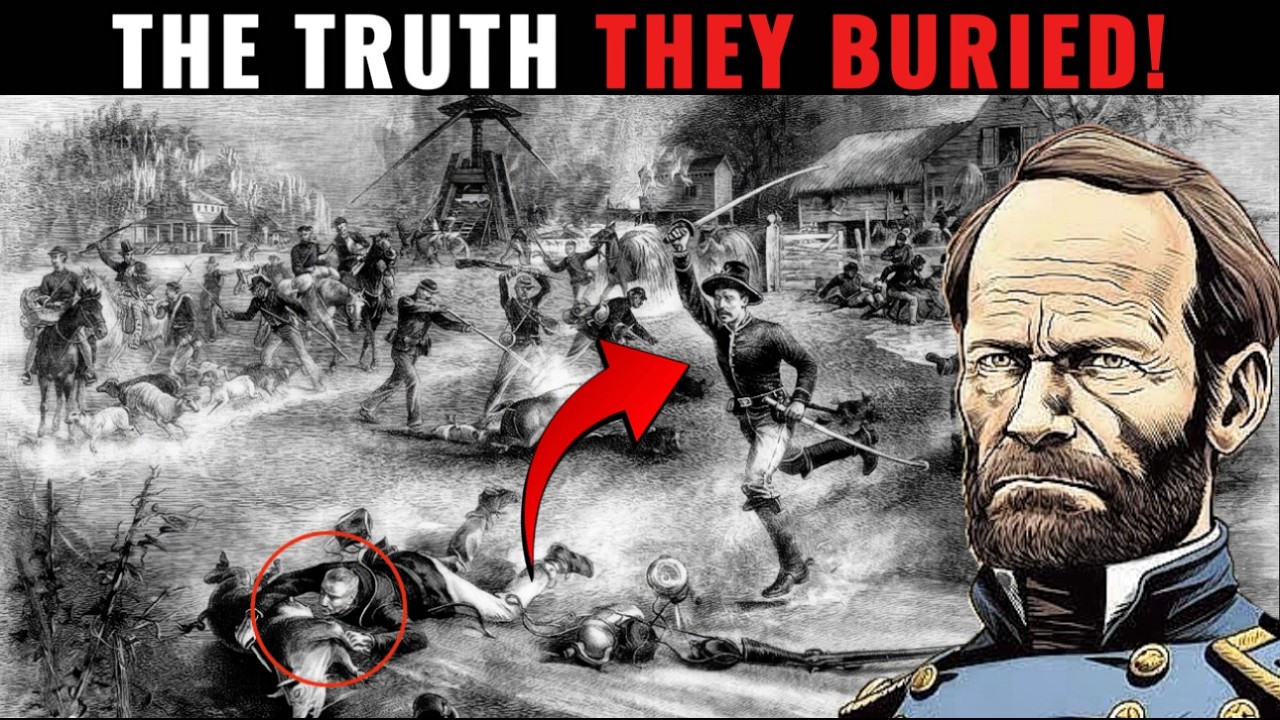
In 1864, Sherman took Atlanta. Then he did the unthinkable. He cut his supply lines. Sixty thousand men vanished into the Georgia wilderness with twenty days of rations.
Their mission was to live off the land and destroy everything else. Soldiers tore up railroad tracks, heated the rails, and twisted them into what became known as “Sherman’s neckties. ” Barns burned. Cotton gins were smashed.
A farmer’s diary recorded that the army left only “chimneys weeping smoke. ” Georgians whispered that the devil was coming. One moment captured his chilling calculus. As flames consumed a Georgia plantation, a sobbing woman confronted him.
“How can you burn a home? ” she asked. Sherman replied, “Madam, we must make this a barren waste till your sons stop fighting. ” Behind them, soldiers threw family portraits onto bonfires, silent faces curling to ash.
He was not just a soldier. He was a strategist of despair, using the trauma of his own collapse to break a nation’s spirit. When he telegraphed Lincoln after capturing Savannah, he wrote, “I beg to present you Savannah as a Christmas gift. ” It was the triumph of a man reborn in fire.
Yet the ghosts lingered. After Columbia, South Carolina burned in 1865, Confederates had lit the first fires, but Sherman’s men fed them. He later wrote, “I am tired and sick of war. Its glory is all moonshine.
” For decades, he would wake gasping from dreams of burning children. Psychiatrists who later studied Sherman saw his breakdown as key. Depression gave him realism. Mania fueled relentless energy.
His madness forged both the empathy to understand Southern morale and the ruthlessness to crush it. Sherman survived the war and survived the whispers. But his march never truly ended. It lives in the scarred earth of Georgia, in the chimneys that once wept smoke, in the twisted rails buried under earth, and in the nightmares of a nation forced to heal.
He remains a figure of bitter memory in the South, where his name is still spoken like a curse. A broken man had weaponized his own darkness to end a war, leaving behind a terrifying lesson carved into history: sometimes madness is the only sanity war understands.