In June 1782, a fifty-nine-year-old man was tied to a stake on the Sandusky Plains in the Ohio territory while roughly one hundred people gathered to watch. For two and a half hours, his skin was burned with gunpowder and glowing embers. He stopped screaming long before it was over. The man enduring this was William Crawford, a retired surveyor and old friend of George Washington.
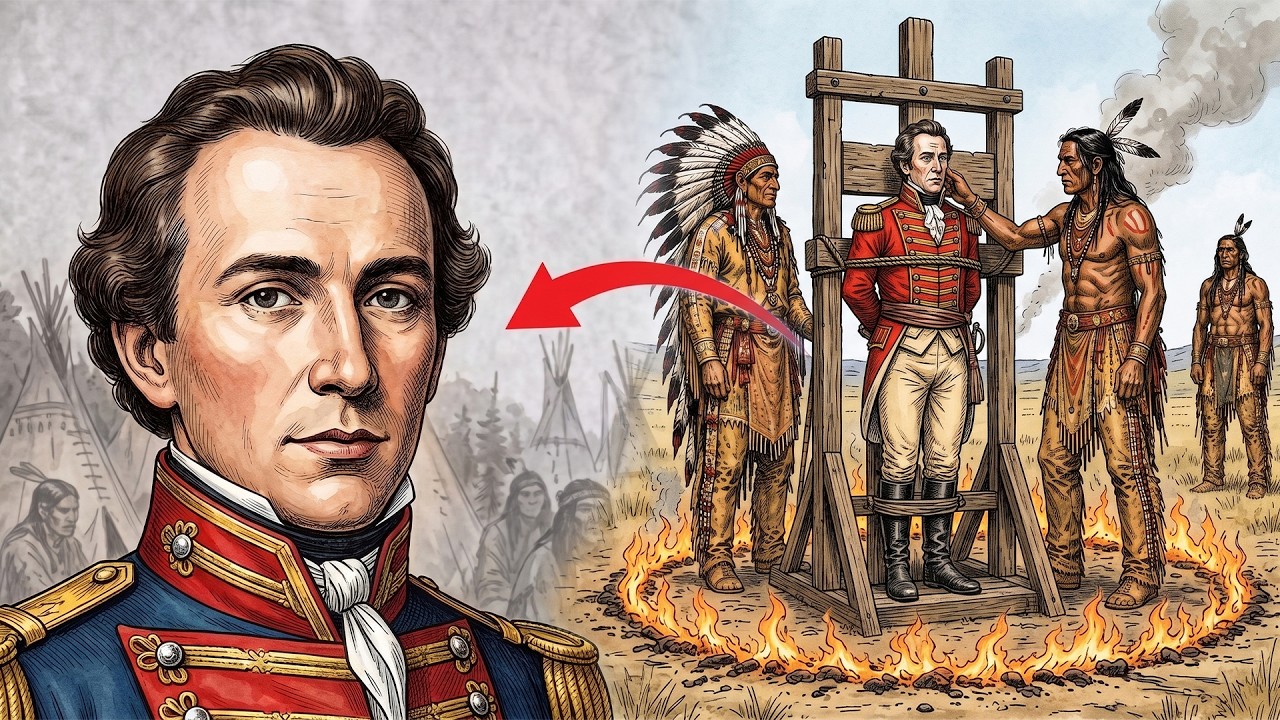
The people watching were Lenape and Wyandot men, women, and children. They were not carrying out a random act of savagery. They were settling an account, and Crawford was not the man who had created the debt. Three months earlier, in March 1782, a Pennsylvania militia unit under Major David Williamson had entered Gnadenhutten, a Moravian settlement in northeastern Ohio.
The community there was composed of Christian Lenape who had refused to take up arms and tried to remain neutral in the frontier war. They were unarmed and praying when Williamson’s men arrived. The militia voted on what to do with them. A minority argued for taking the prisoners to Pittsburgh for trial.
The majority chose to kill them. Over the course of hours, the militia bludgeoned ninety-six men, women, and children to death with carpenters’ mallets. They looted the village the next day, burned the buildings, and left the bodies in mass graves. The Pennsylvania authorities promised an investigation and quietly dropped the matter.
No one was ever tried for the massacre. Every native community on the frontier knew what had happened. The Lenape, Wyandot, and Shawnee understood that the score would eventually be settled. The man they wanted above all others was Williamson, but in the spring of 1782 Williamson was helping organize a new expedition against native settlements along the Sandusky River.
The volunteers, about four hundred and eighty men, were largely the same men who had been at Gnadenhutten. They needed a commander with an experienced name, and they turned to Crawford. Crawford had spent more than twenty years surveying land in the Ohio Valley. In his youth he had ridden through the western territories with George Washington, and the two men had maintained a friendship through letters ever since.
By 1782 Crawford was retired, living on his farm with his family and grandchildren. Why he accepted command of this expedition remains uncertain. Some historians believe he wanted to control the men and prevent another massacre. Others suggest his loyalty to the nation Washington represented pushed him into the duty.
Whatever his reasoning, he said yes. In the days before he left, he wrote ordinary letters to his wife and daughter, instructions about which fields to plow and which debts to pay. He expected to be gone for three weeks. The column crossed the Ohio River at Mingo Bottom on May 25, 1782.
These were not regular soldiers. They were farmers, clerks, and young men who had lost relatives in frontier raids. Some were teenagers who had never seen combat. Others were veterans of every skirmish of the previous decade.
They marched northwest toward the Sandusky villages, expecting to burn them and return home. What they did not know was that the villages had already been evacuated. And they did not know that a war party was already tracking them. The force waiting for them was led by experienced commanders, men the Americans called Captain Pipe and Wingenund.
They had spent decades fighting frontier wars and knew the terrain well. A small group of British soldiers and interpreters from Detroit had joined them, bringing ammunition and intelligence. Warrior bands of Lenape, Wyandot, and Shawnee, initially about two hundred strong, had been watching the American column for days. They had no intention of defending empty villages.
They intended to fight on ground of their own choosing, an open plain where tall grass could hide a man and where exhausted soldiers could be seen from a mile away. Among these warriors was Simon Girty, a white man who had been captured as a child during a native raid and raised among the Lenape and Wyandot. He spoke several native languages fluently and had sided with the British when the Revolution began. In American frontier culture, his name would become synonymous with treason.
At that moment, no one knew that Crawford would look to him for help in his final hour. On June 4, the American column reached the Sandusky Plains and found the villages deserted. Crawford ordered one more day of marching. That afternoon, the battle began with a single rifle shot.
Within minutes, the volunteers were under fire from three directions, but they could not see their attackers. The grass was taller than a kneeling soldier’s shoulders. Crawford directed his men into a small grove of trees, where they dug shallow trenches and built breastworks from branches. The Lenape and Wyandot did not charge.
They surrounded the grove and fired from the grass, changing positions constantly. Their goal was not to win the battle in an afternoon. It was to keep the volunteers pinned down until they were exhausted and low on ammunition. The firing lasted until dusk.
That night, the warriors kept the circle loose but effective, firing occasionally into the grove and sending war cries out of the darkness. By the morning of June 5, more warriors had arrived. The circle was tightening. The Americans were running out of water, ammunition, and options.
Crawford ordered a night retreat. Small groups would slip out in the dark and make their way southeast toward the Ohio. Williamson left first with the main body of about three hundred men. Crawford stayed behind with the slower groups and the wounded.
He also lost time searching for his son and nephew in the darkness. Those few minutes of delay separated him from the main column. When dawn broke on June 6, Crawford’s group was scattered over miles of open plains. The warriors did not pursue Williamson’s disciplined column.
They turned back and swept the terrain in wide arcs, hunting for the fragmented groups left behind. The trap had worked exactly as designed. On June 7, Crawford was captured with a small group that included his son-in-law, William Harrison, and the young surgeon, Dr. John Knight.
They were exhausted and nearly out of ammunition. They surrendered. Crawford was quickly recognized as the ranking officer and was separated from the others. He was marched toward the Lenape village the Americans called Pipe’s Town.
Knight walked beside him and later described Crawford’s silence. He did not cry. He did not beg. He asked Knight once if there was any chance.
Knight, as a doctor, said no. They reached Pipe’s Town around June 10. The village had been preparing for their arrival. A stake had been prepared, a fire pit dug, and materials gathered.
About one hundred people had assembled, men, women, and children. Every one of them had lost someone to the frontier violence of the past decade. Many had buried family members at Gnadenhutten in March. The mothers who came to watch that afternoon were mothers who had buried their children in a mass grave three months earlier.
Knight was kept nearby, close enough to see everything. Simon Girty was there as well. When Crawford saw him, Knight later wrote, his face showed the first real hope he had seen in three days. Crawford asked Girty to shoot him, to spare him the fire.
Girty replied that the natives were resolute, that Crawford must die by fire, and that no intervention was possible. The hope lasted about twenty minutes. Crawford was stripped and tied to the stake. The process began with gunpowder.
Small handfuls of black powder were sprinkled onto his bare skin and ignited, leaving severe burns. Then came the embers, small sticks with glowing tips pressed into his flesh. The women stepped forward and continued the process. Then the children, with smaller sticks, learning.
This was not random cruelty. It was a message, a deliberate repayment for the ninety-six killed at Gnadenhutten. Crawford tried to walk around the stake as far as his bonds would allow. His feet blistered on the heated ground.
After about an hour, he was scalped while still alive, and embers were applied to the exposed skull. Knight, watching from thirty yards away, could not understand how Crawford was still alive. The old man’s screams changed over time, from cries of pain and anger to a muffled groaning that never completely stopped. Toward the end of the second hour, his legs gave out and his body leaned against the ropes.
He died late in the afternoon. There was no clear final blow. His body simply stopped reacting. The ceremony shifted into dismemberment.
The body was cut, the bones broken, and parts were scattered around the stake. Knight was held captive for several days before he escaped into the woods during a moment of confusion. He walked barefoot and starving for three weeks, eating roots and drinking from creeks, until he reached an American settlement on the Ohio. His son-in-law, William Harrison, was killed on the trail.
Other captives were killed or tortured in other villages. Of the roughly four hundred and eighty men who crossed the Ohio in May, between seventy and one hundred died, most of them killed during the retreat and pursuit. Casualties among the opposing side were limited to a few dozen. Williamson, the man responsible for Gnadenhutten, reached Mingo Bottom safely on June 13 with his surviving column.
He had not taken a scratch. He was criticized for the massacre but never stood trial. He lived for decades more. News of Crawford’s death spread quickly.
A letter from Fort Pitt dated July 6, 1782, reached the Pennsylvania Journal and Weekly Advertiser and was reprinted in newspapers across the colonies. George Washington received the news in early August. In a letter to General William Irvine, commander of Fort Pitt, he spoke of his old friend’s barbarous execution. Knight’s narrative was published in Philadelphia in 1783 under a long title describing the expedition, the execution of Colonel Crawford, and the miraculous escape of Dr.
Knight and John Slover. The pamphlet sold well and was reprinted repeatedly. It became one of the most influential frontier narratives of the founding era. The pamphlet did not lie.
Knight recounted what he saw. But it chose what to highlight and what to push into the background. In the American memory that formed over the next century and a half, Crawford’s execution became the defining atrocity of the frontier, the story of a heroic white victim, a savage native mob, and a traitor to be hated. The ninety-six Christian Lenape beaten to death at Gnadenhutten while praying became a footnote.
The proportions of American memory had been inverted. The Lenape were pushed westward in the following decades, driven out of Ohio and Indiana, placed first in Kansas and then on reservations in Oklahoma. Their descendants always remembered that the fire at Pipe’s Town was not the beginning of something. It was an answer.
Modern historians now read Crawford’s death alongside Gnadenhutten as two faces of the same conflict. Crawford was not present at the massacre, but the men he commanded were the perpetrators, and he knew it. The community that tortured him was administering a form of accountability that the American legal system had never offered them. That does not justify the violence.
It places it within the logic of a war. Today, Gnadenhutten is preserved as a small historical park in Ohio, with a monument erected over the mass graves. The exact location of Pipe’s Town has never been definitively determined. The village was abandoned after the war and blended back into nature.
If Crawford had not lost those few minutes looking for his son and nephew, he might have caught up to Williamson’s column and returned home safely, growing old and telling campaign stories to his grandchildren. What determined his fate was not a moral equation. It was the pace of a night march, who was in front and who was left behind. History does not always match great crimes with great punishments.
Sometimes it catches the slowest, the most exhausted, the one left furthest behind.