By late May 1864, Lieutenant General Ulysses S. Grant had spent nearly three weeks driving the Army of the Potomac relentlessly south. There had been no pause for reflection, only the steady, grinding push toward Richmond. The cost had been appalling.
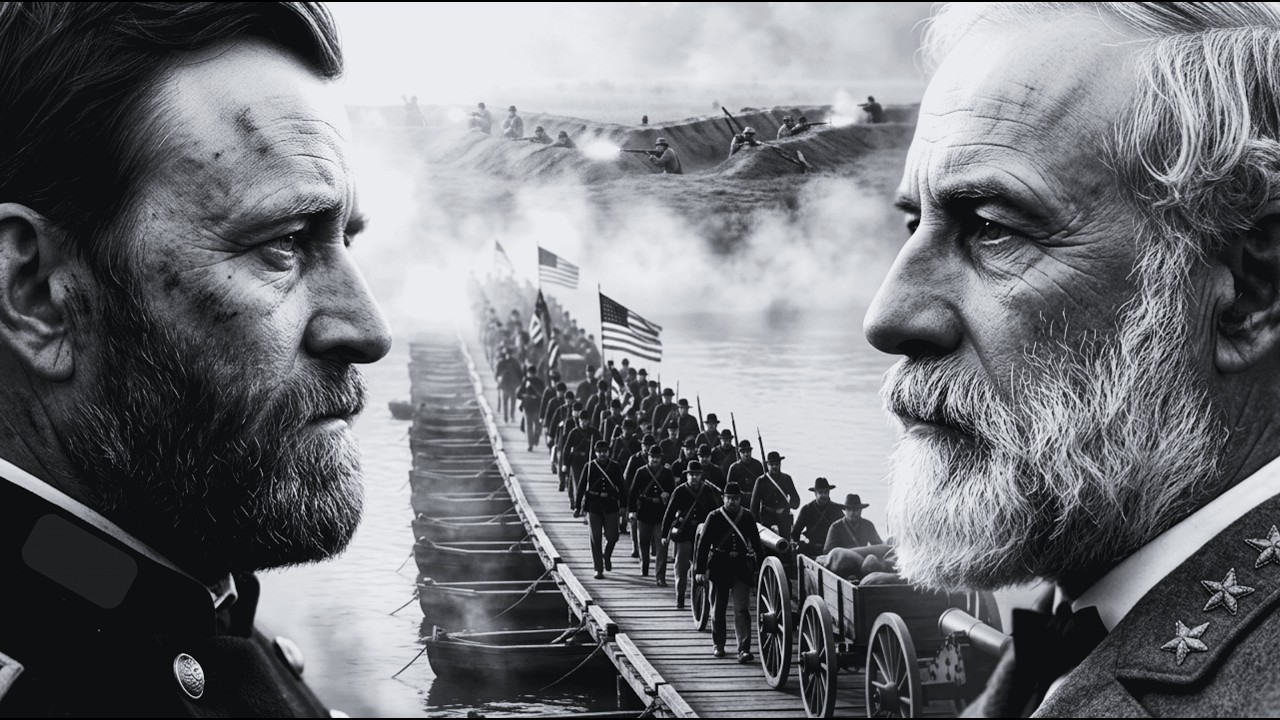
At the Wilderness, tangled forest had turned into a burning nightmare. Then came Spotsylvania Courthouse, where the savage fighting at the Bloody Angle on May 12 and 13 produced thousands of casualties in eighteen hours of close-range combat. Yet Grant did not stop. He did not retreat.
He kept looking for a way around Robert E. Lee and the Army of Northern Virginia. Lee understood that Grant was unlike the Union generals he had faced before. McClellan would have retreated, Burnside would have lost his nerve, Hooker would have second-guessed himself.
Grant simply kept moving forward. Lee also understood that he could not defeat Grant in a contest of strength. The North had more men, more resources, and more industrial capacity. But Lee believed he could still win with cleverness.
On May 23, Grant pushed the Confederates back to the North Anna River, about thirty miles north of Richmond. Lee ordered his engineers to construct fortifications, but not an ordinary defensive line. Working through the night along a five-mile front, they dug an inverted V, a position some soldiers called a hog snout, with the apex at Ox Ford, a critical crossing point. The design was elegant.
When Grant crossed the river, his army would have to split into three separate segments: one at Jericho Mills to the west, one at Ox Ford in the center, and one at Chesterfield Bridge to the east. Isolated from one another, unable to see or support each other, they would be vulnerable to attack from Lee’s interior lines. He could concentrate against one segment, destroy it, and then move against the next. It was the kind of trap military strategists study for an entire career.
The first hours of the battle suggested Lee’s plan might work. At dawn, Union cavalry under Brigadier General James H. Wilson crossed and skirmished with Confederate pickets. By midday, the V Corps pontoon train arrived, and Major General Gouverneur Warren began crossing his full corps at Jericho Mills.
A. P. Hill saw the opportunity and attacked vulnerable Union units caught half on one side of the river and half on the other. His Georgians launched fierce assaults, inflicting about 377 Union casualties, but Warren’s men held their bridgehead and Hill’s attack was repulsed.
Farther east, at Chesterfield Bridge, Colonel John W. Henegan’s small South Carolina Brigade, just one redoubt, held desperately against Winfield Scott Hancock’s massive Second Corps. Massively outnumbered, Henegan’s men used their prepared defenses to slow Hancock long enough to matter. For a moment, the trap seemed to be working.
The Union commanders realized with alarm that they had advanced directly into Lee’s position. They halted and began entrenching. They were, they believed, caught between two Confederate wings. For the first time in the campaign, Lee had Grant exactly where he wanted him.
But there was a critical problem. Lee was sick. Seriously ill, confined to his tent with fever and weakness, probably dysentery or heart strain. He could not ride the lines.
He could not see the battlefield. He had to coordinate perhaps his greatest opportunity through subordinates who were exhausted from weeks of fighting. Lee summoned his commanders to his tent and urged them to strike now, hard and coordinated. The moment would not last.
The Union army was divided. But without Lee personally directing the assault in real time, the coordination began to break down. A. P.
Hill was capable, but he was not Robert E. Lee. He needed Lee’s presence and Lee’s ability to see the entire battlefield at once. Communications between the Confederate units faltered.
The attack was delayed. And while the Confederates struggled to organize, Grant discovered the trap. Grant realized his army had been split into three pieces. He realized he was caught between Lee’s wings.
The choice he made would define the battle. He could panic. He could order a retreat. He could try to pull his army back across the river before the Confederates struck.
Instead, Grant made the decision to stay. He ordered his commanders to halt their advance and dig in. He was going to sit in the trap and wait for Lee to attack him. Grant understood something practical.
He had roughly 68,000 effective men at North Anna against Lee’s roughly 53,000. Intelligence reports suggested Confederate disarray. The longer Grant remained entrenched, the worse any Confederate assault would be. Material advantage, men, firepower, and time were on his side.
At his headquarters at Mount Carmel Church, Grant appeared composed, even methodical. One aide, Horace Porter, recorded him chewing an unlit cigar and quietly sketching notes on a map while his officers worried about their divided position. Grant’s instruction was simple: If Lee attacks, we’ll be ready. No drama, no speeches.
Union soldiers worked frantically through the day and night piling up earthworks, understanding they were in the most vulnerable position of the campaign, and knowing that any delay in fortifying could mean the difference between survival and destruction. Grant’s calculation rested on his knowledge that Lee was sick. He had spies, scouts, and intelligence reports. He knew Lee was not commanding from the field.
He bet that without Lee personally directing, the Confederates would hesitate and fail to launch a coordinated blow. He was right. What followed on May 24 was not the hammer blow Lee had designed. There were skirmishes and local fights at Jericho Mills and Chesterfield Bridge, but no coordinated assault that broke through.
Brigadier General John B. Gordon led the most coordinated Confederate strike of the battle against the apex of the V at Ox Ford, where Hancock’s Second Corps was entrenched. It cost the Confederates roughly 500 casualties and failed. Hill pushed his corps forward despite his own recent illness.
Richard Ewell and Richard Anderson tried as well, but they were exhausted, hampered by terrain, and facing Union soldiers entrenched and ready. Hill did not know what Anderson was doing. Anderson did not know what Ewell needed. The whole attack deteriorated into a series of isolated fights instead of one devastating strike.
Lee, lying in his tent, could only listen to the sounds of the fighting and wait for reports of success that never came. By May 25, the greatest Confederate opportunity of the campaign was gone. Grant, meanwhile, was not waiting for the fight to finish. He sent an optimistic wire to General Halleck in Washington: “I have Lee’s army where I want it.
” Then he disengaged from the North Anna trap. Leaving behind a rear guard and cavalry screen to create the impression that the army was still there, Grant moved his main body rapidly southeast toward the Pamunkey River. By May 26, before Lee had fully realized what was happening, the Union army was across the Pamunkey, moving closer to Richmond. When Lee discovered that Grant had escaped, he was profoundly disappointed.
The chance to crush Grant piecemeal had simply evaporated. The battle itself was statistically inconclusive. Union casualties over the five days were estimated at 2,000 men. Confederate casualties were similar, with 304 confirmed killed.
In the context of the Overland Campaign, the losses were relatively light. There was no decisive breakthrough for either side. But the deeper significance lay in what the battle revealed about the two commanders. For Lee, North Anna was the moment he understood that Grant was fundamentally different from every Union general he had faced.
Grant did not panic when trapped. He did not retreat when cornered. Lee had broken dozens of Union commanders psychologically, made them doubt themselves and pull back. Grant refused to be broken.
His refusal was itself a weapon. For Grant, North Anna was an affirmation. Lee was fallible, sick, and human. Grant’s composure, his refusal to panic, and his steady forward momentum had neutralized one of Lee’s most brilliant tactical schemes.
A Union officer present at North Anna later wrote that he saw Grant riding along the entrenchments during the battle, and his calmness seemed almost supernatural. While the men were terrified and convinced they were about to be destroyed, Grant was smoking a cigar and nodding at the fortifications like a man reviewing completed work. Grant was not unafraid, but he did not let fear make his decisions. After North Anna, Grant continued his relentless advance toward Cold Harbor, where the campaign reached its bloody climax, and then toward Petersburg, where he settled into a siege that would last until the spring of 1865.
But something had changed after North Anna. Lee never set another trap as promising as the one at North Anna. He would fight with the same courage and tactical brilliance, but he did so knowing that his opponent would simply refuse to be broken. Robert E.
Lee surrendered to Ulysses S. Grant at Appomattox Courthouse on April 9, 1865. Historians have debated North Anna for more than 150 years. Some argue that a healthy Lee, commanding personally, could have destroyed Grant.
Others note that Union entrenchments, superior numbers, and the speed with which Grant responded limited the feasibility of any Confederate breakthrough. The simpler truth may be that Grant’s contribution was not tactical genius. It was discipline under pressure. He did not panic, and he let the advantage of men, time, and defensive position do the work.
Against an opponent with overwhelming material advantage and patience, even brilliant tactics eventually run out of answers. Grant’s refusal to break at the North Anna River changed the psychological balance of the Civil War. Lee had tried to trap him, and Grant had simply refused to be caught. He advanced, he fought, and he never retreated.
That refusal, more than any single maneuver, shaped the rest of the war.