The hangings began just after one in the morning on October 16, 1946, inside the gymnasium of Nuremberg Prison. The executioner was John C. Woods, an American master sergeant who had volunteered for the job. His equipment was faulty.
The trapdoor was too small, the drop too short, and several of the men condemned at the Nuremberg trials did not die quickly. The first to mount the gallows was Joachim von Ribbentrop, the former Nazi foreign minister. He walked steadily between two guards, refused at first to answer the officer who asked his name, then nearly shouted it when the question was repeated. His final words were a wish for peace and an understanding between East and West.
The drop did not break his neck, and he died slowly by strangulation. Two minutes after Ribbentrop plunged through the trapdoor, Wilhelm Keitel entered the chamber while the foreign minister’s body was still writhing behind the curtain. Keitel, the former chief of the Oberkommando der Wehrmacht and the most senior soldier in Nazi Germany, walked to the gallows alone, refusing assistance. He had asked to be shot by a firing squad, but the court had denied him a soldier’s death.
His last words called on Almighty God to have mercy on the German people, and he said he was following his sons into death for Germany. The trapdoor struck his head as he fell, and it took him twenty-four minutes to die. Ernst Kaltenbrunner followed at 1:52 a. m.
He had led the Reich Security Main Office after the assassination of Reinhard Heydrich, overseeing the Gestapo, the SD, and the Kripo, and he had accelerated the pace of the Holocaust. At the gallows he insisted he had loved his people and done his duty, and that crimes had been committed of which he had no knowledge. His execution was among the swifter of the night. These three men had been judged for their part in the deadliest conflict in human history.
Ribbentrop had been convicted on all four counts brought at Nuremberg: conspiracy, crimes against peace, war crimes, and crimes against humanity. As foreign minister he had helped Hitler prepare aggressive war. He had negotiated the annexation of Austria and the dismantling of Czechoslovakia, and in August 1939 he signed the pact with the Soviet Union that bore his name, clearing the way for the invasion of Poland and the outbreak of the Second World War. His Foreign Office had also cooperated in the persecution of the Jews, pressing allied governments such as Hungary, Romania, Slovakia, and Croatia to hand over their Jewish citizens for deportation.
The judges rejected his claim that he had merely followed orders, and he was found guilty of knowing that deported Jews were being subjected to brutal persecution and ultimately death. Keitel’s guilt rested on his signature. He had signed illegal orders that permitted the execution of prisoners of war without trial, the killing of enemy commandos, and the execution of communists. He knew the invasion of Poland was an act of aggression, and he knew of the mass slaughter carried out by the Einsatzgruppen in occupied lands.
He claimed he could not go against Hitler’s wishes, but the court did not accept this defense. Keitel had been the first military commander in history to be hanged under the new concept of international law. Kaltenbrunner had been present in December 1940 when it was decided that Jews incapable of working were to be killed. As head of the RSHA he pushed for the liquidation of all Jews in the Reich and the occupied countries, and he forced through a law requiring the compulsory castration of homosexuals.
When he inspected Mauthausen in 1943, he watched demonstrations of different killing methods, and fifteen prisoners were selected to die purely for his benefit. After the July 20 plot against Hitler, Kaltenbrunner carried out the investigations that led to roughly five thousand executions. At his trial he claimed his signature had been counterfeited and that he knew nothing of the final solution, but the evidence of his visit to Mauthausen and the documents bearing his name told a different story. Not all executions of Nazi war criminals took place at Nuremberg.
Two years later, on April 16, 1947, Rudolf Höss, the former commandant of Auschwitz, was led through the camp he had once built into a place of mass murder. He had joined the Freikorps after the First World War and fought in the Baltic states, where he described a savage conflict with no front and no quarter. In 1923 he was arrested after beating a school teacher to death, a killing ordered by Martin Bormann. After his release he joined the SS, and Heinrich Himmler gave him authority to run Auschwitz.
Höss introduced Zyklon B poison gas to the camp and personally oversaw the gassing of Soviet prisoners of war. He built the gas chambers and crematoria that killed thousands every day, and he lived in a villa next door with his family. He later admitted that the killing itself took the least time, saying two thousand could be disposed of in half an hour, and that the victims went into the chambers expecting showers. Höss had been captured in 1946 after his wife gave the British a tip-off.
He had been hiding as a gardener under a false name and was beaten badly during his arrest. He testified at Nuremberg as a defense witness and claimed that at least two and a half million victims had been executed and exterminated at Auschwitz, with another half million succumbing to starvation and disease. He was handed over to the Polish authorities, tried, and sentenced to death. The former prisoners of the camp lobbied for his execution to take place at Auschwitz itself, and the Polish authorities agreed.
They postponed the execution when they learned that an angry mob was waiting to attack the convoy. On the morning of April 16, around one hundred official witnesses, including former prisoners, gathered at the camp. German prisoners of war had built the gallows at dawn, and some have theorized that these same men carried out the hanging. A priest from a nearby village accompanied Höss.
At 10:08 a. m. the stool was pulled from beneath him, and because there was very little drop, his neck was not broken. The authorities had intended him to strangle slowly, and it took thirteen minutes for him to die.
His body was pronounced dead at 10:21 a. m. , and there are rumors that it was cremated in the very ovens he had built, though this remains debated. It was the last public execution ever carried out in Poland, and the gallows still stand at Auschwitz today.
Adolf Eichmann, the man who organized the transports that carried millions to camps like Auschwitz, escaped Europe after the war. He obtained a permit to travel to Argentina under the false name Ricardo Clement, arriving in Buenos Aires in July 1950, and worked for Mercedes-Benz. In 1957 a German prosecutor informed Israel of his whereabouts, and Mossad agents located him in the San Fernando area of Buenos Aires. Argentina refused extradition requests, so the Israelis decided simply to take him.
They watched him return home from work by bus at the same time each day, and on the day of his arrest they wrestled him to the ground near an open field. He was held in safe houses for nine days, sedated, and flown to Israel. His trial opened in Jerusalem on April 11, 1961. He was held in a glass booth to prevent assassination.
He was indicted on fifteen counts, including crimes against the Jewish people and crimes against humanity. He admitted organizing the transport of millions of Jews but claimed he felt no guilt about the deaths, insisting he had been only a cog in the machinery of destruction. The court rejected this defense, finding him a key perpetrator of the genocide of the Jews. He was found guilty on December 12, 1961, and sentenced to death three days later.
At Ramla prison he was guarded by twenty-two carefully selected men, and his food was brought in sealed containers and tasted by the guards before he ate. The executioner chosen was Shalom Nagar, a former paratrooper. Eichmann refused to have his face covered as the noose was placed around his neck, and he was wearing slippers. After the trapdoor was released, he dangled for an hour before his body was cut down.
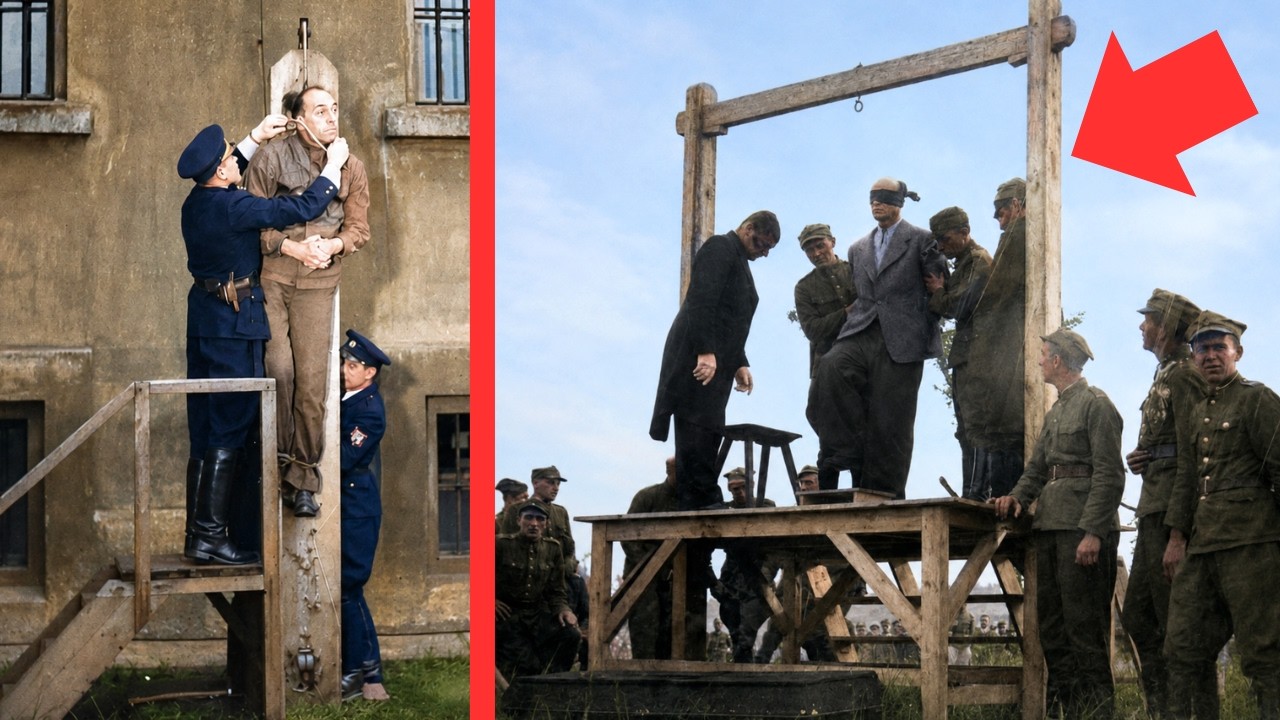
His corpse was cremated in a specially built oven, and his ashes were scattered beyond Israeli territorial waters so that they would not defile the holy land. Other Nazi leaders faced death by methods that carried their own meaning. In July 1946, Arthur Greiser, the Gauleiter of Reichsgau Posen, was hanged in Poznan before a crowd of around fifteen thousand people. As the local ruler of the incorporated Polish lands, he had overseen the gassing of patients from mental hospitals, the murder of roughly one hundred fifty thousand Jews between autumn 1941 and April 1942, and the sending of seventeen hundred Polish priests to Dachau.
He had once said that the Germans must altogether become a master race. He was convicted of murder, torture, persecution, the destruction of Polish culture, and the slaughter in the ghettos. On a sunny morning he was taken to the Citadel, a fortress reduced to rubble by bombing, and mounted the gallows blindfolded and dressed in a suit. He did not ask for forgiveness and showed no emotion.
After he was pronounced dead, the executioner threw away his white gloves in disgust. Kurt Daluege, the former chief of the Order Police, was executed at Pankrác Prison in Prague on October 24, 1946, before thousands of witnesses. He was not hanged on a traditional gallows but was pole hanged, a short-drop method from the Austro-Hungarian Empire. His rope was passed through a pulley, he was hoisted to the top of a three-meter post, and when the chest sling was released, he strangled slowly in front of the crowd.
He and Karl Hermann Frank had been responsible for the destruction of the villages of Lidice and Ležáky after the assassination of Reinhard Heydrich, where all the men were shot, the women sent to concentration camps, and children deemed unfit for Germanization were killed. Daluege showed no remorse, said he had a clear conscience, and claimed he was beloved by three million policemen. The Czechs used pole hanging deliberately. It was their traditional method, distinct from the German fallbeil guillotine used during the occupation, and it stripped the condemned of any claim to honorable military death, marking them simply as criminals.
Karl Hermann Frank, Daluege’s deputy, was publicly pole hanged at the same prison on May 22, 1946, after being convicted of war crimes and crimes against humanity. Five thousand people came to watch the man who had terrorized the Czech lands die slowly on the execution post. No one mourned him. By the time the last of these executions was carried out, the world had witnessed Nazi leaders hanged, strangled, and gassed in the camps they had built.
Some died quickly, some suffered for many minutes, and some, like Kaltenbrunner, continued to protest their innocence until the black hood was placed over their heads. The gallows built for Rudolf Höss still stand at Auschwitz, and the ashes of Adolf Eichmann were scattered at sea. The courts of the victorious nations and the newly liberated states had rejected the defense of following orders, and the men who had organized the slaughter paid for it with their lives.