On 1 September 1939, Hitler ordered the invasion of Poland. Six years later, with Hitler dead, General Alfred Jodl signed the unconditional surrender of Germany to the Allies on 8 May 1945. The war in Europe was over, and what remained of Germany was a shattered country whose cities had been reduced to rubble, whose population was exhausted, and whose political future was about to be decided by foreign powers. For years, Allied bombers had devastated German cities from the air.
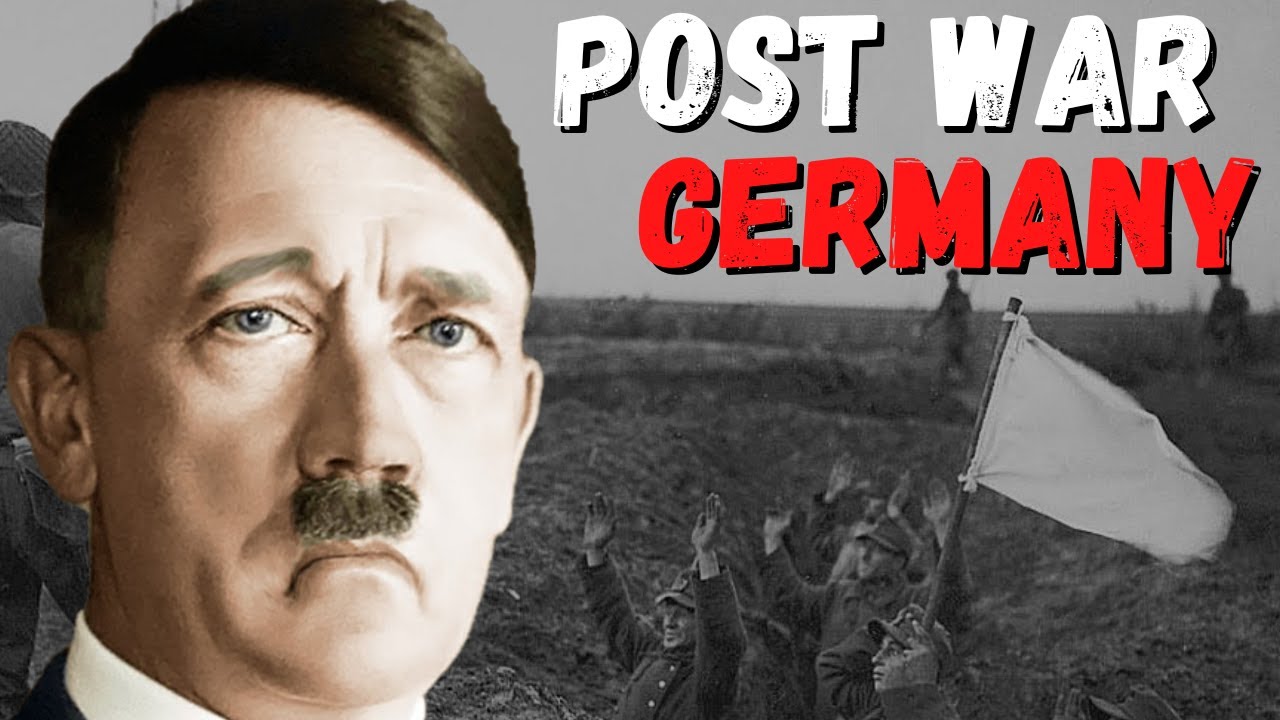
When ground troops pushed into the country in 1945, they found bomb-ravaged towns and then fought through them in street battles against German forces determined to hold out. Hitler’s policy of no surrender and fighting to the last man meant that even the ruins left by bombing were flattened still further in these final desperate engagements. The Soviet advance on Berlin turned the capital into a wasteland of rubble, burnt-out vehicles, and the dead. It was a terrible place for the soldiers who fought through it and for the civilians trapped there with nowhere to go.
The scale of human destruction was immense. Millions of German civilians were left homeless. A large part of the male population had been killed in the war, leaving many women and children without income and without support, sinking into poverty. Hundreds of thousands of German soldiers were held in prisoner-of-war camps across Europe and the Soviet Union.
A painstaking investigation followed, in which thousands of civilians and soldiers were interviewed in order to identify those responsible for war crimes and the Holocaust. For some men, the return home took years; in many cases in the Soviet Union, German soldiers were not repatriated for more than a decade. Most of the principal perpetrators of Nazi crimes were eventually captured. Between 1945 and 1946, the Nuremberg trials prosecuted the leading officials of the Nazi regime, including Hermann Goering and Albert Speer.
Most of those convicted received either life imprisonment or the death sentence. The fate of Germany itself had already been determined months before the surrender. At the Yalta Conference in early 1945, the leaders of Britain, the United States, and the Soviet Union agreed on a post-war plan. Germany would give back all the territory it had occupied during the war.
Its pre-war borders would be divided into four main sectors of occupation: France would administer the southwest, Britain the northwest, the Soviet Union the northeast, and the United States the southeast. Berlin, although now located deep inside the Soviet sector, was itself divided into four sections controlled by the same four powers. Each occupying country was responsible for what happened within its own zone. Berlin became the focal point of post-war tension.
It was there that the Allied powers repeatedly came into conflict over the future of Germany and of Europe. Germany was also forced to pay reparations to Britain, France, and the Soviet Union, largely in the form of dismantled factories, coal, and forced labor. Britain and the United States additionally obtained intellectual reparations, taking scientific technology and patents developed during Nazi rule. The Allies agreed that it was mostly up to the German people themselves to rebuild their country.
They were made responsible for dismantling factories, with the goal of returning Germany to its pre-war industrial level. As tensions between the Soviet Union and the Western Allies grew, the Cold War began. The Soviets sealed off their German-held territories from the Western powers. By 1961, around one thousand East Germans were leaving every day.
Among them were skilled laborers, professionals, and intellectuals. To stop this flow, the Berlin Wall was constructed, trapping the people of East Berlin behind it and separating the city in two. Germany itself would not be remilitarized until many years later. When East Germany began building its own army, the National People’s Army, it looked for men who could serve in it.
The government also needed border troops to prevent civilians from fleeing west, and it recruited thousands of former Wehrmacht and Waffen-SS soldiers held in Soviet gulag prisons. West Germany followed a similar path, recruiting former Wehrmacht soldiers into its new army, the Bundeswehr. There was no shortage of weapons and equipment left over from the war to supply these new forces. Rebuilding Germany took many years and was severely hindered by Cold War divisions and Soviet influence over the eastern sectors.
In 1989, however, Soviet influence fell away and the Berlin Wall was torn down. From the ruins of the war and the divisions that followed, a more modern and progressive Germany emerged, becoming the country known today.