On the morning of May 4, 1945, an SS detachment arrived at the Berghof, Adolf Hitler’s mountain retreat high in the Bavarian Alps. Following orders from Hitler himself, the men looted what they could, doused the building in gasoline, and set it ablaze. By the time American soldiers of the Seventh Infantry Regiment reached the Obersalzberg that afternoon, the villa was engulfed in flames, and the troops could only watch as the showcase of Nazi Germany burned before their eyes. For nearly a decade, the Berghof had served as Hitler’s secondary seat of power, a place where major decisions about war, persecution, and genocide were discussed and finalized.
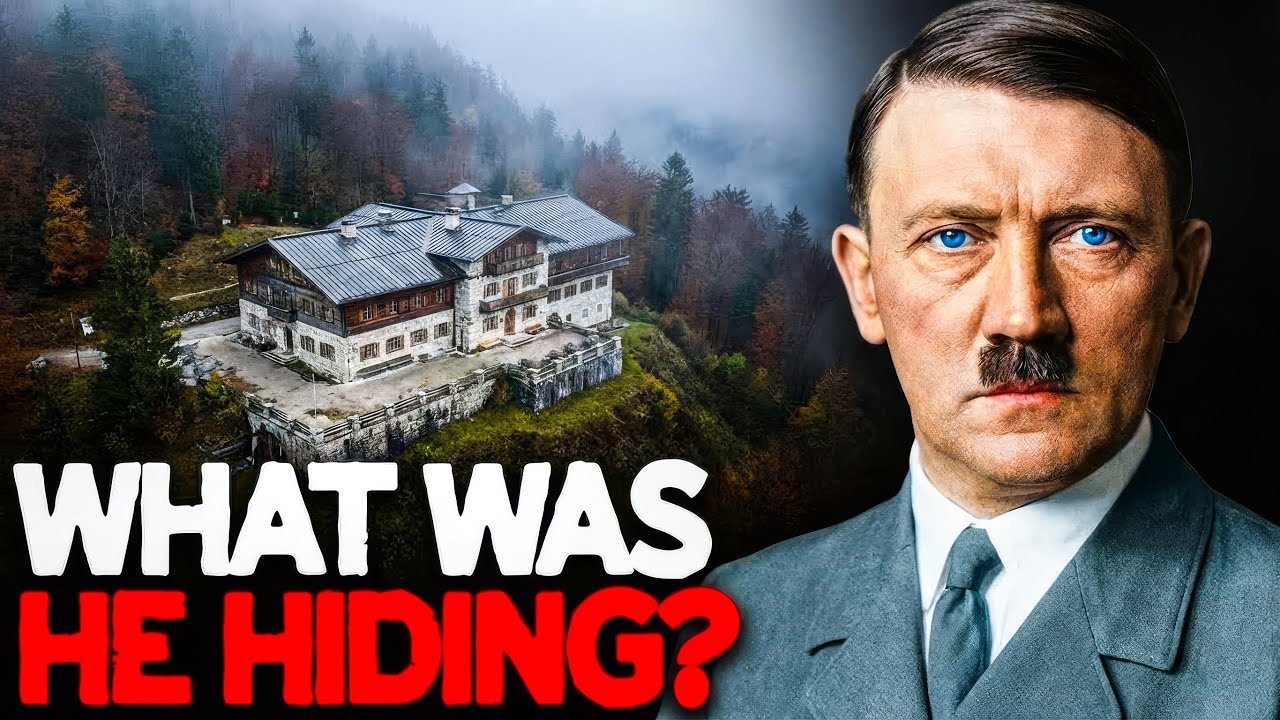
Its image had been carefully crafted through propaganda: the Führer greeting children, walking his dog, entertaining foreign dignitaries against a panorama of Alpine grandeur. British Prime Minister Neville Chamberlain had climbed its famous steps in September 1938 during the negotiations that led to the Munich Agreement. Benito Mussolini and the Duke and Duchess of Windsor had been entertained there. Many visitors left convinced they had met a reasonable man with whom business could be done.
The story of the Berghof began long before Hitler. Around 1916 or 1917, a merchant named Otto Winter built a modest vacation chalet on the Obersalzberg above the market town of Berchtesgaden, calling it Haus Wachenfeld. Hitler first came to the area in 1923, visiting his political mentor Dietrich Eckart under the alias Herr Wolf. After the failed Beer Hall Putsch later that year and his imprisonment at Landsberg, he returned in 1926 and stayed near the Platterhof boarding house, where he dictated the second volume of Mein Kampf.
In 1928 he rented Haus Wachenfeld; by 1933, now Chancellor of Germany with the royalties from Mein Kampf flooding in, he bought the property outright for 40,000 Reichsmarks and began planning renovations. Under the supervision of Martin Bormann, the modest chalet was transformed between 1935 and 1936 into a sprawling villa complex renamed the Berghof, meaning “mountain court. ” Its most famous feature was a massive picture window, nine meters wide and four meters high, which could be lowered mechanically into the wall to provide an unobstructed view of the Untersberg mountain and the Austrian Alps beyond. The great hall was dominated by a red marble fireplace, the dining room paneled in costly pine, and songbirds sang in most rooms.
A hidden projection booth allowed evening screenings of films, including Hollywood productions otherwise banned in Germany. Eva Braun, Hitler’s long-term companion, lived there from 1936 onward, kept secret from the German public and confined to Hitler’s inner circle. The transformation of the Obersalzberg went far beyond the villa itself. Bormann orchestrated the acquisition of surrounding properties, and by 1935 and 1936 all residents had been bought out or forcibly evicted.
Those who resisted found themselves in Dachau until they agreed to sell. In place of the old farmhouses and guesthouses, a mini-city rose for the Nazi elite: Göring built a house nearby, as did Albert Speer. SS barracks went up, and the entire area became a restricted zone patrolled by heavily armed guards. Perhaps the most dramatic addition was the Kehlsteinhaus, perched on a rocky promontory some 1,800 meters above sea level.
Built between 1937 and 1938 at a cost of 30 million Reichsmarks, it required 3,000 men laboring for two years to blast a road through the mountain and carve a 124-meter tunnel lined with marble. Hitler visited it only rarely, disliking the thin air and the vertiginous views, but it became known in the English-speaking world as the Eagle’s Nest. From the mid-1930s through the war years, Hitler spent more time at the Berghof than anywhere else except his East Prussian headquarters during the invasion of the Soviet Union. He spent most of early 1944 there before departing on July 14, 1944, never to return.
With the outbreak of war, extensive defenses had been installed: anti-aircraft batteries dotted the mountainside, and smoke-generating machines could shroud the complex in artificial fog. Beginning in 1943, workers excavated some 6,000 meters of tunnels, chambers, and passages beneath the Berghof and surrounding buildings, creating a subterranean command center complete with offices, living quarters, and even a luxury hotel section. The Allies had considered attacking the Obersalzberg earlier in the war. In June 1944, intelligence confirmed that Hitler was directing the resistance to the Normandy landings from the Berghof.
The Royal Air Force developed a plan designated Operation Hellbound, but General Hap Arnold, head of the United States Army Air Forces, decided against the attack. He reasoned that it was unlikely Hitler would be killed, and even if he were, his inept leadership was actually working to the Allies’ advantage. In April 1945, however, the situation had changed. The Supreme Headquarters Allied Expeditionary Force became concerned about reports suggesting that senior German officials and Waffen SS units would assemble at Berchtesgaden to prolong the fighting from a so-called Alpine Fortress.
This was largely an intelligence failure; the Germans had made few real preparations for such a last stand. But the fear was real enough to prompt action. On April 25, 1945, just five days before Hitler would take his own life in Berlin, a massive force of 305 Lancaster heavy bombers took off from bases in Britain, joined by 16 Mosquito Pathfinder aircraft. Over 1,400 long tons of bombs were released, including four 12,000-pound Tallboy bombs designed to penetrate deep into the earth.
The SS barracks, the primary target, were severely damaged. Göring’s house was destroyed, and so was Bormann’s residence. But the results were mixed when it came to the main objectives. The Kehlsteinhaus emerged completely unscathed, and the Berghof itself was only moderately damaged by three bombs.
Its reinforced construction and lower position had protected it from the worst of the bombardment. Two Lancasters were shot down, with four airmen killed. On the ground, 31 Germans were killed, mostly workers and support staff who had remained despite the deteriorating situation. Photographs taken on April 26 show the Berghof still standing, damaged but largely intact.
This proved to be only a temporary reprieve. After the SS set the fire that burned it to a shell, the race to reach Berchtesgaden had already begun among Allied forces. Three units of the US Seventh Army were competing to capture the prize: the 101st Airborne Division, the French Second Armored Division under General Leclerc, and the US Third Infantry Division. To the average GI, Berchtesgaden represented the juiciest looting opportunity in all of Europe, an area known to be filled with Nazi plunder, gold, jewelry, cash, luxury cars, artwork, and the finest wines in the world.
The Seventh Infantry Regiment of the Third Infantry Division arrived at approximately 4:00 in the afternoon on May 4, taking Berchtesgaden without firing a shot. Major General “Iron Mike” O’Daniel personally ordered his men to seize the only standing bridge over the Saalach River, and when Leclerc arrived, he was turned away on O’Daniel’s express orders. When the regiment reached the Obersalzberg, they found the Berghof violently burning. Soldiers were reported to be very disappointed, as the fire stopped them from taking any trophy items.
The French arrived later that evening and participated in a flag-raising ceremony with the Americans the following morning. The 101st Airborne arrived last on May 5 and was assigned to relieve the Third Infantry Division. What followed was looting on a scale unmatched anywhere else in occupied Germany. Soldiers recovered silverware and personal effects that had survived the flames.
They found Hitler’s black touring Mercedes and Eva Braun’s black Mercedes coupé still intact in the garage and drove them around the countryside for days. The Eagle’s Nest, which had escaped the bombing entirely, proved an even greater treasure trove. The French made the climb first and discovered a wine cellar containing an estimated half million bottles of the finest wine, champagne, and cognac imaginable, including thousands of bottles of Château Lafite Rothschild. They brought up medics with stretchers to carry cases down the mountain and even emptied water from their canteens to fill them with wine.
Major Dick Winters of the 506th Parachute Infantry Regiment later recalled discovering Göring’s wine cellar at the Reichsmarschall’s residence, which contained another 16,000 bottles; the Americans loaded six trucks with booze before being ordered back to Austria. Göring, who had survived the air raid in his bomb shelter, was taken prisoner by the US Army on May 9, 1945. He would later face trial at Nuremberg and commit suicide hours before his scheduled execution. The American military established a recreation center on the Obersalzberg that would remain for 50 years.
The Platterhof was converted into the General Walker Hotel for American troops, and Bormann’s farm was transformed into a golf course. The burned shell of the Berghof remained standing through the late 1940s and into the early 1950s, becoming an unexpected tourist attraction and drawing neo-Nazi pilgrimages who treated the site as a shrine. After negotiations with the American occupation authorities, the state of Bavaria received control of part of the Obersalzberg in 1951, on the condition that the ruins of the Berghof and Göring’s house would be demolished. On April 30, 1952, exactly seven years to the day after Hitler took his own life in his Berlin bunker, the Bavarian government destroyed the remains of the Berghof with explosives.
The houses of Göring and Bormann, the SS barracks, and Hitler’s tea house were all reduced to rubble. In total, more than 50 Nazi buildings were destroyed, leaving nothing for future generations to venerate. The Eagle’s Nest survived, its position high on the mountain saving it from both the bombing and the demolition campaign. For decades, a kind of deliberate amnesia settled over the Obersalzberg.
The Bavarian authorities had no interest in discussing what had happened there, and the American military presence continued with minimal acknowledgement of the site’s history. The strategy of demolition and silence worked, but it could not last forever. The withdrawal of US forces in 1995 forced a reckoning. The Bavarian state government could no longer avoid addressing the area’s heritage.
The Dokumentation Zentrum Obersalzberg, or Obersalzberg Documentation Center, opened in 1999. It provides historical information about the use of the mountainside retreat by Nazi leaders and extends through a tunnel to portions of the original bunker complex. Visitors can walk through the underground passages that workers excavated between 1943 and 1945. After considerable expansion, the museum reopened in 2023 with a completely new permanent exhibition titled “Idyll and Atrocity,” a title that captures the central paradox of the Obersalzberg: how the idyllic mountain residence contrasted with the horrors ordered from there.
Some 350 objects, documents, photographs, and multimedia elements explain the history and tell the stories of those who fell victim to the Nazis. The exhibition ends in a documentation of the Holocaust, presented in the darkness of the underground passages built to protect those who ordered it. Today, visitors can follow a path from the documentation center to the site where the Berghof once stood. The walk takes about ten minutes through trees that have grown up over the intervening decades.
All that remains of Hitler’s mountain retreat is the concrete retaining wall built to stabilize the slope, now overgrown with vegetation. The foundations of the back of the building are barely visible beneath the forest floor. The Eagle’s Nest remains open seasonally as a restaurant and tourist attraction, one of the most popular destinations in Bavaria. The documentation center now attracts more than a million visitors and serves as a model for how former sites of Nazi power can be transformed into places of education and remembrance.
Where the Berghof once stood, only forest grows. What was once the regime’s showcase has become a place of reckoning with the horrors it concealed.