At the estate outside Saint Louis, a cannon fired each time the master of the house returned from a journey. Adolphus Busch carried business cards that read simply, “Adolphus Busch, Your Friend. ” He traveled in a private railroad car, built his own glass factories, owned his own coal mines, and shipped beer across the continent in a fleet of refrigerator cars he designed himself. When he died in 1913, six thousand of his employees marched in his funeral procession, and twenty-five delivery trucks were needed to carry the flowers.
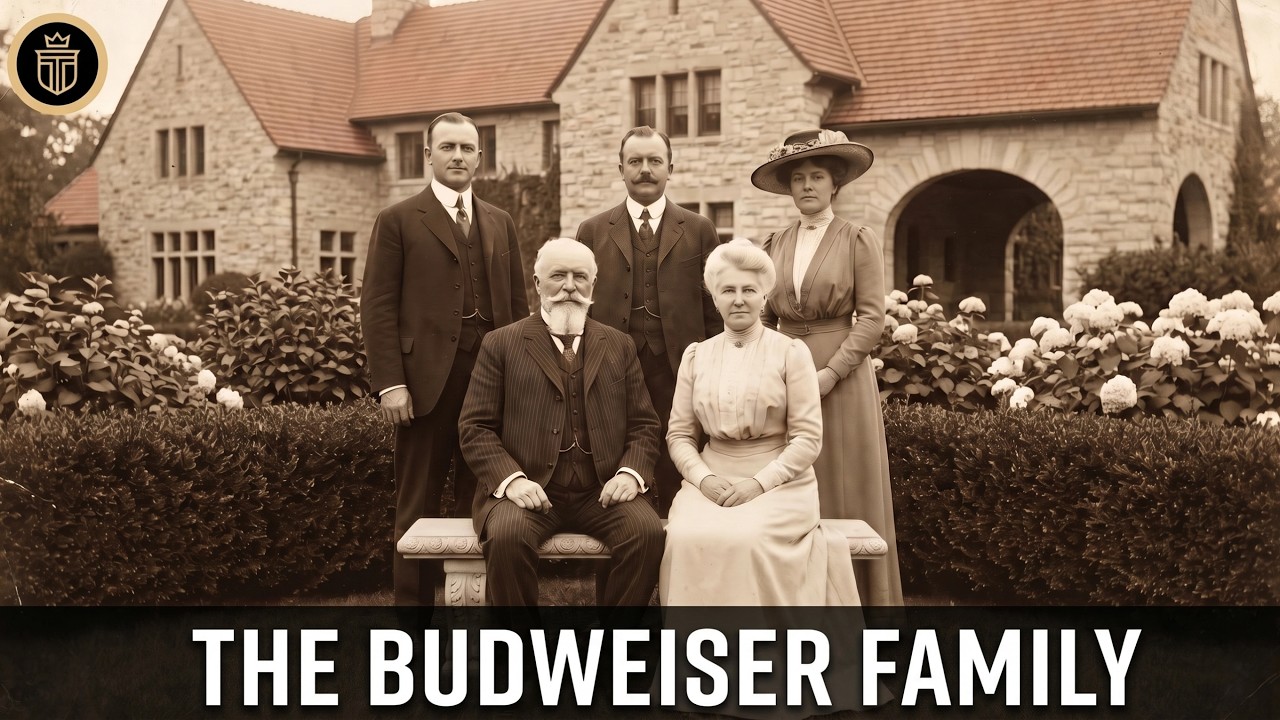
The estate he left was the largest ever probated in Missouri. Ninety-five years later, in the summer of 2008, the American company he built was sold to a Belgian conglomerate run by Brazilians for fifty-two billion dollars, and a city grieved as if it had lost a family member. Between those two moments lies the story of a suicide, fatal car accidents, palace coups, missing blood samples, and a grandson who stood before his employees and promised the company would not be sold on his watch. This is the story of the Anheuser-Busch dynasty.
Adolphus Busch was born on July 10, 1839, in the town of Kastel on the Rhine near Mainz in the Grand Duchy of Hesse. He was the second-youngest of twenty-one children of Ulrich Busch and his second wife, Barbara Pfeiffer. His father was a prosperous wholesale merchant in wine and brewery supplies, a landowner and innkeeper with a sharp commercial instinct. In a family that size, the inheritance would naturally be divided, and younger sons were expected to make their own way.
What set Adolphus apart was the education his father provided. He attended secondary school in Mainz, the academy in Darmstadt, and the Belgian university institute in Brussels, where he trained in languages, accounting, and commercial logic. Before leaving Germany, he trained in his father’s brewery-supply firm and worked in a trading house in Cologne. He arrived in America having absorbed, almost automatically, the entire vocabulary of the brewery-supply trade, knowing the names of equipment, the language of suppliers, and profit margins on materials, without ever having brewed a single barrel of beer himself.
In 1857, at eighteen, he sailed from Germany with three older brothers. They crossed the Atlantic and landed not in New York but in New Orleans, then headed north on the Mississippi to a city chosen with care. Saint Louis in the 1850s was the most German of American cities, where German was spoken on the streets, German newspapers flourished, and the demand for German beer was insatiable. The city also had natural advantages for brewing: the cold, pure water of the Mississippi and ice harvested from limestone caves used to store beer.
Adolphus arrived with modest means but found work as a clerk along the Saint Louis riverfront, where brewery supplies were unloaded daily, and spent two years building relationships and learning the local market. When his father died and he inherited a modest sum from Germany, he quickly founded his own brewery-supply company, initially in partnership with a man named Ernst Feinberg, then with his brother Ulrich. One of his early major clients was another German immigrant, Eberhard Anheuser, who was struggling to make a failing brewery on Pestalozzi Street succeed. Anheuser was not a brewer but a successful soap and candle manufacturer from Kron who had immigrated to Saint Louis in 1843 and amassed a fortune in cleaning supplies.
He entered the beer world by accident, having extended credit to a financially troubled Bavarian brewery and finding himself, when the brewery defaulted, the owner of a brewery against his will. He renamed it “Anheuser and Company” in 1860 and ran it with the efficiency of a businessman rather than the passion of a brewer. On March 7, 1861, a wedding changed the course of American business history in ways none present could have predicted. Two brothers married two sisters.
Adolphus Busch married Lily Anheuser, the daughter of one of his clients, a woman he had come to know through the supply trade. On the same day, at the same ceremony, his brother Ulrich married Anna Anheuser, Lily’s older sister. It was a double wedding that joined two families at the altar before joining them at the boardroom table. In that same year, the American Civil War broke out, and Adolphus, despite his recent arrival and German origins, joined the Union Army and served as a corporal before being discharged.
It was a declaration of allegiance more than a military campaign, a gesture announcing that this man had chosen America. When the war ended, he returned to his father-in-law’s brewery, not merely as a supplier but as a family partner. In 1864, he joined the company formally as a salesman. He was twenty-five, married to the brewery owner’s daughter, and now drawing a salary from the very company he had once supplied.
Within a few years, he would subject the brewery to his ambitions, restructure its operations, and begin a transformation that would make Eberhard Anheuser’s name a mere footnote in the empire of the man who married his daughter. The salesman quickly became a strategist, and the strategist decided the brewery’s beer was not good enough for the empire he intended to build. In 1876, Adolphus and his friend Carl Conrad, a German-born wine and spirits importer of refined taste, made a research trip to Bohemia in the Austro-Hungarian Empire. They visited the city of Budweis, now known as České Budějovice in the Czech Republic, where brewing had been practiced since at least 1265 and where the local beer was celebrated as the beer of kings.
The beer was light, clear, and effervescent, entirely different from the heavy dark lagers produced by most American breweries. Busch and Conrad recognized its appeal immediately. They created their own recipe, a light, filtered beer made from a blend of barley malt and rice added for a refreshing taste. Conrad registered the “Budweiser Lager” trademark with the U.
S. Patent Office in 1878. Conrad held the trademark while the Anheuser brewery produced the product, an arrangement that lasted until Conrad went bankrupt in 1883, when Adolphus acquired the trademark outright. By 1891, the Anheuser-Busch brewery owned the Budweiser name in America permanently, a position the company defended in courts for the next century and a half.
A Czech dispute over the name continued throughout that period, as Bohemian brewers rightly argued they had used the word “Budweiser” for six hundred years before Carl Conrad tasted a drop of their lager. But in the American market, the trademark was secured. The slogan Busch later adopted, “The King of Beers,” was itself a clever inversion of what Czech brewers had called their product for centuries, “the beer of kings. ” He took their heritage, inverted their slogan, and built one of the most recognizable brand identities in human history.
But marketing genius without a way to deliver the beer was merely a clever idea. The brewing industry in the mid-nineteenth century faced a purely physical problem: without refrigeration, beer could travel only a few dozen miles before becoming undrinkable. Every regional brewery was, by necessity, a local brewery. Adolphus Busch decided to solve this transportation problem so radically that geography itself would become irrelevant.
His first decisive step came in 1872 when he became one of the first American brewers to apply Louis Pasteur’s newly published theory of pasteurization to beer production. By heating finished beer to a precise temperature sufficient to kill spoilage organisms without affecting flavor, Busch gave Budweiser a shelf life no other beer possessed. It could be bottled, crated, and shipped hundreds of miles without spoiling. The second decisive step was refrigerated transport.
In 1877, Anheuser-Busch began shipping beer by rail. A year later, realizing he could not depend on third-party railroad equipment, Busch founded the Saint Louis Refrigerator Car Company and built his own fleet. By the early 1880s, he owned roughly 250 refrigerated cars, insulated wagons with ice compartments at each end, serviced through a network of ice stations spaced at regular intervals along the rail lines of the Midwest and East. Then he began expanding into every supporting industry his empire needed.
Rather than buying bottles at market prices, he built his own glass factories, which became significant regional industrial institutions in their own right. He built ice plants next to the glass factories. He acquired coal mines in Illinois and rail lines to connect them directly to the brewery’s boilers. He created his own bottling plant, controlling the packaging process.
The brewery complex stretched along the Saint Louis riverfront covering seventy acres, a city within a city, generating its own electricity, ice, and glass, operating its own rail network, all in service of shipping beer to every corner of the continent. This model of the dominant industrial conglomerate with a vertically integrated supply chain was being applied simultaneously by his contemporaries Andrew Carnegie in steel and John D. Rockefeller in oil. Adolphus Busch was not a brewer who became a businessman; he was a businessman who chose beer as his vehicle.
By the turn of the twentieth century, the brewery was producing more than a million barrels of beer annually, the first brewery in American history to exceed that number. Its refrigerated distribution network reached every state in the Union. Budweiser was no longer a local Saint Louis beer but an American one, the first true national brand in the history of the industry. The man who built it understood that the next challenge was not increasing production but maintaining its position.
He built relationships with distributors, politicians, and competitors with the same intensity he devoted to his supply chain. He carried business cards reading “Adolphus Busch, Your Friend” and meant the recipient to feel his sincerity. He entertained the personal representative of Kaiser Wilhelm II at social events as an equal. He funded a building at Harvard University known today as the Busch-Reisinger Museum, a cultural diplomatic gesture from the German immigrant who had become America’s beer king.
With his wife Lily, he built Villa Lilly, a 39-hectare estate in the hills above Bad Schwalbach in Hesse, not far from where he had grown up, where they spent summers with their thirteen children. He named his greatest property after her, just as he named his finest beer after a city he had visited, seeking to ease immigrants’ homesickness. Both names reflected a man who understood that loyalty, sentiment, and identity mattered as much as refrigeration and pasteurization in building a commercial empire. By the summer of 1913, Adolphus Busch’s health was failing.
The dropsy that had afflicted him for years had worsened, along with heart disease, yet he continued to travel and manage his affairs. He spent his final months at Villa Lilly, in the country he had left fifty-six years earlier. He died there on October 10, 1913, at seventy-four. His body was embalmed at the villa, and a persistent local legend holds that his heart was left in the German soil he loved.
His coffin was brought to America in 1915 for burial in Saint Louis. The obituaries were sweeping. The German Kaiser sent his personal representative to pay respects. The President of the United States sent condolences.
Six thousand Anheuser-Busch employees marched in a solemn parade through the streets of Saint Louis. Twenty-five trucks were used to carry the flower arrangements. The estate was valued at more than fifty million dollars, the largest ever recorded in Missouri at a time when a factory worker’s annual income was less than five hundred dollars. The inheritance fell to his son, August Sr.
, a capable man, but the business he inherited was about to be tested in ways his father, for all his predictive talent, had not anticipated. He left behind a problem his heirs could not have predicted: a firmly and publicly German identity about to collide with the worst possible moment in American politics. In 1912, at the cornerstone ceremony for Adolphus Busch Hall at Harvard, the Germanic cultural museum he funded as a monument to German-American friendship, Adolphus declared before assembled dignitaries that the friendship would last forever at the expense of rivalry between Germany and the United States. The building was barely complete when America entered World War I in 1917, turning the gift from a cultural symbol into a symbol of divided loyalties.
Harvard officials found themselves in an awkward position, as the most important German cultural facility on their campus became a symbol of everything the nation now distrusted. The Busch family and the broader German-American brewing industry faced suspicion, surveillance, and social ostracism during the war years. August Busch Sr. , who inherited the company after his father’s death, weathered the war years by buying Liberty Bonds and maintaining an unequivocally public loyalty to the American war effort.
The family quietly displaced its German connections and survived the crisis. But the years of suspicion left behind a buried thread of German ancestry that no one spoke of and no one could entirely erase. Then came a second crisis, more existential for the company itself. In January 1919, Congress ratified the Eighteenth Amendment, and the country that had drunk Adolphus Busch’s beer for fifty years prohibited its production outright.
While competitors collapsed or disappeared during Prohibition, August Sr. refused to follow them. The Lemp Brewery of Saint Louis, once Anheuser-Busch’s strongest rival, closed its doors. August is said to have told his employees, “We’ll make shoelaces if necessary, but I’ll never close this brewery.
” That stubbornness proved wise. Anheuser-Busch adapted with remarkable speed and scale, launching Bevo, a near-beer grain beverage that became the most popular of its kind, selling over five million cases annually at its peak. The company diversified into baker’s yeast, which ultimately saved it financially, and produced malt syrup marketed for home baking, widely understood as a shortcut for home brewing. The company also expanded into ice cream, soft drinks, corn products, truck bodies, refrigerator cabinets, and even an early camping trailer.
Between 1920 and 1927, more than twenty-six new products were introduced to keep the company running. Baker’s yeast production in particular proved a spectacular success, generating substantial profits during Prohibition. By the early 1930s, August Sr. could argue that Anheuser-Busch was no longer a brewery at all but a diversified consumer products company with enormous unused fermentation tanks in Saint Louis.
When Prohibition ended on April 7, 1933, Anheuser-Busch was ready. The equipment had been maintained, the distribution network preserved, and the workforce kept intact. The day after repeal, more than 3,500 barrels of beer left the Saint Louis plant. A red horse-drawn delivery wagon rolled through the city streets, and a case of Budweiser was sent to President Roosevelt at the White House.
The horses were the first Budweiser Clydesdales, a gift from August’s sons to the company as a surprise on the day beer became legal again. The old man wept when he saw them. But August Sr. did not live to see the full fruits of his perseverance.
After years of heart disease, gout, and dropsy, exhausted by the constant pressure of leading the company through its darkest period, he took his own life on February 13, 1934, at Grant’s Farm, the family estate outside Saint Louis. He was sixty-eight. The New York Times reported the news the next morning under the headline “August Busch Ends His Life With Pistol. ” Saint Louis police noted, with grim expertise, that many German-American brewers had committed suicide in the years following Prohibition, so many that they gave the phenomenon a dark term: “the Dutch act.
” It was an unkind term but a real one, describing the despair that settled over a generation of immigrant entrepreneurs who had built their empires precisely on a product their new country had criminalized. The Clydesdales, given to him just one year earlier to celebrate his survival, became by the end of the year the legacy of a man who had survived everything except survival itself. The throne now passed to his son Gussie, who would run the company for the next four decades. He inherited a brewery and the memory of two men: the immigrant grandfather who built the empire, and the father who refused to close it during the dry years and paid for that refusal with his life.
Gussie would make the company the leading American brewery of the postwar generation. He would own the Saint Louis Cardinals and become one of the most beloved figures in the city. But when the question of succession arrived, he found himself ousted by his eldest son in a campaign of the kind the Busch family had quietly perfected. That eldest son was heading for power.
In 1937, three years after Gussie took control, his first wife gave birth to a boy whose name would be whispered in the corridors of Anheuser-Busch with something like awe: August Busch III. Born June 16, 1937, he was nicknamed “Three Sticks” among employees, a sardonic reference to the Roman numeral after his name and to a man who issued orders rather than receiving them. He was unlike his father in temperament: where Gussie was warm and outgoing, August III was cold, precise, and intensely private, a man who ran the brewery the way a general runs a military campaign. He began his career on the plant floor, starting as a unionized worker in the brewing department before moving into marketing.
He became a vice president of beer marketing in 1963 and was elected to the board at twenty-five. By 1974, at thirty-seven, he had spent eighteen years in the company and commanded respect and fear from the board. The corporate and personal crises that paved the way for a palace coup that year converged with grim efficiency. Financially, Anheuser-Busch’s first-quarter profits dropped sharply to $12.
5 million from $18. 5 million the previous year, a 31% decline that alarmed shareholders and gave board members grounds to question Gussie’s continued effectiveness. The company’s market share hovered around 23%, well below what critics believed it could achieve. Company president Richard Meyer resigned that year in a public dispute.
Then, in the fall of 1974, the incident occurred that broke Gussie’s will entirely. His youngest daughter, eight-year-old Christina, was returning from school in the family car driven by a chauffeur when it was involved in a horrific eight-car collision. Christina and the driver were killed. Another son survived.
Gussie was seventy-five, and the death of his youngest daughter devastated him in a way acquaintances said he never fully recovered from. In the months following Christina’s funeral, August III began a deliberate campaign against his father. The means was a strategic dispute of Gussie’s own making: exhausted and grieving, the old man began seriously considering selling Anheuser-Busch entirely to R. J.
Reynolds, the tobacco and consumer goods giant. August III was horrified. He spent months quietly cultivating board members and managing the public image of his elderly father’s decline. In May 1975, the board of directors voted.
The official statement indicated that August “Gussie” Busch Jr. , seventy-six, had handed over the chief executive role to his son, thirty-eight. The public narrative was that his departure was voluntary, a gracious exit by a father choosing his moment. The truth, revealed only after Gussie’s death in 1989, was the opposite.
He had been forced out in an internal campaign engineered by his son. August III’s management of Anheuser-Busch over the next twenty-seven years was, by industry standards, nearly masterful. He inherited a company controlling 23% of the American beer market and left it in 2002 with 49%, the dominant position in the largest beer market in the world. Annual profits rose from $85 million in 1975 to $1.
71 billion in fiscal year 2001, a twenty-fold increase. He launched Bud Light, a product initially resisted internally as an unnecessary dilution of the flagship brand, which eventually surpassed Budweiser itself to become the best-selling beer in the United States. He invested in Grupo Modelo, the maker of Corona, and acquired a 27% stake in Tsingtao, China’s largest brewery. Through licensing agreements alone, he expanded the Anheuser-Busch brand into markets the company had never reached without the capital risk of building physical infrastructure abroad.
But what his subordinates would remember was not the strategic vision but his temperament. His management style was synonymous with intimidation. He was described by those who worked under him as intensely detail-oriented, frugal to the point of asceticism, and capable of displaying coldness toward subordinates for calculated effect. He had an assistant who was said to keep a notebook of his daily preferences, what he ate, the temperature he preferred in rooms, how he took his coffee, because deviating from these preferences was considered a source of danger rather than mere annoyance.
A piece of gum on the sidewalk or a cracked board in a planter was, in his words, a major sin. This created a culture of extreme financial caution and, simultaneously, deep resentment among the executive class who felt constantly monitored. The question of succession became the final drama of his tenure. The natural answer, by family tradition, was his son.
But the relationship between August III and his son August IV repeated with astonishing precision the dynamic August III had practiced with Gussie, reversed in its emotional context. Where the father had been coldly ambitious and active in removing his own father, the son was passive, seeking approval, perpetually uncertain whether he would ever measure up to what Three Sticks demanded. August III deliberately kept his son’s succession ambiguous, refusing to name him heir, insisting the board decide on merit, and conducting public evaluations of his son’s performance in ways humiliating to a grown man. When the transition finally came through a two-stage process, with outside executive Patrick Stokes appointed CEO in 2002 to bridge generations before August IV was promoted in 2006, the emotional reality was of an heir who had spent his entire adult life trying to win confirmation of his worth, confirmation his father was not inclined to grant simply.
August Anheuser Busch IV was born in 1964, son of August III and his first wife Susan. Family legend held that the first liquid to touch his lips was Budweiser, offered to him at ten hours old as a ritual inheritance, the same way his father had been initiated. On the night of November 13, 1983, eighteen-year-old August Busch IV was drinking in Tucson, Arizona, where he was a freshman at the University of Arizona. He spent part of the evening at a nightclub with Michele Frederick, twenty-two, another University of Arizona student who worked as a waitress.
The two left together in his black Chevrolet Corvette. What happened in the next hour remains disputed. What is not disputed is what investigators found on River Road, in an area Tucson residents called “Dead Man’s Curve” for its poor safety record. The Corvette left the road, became airborne, rolled over, and ejected its passenger.
Michele Frederick was thrown from the car with tremendous force and died at the scene from severe head and chest injuries. Inside the Corvette, deputies found Busch’s wallet, a jacket, and a registered pistol. August IV was not at the scene. Deputies tracked him to his Tucson home, finding him half-naked, with dried blood on his chest and a sheet wrapped around his waist, in a state described as severe mental confusion.
He claimed memory loss about the night’s events. He was treated at a hospital where a skull fracture was documented. Blood and urine samples collected at the hospital, the crucial evidence that would have proven whether Busch was legally drunk, were later described as lost under mysterious circumstances. This chain-of-custody failure deprived prosecutors of the biological evidence needed to prove intoxication beyond doubt.
In July 1984, after eight months of investigation, the Pima County Sheriff’s Office announced the case was closed for insufficient evidence to charge vehicular manslaughter. The family had sent its legal team. Tucson residents noted the closure with suspicion, like a community watching a prominent figure receive treatment unavailable to the ordinary citizen. No criminal charges were ever brought against August Busch IV.
He returned to Saint Louis within months, and the following year, his father’s company enrolled him as a brewing apprentice. Two years later, in 1985, he was involved in a high-speed police chase through Saint Louis streets that ended only when officers shot out his tires. According to his account, he believed he was being chased by kidnappers and was fleeing in fear, not fleeing police. The officers apparently accepted his explanation, or his identity, changed his tire, and released him.
Later, he was charged with assault, specifically for an incident in which he was accused of attempting to run over an officer with his Mercedes. The case went to trial, and a jury acquitted him of all charges. Two incidents, one dead woman, not a single conviction. The pattern critics of the family noted was not that the heir was uniquely reckless, but that no matter what the heir did, no matter the evidence, the matter was settled without consequence.
Blood samples disappeared, witnesses were not called, and juries acquitted. The real story of August Busch IV’s career is that alongside the accumulating disasters ran a parallel record of genuine professional achievement. When he joined the company as a brewing apprentice in 1985, following family tradition, he became a member of the Brewery Workers Union Local 6. He rose through brewing operations and logistics before moving toward marketing, where he excelled.
By 1994, he was vice president of brand management. By 1996, vice president of marketing. By 2000, group vice president of marketing and wholesale operations. He earned a bachelor’s degree in finance from Saint Louis University, an MBA from the same institution, and a brewing certificate from the International Institute of Brewing in Berlin.
His fingerprints are visible on some of the most successful beer advertising campaigns in American history. The “Budweiser Frogs” campaign, featuring three robotic frogs croaking “Budweiser,” launched in 1995 and became a cultural phenomenon. The “Whassup” campaign of 1999 swept advertising industry awards and entered the American cultural lexicon. When the campaign won the Grand Clio for television in 2000, the credit was effectively his.
In 2001, he was named Advertiser of the Year. His father publicly acknowledged the results. But what August III had not done, even then, was commit to his son as successor. In April 2002, when the elder Busch stepped down as CEO after twenty-seven years, it was not his son who was appointed.
It was Patrick Stokes, a 37-year Anheuser-Busch veteran, the first non-family member to lead the company in its history. On December 1, 2006, four full years after Stokes’s appointment, August IV was formally named president and CEO of Anheuser-Busch. He was forty-two, had spent twenty-one years inside the company, and had made a promise before distributors, employees, and Saint Louisans who adored the brand: Anheuser-Busch would not be sold on his watch. Upon his appointment, the company held 48.
8% of U. S. beer sales, owned half of Grupo Modelo, and held a 27% stake in Tsingtao. He had about twenty-two months before he received the call.
In early summer 2008, InBev, the Belgian-Brazilian group formed through a series of mergers that combined European and Latin American beer brands under management in Leuven run by Brazilian executives, moved. The offer was hostile in everything but its formal mechanics. It was swift, well-financed, and aimed precisely at a company whose stock price had fallen and whose internal father-son conflicts were visible to anyone paying attention. The amount was fifty-two billion dollars.
What almost no one knew at the time was that even after the offer was made, August III was not standing decisively with his son. It was widely believed inside the company that the elder Busch had facilitated, or at least not obstructed, the conditions that made the InBev offer possible. Whether his actions were deliberate sabotage of his son or merely recognition that the company had reached the end of family control, the public father-son conflict during the bidding process raised the price and accelerated the process. The promise made to those employees in 2006 was broken twenty-two months after it was made.
The company Adolphus Busch had built, with his cannon on the lawn and his private railcar and his fleet of refrigerator cars that reshaped American commerce, was sold to a Belgian conglomerate run by Brazilians for fifty-two billion dollars. A whole American city grieved as though it had lost a family member, because in fact it had. The Clydesdales continued to appear in Super Bowl commercials. The brewery on the Saint Louis riverfront continued to produce beer.
But the dynasty that had ruled American brewing for 151 years, surviving Prohibition and two world wars, a father’s suicide and a palace coup against another father, had ended. The fourth inherited a throne his father had been unwilling to give him and lost it within twenty-two months. The Belgian giant renamed itself AB InBev and became, by some measures, the largest brewer in the world. The cannon on the lawn of the founders’ estate fell silent long ago.
Distributors who received that promise in 2006 watched it dissolve in embarrassed silence. The name remained on the bottles, but the family that put it there no longer inhabited the building.