Durie Malcolm’s story did not begin with tears but with a drunken stumble through Palm Beach in 1947. She and the young congressman John F. Kennedy arrived at the door of a drowsy judge in the dead of night, demanding a wedding. There were no photographers, no flowers, only hasty signatures scrawled onto a marriage ledger.
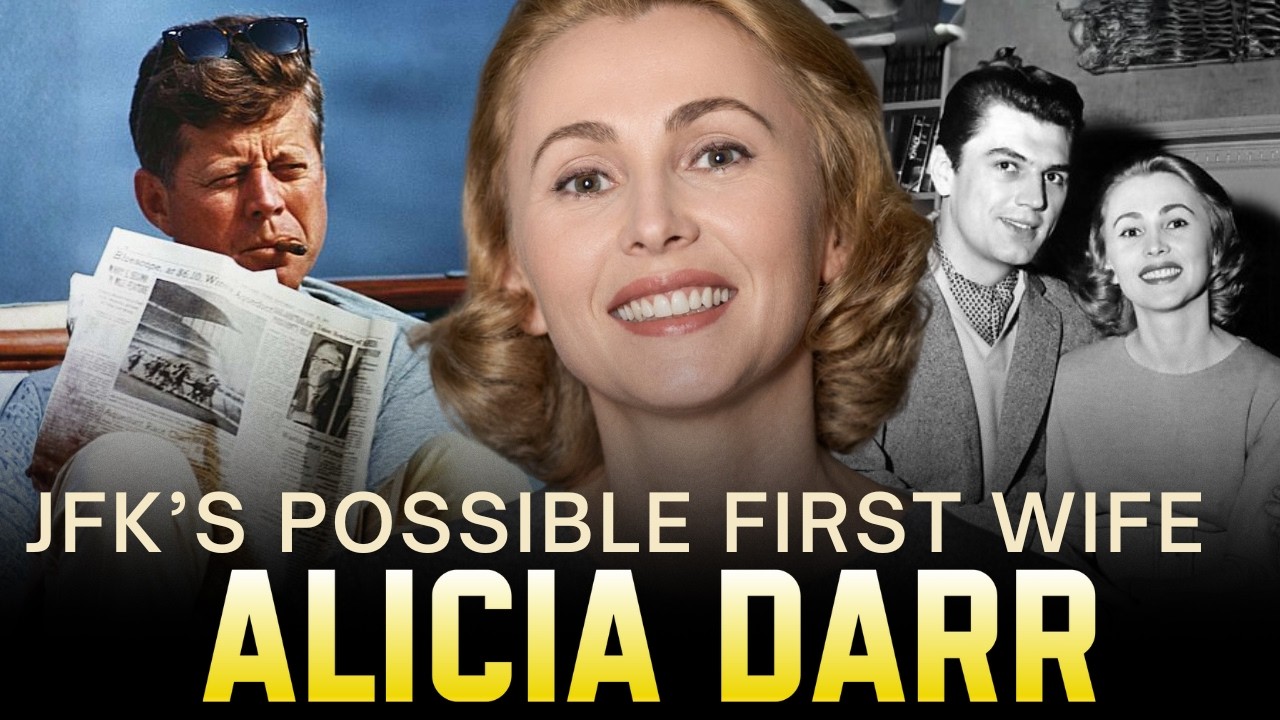
In that impulsive moment, neither of them realized they were scripting a secret that the Kennedy dynasty would later spend enormous wealth and political capital to bury. When the intoxication faded the next morning, panic set in. A marriage could destroy Jack’s political future. Court files were pilfered.
Marriage documents were reportedly destroyed, as if they had never existed. Durie Malcolm transformed from a lawful wife into an invisible figure in an instant. She had been born into the bedrock of American privilege, a world older and more exclusive than the Kennedys. Born Durie Kerr around 1917, she descended from the Blauvelt family, a Dutch clan established in America since the seventeenth century.
While the Kennedys fought for acceptance, flashing new money to buy respectability, the Blauvelts were the quiet aristocracy. Her father, Frederick Kerr, was a formidable broker on the Chicago Stock Exchange. Her mother, Isabelle, was a figure of icy social perfection. From birth, Durie’s life was chronicled in the society pages.
She was not just a child but an asset, a piece of living porcelain expected to remain flawless. Durie was also strikingly beautiful. She was repeatedly voted the most beautiful girl in society. Standing nearly five foot ten in an era that prized petite femininity, she physically dominated nearly everyone she encountered.
She favored bold lines and severe elegance. She didn’t glide, she strode. Beneath the silk and pearls, though, simmered a volatile temperament. Friends described her as an ice queen on the surface with the temperament of a street fighter underneath.
She had a sharp tongue and a refusal to be bored that bordered on the pathological. She was raised in stiflingly polite circles in Chicago and St. Louis before the family drifted to the sun-drenched exclusivity of Palm Beach. In the 1930s, daughters of the wealthy were bred for a singular ornamental purpose: to marry well and manage grand households.
Durie was a genetic error in that system. She played ice hockey, a sport almost unheard of for women of her station. She rode horses at terrifying speed and took to the polo field, a domain reserved for men. When the constraints of her family name became suffocating, she fractured her identity.
In the neon-lit nights of Miami or the jazz clubs of New York, she became Alicia Dar. Under that alias, she courted disaster. She drove fast cars, drank with sailors and drifters. Police records later unearthed by opposition researchers paint a chaotic picture.
Alicia Dar was arrested for drunk and disorderly conduct multiple times. In one incident, the charge alleged that she had bitten a police officer on the hand. That act of violence, biting a figure of authority, spoke to a feral rejection of control. Her romantic history became a revolving door of high-profile, volatile unions.
In 1937, she married Fermine de Loge IV, heir to a Missouri lead mining fortune. It produced a daughter, also named Durie, but the marriage dissolved quickly. In 1942, she married F. John Bersbach, grandson of the man who popularized Lincoln Logs.
That union lasted barely six months. By 1946, she was a twice-divorced thirty-year-old, wealthy, bored, and living in Palm Beach. Jack Kennedy of 1947 was not the robust figure of the 1960 campaign posters. He was a twenty-nine-year-old congressman whose body had been broken by war.
He had survived the sinking of PT-109, but his back caused constant agony, often requiring crutches. More secretly, he battled Addison’s disease, which left him gaunt and exhausted. His doctors had predicted his death since his teenage years. That constant proximity to death fueled a ravenous hunger for life.
He didn’t want the boring, adoring debutantes his mother Rose tried to arrange. He wanted vitality. In the winter of 1947, Jack retreated to the Kennedy estate in Palm Beach to recover and prepare for his next political leap. It was inevitable that their orbits would collide.
Witnesses described a magnetic, almost aggressive attraction. Jack was used to women who surrendered instantly. Durie, however, had chewed up millionaires and bitten police officers. She was not impressed by a skinny congressman.
That indifference was the ultimate aphrodisiac for Jack. She saw through him in a way few others did. She saw a man as damaged and reckless as she was. As the winter social season reached its fever pitch, the flirtation shifted.
The precise date is lost, some accounts place it in late January, others in February, but the setting is consistent: a party that had gone on too long. By two in the morning, the conversation had turned into a high-stakes game of chicken. According to the narrative reconstructed by investigative biographers like Seymour Hersh, Durie allegedly laid down her condition. She would not sleep with Jack unless they were married.
For a man who saw life as a series of barriers to be breached, this was a challenge. In the alcohol-soaked logic of three in the morning, a challenge had to be accepted. The most plausible scenario keeps them in Florida. The pair, likely accompanied by a friend or reluctant driver, found a justice of the peace in a sleepy town outside the Palm Beach limits.
There were no white dresses. A sleepy official was woken in the dark, willing to perform a civil service for a fee. Names were signed. Vows were mumbled.
In a matter of minutes, the deed was done. It was intended as a lark, but the law does not recognize irony. The sunlight of the following morning brought terrifying clarity. If a document had been signed and filed, Jack Kennedy was in mortal political danger.
A marriage to a twice-divorced Protestant socialite with an arrest record was not just a scandal. In the eyes of Catholic voters in Boston, it was anathema. The Catholic Church was rigid. To marry a divorcée was political suicide.
The immediate aftermath is shrouded in silence. There is no record of a honeymoon. The marriage was likely abandoned instantly. An annulment would require a public filing, creating a paper trail, exactly what Jack could not afford.
So they ignored it. Jack returned to Washington. Durie returned to the polo fields. But Durie did not merely drift away.
Four months later, in July 1947, she married Thomas Chevlin, heir to a lumber fortune, a Yale graduate, and a world-class big game fisherman. The marriage insulated her within a fortress of old money and respectability. It lasted until Chevlin’s death. As the 1940s bled into the 1950s, Jack’s star rose higher.
In 1952, he launched his campaign for the U. S. Senate. If a reporter had dug up the Durie Malcolm story, the run would have collapsed.
The secret held. Jack won. And then he made the stakes infinitely higher. His wedding to Jacqueline Lee Bouvier was dubbed the social event of the season.
The Archbishop of Boston presided. But under American law, you cannot marry a second wife while still legally married to the first. Unless a divorce or annulment had been secretly processed, and no record of such a proceeding has ever been found, Jack was technically committing bigamy. If true, his children would be legally illegitimate, and the presidency would be impossible.
For years, the Kennedys lived on this fault line. The unraveling began not with a bang but with the dull thud of a heavy book hitting a library shelf. In 1957, the Association of Blauvelt Descendants published the Blauvelt family genealogy, a massive scholarly tome intended for historical societies and genealogical libraries. On page 884, under entry number 12,427, the editors compiled the life history of Durie Malcolm, listing her parents and her first two marriages.
Then, printed in black and white, was a third line: a marriage to John F. Kennedy. It stated the fact without speculation or question marks. The book was shipped to libraries across America.
It sat on open shelves in the Library of Congress. The secret was out, waiting for the first curious journalist to open it to page 884. When the news reached the Kennedy compound, the reaction was militaristic. Joseph P.
Kennedy, the patriarch, understood that the truth was less important than the record of the truth. Jack was preparing for a presidential run in 1960. Joe Kennedy dispatched agents to libraries, historical societies, and archives. Their mission was to locate every copy of the genealogy.
Intermediaries purchased any copy that surfaced. In libraries where volumes remained, agents allegedly visited the stacks with razor blades, located page 884, and sliced it cleanly from the binding. Today, rare book collectors confirm that finding an intact original 1957 edition is the holy grail of the field. Most surviving copies have a physical scar where the page used to be.
The problem of the official record remained. Seymour Hersh suggested that Joe Kennedy leveraged his connections with organized crime to access sealed court records. We will likely never know the specifics, but to this day, no official marriage certificate for John F. Kennedy and Durie Malcolm has ever been found.
The absence of evidence became the evidence of the cleanup. As the 1960 election approached, the whispers began to leak. To kill the story, the Kennedy campaign produced a signed affidavit from Durie Malcolm herself. In the document, she formally denied ever having been married to Kennedy.
She claimed they had only dated briefly in 1947. The press, largely enamored with Kennedy, accepted the affidavit. Without the marriage license, there was no story. The election of 1960 was razor thin, decided by fewer than 120,000 votes.
If the story had broken, Kennedy would not have been president. But the silence held. On election night, Durie sat in her home in Palm Beach, watching the man she once allegedly married claim the highest office. While the Kennedys occupied the White House, Durie lived in a parallel universe of silence.
She devoted herself to philanthropy, becoming a prominent hostess who entertained the Duke and Duchess of Windsor. Her home filled with dogs. She found solace in the honesty of animals, a stark contrast to the duplicity of her human past. The name Kennedy was treated like a landmine at her dinner parties.
Everyone knew it was there, and everyone knew not to step on it. She outlived Jack by forty-five years. She outlived Jackie. She outlived John Jr.
When young reporters tracked her down and asked if she had been his wife, she would not get angry. She would simply smile, that cool patrician smile, and say nothing. She understood the power of silence. Durie Malcolm died in 2008 at the age of ninety-one.
She took the truth to her grave. We are left only with the artifacts. The entry on page 884 explicitly identifies the spouse as John F. Kennedy, son of Joseph P.
Kennedy. The information was likely submitted to the genealogists in the late 1940s or early 1950s, when Jack was a minor congressman. There was no incentive to fabricate such a claim at that time. J.
Edgar Hoover, who monitored the rumor with the intensity of a predator, did not treat the allegation as gossip. He treated it as intelligence. If the marriage were a myth, he would have discarded it. Innocent parties do not hunt down and purchase every available copy of a genealogy book.
Innocent parties do not send agents to slice pages out of library volumes with razor blades. The violence of the erasure suggests the book contained a truth the Kennedys could not afford to let live. Durie Malcolm was the queen who was never crowned, the first lady edited out of the script. And perhaps in the quiet dignity of her ninety-one years, she understood something the Kennedys never did.
The truth doesn’t need to be on the front page to be real.