A photograph from the summer of 1953, somewhere on the Kennedy compound in Hyannis Port, shows both women. Jacqueline Bouvier, not yet married into the Kennedy family, stands at the edge of a group she had not yet been absorbed into. Ethel Skakel Kennedy, already three years into her marriage to Robert Kennedy and already a mother, talks at full volume about something. The two women are not looking at each other.
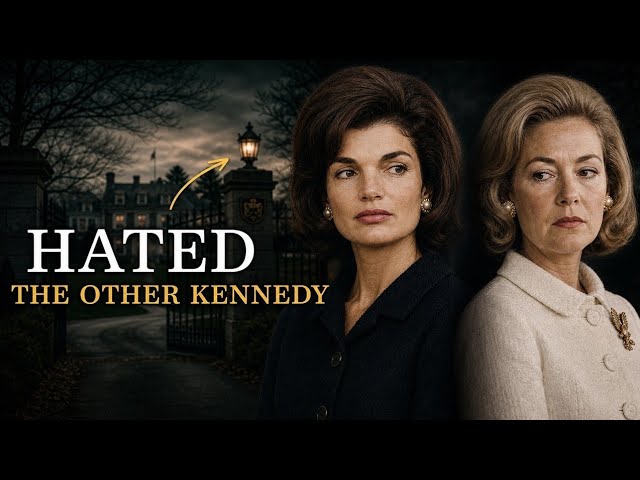
What later became known as a feud was actually something much more complicated. A feud suggests two people equally invested in fighting. Jackie and Ethel were not. Ethel was often unsure there was even a problem.
Jackie knew there was one, and according to the accounts that survived, she understood it almost from the beginning. To understand why, you have to start with the families that created them. Jacqueline Lee Bouvier was born in July 1929 in Southampton, New York. Her father, John Vernou Bouvier III, was a wealthy stockbroker whose finances were far less stable than the lifestyle he maintained.
Her mother, Janet Norton Lee, came from a family that had made money in real estate. The Bouviers had the appearance of old society: the French name, the houses, the horses, the memberships, the connections. Beneath that surface, the family’s financial security was not as permanent as it appeared. Jackie’s parents separated when she was young and divorced in 1940.
Her mother later remarried Hugh Auchincloss, a wealthy Standard Oil heir, and through that marriage Jackie entered an even more established world of American wealth and society. She attended Miss Porter’s School, studied at Vassar, spent time in France, and eventually graduated from George Washington University. She became fluent in French and developed an appreciation for art, literature, architecture, and history that later became central to her public identity. Ethel Skakel was born in April 1928 in Chicago.
Her father, George Skakel, had built a successful business and become genuinely wealthy. The Skakel family was large, Catholic, and intensely competitive. There were seven children, and the household was noisy, athletic, and constantly active. Ethel attended Manhattanville College of the Sacred Heart, where she became friends with Jean Kennedy.
Through Jean, she met Robert F. Kennedy. They married in June 1950. The difference between the two women was not simply wealth, personality, or background.
Their childhoods had taught them completely different ways of dealing with the world. Jackie’s childhood taught her that appearances mattered. Her parents’ marriage had been unstable, and she watched her mother navigate the complicated social consequences of divorce and remarriage. Jackie learned to control what other people could see.
If the outside looked perfect, people had less opportunity to discover what was happening underneath. Ethel grew up with almost the opposite philosophy. In the Skakel household, there was little reason to make yourself smaller. Seven children competed for attention, played sports, argued, laughed, and fought.
You spoke loudly because someone else might speak louder. You participated because participation was how you proved you belonged. That difference became obvious at Hyannis Port. The Kennedy compound was not a quiet summer retreat.
It was a place where family life operated almost like a permanent competition: sailing, touch football, long meals, political discussion, constant interaction. The Kennedys were expected to participate. Ethel fit naturally into that environment. Jackie did not.
She was perfectly capable of being social, but she did not enjoy the physical competition and constant noise that defined Kennedy family life. She preferred books, drawing, conversation, and quiet. Ethel, meanwhile, was energetic, physical, and completely comfortable taking up space. To Ethel, Jackie could seem distant and overly formal.
To Jackie, Ethel could seem exhausting. Neither woman necessarily believed she was doing anything wrong. They simply operated according to completely different rules. The difference became even more visible as the Kennedy family entered national politics.
When John F. Kennedy ran for president in 1960, Jackie became a major public figure. She was pregnant during much of the campaign and was carefully presented to the public as young, cultured, and elegant. She wrote a newspaper column, appeared on television, and spoke several languages.
People were fascinated by her. Ethel, meanwhile, was involved in the campaign in a completely different way. She traveled, organized, greeted supporters, and brought the energetic Kennedy family style to campaign events. She was practical, loud, cheerful, and constantly present.
Jackie was the image. Ethel was the energy. The distinction mattered because the press rewarded Jackie in a way that it did not reward Ethel. Cameras followed Jackie everywhere.
Her clothes became news. Her voice, manners, and appearance were analyzed. Ethel’s work was much less visible. Jackie received enormous attention without behaving like the kind of person who actively demanded it.
Ethel worked constantly and naturally expected participation to be valued. Then came November 1963. John Kennedy was assassinated in Dallas, and the Kennedy family changed permanently. Robert Kennedy was devastated.
The grief affected him deeply, and his life and political outlook changed in the years that followed. Ethel remained beside him, running their household and raising their growing family while Robert became increasingly involved in issues of poverty, civil rights, and the Vietnam War. Jackie’s life changed in another direction. She became the nation’s most famous widow.
She moved out of the White House, relocated to Georgetown, and tried to protect her children while living under extraordinary public attention. Her silence became part of her identity. She rarely explained what she was feeling. She did not publicly narrate her grief.
Instead, she maintained control over what the public was allowed to see. Ethel’s approach was different. Her family life was open, loud, and intensely connected. At Hickory Hill, Robert and Ethel’s home, there were children, political visitors, activists, writers, friends, and constant conversation.
For Jackie, this kind of environment could feel overwhelming. For Ethel, it was normal. The real difference between them became even more obvious in 1968. Robert Kennedy ran for president.
Ethel supported him completely. She traveled with him, appeared at events, and remained part of the campaign even while pregnant with their eleventh child. Jackie did not become a visible part of the campaign. That did not necessarily mean she opposed Robert, but her distance was noticed by people around both families.
Ethel’s idea of loyalty was visible: you showed up, you stood beside your husband, you made your commitment public. Jackie’s idea of loyalty was private: she believed personal feelings and family decisions did not necessarily have to be displayed to the world. Then, on June 5, 1968, Robert Kennedy was shot in Los Angeles after winning the California Democratic primary. He died the following day.
Ethel was pregnant and suddenly became a widow with ten children and another on the way. Jackie was in New York when the news arrived. She traveled to Los Angeles and attended the funeral. For a brief moment, whatever distance existed between them was overshadowed by tragedy.
They shared the journey of Robert Kennedy’s funeral and burial. But the public attention created another painful difference. The cameras followed Jackie. They always had.
Even though Ethel was the widow who had lost her husband, Jackie was still one of the most photographed women in the world. Her presence automatically attracted attention. That was not something Jackie necessarily controlled. But for Ethel, who was experiencing the worst moment of her life, watching the world’s attention repeatedly move toward Jackie could have been deeply painful.
Then came another event that permanently changed how people viewed Jackie. Only a few months after Robert Kennedy’s death, Jacqueline Kennedy married Greek shipping magnate Aristotle Onassis. The announcement shocked much of the public. Jackie was no longer simply the widow of John Kennedy.
She was making a completely new life for herself, moving into a world of private islands, wealth, yachts, and international society. The public reaction was intense. Some people believed she had abandoned the image they had created for her. Ethel did not publicly attack her, but privately, according to accounts from people around the family, the marriage was difficult for her to understand.
Ethel had devoted her entire adult life to Robert Kennedy, their children, and the Kennedy family. She had built her identity around family, faith, and loyalty. Jackie had chosen something different: protection, privacy, and independence. The contrast became even more complicated because Jackie and Ethel’s children grew up under very different circumstances.
Jackie’s children, Caroline and John, had enormous financial resources, private education, and significant protection from the outside world. Ethel’s eleven children grew up in a large household shaped by politics, faith, public life, and the permanent absence of their father. Both families had advantages. Both families also carried enormous burdens.
Jackie returned to New York after Aristotle Onassis died in 1975. She began working in publishing, first at Viking Press and later at Doubleday. This was an important part of her life because it demonstrated something the public had often overlooked: she was not simply a famous widow or a glamorous social figure. She had genuine interests and worked seriously as an editor, preferring books, authors, and intellectual work to publicity.
Ethel remained connected to Robert Kennedy’s legacy. She worked with organizations associated with his memory, raised money, and continued supporting causes connected to the work he had begun. The two women increasingly lived in separate worlds. They were not constantly fighting.
They were simply distant. Their differences became almost philosophical. Ethel believed that family meant permanent involvement: you stayed, you participated, you remembered, you carried the name forward. Jackie believed that survival sometimes required distance: you protected your private life, you decided what belonged to you and what belonged to the public.
That difference explains why their relationship is often misunderstood. The popular version is that they hated each other because they were jealous and competitive. The more complicated version is that they represented two completely different ideas of womanhood. Ethel embraced family life completely.
Her identity was connected to Robert, their children, Catholic faith, and the Kennedy political legacy. Jackie protected a private part of herself that she refused to surrender completely to anyone. That protection helped her survive enormous public pressure, but it also came with a cost. She became one of the most photographed women of the twentieth century while remaining one of the least personally understood.
Ethel experienced the opposite kind of life. Her home was open. Her family was enormous.
Her husband’s legacy became part of her daily existence.